ESP HONDA ODYSSEY 1996 Owner's Manual
[x] Cancel search | Manufacturer: HONDA, Model Year: 1996, Model line: ODYSSEY, Model: HONDA ODYSSEY 1996Pages: 240, PDF Size: 2.64 MB
Page 106 of 240

Audio System
Theft Protection
On U.S. EX model
Your car's audio system will disable itself if it is disconnected fromelectrical power for any reason. To
make it work again, the user must enter a specific five-digit code in the
Preset buttons. Because there are
hundreds of number combinations possible from five digits, making the system work without knowing the
exact code is nearly impossible.
You should have received a card that lists your audio system's code number and serial number. It is best
to store this card in a safe place at
home, or to keep it in your wallet or
purse. In addition, you should write the audio system's serial number in
this Owner's Manual. If you should
happen to lose the card, you must
obtain the code number from yourHonda dealer. To do this, you will
need the system's serial number. If your car's battery is disconnected
or goes dead, the audio system will
disable itself. If this happens, you
will see "Code" in the frequency display the next time you turn on the
system. Use the Preset buttons toenter the five-digit code. If it is
entered correctly, the radio will start
playing.
If you make a mistake entering thecode, do not start over or try to
correct your mistake. Complete the
five-digit sequence, then enter the correct code. You have three tries toenter the correct code. If you are
unsuccessful in three attempts, you
must then leave the system on for one hour before trying again. You will have to store your favorite
stations in the Preset buttons after
the system begins working. Your original settings were lost when
power was disconnected.
Comfort and Convenience FeaturesProCarManuals.comMain Menu s t Table of Contents
Page 126 of 240
The Braking System, Driving in Bad Weather
A car with ABS may require a longer distance to stop on loose or uneven
surfaces than an equivalent car with-
out Anti-lock. The ABS cannot make
up for road conditions or bad judg-
ment. It is still your responsibility to
drive at reasonable speeds for
weather and traffic conditions, and
to leave a margin of safety.
For a technical description of the
ABS hardware, refer to page 220 . Driving in Bad Weather
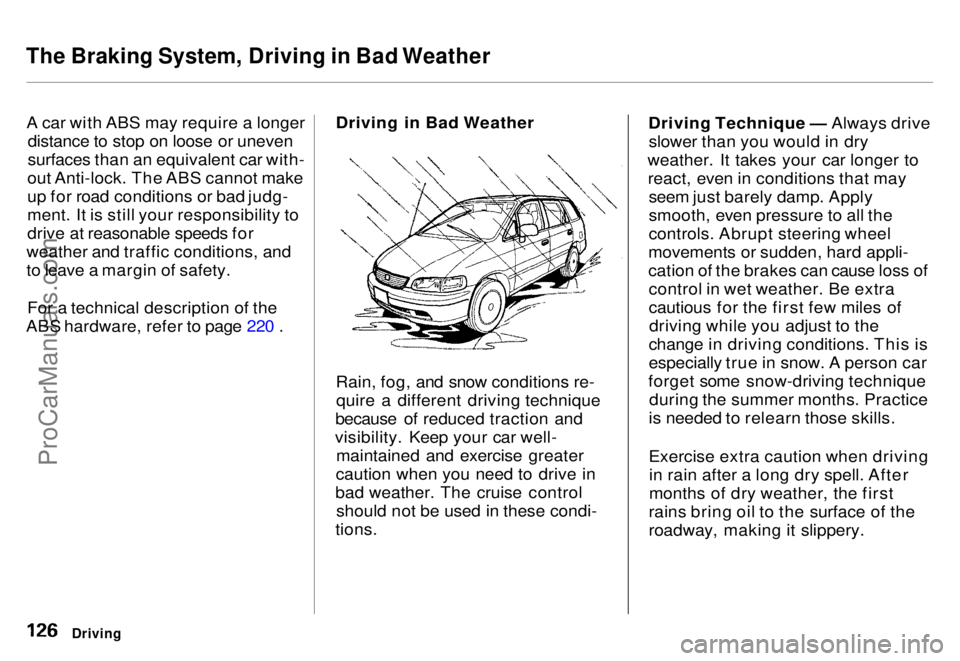
Rain, fog, and snow conditions re-
quire a different driving technique
because of reduced traction and
visibility. Keep your car well- maintained and exercise greater
caution when you need to drive in
bad weather. The cruise control should not be used in these condi-
tions. Driving Technique — Always drive
slower than you would in dry
weather. It takes your car longer to react, even in conditions that may seem just barely damp. Apply
smooth, even pressure to all the
controls. Abrupt steering wheel
movements or sudden, hard appli-
cation of the brakes can cause loss of control in wet weather. Be extra
cautious for the first few miles ofdriving while you adjust to the
change in driving conditions. This is
especially true in snow. A person car
forget some snow-driving technique during the summer months. Practice
is needed to relearn those skills.
Exercise extra caution when driving in rain after a long dry spell. After
months of dry weather, the first
rains bring oil to the surface of the
roadway, making it slippery.
DrivingProCarManuals.comMain Menu s t Table of Contents
Page 129 of 240

Towing a Trailer
The best way to confirm that your total towing package is within thesespecifications is to get it weighed.
Load the car and trailer as you
normally would while towing, and
take them to a public scale. Have them check the total weight and the
weight at each axle, then compare the weights to the specifications. Trailer Hitches
Your Honda dealer, or the HondaCustomer Relations Zone Office, can
give you advice on the proper hitch
for your car. Never use a hitch that mounts only to the rear bumper. The
bumper is not designed to handle that type of load. The hitch should
bolt to the underbody of the car and distribute the load over a wide area.
Always have a trailer hitch installed by a qualified technician.
A trailer hitch that is not adequate for the size of the trailer, or a hitch that isimproperly installed, can cause damage
to the underside of your car.
Driving
NOTICE
Improperly loading your car and
trailer can seriously affect its
steering and braking performance, causing a crashin which you can be seriously
injured.
Check the loading of your car
and trailer carefully before
starting to drive.ProCarManuals.comMain Menu s t Table of Contents
Page 133 of 240

Towing a Trailer
If you have to stop while going uphill,
do not hold the car in place by
pressing on the accelerator. This can cause the automatic transmission to
overheat. Use the parking brake or
footbrake.
When parking your car and trailer, especially on a hill, be sure to follow
all the normal precautions. Turn
your front wheels into the curb, set the parking brake firmly, and put the
transmission in Park. In addition, place wheel chocks at each of the
trailer's tires. Backing up with a trailer is difficult
and takes practice. Drive slowly,
make small movements with the steering wheel, and have someone
stand outside to guide you. Grip the
steering wheel on the bottom (rather
than the usual position near the top). Move your hand to the left to get thetrailer to move to the left, and right
to move the trailer right.
DrivingProCarManuals.comMain Menu s t Table of Contents
Page 183 of 240
Exterior Care
Washing
Frequent washing helps preserve
your car's beauty. Dirt and grit can scratch the paint, while tree sap and
bird droppings can permanently ruin
the finish.
Wash your car in a shady area, not in direct sunlight. If the car is parked in
the sun, move it into the shade and
let the exterior cool down before you start.
Chemical solvents and strong cleaners
can damage the paint, metal, and
plastic on your car.
Rinse the car thoroughly with cool
water to remove loose dirt. Fill a bucket with cool water. Mix
in a mild detergent, such as
dishwashing liquid or a product
made especially for car washing. Wash the car, using the water and
detergent solution and a soft-
bristle brush, sponge, or soft cloth. Start at the top and work your waydown. Rinse frequently. Check the body for road tar, tree
sap, etc. Remove these stains with
tar remover or turpentine. Rinse it off immediately so it does not
harm the finish. Remember to re-
wax these areas, even if the rest of the car does not need waxing. When you have washed and rinsed
the whole exterior, dry it with achamois or soft towel. Letting it
air-dry will cause dulling and water
spots.
As you dry the car, inspect it for chips and scratches that could allow
corrosion to start. Repair them with
touch-up paint (see page 185 ).
The radio antenna on your car does not
need to be removed when you use a "drive-through" car wash. However,
you remove the antenna, make sure to reinstall it and tighten it securely using
an appropriate tool.
Waxing Always wash and dry the whole car before waxing it. You should wax
your car, including the metal trim,
whenever water sits on the surfacein large patches. It should form into
beads or droplets after waxing.
You should use a quality liquid or paste wax. Apply it according to theinstructions on the container. In
general, there are two types of
products:
Appearance Care
NOTICE
NOTICEProCarManuals.comMain Menu s t Table of Contents
Page 187 of 240

Corrosion Protection
Two factors normally contribute to causing corrosion in your car:
1. Moisture trapped in body cavities. Dirt and road salt that collects in
hollows on the underside of the car stays damp, promoting
corrosion in that area.
2. Removal of paint and protective coatings from the exterior and
underside of the car. Many corrosion-preventive measures
are built into your Honda. You can
help keep your car from corroding
by performing some simple periodic
maintenance:
Repair chips and scratches in the
paint as soon as you discover them.
Inspect and clean out the drain
holes in the bottom of the doors and body. Check the floor coverings for
dampness. Carpeting and floor
mats may remain damp for a long
time, especially in winter. This dampness can eventually cause
the floor panels to corrode. Use a high-pressure spray to clean
the underside of your car. This is especially important in areas that
use road salt in winter. It is also a
good idea in humid climates and areas subject to salt air. Carsequipped with ABS have a sensor
and wiring at each wheel. Be
careful not to damage them. Have the corrosion-preventive
coatings on the underside of your
car inspected and repaired periodically.
Appearance CareProCarManuals.comMain Menu s t Table of Contents
Page 190 of 240
Compact Spare Tire
Your car has a compact spare tire that takes up less space. Use this spare tire as a temporary replace-
ment only. Get your regular tire
repaired or replaced and put back on
your car as soon as you can.
Check the inflation pressure of the
compact spare tire every time you
check the other tires. It should be
inflated to:420 kPa (4.2 kgf/cm2 , 60 psi)
Follow these precautions whenever
you are using the compact spare tire:
Do not exceed 50 mph (80 km/h)
under any circumstances.
This tire gives a harsher ride and
less traction on some road sur-
faces than the regular tire. Use
greater caution while driving on
this tire.
Do not mount snow chains on the
compact spare.
The wheel of the compact spare
tire is designed especially to fit
your car. Do not use your spare tire on another car unless it is the
same make and model.
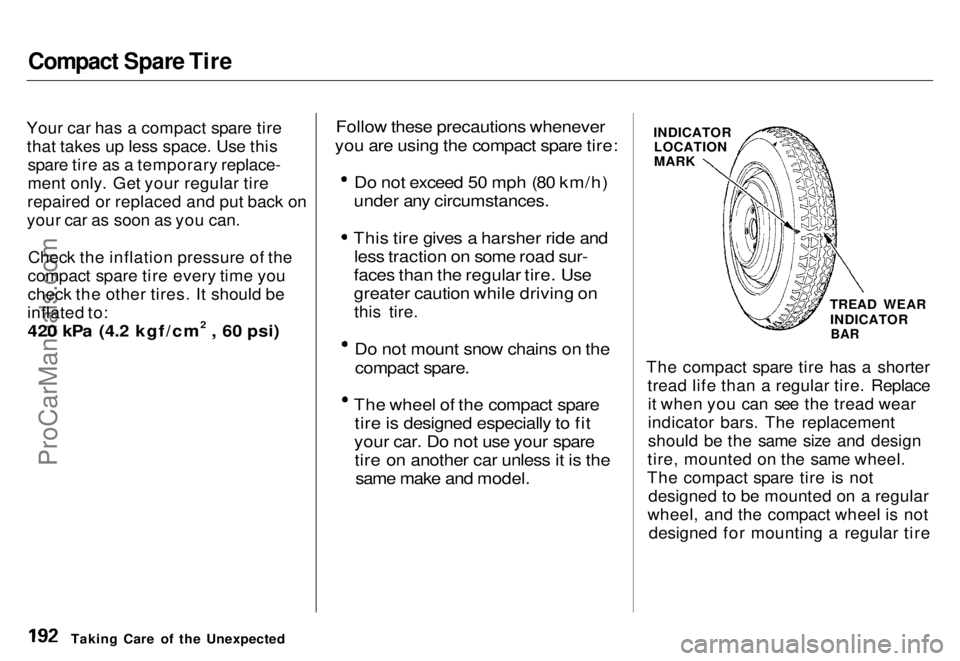
INDICATOR
LOCATION
MARK
TREAD WEARINDICATOR
BAR
The compact spare tire has a shorter tread life than a regular tire. Replaceit when you can see the tread wear
indicator bars. The replacement
should be the same size and design
tire, mounted on the same wheel.
The compact spare tire is not designed to be mounted on a regular
wheel, and the compact wheel is not designed for mounting a regular tire
Taking Care of the Unexpected
ProCarManuals.coms t Main Menu Table of Contents
Page 218 of 240
Tire Information
Tire Size Designation
A tire's sidewall is marked with a tire size designation. You will need this
information when selecting replace-ment tires for your car. The follow-
ing explains what the letters and
numbers in the tire size designation
mean.
(Example tire size designation)
P205/65R15 92S
P — Applicable vehicle type (tires
marked with the prefix "P" are intended for use on passenger cars;
however, not all tires have this
marking).
205 — Tire width in millimeters.
65 — Aspect ratio. The tire's section
height as a percentage of its width.
R — Tire construction code (Radial).
15 — Rim diameter in inches. 92 — Load Index, a numerical code
associated with the maximum load
the tire can carry.
S — Speed Rating Symbol. See thespeed rating chart in this section for
additional information.
Wheel Size Designation
Wheels are also marked with important information that you needif you ever have to replace one. The
following explains what the letters and numbers in the wheel size
designation mean.
(Example wheel size designation)
15
x
6
JJ
15 — Rim diameter in inches.
6 — Rim width in inches.
JJ — Rim contour designation.
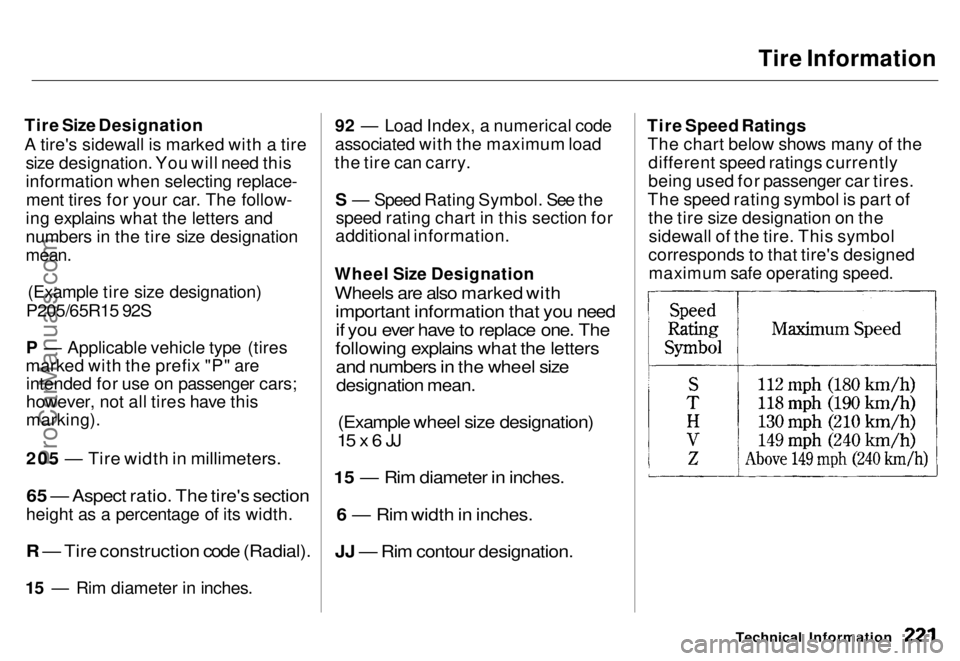
Tire Speed Ratings
The chart below shows many of the different speed ratings currently
being used for passenger car tires.
The speed rating symbol is part of the tire size designation on thesidewall of the tire. This symbol
corresponds to that tire's designed
maximum safe operating speed.
Technical InformationProCarManuals.comMain Menu s t Table of Contents
Page 220 of 240

Tire Information
Traction
The traction grades, from highest to lowest, are A, B, and C, and they
represent the tire's ability to stop on
wet pavement as measured under controlled conditions on specified
government test surfaces of asphalt and concrete. A tire marked C may
have poor traction performance.
Warning: The traction grade as- signed to this tire is based on brak-
ing (straight ahead) traction tests and does not include cornering (turning) traction. Temperature
The temperature grades are A (the highest), B, and C, representing the
tire's resistance to the generation of
heat and its ability to dissipate heat
when tested under controlledconditions on a specified indoor
laboratory test wheel. Sustained high
temperature can cause the material of the tire to degenerate and reduce
tire life, and excessive temperature can lead to sudden tire failure. The
grade C corresponds to a level of
performance which all passenger car
tires must meet under the Federal Motor Vehicle Safety Standard No.109. Grades B and A represent
higher levels of performance on the laboratory test wheel than theminimum required by law. Warning: The temperature grade for
this tire is established for a tire thatis properly inflated and not over-
loaded. Excessive speed, underinfla-
tion, or excessive loading either separately or in combination, can
cause heat build-up and possible tire
failure.
Technical InformationProCarManuals.comMain Menu s t Table of Contents