fuel HONDA ODYSSEY 1996 Owner's Manual
[x] Cancel search | Manufacturer: HONDA, Model Year: 1996, Model line: ODYSSEY, Model: HONDA ODYSSEY 1996Pages: 240, PDF Size: 2.64 MB
Page 169 of 240
Tires
InflationKeeping the tires properly inflatedprovides the best combination of
handling, tread life and riding
comfort. Under-inflated tires wear
unevenly, adversely affect handling
and fuel economy, and are more
likely to fail from being overheated. Overinflated tires can make your car
ride more harshly, are more prone to damage from road hazards, and wear
unevenly.
We recommend that you visually check your tires every day and use a
gauge to measure the air pressure at least once a month. If you think a tire
might be low, check it immediately. Remember to check the spare tire at
the same time you check all the other tires.
Check the pressure in the tires when
they are cold. This means the car has been parked for at least three
hours. If you have to drive the car
before checking the tire pressure,
the tires can still be considered
"cold" if you drive less than 1.6 km
(1 mile).
If you check the pressure when the
tires are hot (the car has been driven
several miles), you will see readings
30 to 40 kPa (0.3 to 0.4 kg/cm2,4 to
6 psi) higher than the cold reading.
This is normal. Do not let air out to
match the specified cold pressure.
The tire will be underinflated.
Recommended Tire Pressures for
Normal Driving
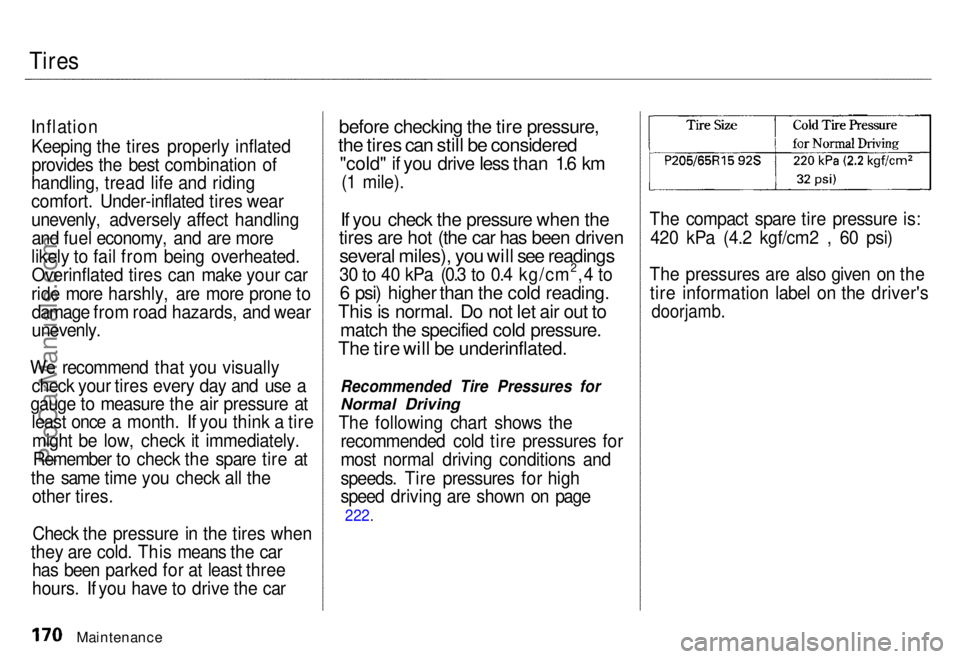
The following chart shows the recommended cold tire pressures for
most normal driving conditions and
speeds. Tire pressures for high
speed driving are shown on page 222. The compact spare tire pressure is:
420 kPa (4.2 kgf/cm2 , 60 psi)
The pressures are also given on the tire information label on the driver's
doorjamb.
MaintenanceProCarManuals.comMain Menu s t Table of Contents
Page 174 of 240
Lights
Check the operation of your car's
exterior lights at least once a month.
A burned out bulb can create an unsafe condition by reducing your car's visibility and the ability to
signal your intentions to other
drivers.
Check the following: Headlights (low and high beam)
Parking lights
Taillights
Brake lights
High-mount brake light
Turn signals
Back-up lights
Hazard light function
License plate light
Side marker lights
Daytime running lights
(Canadian cars)
If you find any bulbs are burned out,
replace them as soon as possible. Refer to the chart on page 219 todetermine what type of replacement
bulb is needed. Headlight Aiming
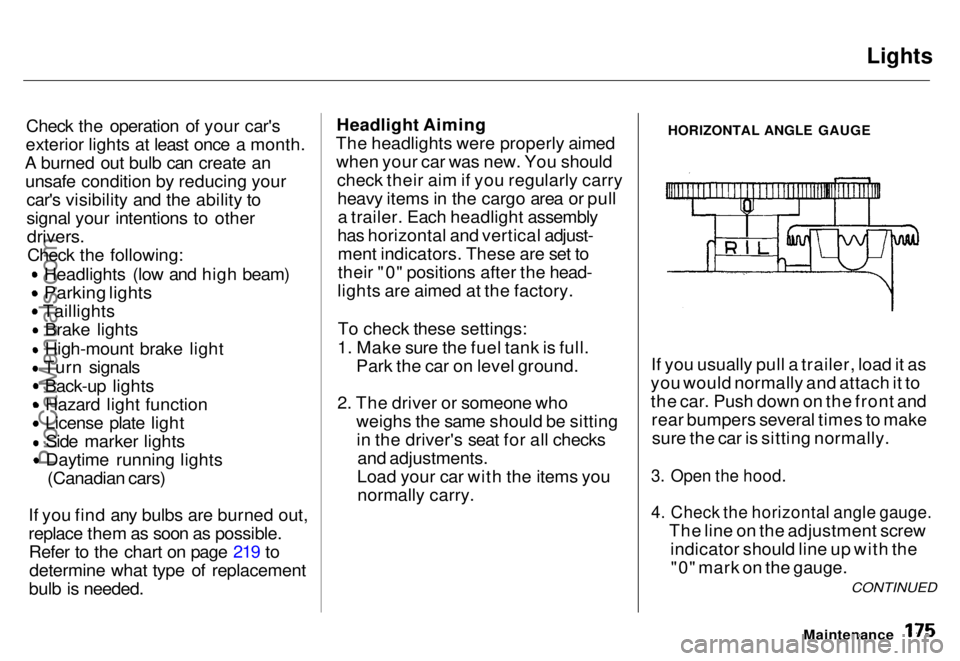
The headlights were properly aimed when your car was new. You should check their aim if you regularly carryheavy items in the cargo area or pulla trailer. Each headlight assembly
has horizontal and vertical adjust- ment indicators. These are set to
their "0" positions after the head-
lights are aimed at the factory.
To check these settings:
1. Make sure the fuel tank is full. Park the car on level ground.
2. The driver or someone who weighs the same should be sittingin the driver's seat for all checks and adjustments.
Load your car with the items you normally carry. HORIZONTAL ANGLE GAUGE
If you usually pull a trailer, load it as
you would normally and attach it to
the car. Push down on the front and rear bumpers several times to makesure the car is sitting normally.
3. Open the hood.
4. Check the horizontal angle gauge.
The line on the adjustment screwindicator should line up with the"0" mark on the gauge.
Maintenance
CONTINUEDProCarManuals.comMain Menu s t Table of Contents
Page 181 of 240
Storing Your Car
If you need to park your car for an
extended period (more than 1
month), there are several things you should do to prepare it for storage.
Proper preparation helps prevent
deterioration and makes it easier to
get your car back on the road. It is
best to store your car indoors if at all
possible.
Fill the fuel tank.
Change the engine oil and filter
(see page 148). Wash and dry the exterior
completely.
Clean the interior. Make sure the
carpeting, floor mats, etc. are
completely dry.
Leave the parking brake off. Put
the transmission in Park. Block the rear wheels.
If the car is to be stored for a
longer period, it should be supported on jackstands so the
tires are off the ground.
Leave one window open slightly (if
the car is being stored indoors).
Disconnect the battery.Support the front and rear wiper
blade arms with a folded towel or
rag so they do not touch the
windshield. Apply a silicone spray lubricant to
all door and tailgate seals. Also,
apply wax to the painted surfaces
that mate with the door and
tailgate seals. Cover the car with a "breathable"
car cover, one made from a porous
material such as cotton.
Nonporous materials, such as
plastic sheeting, trap moisture
which can damage the paint. If possible, run the engine for a
while periodically (preferably once
a month).
If you store your car for 12 months or longer, have your Honda dealer
perform the inspections called for in
the 24 months/48,000 km (30,000 miles) maintenance schedule (Normal Conditions) as soon as you
take it out of storage (see page 140 )
The replacements called for in the maintenance schedule are not
needed unless the car has actually
reached that time or mileage.
MaintenanceProCarManuals.comMain Menu s t Table of Contents
Page 198 of 240
If Your Engine Won't Start, Jump Starting
The Starter Operates Normally In this case, the starter motorsounds normal when you turn the
ignition switch to START (III), but
the engine does not run. Are you using the proper starting
procedure? Refer to Starting the
Engine on page 119 . Do you have fuel? Turn the
ignition switch to ON (II) for a
minute and watch the fuel gauge.
The low fuel level warning light may not be working, so you were
not reminded to fill the tank. There may be an electrical
problem, such as no power to the
fuel pump. Check all the fuses (see page 208).
If you find nothing wrong, you will
need a qualified technician to find
the problem. See Towing on page
213.
Jump Starting
If your car's battery has run down,
you may be able to start the engine by using a booster battery. Although
this seems like a simple procedure,
there are several precautions you should take. Follow the directions
closely.
You cannot start a Honda by pushing or pulling it. To jump start your car:
1. Open the hood and check the physical condition of the battery(see page 162 ). In very cold
weather, check the condition of the electrolyte. If it seems slushyor like ice, do not try jump starting
until it thaws.
If a battery sits in extreme cold, the
electrolyte inside can freeze.
Attempting to jump start with a frozen battery can cause it to rupture or
explode.
2. Turn off all the electrical acces- sories: heater, A/C, stereo system
lights, etc. Put the transmission in Neutral or
Park and set the parking brake.
Taking Care of the Unexpected
NOTICE
A battery can explode if you do
not follow the correct procedure,
seriously injuring anyone nearby.
Keep all sparks, open flames,
and smoking materials away
from the battery.ProCarManuals.coms t Main Menu Table of Contents
Page 204 of 240
Malfunction Indicator Lamp
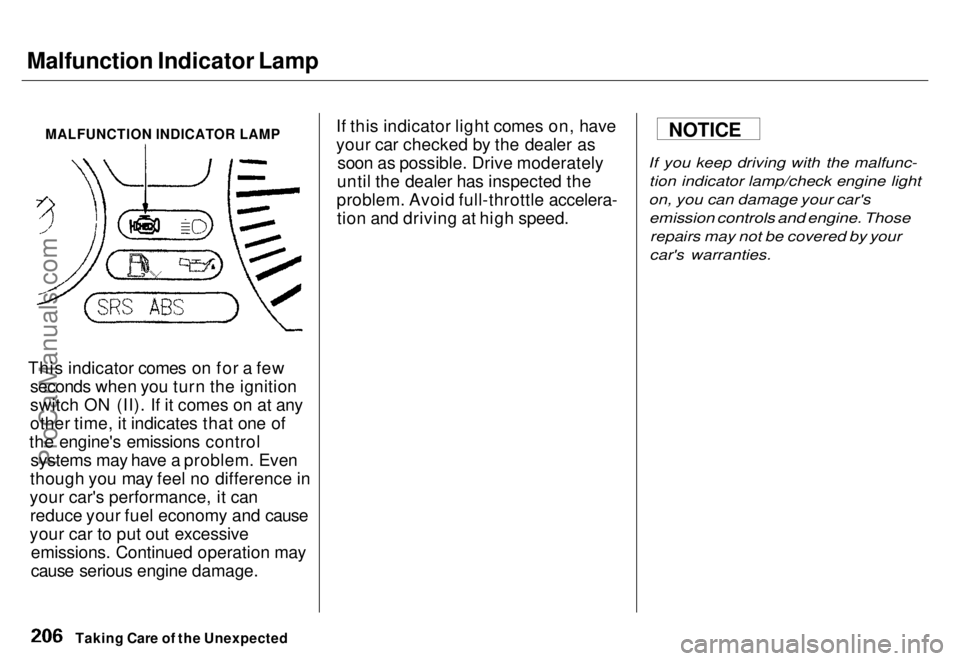
MALFUNCTION INDICATOR LAMP
This indicator comes on for a few seconds when you turn the ignition
switch ON (II). If it comes on at any
other time, it indicates that one of
the engine's emissions control systems may have a problem. Even
though you may feel no difference in
your car's performance, it can reduce your fuel economy and cause
your car to put out excessive emissions. Continued operation may
cause serious engine damage. If this indicator light comes on, have
your car checked by the dealer as
soon as possible. Drive moderately
until the dealer has inspected the
problem. Avoid full-throttle accelera- tion and driving at high speed.
If you keep driving with the malfunc-
tion indicator lamp/check engine light
on, you can damage your car's
emission controls and engine. Those
repairs may not be covered by your
car's warranties.
Taking Care of the Unexpected NOTICEProCarManuals.comMain Menu s t Table of Contents
Page 221 of 240
Emission Controls
The burning of gasoline in your car's engine produces several byproducts.
Some of these are carbon monoxide (CO), oxides of nitrogen (NOx) and
hydrocarbons (HC). Gasoline
evaporating from the tank also
produces hydrocarbons. Controlling
the production of NOx, CO, and HC
is important to the environment. Under certain conditions of sunlight
and climate, NOx and HC react to
form photochemical "smog." Carbon monoxide does not contribute to
smog creation, but it is a poisonous
gas.
The Clean Air Act
The United States Clean Air Act* sets standards for automobile
emissions. It also requires that
automobile manufacturers explain to
owners how their emission controls
work and what to do to maintain
them. This section summarizes how the emission controls work.Scheduled maintenance is on page 140.
* In Canada, Honda vehicles comply
with the Canadian Motor Vehicle Safety Standards (CMVSS) for
Emissions valid at the time they are
manufactured. Crankcase Emission Control
System
Your car has a Positive Crankcase Ventilation System. This keeps
gasses that build up in the engine's crankcase from going into the
atmosphere. The Positive Crankcase
Ventilation valve routes them from the crankcase back to the intakemanifold. They are then drawn into
the engine and burned.
Evaporative Emission Control System
As gasoline evaporates in the fuel
tank, an evaporative emission control
canister filled with charcoal adsorbs
the vapor. It is stored in this canister
while the engine is off. After the
engine is started and warmed up, the
vapor is drawn into the engine and burned during driving.
Technical InformationProCarManuals.comMain Menu s t Table of Contents
Page 222 of 240

Emission Controls
Exhaust Emission Controls
The exhaust emission controls include four systems: PGM-FI,
Ignition Timing Control, ExhaustGas Recirculation and Three Way
Catalytic Converter. These foursystems work together to control the
engine's combustion and minimize
the amount of HC, CO, and NOx that comes out the tailpipe. The exhaust
emission control systems areseparate from the crankcase and
evaporative emission control
systems.
PGM-FI System
The PGM-FI System uses sequential multiport fuel injection.It has three subsystems: Air Intake,
Engine Control, and Fuel Control.
The Powertrain Control Module (PCM) uses various sensors to
determine how much air is going
into the engine. It then controls how much fuel to inject under all operat-
ing conditions. Ignition Timing Control System
This system constantly adjusts the ignition timing, reducing the amount
of HC, CO and NOx produced.
Exhaust Gas Recirculation (EGR)
System
The Exhaust Gas Recirculation (EGR) system takes some of the
exhaust gas and routes it back into
the intake manifold. Adding exhaust gas to the air/fuel mixture reduces
the amount of NOx produced when
the fuel is burned.
Three Way Catalytic Converter
The three way catalytic converter is in the exhaust system. Throughchemical reactions, it converts HC, CO, and NOx in the engine's exhaust
to carbon dioxide (CO 2), dinitrogen
(N 2), and water vapor.
Replacement Parts
The emission control systems are designed and certified to work to-
gether in reducing emissions to levels that comply with the Clean Air
Act. To make sure the emissions remain low, you should use only new
genuine Honda replacement parts or
their equivalent for repairs. Usinglower quality parts may increase theemissions from your car.
The emissions control systems are covered by warranties separate from
the rest of your car. Read your
warranty manual for more informa-
tion.
Technical InformationProCarManuals.comMain Menu s t Table of Contents
Page 234 of 240
Index
DANGER, Explanation of................. ii
Dashboard........................................ 32 Dashboard Compartment............... 68
Daytime Running Lights................. 40Dead Battery, What to Do............ 200
Defects, Reporting Safety............. 232
Defogger, Rear Window................. 43 Defrosting the Windows................. 79
DEXRON® II Automatic Transmission Fluid.................... 155
Dimensions.................................... 218
Dimming the Headlights................ 40
Dipstick Automatic Transmission........... 155
Engine Oil................................... 146
Directional Signals.......................... 43
Disabled, Towing Your Car If..... 213
Disc Brake Wear Indicators......... 124
Disposal of Used Oil...................... 150Doors Locking and Unlocking............... 50
Power Door Locks....................... 50
DOT Tire Quality Grading........... 222
Drive Belts...................................... 169
Driving............................................ 117
Economy..................................... 114
In Bad Weather.......................... 126
In Foreign Countries................. 109
Economy, Fuel............................... 114
Emergencies on the Road............. 191
Battery, Jump Starting.............. 200
Changing a Flat Tire................. 193
Charging System Indicator...... 205
Checking the Fuses................... 209
Low Oil Pressure Indicator...... 204
Malfunction Indicator Lamp.... 206
Manually Closing Sunroof........ 207
Overheated Engine................... 202
Emergency Brake............................ 65
Emergency Flashers....................... 43
Emission Controls......................... 224
Engine
Belts............................................. 169
Coolant Temperature Gauge..... 38
Malfunction Indicator
Lamp................................ 34,
206
Oil Pressur e
Indicator......... 34, 204Oil, What Kind to Use............... 147
Overheating................................ 202
Specifications............................. 219
Ethanol in Gasoline ....................... 109
Evaporative Emission Controls.... 224
Exhaust Fumes................................ 29Expectant Mothers, Use of Seat Belts by......................................... 10
Exterior, Cleaning the................... 184
Fabric, Cleaning............................. 186
Fan, Interior...................................... 74
Features, Comfort and
Convenience............................... 73
Filling the Fuel Tank..................... 110
Filter
Air................................................ 158
Oil................................................ 148
First Gear Position......................... 122
Flashers, Hazard Warning.............. 43
Flat Tire, Changing a.................... 193
CONTINUEDProCarManuals.comMain Menu s t
Page 235 of 240
Index
Fluids
Automatic Transmission........... 155
Brake........................................... 156
Power Steering........................... 157
Windshield Washer................... 154
FM Stereo Radio
Reception.................................... 97
Folding the Second Seats ............... 58
Folding the Third Seats.................. 60
Foreign Countries, Driving in...... 109
Four-way Flashers......................... 43
Front End, Towing by Emergency
Wrecker.................................... 213
Fuel.................................................. 108
Fill Door and Cap....................... 110
Gauge.......................................... 38
Octane Requirement................. 108
Oxygenated................................ 108
Tank, Filling the......................... 110
Fuses, Checking the...................... 209
Gas Mileage, Improving................ 114
Gasohol........................................... 108
Gasoline.......................................... 108
Gauge.......................................... 38
Octane Requirement................. 108
Tank, Filling the......................... 110
Gas Station Procedures................. 110
Gauges Engine Coolant Temperature .... 38
Fuel.............................................. 38
Gearshift Lever Positions............. 120 Glass Cleaning............................... 187
Glove Box......................................... 53
Halogen Headlight Bulbs.............. 177
Hazard Warning Flashers............. 43
Headlights....................................... 40
Aiming......................................... 175Daytime Running Lights............. 40
High Beam Indicator................... 36High Beams, Turning on............ 40
Low Beams, Turning on............. 40
Reminder Chime.......................... 40 Replacing Halogen Bulbs ......... 177
Turning on.................................. 40
Head Restraints............................... 56
Heating and Cooling........................ 74 High Altitude, Starting at............ 119
High-Low Beam Switch............... 40
Hood, Opening the ...................... 111
Horn............................................... 39
Hot Coolant, Warning about...... 151 Hydroplaning................................ 127
Identification Number, Vehicle.. 216
If Your Car Has to be Towed..... 213Ignition
Keys............................................. 49
Switch.......................................... 49
Timing Control System............. 225
Indicator Lights, Instrument
Panel............................................. 33
Infant Restraint............................... 22 Inflation, Proper Tire .................... 170
Inside Mirror................................... 64
Inspection, Tire.............................. 171
Instrument Panel............................. 33
Instrument Panel Brightness........ 41
Interior Cleaning............................ 186
Interior Lights................................. 70
Introduction...................................... iProCarManuals.comMain Menu s t
Page 236 of 240
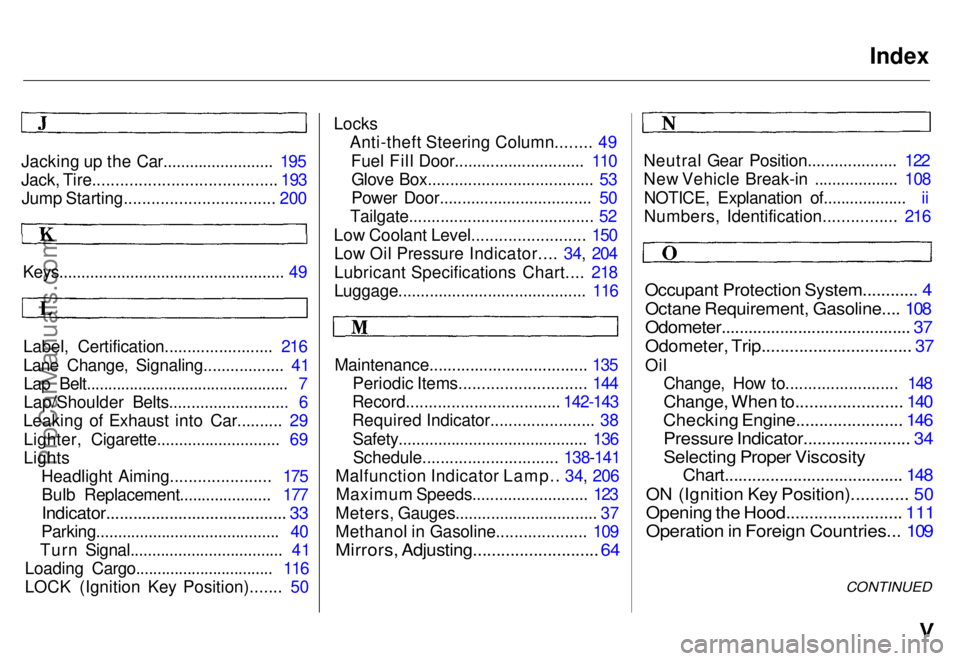
Index
Jacking up the Car......................... 195
Jack, Tire........................................ 193
Jump Starting................................. 200
Keys................................................... 49
Label, Certification........................ 216
Lane Change, Signaling.................. 41Lap Belt............................................... 7
Lap/Shoulder Belts........................... 6
Leaking of Exhaust into Car.......... 29
Lighter, Cigarette............................ 69
Lights Headlight Aiming...................... 175Bulb Replacement..................... 177
Indicator........................................ 33
Parking.......................................... 40
Turn Signal................................... 41
Loading Cargo................................ 116
LOCK (Ignition Key Position)....... 50 Locks
Anti-theft Steering Column........ 49
Fuel Fill Door............................. 110Glove Box..................................... 53
Power Door.................................. 50
Tailgate......................................... 52
Low Coolant Level......................... 150 Low Oil Pressure Indicator.... 34, 204
Lubricant Specifications Chart.... 218
Luggage.......................................... 116
Maintenance................................... 135 Periodic Items............................ 144
Record.................................. 142-143
Required Indicator....................... 38
Safety........................................... 136Schedule.............................. 138-141
Malfunction Indicator Lamp.. 34, 206 Maximum Speeds.......................... 123
Meters, Gauges................................ 37
Methanol in Gasoline.................... 109
Mirrors, Adjusting...........................
64
Neutral Gea r
Position.................... 122
New Vehicle Break-in ................... 108
NOTICE, Explanation of................... ii
Numbers, Identification................ 216
Occupant Protection System............ 4
Octane Requirement, Gasoline.... 108
Odometer.......................................... 37
Odometer, Trip................................ 37
Oil Change, How to......................... 148
Change, When to....................... 140
Checking Engine....................... 146
Pressure Indicator....................... 34
Selecting Proper Viscosity
Chart....................................... 148
ON (Ignition Key Position)............ 50
Opening the Hood......................... 111
Operation in Foreign Countries... 109
CONTINUEDProCarManuals.comMain Menu s t