maintenance HONDA ODYSSEY 1996 Workshop Manual
[x] Cancel search | Manufacturer: HONDA, Model Year: 1996, Model line: ODYSSEY, Model: HONDA ODYSSEY 1996Pages: 240, PDF Size: 2.64 MB
Page 175 of 240
Lights
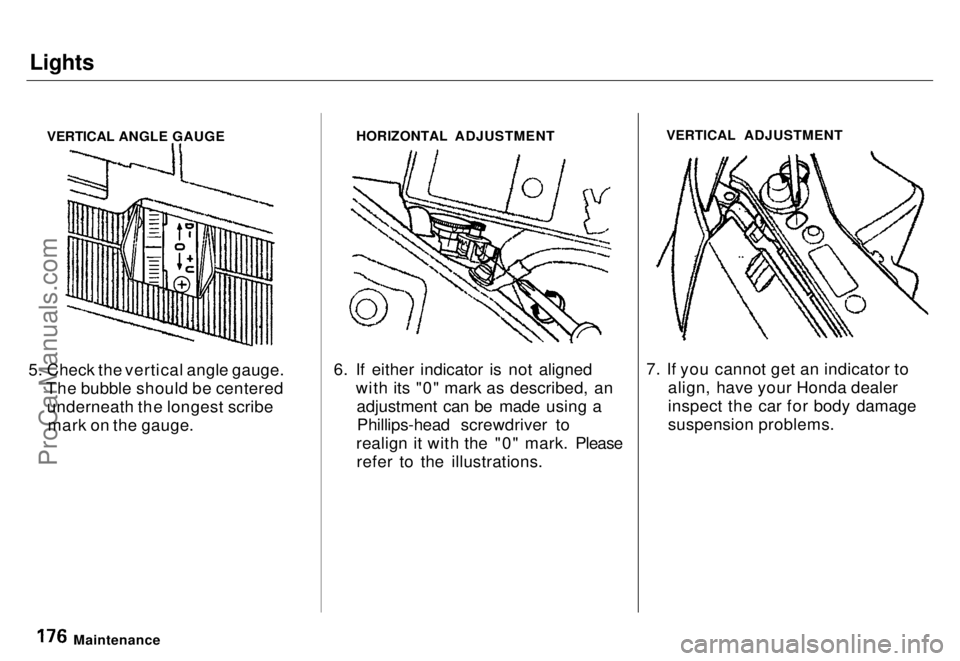
VERTICAL ANGLE GAUGE
5. Check the vertical angle gauge. The bubble should be centeredunderneath the longest scribemark on the gauge. HORIZONTAL ADJUSTMENT
6. If either indicator is not aligned with its "0" mark as described, anadjustment can be made using aPhillips-head screwdriver to
realign it with the "0" mark. Please refer to the illustrations. VERTICAL ADJUSTMENT
7. If you cannot get an indicator to align, have your Honda dealer
inspect the car for body damage
suspension problems.
MaintenanceProCarManuals.comMain Menu s t Table of Contents
Page 176 of 240
Lights
Replacing a Headlight Bulb
Your car has halogen headlight bulbs, one on each side. When
replacing a bulb, handle it by its steel
base and protect the glass fromcontact with your skin or hard
objects. If you touch the glass, clean
it with denatured alcohol and a clean
cloth.
Halogen headlight bulbs get very hot when lit. Oil, perspiration, or a scratchon the glass can cause the bulb to
overheat and shatter.
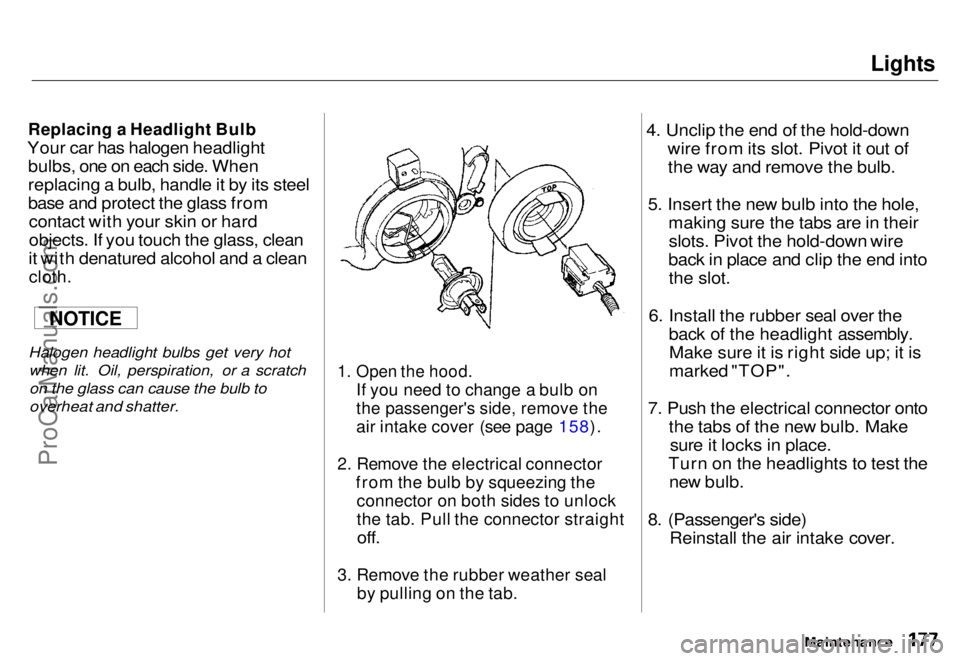
1. Open the hood.
If you need to change a bulb on
the passenger's side, remove the
air intake cover (see page 158).
2. Remove the electrical connector
from the bulb by squeezing the
connector on both sides to unlock
the tab. Pull the connector straight
off.
3. Remove the rubber weather seal
by pulling on the tab.
4. Unclip the end of the hold-down
wire from its slot. Pivot it out ofthe way and remove the bulb.
5. Insert the new bulb into the hole, making sure the tabs are in theirslots. Pivot the hold-down wire
back in place and clip the end into the slot.
6. Install the rubber seal over the back of the headlight assembly.Make sure it is right side up; it is
marked "TOP".
7. Push the electrical connector onto the tabs of the new bulb. Makesure it locks in place.
Turn on the headlights to test the new bulb.
8. (Passenger's side) Reinstall the air intake cover.
Maintenance
NOTICEProCarManuals.comMain Menu s t Table of Contents
Page 177 of 240
Lights
Replacing the Front Side Marker/
Turn Signal and Parking Light
Bulb
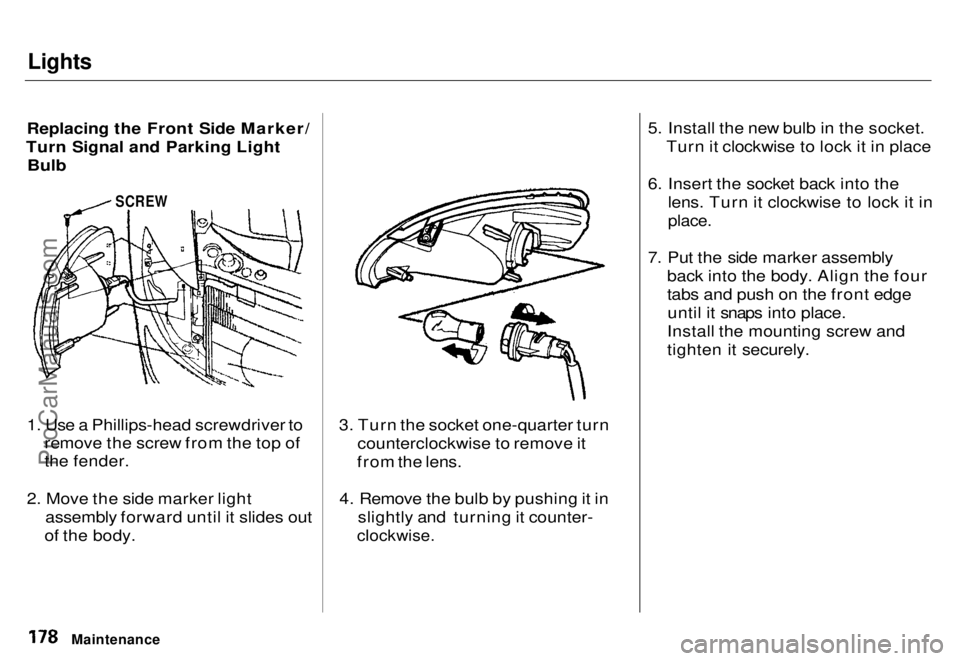
SCREW
1. Use a Phillips-head screwdriver to remove the screw from the top of
the fender.
2. Move the side marker light assembly forward until it slides out
of the body. 3. Turn the socket one-quarter turn
counterclockwise to remove it
from the lens.
4. Remove the bulb by pushing it in slightly and turning it counter-
clockwise.
5. Install the new bulb in the socket.
Turn it clockwise to lock it in place
6. Insert the socket back into the lens. Turn it clockwise to lock it in
place.
7. Put the side marker assembly back into the body. Align the four
tabs and push on the front edgeuntil it snaps into place.
Install the mounting screw and
tighten it securely.
MaintenanceProCarManuals.comMain Menu s t Table of Contents
Page 178 of 240
Lights
Replacing Rear Bulbs
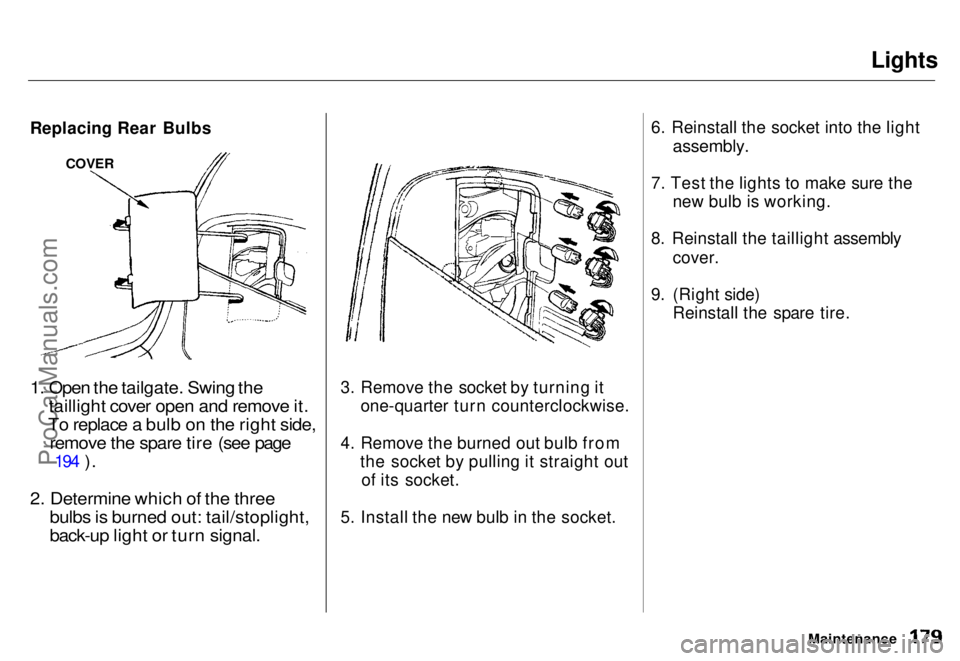
1. Open the tailgate. Swing the taillight cover open and remove it.
To replace a bulb on the right side, remove the spare tire (see page
194
).
2. Determine which of the three bulbs is burned out: tail/stoplight,
back-up light or turn signal.
3. Remove the socket by turning it
one-quarter turn counterclockwise.
4. Remove the burned out bulb from the socket by pulling it straight outof its socket.
5. Install the new bulb in the socket. 6. Reinstall the socket into the light
assembly.
7. Test the lights to make sure the new bulb is working.
8. Reinstall the taillight assembly cover.
9. (Right side) Reinstall the spare tire.
Maintenance
COVERProCarManuals.comMain Menu s t Table of Contents
Page 179 of 240
Lights
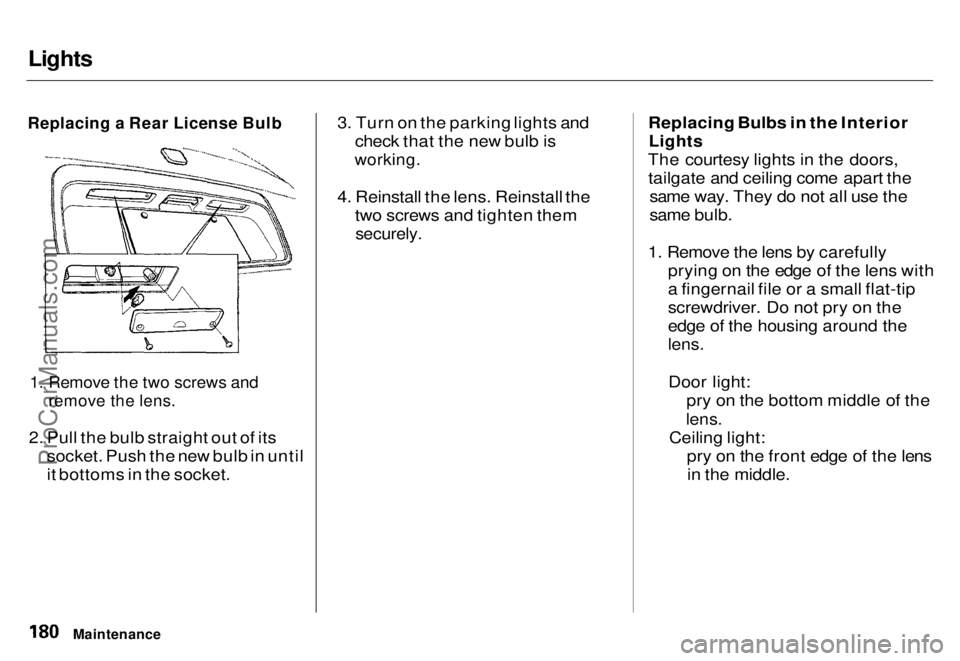
Replacing a Rear License Bulb
1. Remove the two screws and
remove the lens.
2. Pull the bulb straight out of its socket. Push the new bulb in until
it bottoms in the socket. 3. Turn on the parking lights and
check that the new bulb is
working.
4. Reinstall the lens. Reinstall the two screws and tighten them
securely.
Replacing Bulbs in the Interior
Lights
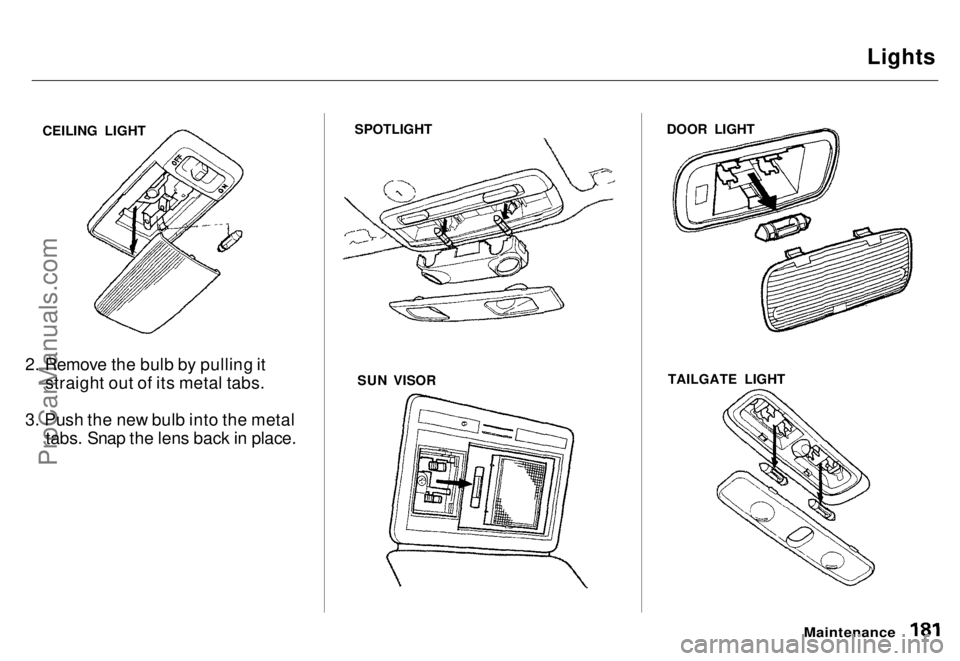
The courtesy lights in the doors, tailgate and ceiling come apart the same way. They do not all use the
same bulb.
1. Remove the lens by carefully prying on the edge of the lens with
a fingernail file or a small flat-tip
screwdriver. Do not pry on the
edge of the housing around the
lens.
Door light: pry on the bottom middle of the
lens.
Ceiling light: pry on the front edge of the lensin the middle.
MaintenanceProCarManuals.comMain Menu s t Table of Contents
Page 180 of 240
Lights
CEILING LIGHT
2. Remove the bulb by pulling it straight out of its metal tabs.
3. Push the new bulb into the metal tabs. Snap the lens back in place. SPOTLIGHT
SUN VISOR DOOR LIGHT
TAILGATE LIGHT
MaintenanceProCarManuals.comMain Menu s t Table of Contents
Page 181 of 240
Storing Your Car
If you need to park your car for an
extended period (more than 1
month), there are several things you should do to prepare it for storage.
Proper preparation helps prevent
deterioration and makes it easier to
get your car back on the road. It is
best to store your car indoors if at all
possible.
Fill the fuel tank.
Change the engine oil and filter
(see page 148). Wash and dry the exterior
completely.
Clean the interior. Make sure the
carpeting, floor mats, etc. are
completely dry.
Leave the parking brake off. Put
the transmission in Park. Block the rear wheels.
If the car is to be stored for a
longer period, it should be supported on jackstands so the
tires are off the ground.
Leave one window open slightly (if
the car is being stored indoors).
Disconnect the battery.Support the front and rear wiper
blade arms with a folded towel or
rag so they do not touch the
windshield. Apply a silicone spray lubricant to
all door and tailgate seals. Also,
apply wax to the painted surfaces
that mate with the door and
tailgate seals. Cover the car with a "breathable"
car cover, one made from a porous
material such as cotton.
Nonporous materials, such as
plastic sheeting, trap moisture
which can damage the paint. If possible, run the engine for a
while periodically (preferably once
a month).
If you store your car for 12 months or longer, have your Honda dealer
perform the inspections called for in
the 24 months/48,000 km (30,000 miles) maintenance schedule (Normal Conditions) as soon as you
take it out of storage (see page 140 )
The replacements called for in the maintenance schedule are not
needed unless the car has actually
reached that time or mileage.
MaintenanceProCarManuals.comMain Menu s t Table of Contents
Page 187 of 240
Corrosion Protection
Two factors normally contribute to causing corrosion in your car:
1. Moisture trapped in body cavities. Dirt and road salt that collects in
hollows on the underside of the car stays damp, promoting
corrosion in that area.
2. Removal of paint and protective coatings from the exterior and
underside of the car. Many corrosion-preventive measures
are built into your Honda. You can
help keep your car from corroding
by performing some simple periodic
maintenance:
Repair chips and scratches in the
paint as soon as you discover them.
Inspect and clean out the drain
holes in the bottom of the doors and body. Check the floor coverings for
dampness. Carpeting and floor
mats may remain damp for a long
time, especially in winter. This dampness can eventually cause
the floor panels to corrode. Use a high-pressure spray to clean
the underside of your car. This is especially important in areas that
use road salt in winter. It is also a
good idea in humid climates and areas subject to salt air. Carsequipped with ABS have a sensor
and wiring at each wheel. Be
careful not to damage them. Have the corrosion-preventive
coatings on the underside of your
car inspected and repaired periodically.
Appearance CareProCarManuals.comMain Menu s t Table of Contents
Page 221 of 240
Emission Controls
The burning of gasoline in your car's engine produces several byproducts.
Some of these are carbon monoxide (CO), oxides of nitrogen (NOx) and
hydrocarbons (HC). Gasoline
evaporating from the tank also
produces hydrocarbons. Controlling
the production of NOx, CO, and HC
is important to the environment. Under certain conditions of sunlight
and climate, NOx and HC react to
form photochemical "smog." Carbon monoxide does not contribute to
smog creation, but it is a poisonous
gas.
The Clean Air Act
The United States Clean Air Act* sets standards for automobile
emissions. It also requires that
automobile manufacturers explain to
owners how their emission controls
work and what to do to maintain
them. This section summarizes how the emission controls work.Scheduled maintenance is on page 140.
* In Canada, Honda vehicles comply
with the Canadian Motor Vehicle Safety Standards (CMVSS) for
Emissions valid at the time they are
manufactured. Crankcase Emission Control
System
Your car has a Positive Crankcase Ventilation System. This keeps
gasses that build up in the engine's crankcase from going into the
atmosphere. The Positive Crankcase
Ventilation valve routes them from the crankcase back to the intakemanifold. They are then drawn into
the engine and burned.
Evaporative Emission Control System
As gasoline evaporates in the fuel
tank, an evaporative emission control
canister filled with charcoal adsorbs
the vapor. It is stored in this canister
while the engine is off. After the
engine is started and warmed up, the
vapor is drawn into the engine and burned during driving.
Technical InformationProCarManuals.comMain Menu s t Table of Contents
Page 225 of 240
Warranty Coverages
U.S. Owners
Your new Honda is covered by these
warranties:
New Car Limited Warranty — covers
your new car, except for the battery, emissions control systems and
accessories, against defects in
materials and workmanship.
Emissions Control Systems Defects Warranty and Emissions
Performance Warranty — these two
warranties cover your car's emis- sions control systems. Time, mileage,
and coverage are conditional. Please
read the warranty manual for exact
information.
Original Equipment Battery Limited
Warranty — this warranty gives up
to 100% credit toward a replacement
battery.
Seat Belt Limited Warranty — a seat
belt that fails to function properly is covered for the useful life of the car.
Rust Perforation Limited Warranty — all exterior body panels are
covered for rust-through from the
inside for the specified time period
with no mileage limit.
Accessory Limited Warranty — Genuine Honda Accessories are
covered under this warranty. Time
and mileage limits depend on the
type of accessory and other factors. Please read your warranty manual
for details.
Replacement Parts Limited
Warranty — covers all Genuine
Honda replacement parts against
defects in materials and workman-
ship.
Replacement Battery Limited
Warranty — provides prorated
coverage for a replacement battery
purchased from a Honda dealer.
Replacement Muffler Lifetime
Limited Warranty — provides
coverage for as long as the pur-
chaser of the muffler owns the car.
Restrictions and exclusions apply toall these warranties. Please read the 1996 Honda Warranties booklet that
came with your car for precise
information on warranty coverages.
Your Honda's original tires are covered by their manufacturer. Tire
warranty information is in a separate booklet.
Canadian Owners
Please refer to the 1996 Warranty and Maintenance Guide that came
with your car.
Warranty and Customer RelationsProCarManuals.coms t Main Menu Table of Contents