dashboard HONDA ODYSSEY 1996 Owners Manual
[x] Cancel search | Manufacturer: HONDA, Model Year: 1996, Model line: ODYSSEY, Model: HONDA ODYSSEY 1996Pages: 240, PDF Size: 2.64 MB
Page 1 of 240

1996 Odyssey Online Reference Owner's Manual
Use these links (and links throughout this manual) to navigate through this reference.
For a printed owner's manual, click on authorized manuals or go to www.helminc.com.
Contents
Introduction........................................................................\
........................................................................... i
A Few Words About Safety ........................................................................\
................................................ ii
Driver and Passenger Safety ........................................................................\
............................................. 3
Proper use and care of your vehicle's seat belts, and Supplemental Restraint System.
Instruments and Controls........................................................................\
...................................................31
Instrument panel in
dicator and gauge, and how to use dashboard and steering column controls.
Comfort and Convenience Features........................................................................\
.................................73
How t o
op
erate the climate control system, the audio system, and other convenience features.
Before Driving ........................................................................\
.................................................................... 107
What gasoli n
e to u
se, how to break-in your new vehicle, and how to load luggage and other cargo.
Driving........................................................................\
.................................................................................. 117
The proper way t o
start the engine, shift the tr ansmission, and park, plus towing a trailer.
Maintenance........................................................................\
........................................................................ 135
T h
e Ma
intenance Schedule shows you when you need to take your vehicle to the dealer.
Appearance Care........................................................................\
................................................................ 183
T i
ps on cl
eaning and protecting your vehicle. Things to look for if your car ever needs body repairs.
Taking Care of the Unexpected........................................................................\
...................................... 191
This section covers sever
a
l problems motorists someti mes experience, and how to handle them.
Technical Information........................................................................\
...................................................... 215
ID numbers, dimens ions, capacities, and techn
ical information.
Warranty and Customer Relations (U.S. and Canada)..................................................................... 227
A summary of th
e warr
anties covering your new Honda, and how to contact us.
Authorized Manuals (U.S. only)........................................................................\
...................................... 233
How t o
order
manuals and other technical literature.
Index ........................................................................\
......................................................................................... I
Gas Station Information
Information you need when you pull up to the fuel pump.
Owner's Identification Form
ProCarManuals.com
Page 13 of 240
Supplemental Restraint System
Your car is equipped with a Supple- mental Restraint System (SRS) to
help protect the head and chest ofthe driver and front seat passenger during a severe frontal collision.
This system does not replace your seat
belts. It supplements, or adds to, the
protection offered by seat belts and other occupant protection features. SRS Components
Your supplemental restraint system includes: One airbag in the steering wheel
for the driver and another in the dashboard for the passenger.
Sensors that can detect a severe frontal collision.
A sophisticated electronic systemthat continually monitors thesensors, control unit, airbag
activators, and all related wiringwhen the ignition is ON (II).
An indicator light on the instru- ment panel to alert you to a possi-
ble problem with the system.
Emergency backup power in case
your car's electrical system is disconnected in a crash. What Happens In a Crash
If you ever have a severe frontal
collision, the sensors will detect rapid deceleration and signal the
control unit to instantly inflate the
airbags.
During a crash, your seat belts will
help to restrain your lower body andtorso. The airbags will provide a
cushion to absorb crash energy and
help keep the head and chest of thedriver and front passenger from
striking the interior of the car.
After inflating, the airbags will immediately deflate. The entire
process, from detection to deflation, takes a fraction of a second. This
process occurs so quickly that youmay not hear the loud noise created
by the airbag inflators, or realize
what has happened.
Driver and Passenger Safety
Not wearing seat belts
increases the chance of serious
injury or death in a crash, evenif you have airbags.
Be sure you and your
passengers always wear seat
belts and wear them properly.ProCarManuals.comMain Menu s t Table of Contents
Page 17 of 240
Supplemental Restraint System
The passenger's airbag is stored near the top of the dashboard, undera lid marked SRS. Do not place any
objects on top of this lid. If the airbag
inflates, those objects can be
propelled inside the car and possibly hurt someone. How the SRS Indicator
Light Works
The purpose of the SRS light on your instrument panel is to alert you of apotential problem with your supple-
mental restraint system.
Have the system checked if: The light does not come on when
you turn the ignition ON (II). The light stays on after the engine
starts. The light comes on or flashes
while you are driving.
If you see any of these indications,
the airbag may not work when
needed in an accident. Take the car
to your dealer promptly for diagnosis
and service.
System Service
Your supplemental restraint system is virtually maintenance-free. There
are no parts you can safely service.
You must have the system serviced by an authorized Honda dealer:
If your airbags ever inflate, the
airbags and control unit must be
replaced. Do not try to remove or discard the airbags by yourself.
This must be done by a Honda
dealer.
If the SRS indicator light alerts
you of a problem. Have the supplemental restraint systemchecked as soon as possible.Otherwise, your airbags might not
inflate when you need them.
When the car is ten years old. Have the dealer inspect thesystem. The production date is on
the driver's doorjamb for your
convenience.
Driver and Passenger Safety
S R S
ProCarManuals.comMain Menu s t Table of Contents
Page 32 of 240
Instruments and Controls
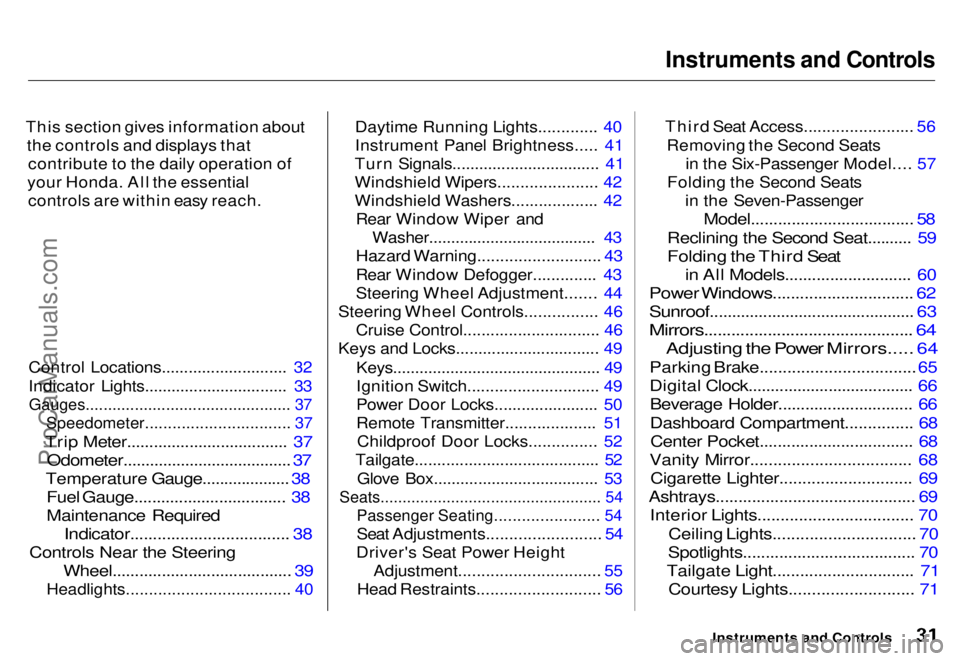
This section gives information about the controls and displays thatcontribute to the daily operation of
your Honda. All the essential controls are within easy reach.
Control Locations............................ 32
Indicator Lights................................ 33
Gauges.............................................. 37
Speedometer................................ 37
Trip Meter.................................... 37
Odometer......................................
37
Temperature Gauge................... .
38
Fuel Gauge.................................. 38
Maintenanc
e Required
Indicator...................................
38
Controls Nea r
the Steering
Wheel........................................ 39
Headlights.................................... 40
Daytime Running Lights............. 40
Instrument Panel Brightness..... 41
Turn Signals................................. 41
Windshield Wipers...................... 42
Windshield Washers................... 42 Rear Window Wiper and Washer...................................... 43
Hazard Warning........................... 43
Rear Window Defogger.............. 43
Steering Wheel Adjustment....... 44
Steering Wheel Controls................ 46 Cruise Control.............................. 46
Keys and Locks................................ 49
Keys............................................... 49
Ignition Switch............................. 49
Power Door Locks....................... 50
Remote Transmitter.................... 51Childproof Door Locks............... 52
Tailgate......................................... 52
Glove Box..................................... 53
Seats.................................................. 54
Passenger Seating....................... 54
Seat Adjustments......................... 54
Driver's Seat Power Height Adjustment............................... 55
Head Restraints........................... 56 Third Seat Access........................ 56
Removing the Second Seats in the Six-Passenger Model.... 57
Folding the Second Seats in the Seven-Passenger
Model....................................
58
Reclining th e
Second Seat.......... 59
Folding the Third Seat
in All Models............................ 60
Power Windows............................... 62
Sunroof.............................................. 63
Mirrors.............................................. 64
Adjusting the Power Mirrors..... 64
Parking Brake..................................
65
Digital Clock.................................... .
66
Beverage Holder.............................. 66
Dashboard Compartment............... 68 Center Pocket.................................. 68
Vanity Mirror................................... 68 Cigarette Lighter............................. 69
Ashtrays............................................ 69 Interior Lights.................................. 70
Ceiling Lights............................... 70
Spotlights...................................... 70
Tailgate Light............................... 71 Courtesy Lights........................... 71
Instruments and ControlsProCarManuals.comMain Menu s t
Page 40 of 240
Controls Near the Steering Wheel
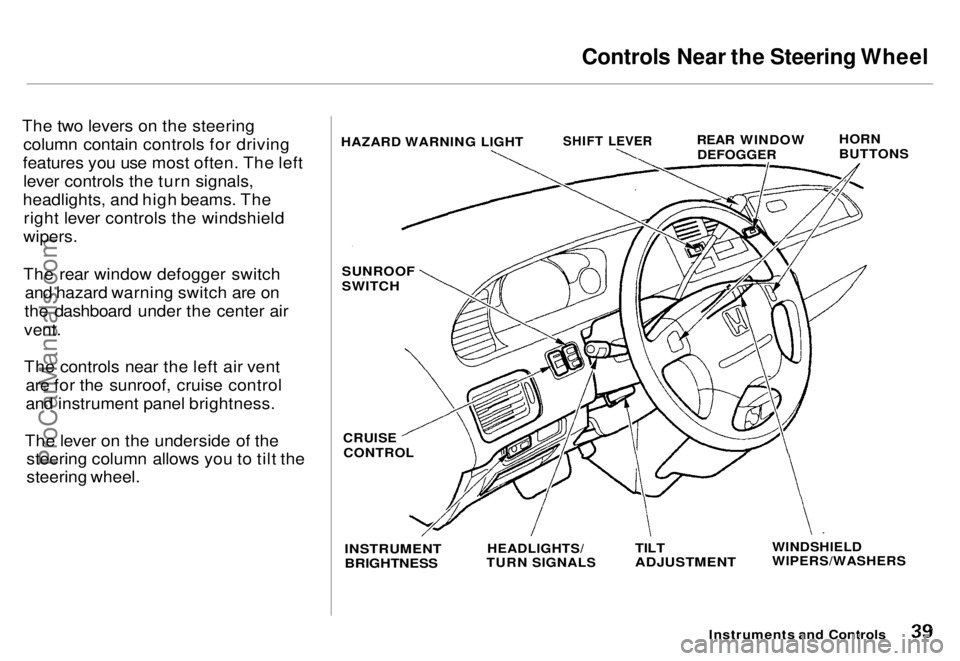
The two levers on the steering column contain controls for driving
features you use most often. The left lever controls the turn signals,
headlights, and high beams. The right lever controls the windshield
wipers.
The rear window defogger switch and hazard warning switch are on
the dashboard under the center air
vent.
The controls near the left air vent are for the sunroof, cruise control
and instrument panel brightness.
The lever on the underside of the steering column allows you to tilt the
steering wheel.
Instruments and Controls
HAZARD WARNING LIGHT
SHIFT LEVER
REAR WINDOW
DEFOGGER
HORN
BUTTONS
SUNROOF
SWITCH
CRUISE
CONTROL
INSTRUMENT
BRIGHTNESS
HEADLIGHTS/
TURN SIGNALS
TILT
ADJUSTMENT
WINDSHIELD
WIPERS/WASHERSProCarManuals.comMain Menu s t Table of Contents
Page 42 of 240
Controls Near the Steering Wheel
Instrument Panel Brightness
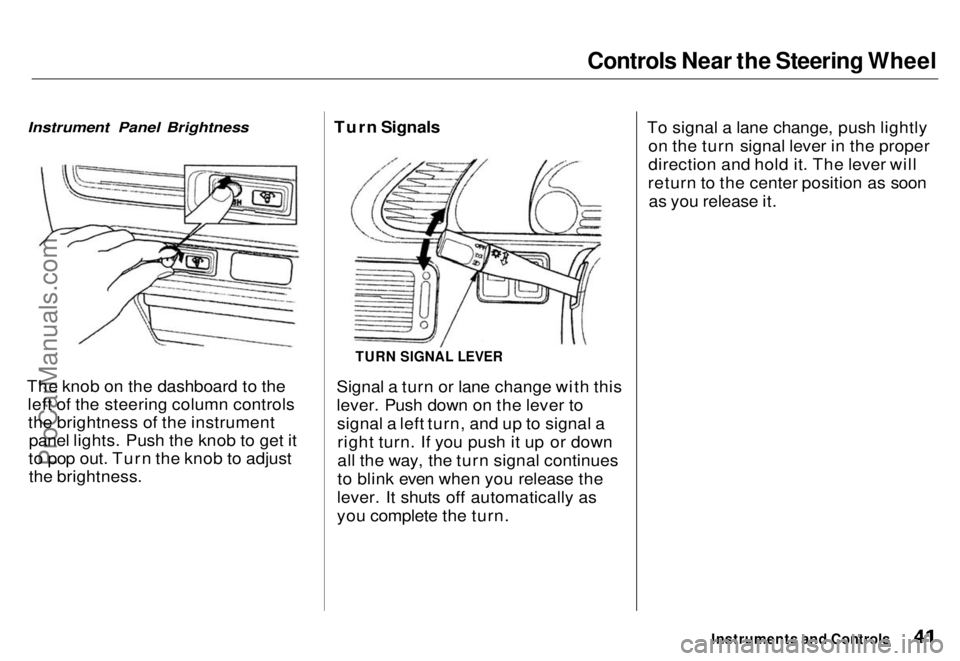
The knob on the dashboard to the left of the steering column controlsthe brightness of the instrument panel lights. Push the knob to get it
to pop out. Turn the knob to adjust the brightness. Turn Signals
Signal a turn or lane change with this
lever. Push down on the lever tosignal a left turn, and up to signal aright turn. If you push it up or down
all the way, the turn signal continues
to blink even when you release the
lever. It shuts off automatically as
you complete the turn. To signal a lane change, push lightly
on the turn signal lever in the proper
direction and hold it. The lever will
return to the center position as soon as you release it.
Instruments and Controls
TURN SIGNAL LEVERProCarManuals.comMain Menu s t Table of Contents
Page 64 of 240
Power Windows, Sunroof
The MAIN switch controls power to the passengers' windows. With this
switch off, the passengers' windowscannot be raised or lowered. The
MAIN switch does not affect thedriver's window. Keep the MAIN
switch off when you have children in
the car so they do not injure them- selves by operating the windows
unintentionally.
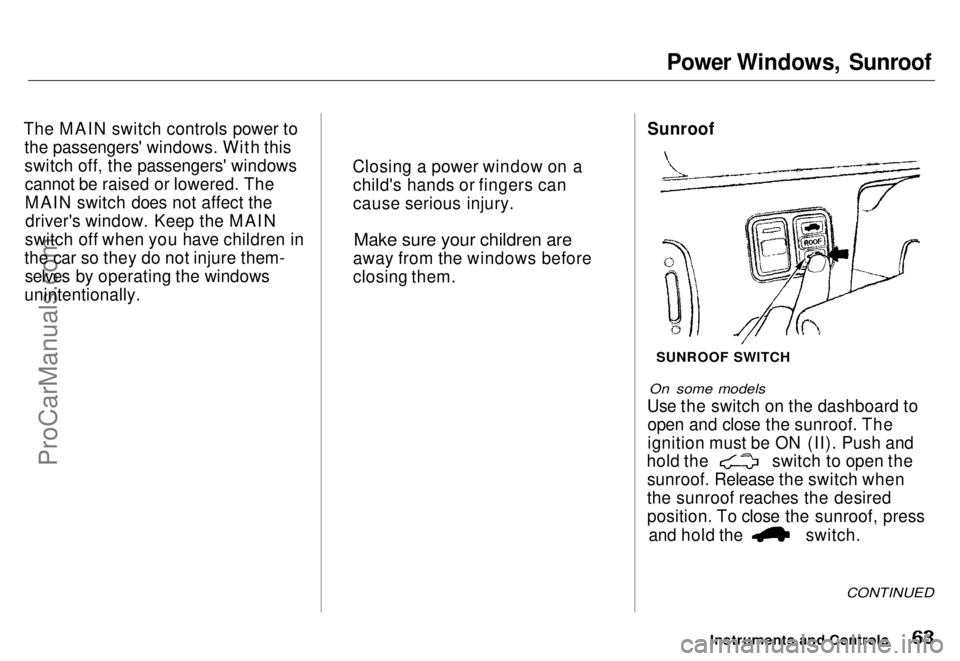
On some models
Use the switch on the dashboard to open and close the sunroof. The
ignition must be ON (II). Push and hold the switch to open the
sunroof. Release the switch when
the sunroof reaches the desired
position. To close the sunroof, press and hold the switch.
CONTINUED
Instruments and Controls
Sunroof
SUNROOF SWITCH
Closing a power window on a
child's hands or fingers can
cause serious injury.
Make sure your children are
away from the windows before
closing them.
ProCarManuals.coms t Main Menu Table of Contents
Page 69 of 240
Dashboard Compartment, Center Pocket, Vanity Mirror
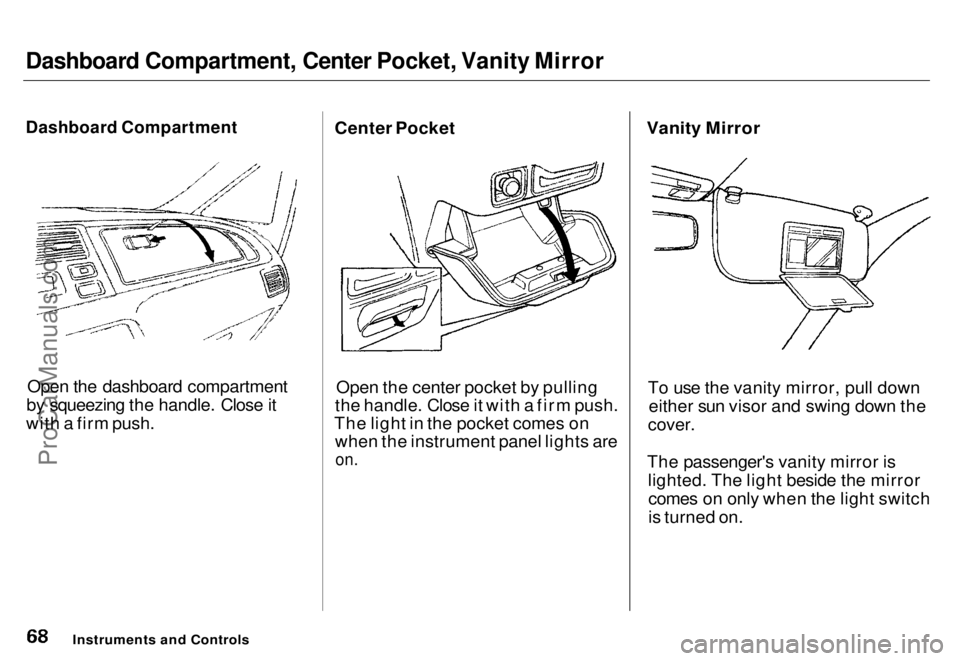
Dashboard Compartment
Open the dashboard compartment
by squeezing the handle. Close it
with a firm push. Center Pocket
Open the center pocket by pulling
the handle. Close it with a firm push.
The light in the pocket comes on when the instrument panel lights are
on.
Vanity Mirror
To use the vanity mirror, pull downeither sun visor and swing down the
cover.
The passenger's vanity mirror is lighted. The light beside the mirrorcomes on only when the light switch
is turned on.
Instruments and ControlsProCarManuals.coms t Main Menu Table of Contents
Page 75 of 240
Heating and Cooling
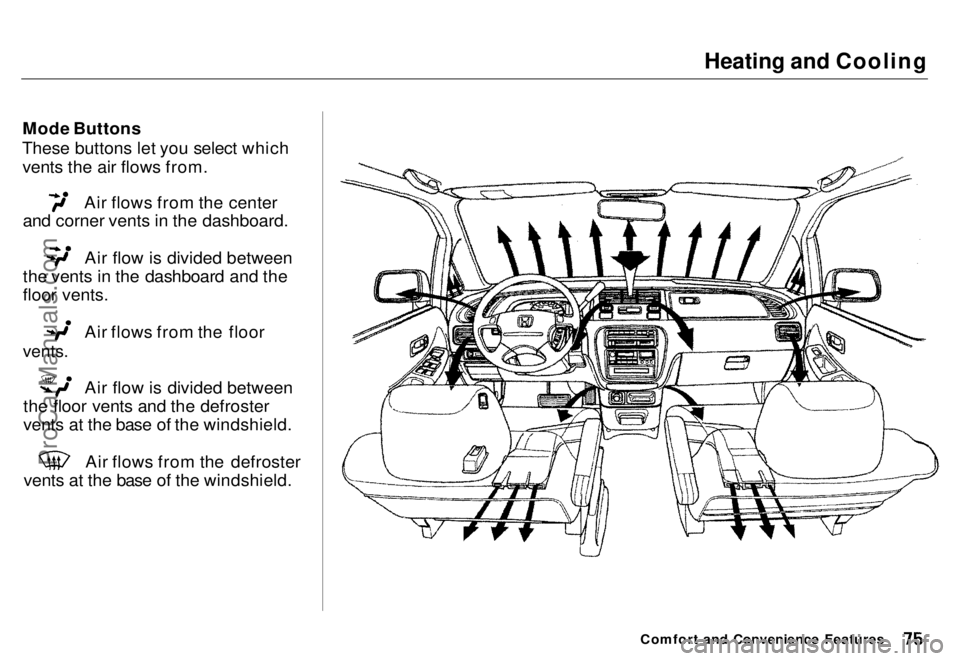
Mode Buttons
These buttons let you select which vents the air flows from. Air flows from the center
and corner vents in the dashboard. Air flow is divided between
the vents in the dashboard and the
floor vents. Air flows from the floor
vents.
Air flow is divided between
the floor vents and the defroster
vents at the base of the windshield. Air flows from the defroster
vents at the base of the windshield.
Comfort and Convenience FeaturesProCarManuals.comMain Menu s t Table of Contents
Page 76 of 240
Heating and Cooling
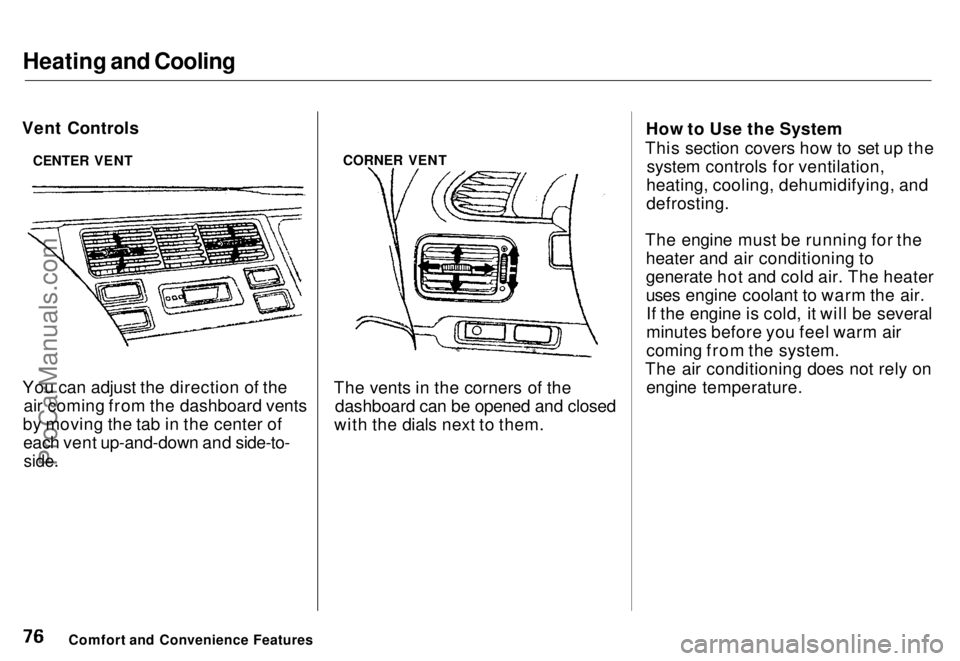
Vent Controls
You can adjust the direction of the air coming from the dashboard vents
by moving the tab in the center of each vent up-and-down and side-to-
side.
CORNER VENT
The vents in the corners of the dashboard can be opened and closed
with the dials next to them. How to Use the System
This section covers how to set up the system controls for ventilation,
heating, cooling, dehumidifying, and
defrosting.
The engine must be running for the heater and air conditioning to
generate hot and cold air. The heater
uses engine coolant to warm the air.If the engine is cold, it will be several
minutes before you feel warm air
coming from the system.
The air conditioning does not rely on engine temperature.
Comfort and Convenience Features
CENTER VENTProCarManuals.comMain Menu s t Table of Contents