ECU HONDA ODYSSEY 1997 User Guide
[x] Cancel search | Manufacturer: HONDA, Model Year: 1997, Model line: ODYSSEY, Model: HONDA ODYSSEY 1997Pages: 241, PDF Size: 2.52 MB
Page 28 of 241
Child Safety
Second Seat Installation:
There are three attachment points available for the seven-passenger
model, and two attachment points
available for the six-passenger model.
To use a tether-style child seat in the second seat, the third seat must be
stored in the floor recess (see page 60). You will find a U-shaped slit in
the carpeting at each attachment
point. Select the attachment point
you want to use, and pull up the carpeting at the slit. Attach the
tether strap to the mounting hook and make sure it is secure.
Important Safety Information
Keep the third seat in the floor while
using a tether-style child seat in the second seat. If you attempt to return
the third seat to the upright position,
you may damage the vehicle or
tether, even though the damage may not be obvious. If this happens, the
child seat may not be properly restrained in a crash.
Third Seat Installation:
There are two attachment points on
the tailgate sill. Select the attach-
ment point you want use, and
remove the plug with a small flat-
tipped screwdriver or a fingernail file.
Install the tether hardware that came
with the child seat.
Tighten the bolt to:
16 lbf.ft (2.2 kgf.m , 22 N.m)
If you are not sure how to install the
hardware, have it installed by your
authorized Honda dealer.
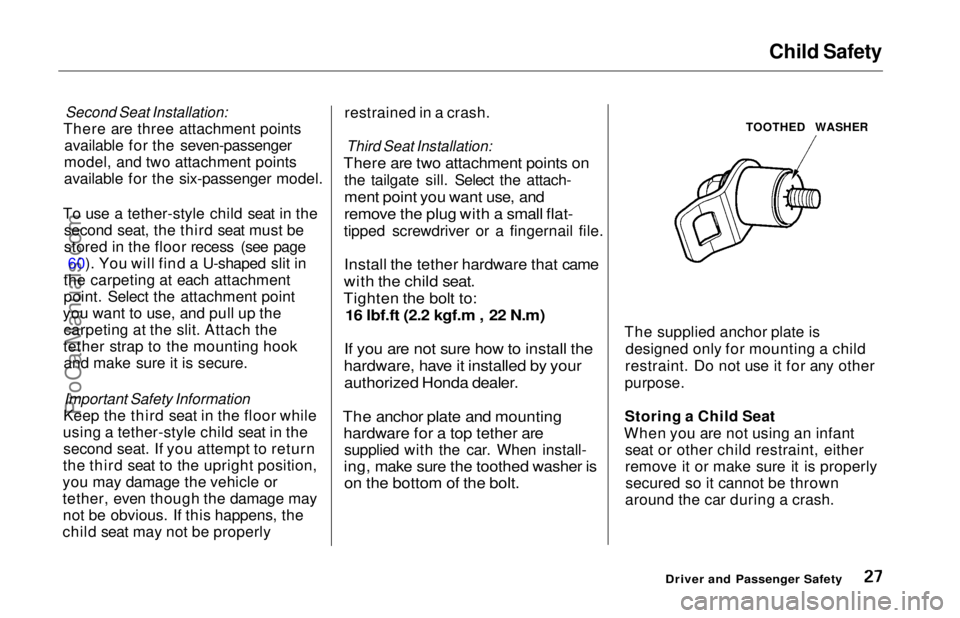
The anchor plate and mounting hardware for a top tether are
supplied with the car. When install-
ing, make sure the toothed washer is
on the bottom of the bolt.
TOOTHED WASHER
The supplied anchor plate is designed only for mounting a child
restraint. Do not use it for any other
purpose.
Storing a Child Seat
When you are not using an infant seat or other child restraint, either
remove it or make sure it is properlysecured so it cannot be thrown
around the car during a crash.
Driver and Passenger SafetyProCarManuals.comMain Menu Table of Contents s t
Page 46 of 241
Controls Near the Steering Wheel
1. Adjust the seat so you are a comfortable distance from the
pedals and can operate them safely.
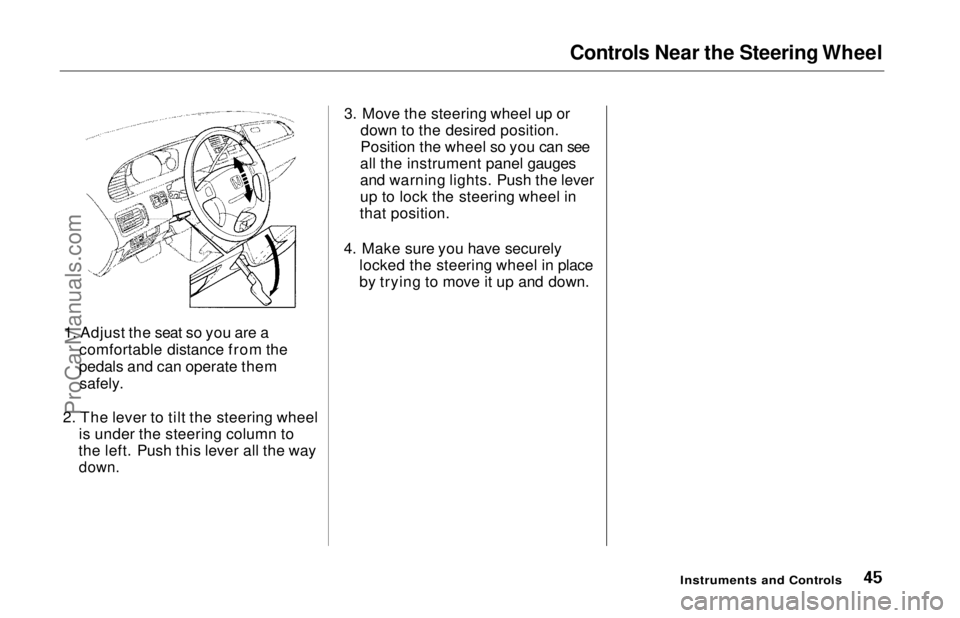
2. The lever to tilt the steering wheel is under the steering column to
the left. Push this lever all the way
down.
3. Move the steering wheel up or
down to the desired position.
Position the wheel so you can see
all the instrument panel gauges
and warning lights. Push the lever
up to lock the steering wheel in
that position.
4. Make sure you have securely locked the steering wheel in place
by trying to move it up and down.
Instruments and ControlsProCarManuals.comMain Menu Table of Contents s t
Page 58 of 241
Seats
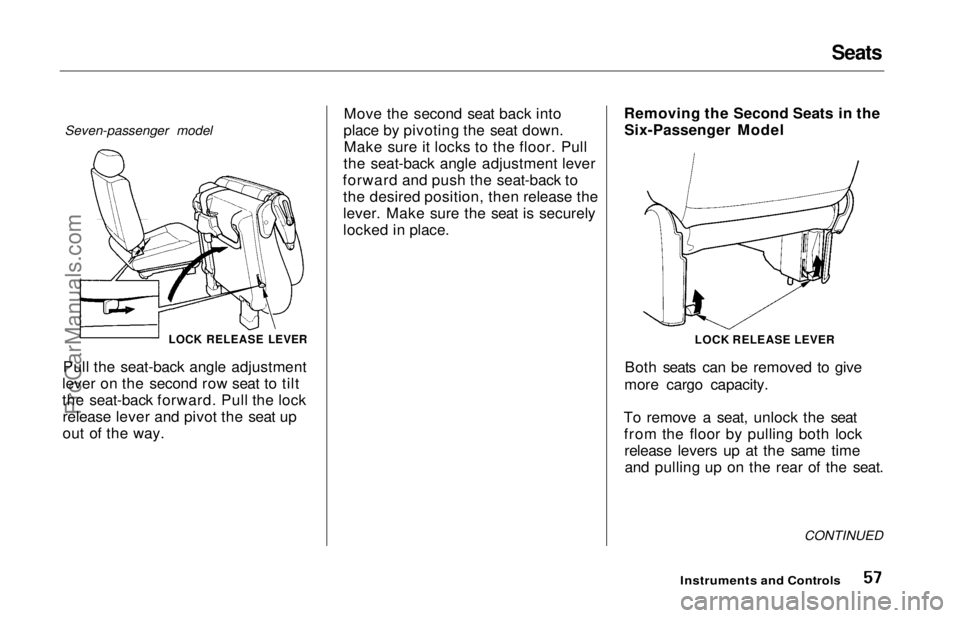
Seven-passenger model
LOCK RELEASE LEVER
Pull the seat-back angle adjustment
lever on the second row seat to tilt
the seat-back forward. Pull the lock release lever and pivot the seat up
out of the way. Move the second seat back into
place by pivoting the seat down. Make sure it locks to the floor. Pull
the seat-back angle adjustment lever
forward and push the seat-back to the desired position, then release the
lever. Make sure the seat is securely
locked in place. Removing the Second Seats in the
Six-Passenger Model
Both seats can be removed to give
more cargo capacity.
To remove a seat, unlock the seat from the floor by pulling both lockrelease levers up at the same timeand pulling up on the rear of the seat.
CONTINUED
Instruments and Controls
LOCK RELEASE LEVERProCarManuals.comMain Menu Table of Contents s t
Page 59 of 241
Seats
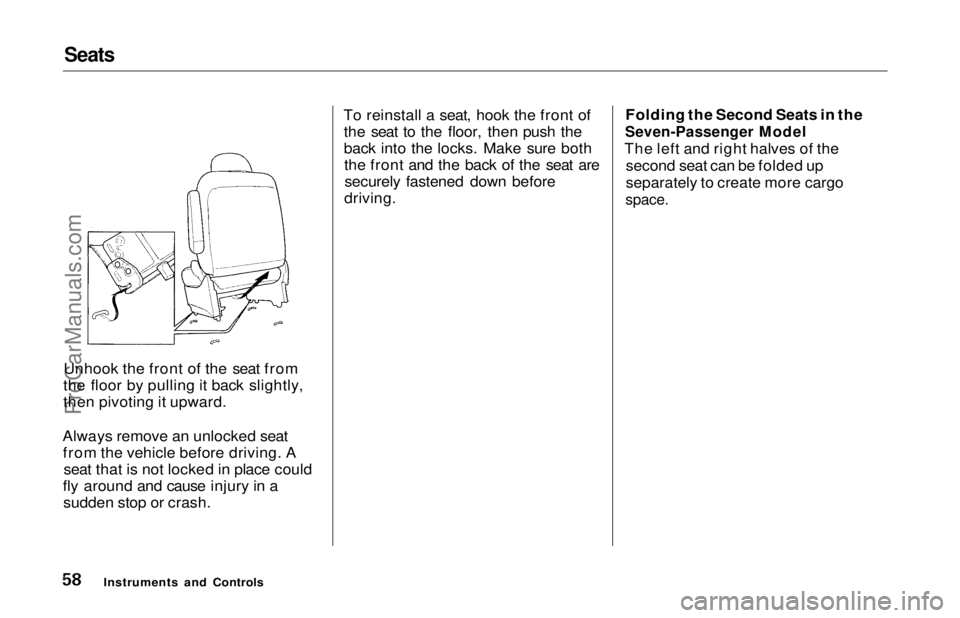
Unhook the front of the seat from
the floor by pulling it back slightly,
then pivoting it upward.
Always remove an unlocked seat from the vehicle before driving. A seat that is not locked in place could
fly around and cause injury in a sudden stop or crash. To reinstall a seat, hook the front of
the seat to the floor, then push the
back into the locks. Make sure boththe front and the back of the seat aresecurely fastened down before
driving. Folding the Second Seats in the
Seven-Passenger Model
The left and right halves of the second seat can be folded up
separately to create more cargo
space.
Instruments and ControlsProCarManuals.comMain Menu Table of Contents s t
Page 60 of 241
Seats
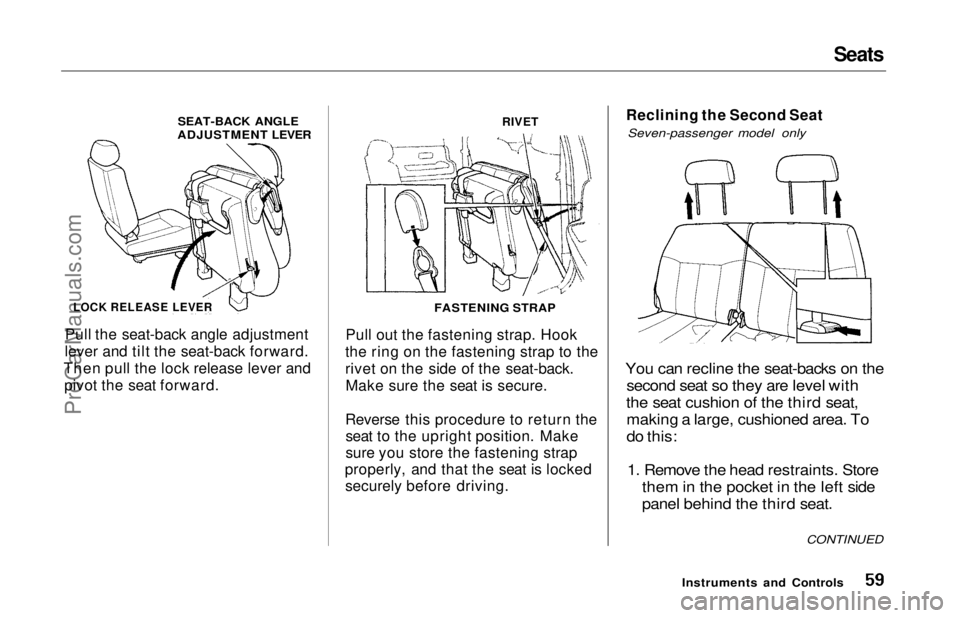
Pull the seat-back angle adjustment
lever and tilt the seat-back forward.
Then pull the lock release lever and pivot the seat forward.
RIVET
Pull out the fastening strap. Hook
the ring on the fastening strap to the
rivet on the side of the seat-back. Make sure the seat is secure.
Reverse this procedure to return the seat to the upright position. Make
sure you store the fastening strap
properly, and that the seat is locked securely before driving. Reclining the Second Seat
Seven-passenger model only
You can recline the seat-backs on the second seat so they are level with
the seat cushion of the third seat, making a large, cushioned area. To
do this:
1. Remove the head restraints. Store them in the pocket in the left side
panel behind the third seat.
Instruments and Controls
CONTINUED
SEAT-BACK ANGLE
ADJUSTMENT LEVER
LOCK RELEASE LEVER
FASTENING STRAPProCarManuals.comMain Menu Table of Contents s t
Page 62 of 241
Seats
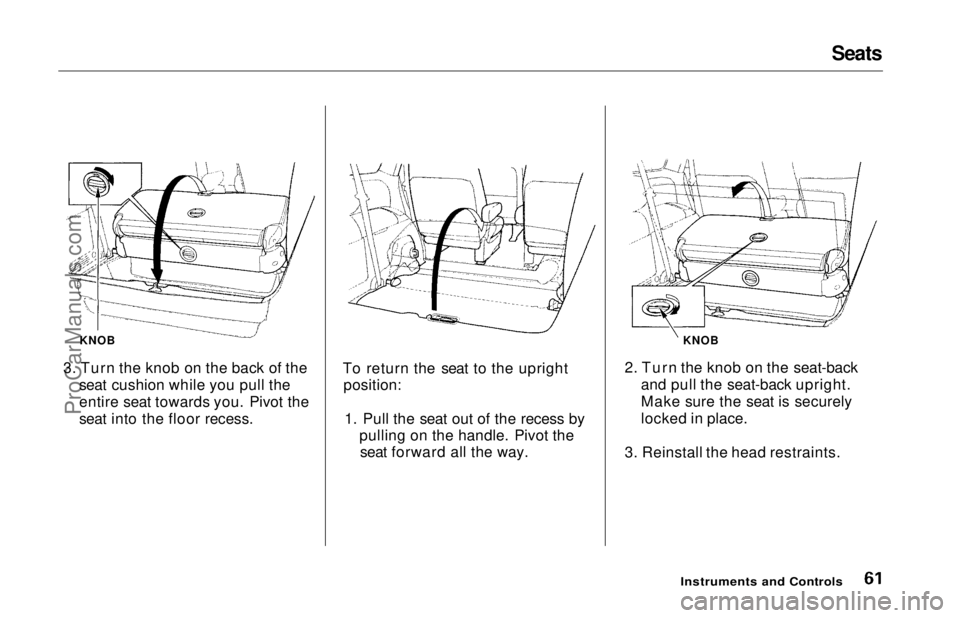
KNOB
3. Turn the knob on the back of the seat cushion while you pull the
entire seat towards you. Pivot the
seat into the floor recess. To return the seat to the upright
position:
1. Pull the seat out of the recess by pulling on the handle. Pivot theseat forward all the way. KNOB
2. Turn the knob on the seat-back and pull the seat-back upright.
Make sure the seat is securely
locked in place.
3. Reinstall the head restraints.
Instruments and ControlsProCarManuals.comMain Menu Table of Contents s t
Page 116 of 241
Loading Cargo
The maximum load you can carry in your Honda is 1,150 Ibs (535 kg). It
includes the total weight of all
passengers and their belongings, any
accessories, and the tongue weight
of a trailer. This 1,150 Ibs (535 kg)
figure is shown as the Vehicle Capacity Weight on the tire infor-
mation label attached to the driver's doorjamb.
To figure out how much cargo you
can cany: Figure the total "occupant weight"
you will be transporting. To do this, multiply the number of people (driver and all passengers) by 150
Ibs (70 kg). Subtract this number from the
Vehicle Capacity Weight (1,150 lbs/535 kg). If you are towing a trailer, subtract
the tongue weight. See Towing a
Trailer on page 130 .
This final number is the total weight of cargo you can load in or on the car.
With seven occupants (driver and six passengers), the maximum recom-
mended weight for cargo is 100 Ibs
(45 kg).
Where you store this cargo, and how
well you secure it, are just as important as how much it weighs.
Make sure you load cargo so it will
not shift while driving. Items stored
in the cargo area behind the third
seat should be stored as far forward
as possible. You could store addi-
tional items on the floor behind the
front seats. Make sure they cannot roll under the front seat and
interfere with the pedals.
For greater cargo capacity, the thirdseat can be folded into the floor and
the second row seats can either be removed or folded up (depending onmodel). Passengers should never sit
in the open cargo area while the car
is moving. They should sit in one of
the seats and wear their seat belts.
If you must carry large objects that
prevent you from closing the tailgate,
be aware that exhaust gas can enter the interior. See Carbon Monoxide
Hazard on page 29 .
Before DrivingProCarManuals.comMain Menu Table of Contents s t
Page 118 of 241
Preparing to Drive
You should do the following checks and adjustments every day before
you drive your car.
1. Make sure all windows, mirrors, and outside lights are clean and
unobstructed. Remove frost, snow,or ice.
2. Check that the hood and tailgate are fully closed.
3. Visually check the tires. If a tire looks low, use a gauge to check its
pressure.
4. Check that any items you may be carrying with you inside are stored
properly or fastened down securely. 5. Check the adjustment of the seat
(see page 54).
6. Check the adjustment of the inside and outside mirrors (see
page 64).
7. Check the adjustment of the steering wheel (see page 44).
8. Make sure the doors are securely
closed and locked.
9. Fasten your seat belt. Check that your passengers have fastenedtheir seat belts (see page 7). 10.Turn the ignition ON (II). Check
the indicator lights in the instru-
ment panel.
11. Start the engine (see page 119).
12. Check the gauges and indicator lights in the instrument panel (seepage 33).
DrivingProCarManuals.comMain Menu Table of Contents s t
Page 132 of 241
Towing a Trailer
Mirrors
Many states and provinces have laws
requiring special outside mirrors
when you are towing a trailer. Check the laws in your area. You may want
to install mirrors, even if they are not
required. Hook up the trailer and see
how much it obscures your ability to see behind you with the standard
mirrors. If you cannot see directly
behind you, or have a large blind spot next to the trailer or the car,
you should install mirrors intended for towing. Connecting the Trailer
Most trailers that have a gross
weight of 1,000 Ibs (450 kg) do not
have their own braking system. If
you are thinking of getting a trailer that does have brakes, make sure
they are electrically-operated. Thereare no provisions in your car to tap
into its hydraulic braking system.
Any attempt to attach the trailer's brakes to your car's hydraulicsystem, no matter how successful it
may seem, will lower braking effectiveness and create a potential
hazard.
Always use a safety chain when
towing a trailer. Connect the safetychain securely at both ends. Make
sure the chain crosses under the
tongue so it will catch the trailer if it becomes unhitched. Leave enoughslack in the chain so it can't bind in a
sharp turn. Do not let it drag on the
ground.
DrivingProCarManuals.comMain Menu Table of Contents s t
Page 133 of 241
Towing a Trailer
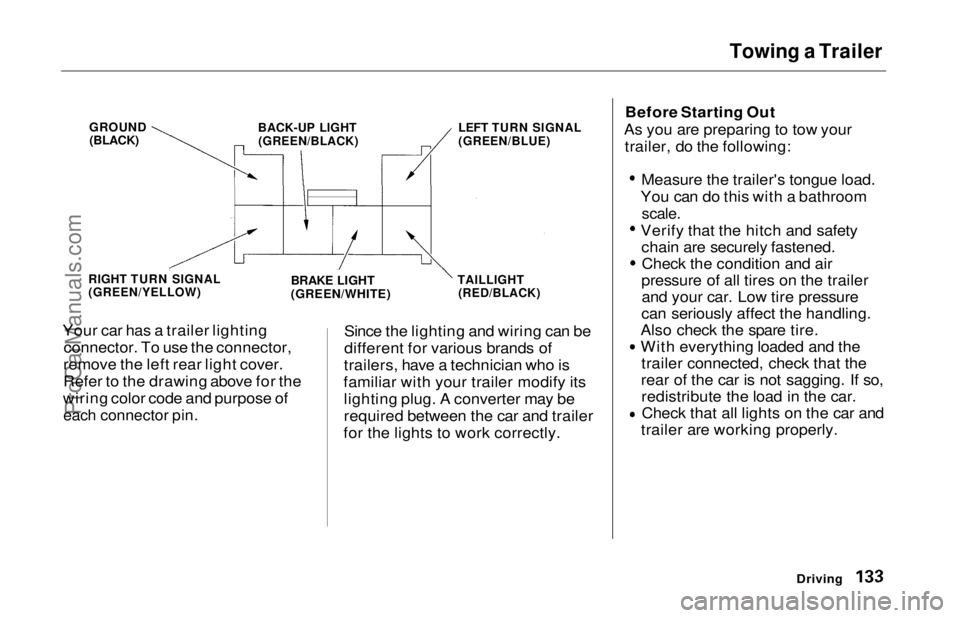
Your car has a trailer lighting connector. To use the connector,
remove the left rear light cover.
Refer to the drawing above for the
wiring color code and purpose of
each connector pin.
Since the lighting and wiring can be
different for various brands of
trailers, have a technician who is
familiar with your trailer modify its lighting plug. A converter may be
required between the car and trailer
for the lights to work correctly. Before Starting Out
As you are preparing to tow your trailer, do the following:
Measure the trailer's tongue load.
You can do this with a bathroom
scale.
Verify that the hitch and safety chain are securely fastened.Check the condition and air
pressure of all tires on the trailer and your car. Low tire pressure
can seriously affect the handling.
Also check the spare tire.
With everything loaded and the trailer connected, check that the
rear of the car is not sagging. If so, redistribute the load in the car.Check that all lights on the car and
trailer are working properly.
Driving
GROUND
(BLACK)
BACK-UP LIGHT
(GREEN/BLACK)
LEFT TURN SIGNAL
(GREEN/BLUE)
RIGHT TURN SIGNAL
(GREEN/YELLOW)
BRAKE LIGHT
(GREEN/WHITE)
TAILLIGHT
(RED/BLACK)ProCarManuals.comMain Menu Table of Contents s t