ABS HONDA ODYSSEY 1997 Owners Manual
[x] Cancel search | Manufacturer: HONDA, Model Year: 1997, Model line: ODYSSEY, Model: HONDA ODYSSEY 1997Pages: 241, PDF Size: 2.52 MB
Page 13 of 241
Supplemental Restraint System
Your car is equipped with a Supple- mental Restraint System (SRS) to
help protect the head and chest of
the driver and front seat passenger during a severe frontal collision.
This system does not replace your seat
belts. It supplements, or adds to, the
protection offered by seat belts and
other occupant protection features.
SRS Components
Your supplemental restraint system
includes:
One airbag in the steering wheel
for the driver and another in the dashboard for the passenger. Sensors that can detect a severe
frontal collision. A sophisticated electronic system
that continually monitors thesensors, control unit, airbag
activators, and all related wiring
when the ignition is ON (II). An indicator light on the instru-
ment panel to alert you to a possi-
ble problem with the system. Emergency backup power in case
your car's electrical system is disconnected in a crash. What Happens In a Crash
If you ever have a severe frontal
collision, the sensors will detect
rapid deceleration and signal the
control unit to instantly inflate the
airbags.
During a crash, your seat belts will
help to restrain your lower body and
torso. The airbags will provide a cushion to absorb crash energy and
help keep the head and chest of the driver and front passenger from
striking the interior of the car.
After inflating, the airbags will immediately deflate. The entire
process, from detection to deflation,
takes a fraction of a second. This
process occurs so quickly that you may not hear the loud noise created
by the airbag inflators, or realize
what has happened.
Driver and Passenger Safety
Not wearing a seat belt
increases the chance of serious
injury or death in a crash, even
if you have airbags.
Be sure you and your
passengers always wear seat
belts and wear them properly.ProCarManuals.comMain Menu Table of Contents s t
Page 14 of 241
Supplemental Restraint System
After the crash, you may see what looks like smoke. This is actually
powder from the airbag's surface.People with respiratory problems
may experience some temporary discomfort from the chemicals used
by the airbag's activators.
Important Facts About Airbags
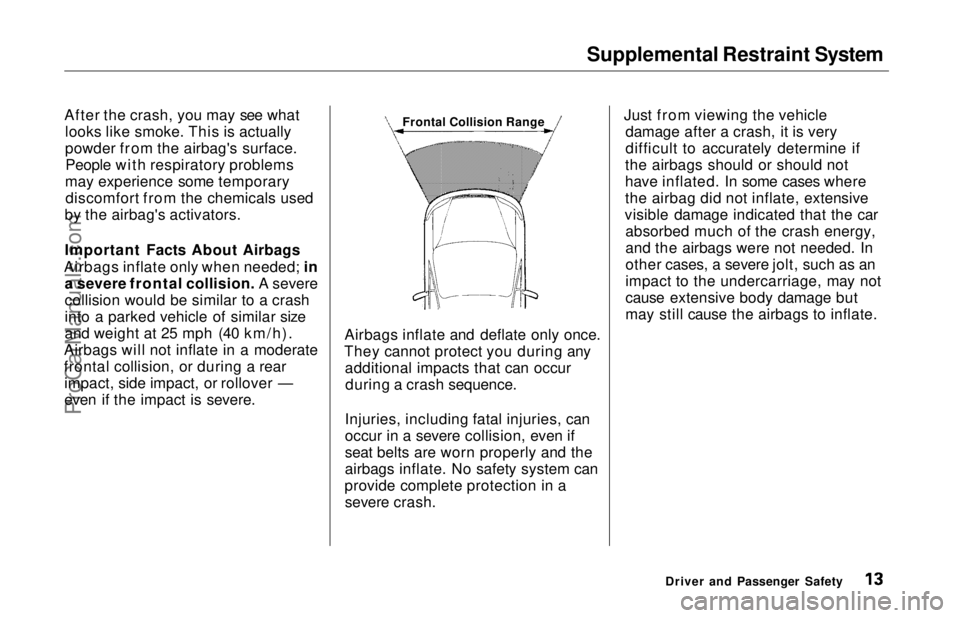
Airbags inflate only when needed; in a severe frontal collision. A severe
collision would be similar to a crash
into a parked vehicle of similar size
and weight at 25 mph (40 km/h).
Airbags will not inflate in a moderate
frontal collision, or during a rear impact, side impact, or rollover —
even if the impact is severe. Airbags inflate and deflate only once.
They cannot protect you during any additional impacts that can occurduring a crash sequence.
Injuries, including fatal injuries, can
occur in a severe collision, even if
seat belts are worn properly and the
airbags inflate. No safety system can
provide complete protection in a severe crash. Just from viewing the vehicle
damage after a crash, it is very
difficult to accurately determine if
the airbags should or should not
have inflated. In some cases where
the airbag did not inflate, extensive
visible damage indicated that the car absorbed much of the crash energy,
and the airbags were not needed. In
other cases, a severe jolt, such as an
impact to the undercarriage, may not
cause extensive body damage but
may still cause the airbags to inflate.
Driver and Passenger Safety
Frontal Collision RangeProCarManuals.comMain Menu Table of Contents s t
Page 36 of 241
Indicator Lights
U.S.
Anti-lock Brake System
(ABS) Indicator
This light normally comes on when you turn the ignition ON (II) andgoes off after the engine starts. If itcomes on at any other time, there is
a problem in the ABS. If this happens,
take the car to your dealer to have it
checked. With the light on, your car still has normal braking ability but no
anti-lock.
Turn Signal and
Hazard Warning
Indicators
The left or right turn signal light blinks when you signal a lane changeor turn. If the light does not blink or
blinks rapidly, it usually means one of the turn signal bulbs is burned out (see page 180). Replace the bulb as
soon as possible, since other drivers
cannot see that you are signalling.
When you turn on the Hazard
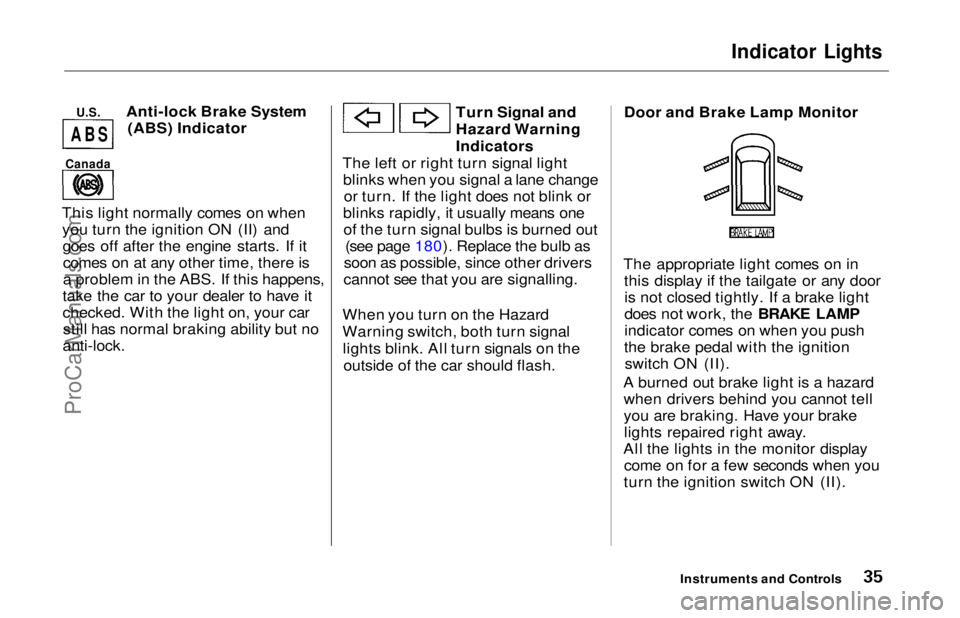
Warning switch, both turn signal lights blink. All turn signals on the outside of the car should flash. Door and Brake Lamp Monitor
The appropriate light comes on in this display if the tailgate or any dooris not closed tightly. If a brake light
does not work, the BRAKE LAMP
indicator comes on when you push
the brake pedal with the ignition switch ON (II).
A burned out brake light is a hazard when drivers behind you cannot tell
you are braking. Have your brakelights repaired right away.
All the lights in the monitor display come on for a few seconds when you
turn the ignition switch ON (II).
Instruments and Controls
Canada
A
B SProCarManuals.comMain Menu Table of Contents s t
Page 66 of 241
Parking Brake
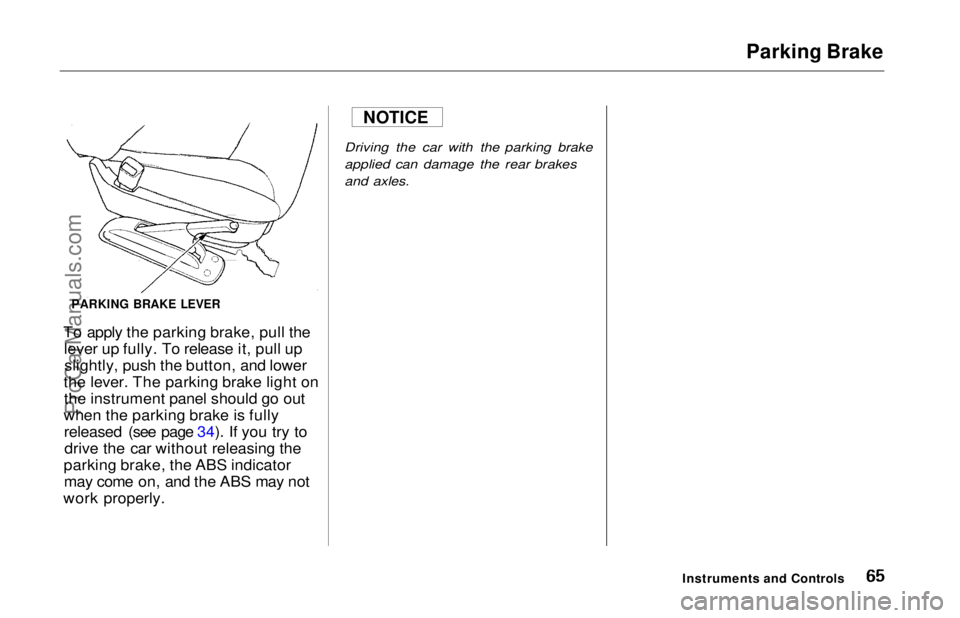
To apply the parking brake, pull the lever up fully. To release it, pull upslightly, push the button, and lower
the lever. The parking brake light on the instrument panel should go out
when the parking brake is fully released (see page 34). If you try todrive the car without releasing the
parking brake, the ABS indicator may come on, and the ABS may not
work properly.
Driving the car with the parking brake
applied can damage the rear brakes
and axles.
Instruments and Controls
PARKING BRAKE LEVER
NOTICEProCarManuals.comMain Menu Table of Contents s t
Page 117 of 241

Driving
This section gives you tips on starting the engine under various
conditions, and how to operate the
automatic transmission. It also
includes important information on
parking your car, the braking system and facts you need if you are plan-
ning to tow a trailer. Preparing to Drive......................... 118
Starting the Engine........................ 119
Starting in Cold Weatherat High Altitude ..................... 119
Automatic Transmission............... 120 Shift Lever Position Indicator.. 120
Shift Lever Positions................. 120
Maximum Speeds...................... 123
Shift Lock Release..................... 123
Parking............................................ 124
The Braking System...................... 124 Brake Wear Indicators.............. 125
Brake System Design................ 125
Anti-lock Brakes........................ 126 Important Safety Reminders.... 127
ABS Indicator............................. 127
Driving in Bad Weather................ 128
Towing a Trailer............................ 130
DrivingProCarManuals.comMain Menu s t
Page 124 of 241
Parking
Always use the parking brake when
you park your vehicle. The indicator on the instrument panel shows that
the parking brake is not fully released; it does not indicate that the
parking brake is firmly set. Make sure the parking brake is set firmly
or your vehicle may roll if it is
parked on an incline.
Set the parking brake before you put
the transmission in Park. This keeps
the vehicle from moving and putting
pressure on the parking mechanism
in the transmission — making it easier to move the shift lever out of
Park when you want to drive away. If the vehicle is facing uphill, turn
the front wheels away from the curb.
If the vehicle is facing downhill, turn
the front wheels toward the curb.
Make sure the parking brake is fully
released before driving away.
Driving with the parking brake
partially set can overheat or damage the rear brakes, and will cause the
ABS indicator to light. Parking Tips
Make sure the sunroof and the
windows are closed.
Turn off the lights. Place any packages, valuables, etc.,
in the cargo area or take them
with you.
Lock the doors with the key or the
remote transmitter.
Never park over dry leaves, tall
grass, or other flammable
materials. The three way catalytic
converter gets very hot, and could
cause these materials to catch on
fire.
DrivingProCarManuals.comMain Menu Table of Contents s t
Page 126 of 241
The Braking System
If this happens, you will immediately
notice that the brake pedal goes
down much farther and you need to
press on it much harder. A much
longer distance will be needed to stop the car.
Slow the car by downshifting to a
lower gear and removing your foot
from the accelerator pedal. Pull to the side of the road as soon as it issafe. Because of the longer stopping
distance needed, brake system
failure is very hazardous. You should
have your car towed, but if you must drive the car in this condition, be
extremely cautious. Have your car
repaired as soon as possible.
Anti-lock Brakes
Your vehicle has an Anti-lock BrakeSystem (ABS).
ABS helps to prevent the wheels from locking up and skidding during
hard braking, allowing you to retainsteering control.
When the front tires skid, you lose steering control; the car continues
straight ahead even though you turn
the steering wheel. The ABS helps to
prevent lock-up and retain steering
control by pumping the brakes
rapidly; much faster than a person
can do it. You should never pump the
brake pedal, this defeats the purpose of the ABS. Let the ABS
work for you by always keeping firm, steady pressure on the brake pedal
as you steer away from the hazard.
This is sometimes referred to as
"stomp and steer."
You will feel a pulsation in the brake pedal when the ABS activates, and
you may hear some noise. This is normal, it is the ABS rapidly
pumping the brakes.
Activation varies with the amount of traction your tires have. On drypavement, you will need to press on
the brake pedal very hard before you
activate the ABS. However, you may
feel the ABS activate immediately if
you are trying to stop on snow or ice.
DrivingProCarManuals.comMain Menu Table of Contents s t
Page 127 of 241
The Braking System
Important Safety Reminders
ABS does not reduce the time or distance it takes to stop the car, it
only helps with steering control
during braking. You should always
maintain a safe following distance
from other vehicles.
ABS will not prevent a skid that results from changing direction
abruptly, such as trying to take a
corner too fast or making a sudden
lane change. Always drive at a safe,
prudent speed for the road and
weather conditions.
ABS cannot prevent a loss of stability. Always steer moderately
when you are braking hard. Severe or sharp steering wheel movement
can still cause your vehicle to veer
into oncoming traffic or off the road. A vehicle with ABS may require a
longer distance to stop on loose or
uneven surfaces, such as gravel orsnow, than a vehicle without anti-
lock. Slow down and allow a greater distance between vehicles under
those conditions.
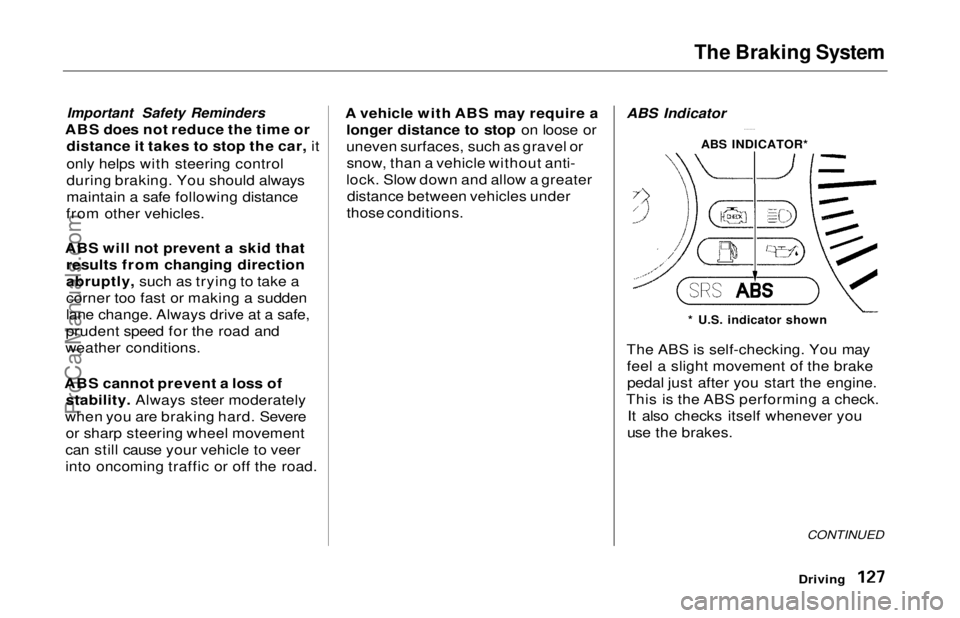
ABS Indicator
The ABS is self-checking. You may
feel a slight movement of the brakepedal just after you start the engine.
This is the ABS performing a check. It also checks itself whenever you
use the brakes.
Driving
ABS INDICATOR*
* U.S. indicator shown
CONTINUEDProCarManuals.comMain Menu Table of Contents s t
Page 128 of 241
The Braking System, Driving in Bad Weather
If anything goes wrong, the ABS
indicator on the instrument panel
comes on (see page 35). This means
the anti-lock function of the braking
system has shut down. The brakes
still work like a conventional system
without anti-lock, providing normal stopping ability. You should have the
dealer inspect your vehicle as soon
as possible if this light stays on after
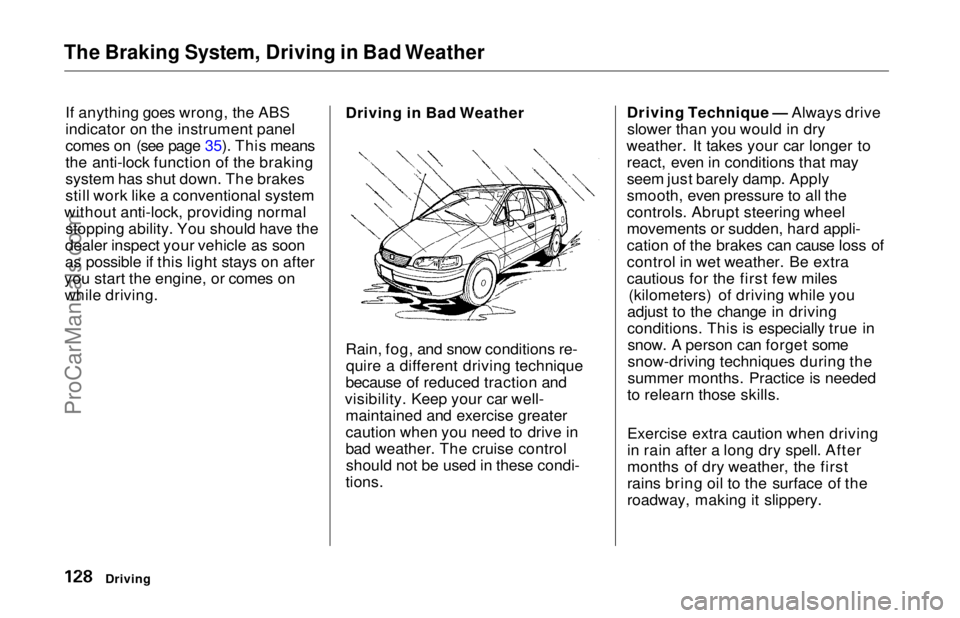
you start the engine, or comes on while driving. Driving in Bad Weather
Rain, fog, and snow conditions re-
quire a different driving technique
because of reduced traction and
visibility. Keep your car well- maintained and exercise greater
caution when you need to drive in
bad weather. The cruise controlshould not be used in these condi-
tions. Driving Technique — Always drive
slower than you would in dry
weather. It takes your car longer to react, even in conditions that may
seem just barely damp. Apply
smooth, even pressure to all the
controls. Abrupt steering wheel
movements or sudden, hard appli-
cation of the brakes can cause loss of
control in wet weather. Be extra
cautious for the first few miles (kilometers) of driving while you
adjust to the change in driving
conditions. This is especially true in snow. A person can forget some
snow-driving techniques during the
summer months. Practice is needed
to relearn those skills.
Exercise extra caution when driving
in rain after a long dry spell. After
months of dry weather, the first
rains bring oil to the surface of the
roadway, making it slippery.
DrivingProCarManuals.comMain Menu Table of Contents s t
Page 157 of 241
Brake Fluid
Check the fluid level in the reser-
voirs monthly. There are two reser-
voirs. They are:
Brake fluid reservoir
ABS reservoir
The brake fluid in the brake and anti- lock brake systems should be
replaced according to the time anddistance recommendations in the
maintenance schedule. Always use Genuine Honda DOT 3
brake fluid. If it is not available, youshould use only DOT 3 or DOT 4
fluid, from a sealed container, as a temporary replacement. However,
the use of any non-Honda brake fluid can cause corrosion and decrease
the life of the system. Have the
brake fluid replaced with Honda DOT 3 brake fluid as soon as
possible.
Brake fluid marked DOT 5 is not
compatible with your car's brakingsystem and can cause extensive
damage.
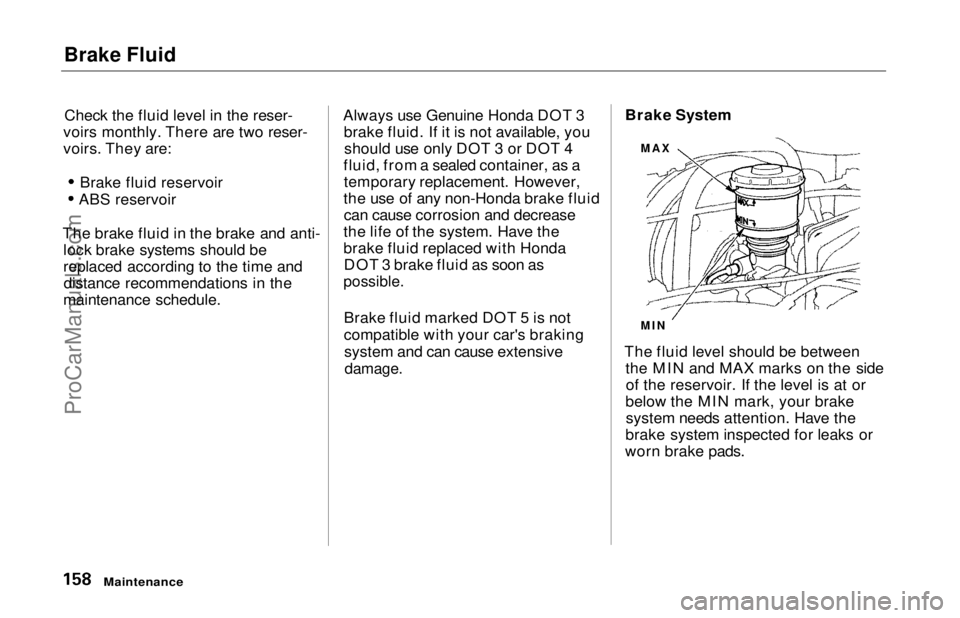
Brake System
The fluid level should be between the MIN and MAX marks on the sideof the reservoir. If the level is at or
below the MIN mark, your brake system needs attention. Have the
brake system inspected for leaks or
worn brake pads.
Maintenance
MAX
MINProCarManuals.comMain Menu Table of Contents s t