door lock HONDA ODYSSEY 1997 Owners Manual
[x] Cancel search | Manufacturer: HONDA, Model Year: 1997, Model line: ODYSSEY, Model: HONDA ODYSSEY 1997Pages: 241, PDF Size: 2.52 MB
Page 4 of 241
Driver and Passenger Safety
This section gives you important
information about occupant protec-
tion. It shows how to use seat belts
properly. It explains the Supple-
mental Restraint System. And it
gives useful information about how
to protect infants and children in
your car.
Your Occupant Protection System.. 4
The Seat Belt System
and How It Works...................... 5
Why Wear Seat Belts.................... 5
Important Safety Reminders........ 5
Seat Belt System Components..... 6
Lap/Shoulder Belt......................... 6
Lap Belt........................................... 7
Wearing Seat Belts Properly........ 7
Wearing a Lap/Shoulder Belt...... 7
Wearing the Lap Belt.................... 9
Advice for Pregnant Women...... 10
Seat Belt Maintenance................ 11
Supplemental Restraint System..... 12
SRS Components......................... 12
What Happens In a Crash........... 12
Important Facts About
Airbags...................................... 13
How the Driver's Airbag Works........................................ 14
How the Passenger's Airbag Works........................................ 15
How the SRS Indicator Light Works........................................ 16
System Service............................. 16
System Service Precautions....... 17
Additional Safety Information........ 18
Seat-back Position........................ 18
Head Restraint Position.............. 18
Door Locks................................... 19 Storing Cargo Safely................... 19
Driving with Pets......................... 19
Child Safety...................................... 20 Where Should Children Sit?....... 20Important Safety Reminders...... 21
General Guidelines for Restraining Children Under 40 Ibs (18 kg) ............... 22
Restraining
an Infant Who WeighsLess Than 20 Ibs (9 kg).......... 22
Restraining
a Child Who Weighs Between 20 and 40 Ibs (9 and 18 kg)..... 23
Restraining a Child Who Weighs Over 40 Ibs (18 kg).................. 24
Securing a Child Seat with a Lap/Shoulder Belt................... 25
Using Child Restraints with Tethers............................. 26
Storing a Child Seat..................... 27
Alcohol and Drugs........................... 28 Carbon Monoxide Hazard.............. 29
Safety Labels.................................... 30
Driver and Passenger SafetyProCarManuals.comMain Menu s t
Page 5 of 241
Your Occupant Protection System
Your Honda is equipped with seat
belts and other features that work
together to protect you and your
passengers during a crash.
Seat belts are the most important
part of your occupant protection system. When worn properly, seat
belts can reduce the chance of serious injury or death in a crash.
For added protection during a severe
frontal collision, your Odyssey has a Supplemental Restraint System (SRS) with airbags for the driver and
a front seat passenger. Two indicator lights are also part of
your safety system. One reminds youto make sure you and your passen-
gers wear seat belts. The otheralerts you to a possible problem with
your supplemental restraint system (see page 16).
The seats, head restraints and door locks also play a role in occupantsafety. For example, reclining the
seat-back can decrease the effec-
tiveness of your seat belt. Head restraints can help protect your neckand head, especially during rear-end
impacts. Door locks help keep your doors from being accidentally
opened during a crash. To get the maximum protection from
your occupant protection system, check the following before you drive
away:
Everyone in the car is wearing a
seat belt properly (see page 7). Infants and small children are
properly secured in child safety seats (see page 20). All doors and the tailgate are
closed and locked (see page 19). Seat-backs are upright and head
restraints are properly adjusted (see pages 18 and 55). There are no loose items that
could be thrown around and hurtsomeone during a crash or sudden
stop (see page 19).
By following these guidelines, you
can reduce injuries to yourself and
your passengers in many crash situations. Remember, however, that
no safety system can prevent all
injuries or deaths that can occur in severe crashes.
Driver and Passenger SafetyProCarManuals.comMain Menu Table of Contents s t
Page 19 of 241
Additional Safety Information
The seat belts and airbags are obvi-ously important parts of your occu-
pant protection system.
In addition, you should know thatsitting upright, adjusting the head
restraints properly, locking the doors, and stowing things properly can also
increase your safety and possibly even save your life. Seat-back Position
The seat-backs should be in an upright position for you and your
passengers to get the most protec-
tion from the seat belts.
If you recline a seat-back, you reduce
the protective capability of your seat belt. The farther a seat-back is
reclined, the greater the risk that
you will slide under the belt in a severe crash and be very seriously
injured.
For information on how to adjust the
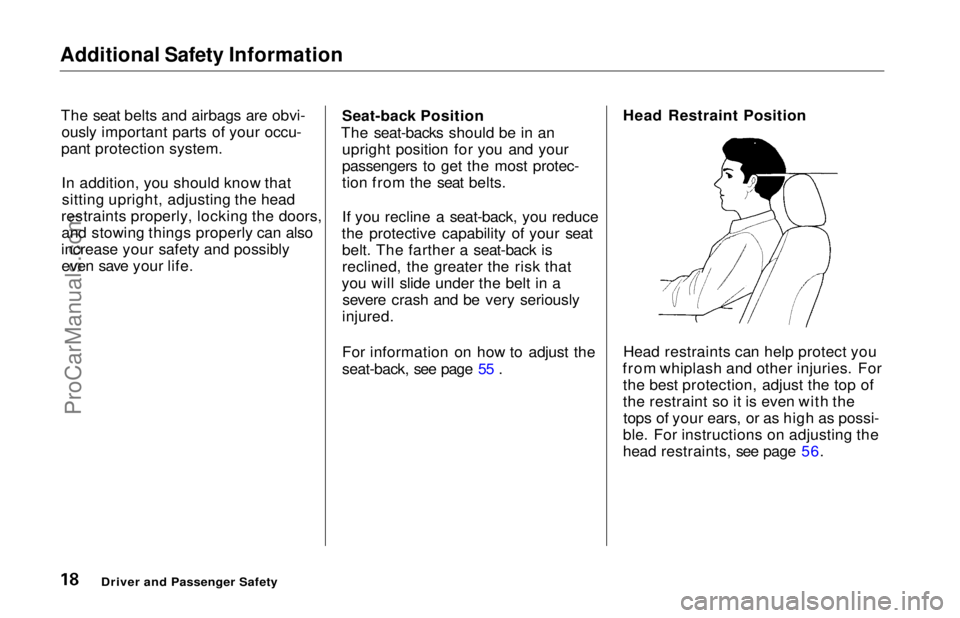
seat-back, see page 55 . Head Restraint Position
Head restraints can help protect you
from whiplash and other injuries. For the best protection, adjust the top of
the restraint so it is even with thetops of your ears, or as high as possi-
ble. For instructions on adjusting the
head restraints, see page 56.
Driver and Passenger SafetyProCarManuals.comMain Menu Table of Contents s t
Page 20 of 241
Additional Safety Information
Door Locks
It is not safe to leave your car doors
unlocked. A passenger, especially a
child, could open a door and acci- dentally fall out. Also, there is a
greater chance of being thrown out of the car during a crash when the
doors are not locked.
Storing Cargo Safely
Before you drive, make sure you
first securely store or tie down any
items that could be thrown around
the car and hurt someone, or
interfere with your ability to operate
the controls.
Be sure to keep compartment doors
closed when the car is moving. If a
front passenger hits the door of an open glove box, for example, he
could injure his knees.
For information on loading cargo,
see page 116. Driving with Pets
Loose pets can be a hazard while you
are driving. An unrestrained pet can
interfere with your ability to drive
the car. In a crash or sudden stop, loose pets or cages can be thrownaround inside the car and hurt you or
your passengers. It is also for their safety that pets should be properly
restrained in your car.
The recommended way to restrain a medium-sized or larger dog is with aspecial traveling harness. This har-
ness can be secured to the rear seat
with a seat belt. Travel harnesses are available at pet stores.
A small dog, cat, or other small animal will be safest in a pet carrier
with rigid sides. Choose a style that allows you to secure it to the car's
seat by routing a seat belt through
the carrier's handle. For further information, contact your
veterinarian or local animal protec- tion society.
Driver and Passenger SafetyProCarManuals.comMain Menu Table of Contents s t
Page 22 of 241
Child Safety
If a toddler seat is used in the front
passenger's seat, the vehicle seat should be moved as far back as
possible. If the passenger's bag
inflates, it could seriously hurt a
toddler who is not in the proper
position or properly restrained.
We also recommend that any child who is too large to use an infant or
toddler seat ride in the second or
third seat and wear a lap/shoulder
belt properly for protection. If thechild is not large enough to wear the
lap/shoulder belt properly, you should use a booster seat. Important Safety Reminders
Never hold a baby or child on your
lap when riding in a car. If you are
wearing your seat belt, the violent
forces created during a crash will tear the child from your arms. The
child could be seriously hurt or killed.
If you are holding a child and not
wearing a seat belt in a crash, you could crush the child against the car's
interior.
Never put your seat belt over
yourself and a child. During a crash, the belt could press deep into thechild, causing serious internal
injuries.
Two children should never use the
same seat belt. If they do, they could
be very seriously injured in a crash.
If you are driving with small children
in the car, you should use the
childproof door locks to prevent
them from opening the rear doors (see page 52).
For their safety, do not leave
children alone in your car without adult supervision.
Driver and Passenger SafetyProCarManuals.comMain Menu Table of Contents s t
Page 26 of 241
Child Safety
Securing a Child Seat with a Lap/
Shoulder Belt
The lap/shoulder belt retractors in the passenger seating positions have
a built-in locking mechanism in-
tended to secure a child seat. When
you are placing a child seat in one of these outside seating positions, do
the following: 1. Place the child seat in the desired
seating position. Route the lap/
shoulder belt through the seat
according to the seat manufac-
turer's instructions.
2. Insert the latch plate into the buckle. Make sure it is fully
latched.
3. Slowly pull the shoulder portion of the belt out of the retractor until it
stops.
4. Allow the belt to slowly feed back into the retractor. You should heara clicking noise that indicates the
locking mechanism has engaged.
5. After the belt has retracted fully, pull up on the shoulder portion to
remove any slack.
6. Push and pull on the child seat to
verify that it is held firmly in place.If not, unlatch the seat belt, allow
it to retract fully, and repeat these
steps.
To unlatch the seat belt, push the red PRESS button on the buckle.Guide the belt across to the door
pillar. If the belt doesn't retract easily, pull it out and check for twistsor kinks.
Driver and Passenger SafetyProCarManuals.comMain Menu Table of Contents s t
Page 32 of 241
Instruments and Controls
This section gives information about the controls and displays thatcontribute to the daily operation of
your Honda. All the essential controls are within easy reach.
Control Locations............................ 32
Indicator Lights................................ 33 Gauges.............................................. 37
Speedometer................................ 37
Trip Meter.................................... 37
Odometer...................................... 37
Temperature Gauge.................... 38 Fuel Gauge................................... 38
Maintenance Required Indicator.................................... 38
Controls Near the Steering
Wheel........................................ 39
Headlights.................................... 40
Daytime Running Lights............. 40
Instrument Panel Brightness..... 41
Turn Signals................................. 41
Windshield Wipers...................... 42
Windshield Washers................... 43 Rear Window Wiper and Washer......................................
43
Hazard Warning...........................
43
Rear Window Defogger.............. 44
Steering Wheel Adjustment....... 44
Steering Wheel Controls ................ 46 Cruise Control.............................. 46
Keys and Locks................................ 49
Keys...............................................49
Ignition Switch............................. 49
Power Door Locks....................... 50
Remote Transmitter....................
51
Childproof Door
Locks............... 52
Tailgate......................................... 52 Glove Box..................................... 53
Seats.................................................. 54
Passenger Seating....................... 54
Seat Adjustments......................... 54
Driver's Seat Power Height Adjustment............................... 55
Head Restraints........................... 56
Third Seat Access........................ 56
Removing the Second Seats
in the Six-Passenger Model.... 57
Folding the Second Seats in the Seven-PassengerModel.................................... 58
Reclining the Second Seat.......... 59
Folding the Third Seat in All Models............................ 60
Power Windows............................... 62
Sunroof.............................................. 63
Mirrors.............................................. 64
Adjusting the Power Mirrors..... 64
Parking Brake.................................. 65
Digital Clock..................................... 66
Beverage Holder.............................. 66
Dashboard Compartment............... 68
Center Pocket.................................. 68
Vanity Mirror................................... 68
Cigarette Lighter............................. 69
Ashtrays............................................ 69
Interior Lights.................................. 70
Ceiling Lights............................... 70
Spotlights...................................... 70
Tailgate Light............................... 71
Courtesy Lights........................... 71
Instruments and ControlsProCarManuals.comMain Menu s t
Page 33 of 241
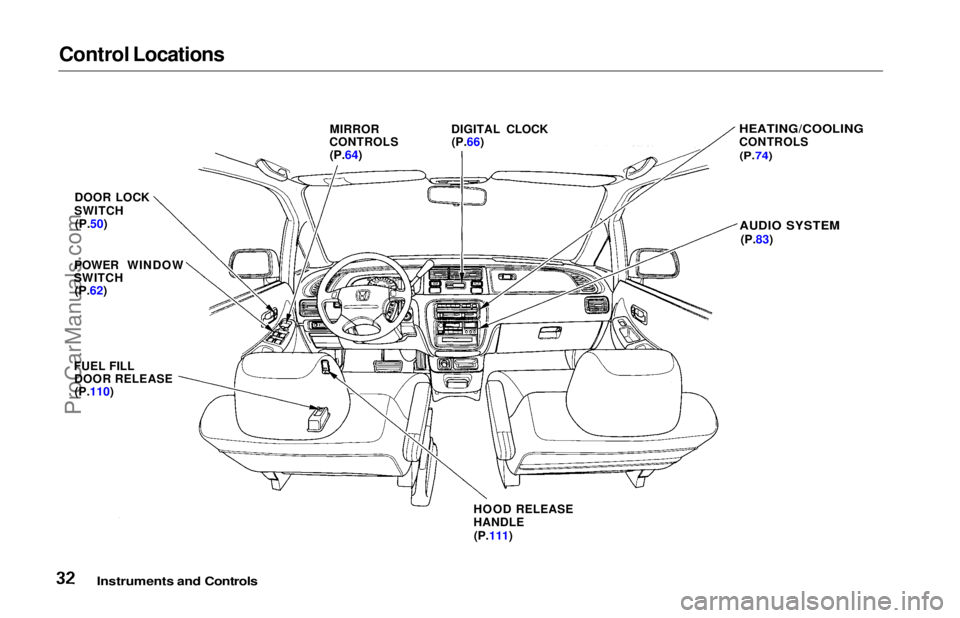
Control Locations
Instruments and Controls
MIRROR
CONTROLS
(P.64)
DIGITAL CLOCK
(P.66)
HEATING/COOLING
CONTROLS
(P.74)
AUDIO SYSTEM
(P.83)
DOOR LOCK
SWITCH (P.50)
POWER WINDOW
SWITCH
(P.62)
FUEL FILL DOOR RELEASE(P.110)
HOOD RELEASE
HANDLE(P.111)ProCarManuals.comMain Menu Table of Contents s t
Page 34 of 241
Indicator Lights
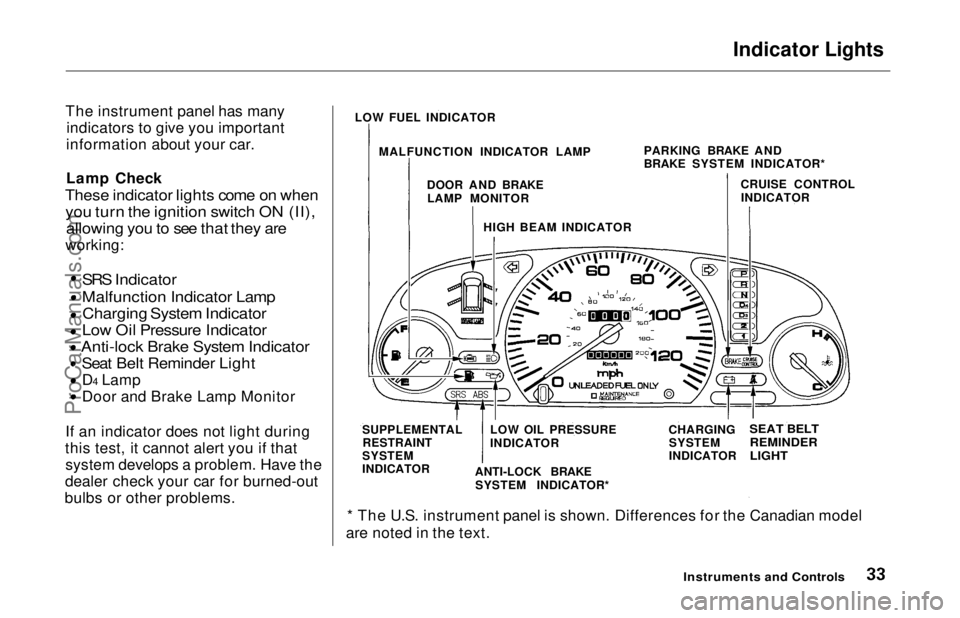
The instrument panel has many indicators to give you important
information about your car.
Lamp Check
These indicator lights come on when
you turn the ignition switch ON (II),
allowing you to see that they are
working:
SRS Indicator
Malfunction Indicator Lamp
Charging System Indicator
Low Oil Pressure Indicator
Anti-lock Brake System Indicator
Seat Belt Reminder Light
D4 Lamp
Door and Brake Lamp Monitor
If an indicator does not light during
this test, it cannot alert you if that system develops a problem. Have the
dealer check your car for burned-out
bulbs or other problems.
* The U.S. instrument panel is shown. Differences for the Canadian model
are noted in the text.
Instruments and Controls
LOW FUEL INDICATOR
MALFUNCTION INDICATOR LAMP DOOR AND BRAKELAMP MONITOR
HIGH BEAM INDICATOR PARKING BRAKE AND
BRAKE SYSTEM INDICATOR*
CRUISE CONTROLINDICATOR
SUPPLEMENTAL RESTRAINT
SYSTEM
INDICATOR LOW OIL PRESSURE
INDICATOR
ANTI-LOCK BRAKE SYSTEM INDICATOR* CHARGING
SYSTEM
INDICATOR
SEAT BELT
REMINDER
LIGHTProCarManuals.comMain Menu Table of Contents s t
Page 36 of 241
Indicator Lights
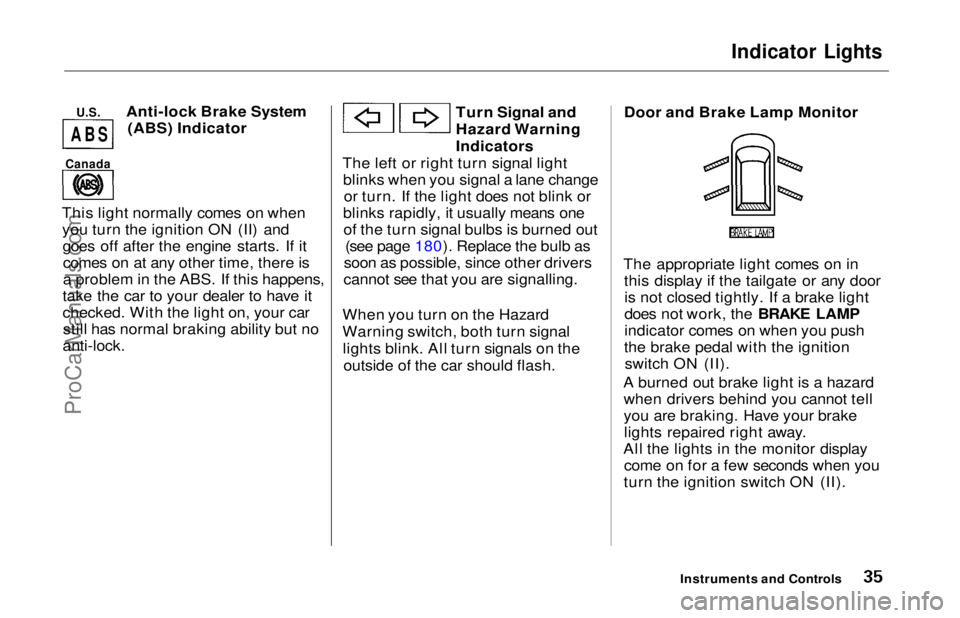
U.S.
Anti-lock Brake System
(ABS) Indicator
This light normally comes on when you turn the ignition ON (II) andgoes off after the engine starts. If itcomes on at any other time, there is
a problem in the ABS. If this happens,
take the car to your dealer to have it
checked. With the light on, your car still has normal braking ability but no
anti-lock.
Turn Signal and
Hazard Warning
Indicators
The left or right turn signal light blinks when you signal a lane changeor turn. If the light does not blink or
blinks rapidly, it usually means one of the turn signal bulbs is burned out (see page 180). Replace the bulb as
soon as possible, since other drivers
cannot see that you are signalling.
When you turn on the Hazard
Warning switch, both turn signal lights blink. All turn signals on the outside of the car should flash. Door and Brake Lamp Monitor
The appropriate light comes on in this display if the tailgate or any dooris not closed tightly. If a brake light
does not work, the BRAKE LAMP
indicator comes on when you push
the brake pedal with the ignition switch ON (II).
A burned out brake light is a hazard when drivers behind you cannot tell
you are braking. Have your brakelights repaired right away.
All the lights in the monitor display come on for a few seconds when you
turn the ignition switch ON (II).
Instruments and Controls
Canada
A
B SProCarManuals.comMain Menu Table of Contents s t