tire type HONDA ODYSSEY 1997 Owners Manual
[x] Cancel search | Manufacturer: HONDA, Model Year: 1997, Model line: ODYSSEY, Model: HONDA ODYSSEY 1997Pages: 241, PDF Size: 2.52 MB
Page 170 of 241

Tires
To safely operate your car, your tires must be the proper type and size, in
good condition with adequate tread, and correctly inflated. The following
pages give more detailed information on how and when to check air
pressure, how to inspect your tires
for damage and wear, and what to do
when your tires need to be replaced. Inflation
Keeping the tires properly inflated
provides the best combination of
handling, tread life and riding
comfort. Underinflated tires wear
unevenly, adversely affect handling
and fuel economy, and are more
likely to fail from being overheated. Overinflated tires can make your car
ride more harshly, are more prone to damage from road hazards, and wear
unevenly.
We recommend that you visually check your tires every day. If you
think a tire might be low, check it immediately with a tire gauge. Use a gauge to measure the air
pressure at least once a month. Even
tires that are in good condition may
lose one to two psi per month. Remember to check the spare tire at
the same time you check all the other tires.
Check the pressure in the tires when
they are cold. This means the car
has been parked for at least three
hours. If you have to drive the car
before checking the tire pressure,
the tires can still be considered "cold" if you drive less than 1 mile (1.6 km).
CONTINUED
Maintenance
Using tires that are excessively
worn or improperly inflated can
cause a crash in which you can be seriously hurt or killed.
Follow all instructions in this
owner's manual regarding tire
inflation and maintenance.ProCarManuals.comMain Menu Table of Contents s t
Page 174 of 241

Tires
It is best to replace all four tires at
the same time. If that is not possible
or necessary, then replace the two
front tires or the two rear tires as a
pair. Replacing just one tire can seriously affect your car's handling.
The ABS works by comparing the speed of the wheels. When replacing
tires, use the same size originally supplied with the car. Tire size and
construction can affect wheel speed
and may cause the system to work in-
consistently. If you ever need to replace a wheel,
make sure the wheel's specifications
match those of the original wheel
that came on your car. Replacement
wheels are available at your Honda
dealer.
Wheels and Tires Wheel: 15 x 6 JJ
Tire:
P205/65R15 92S
See Tire Information on page 222 for
additional information about tire and
wheel size designations. See page 223 for information about DOT Tire
Quality Grading.
Winter Driving
Tires that are marked "M + S" or "All Season" on the sidewall have an
all-weather tread design. They
should be suitable for most winterdriving conditions. Tires without
these markings are designed for optimum traction in dry conditions.
They may not provide adequate performance in winter driving.
For the best performance in snowyor icy conditions, you should install
snow tires or tire chains. They may
be required by local laws under certain conditions.
CONTINUED
Maintenance
Installing improper tires on your
car can affect handling and
stability. This can cause a crash in which you can be seriously
hurt or killed.
Always use the size and type of
tires recommended in this owner's manual.ProCarManuals.comMain Menu Table of Contents s t
Page 175 of 241
Tires
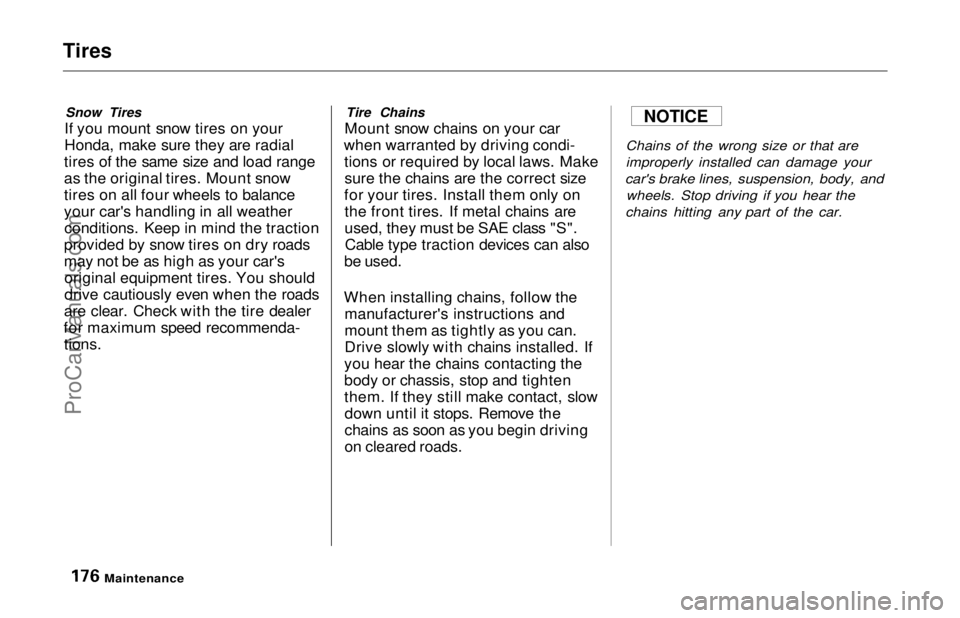
Snow Tires
If you mount snow tires on your
Honda, make sure they are radial
tires of the same size and load range
as the original tires. Mount snow
tires on all four wheels to balance
your car's handling in all weather conditions. Keep in mind the traction
provided by snow tires on dry roads
may not be as high as your car's original equipment tires. You should
drive cautiously even when the roads
are clear. Check with the tire dealer
for maximum speed recommenda- tions. Tire Chains
Mount snow chains on your car
when warranted by driving condi- tions or required by local laws. Makesure the chains are the correct size
for your tires. Install them only on the front tires. If metal chains are
used, they must be SAE class "S".Cable type traction devices can also
be used.
When installing chains, follow the manufacturer's instructions and
mount them as tightly as you can.
Drive slowly with chains installed. If
you hear the chains contacting the
body or chassis, stop and tighten
them. If they still make contact, slow down until it stops. Remove the
chains as soon as you begin driving
on cleared roads.
Chains of the wrong size or that are
improperly installed can damage your
car's brake lines, suspension, body, and
wheels. Stop driving if you hear the
chains hitting any part of the car.
Maintenance
NOTICEProCarManuals.comMain Menu Table of Contents s t
Page 213 of 241
Towing
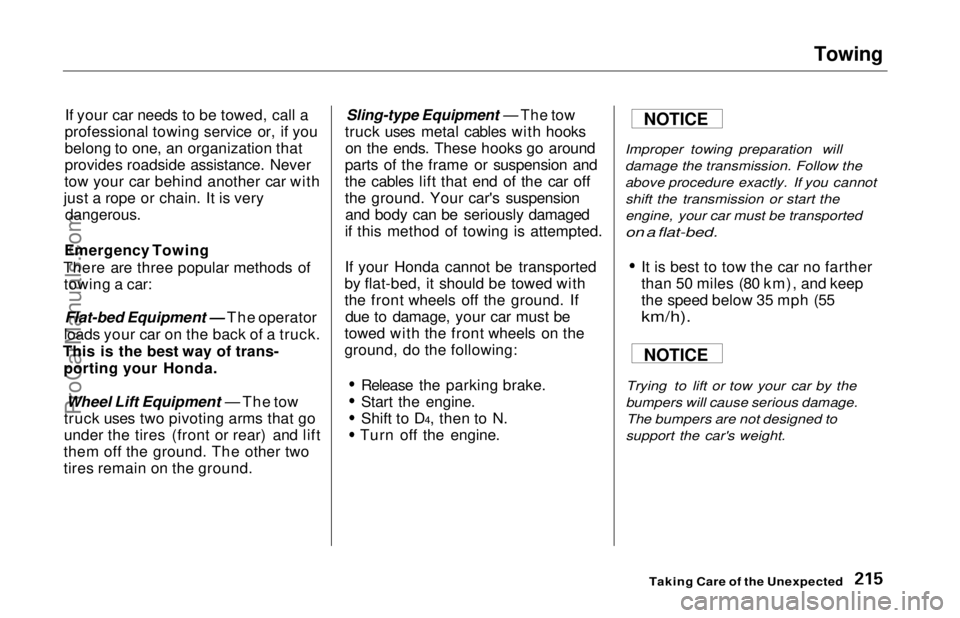
If your car needs to be towed, call a
professional towing service or, if you
belong to one, an organization that
provides roadside assistance. Never
tow your car behind another car with
just a rope or chain. It is very
dangerous.
Emergency Towing
There are three popular methods of towing a car:
Flat-bed Equipment — The operator
loads your car on the back of a truck.
This is the best way of trans- porting your Honda.
Wheel Lift Equipment — The tow
truck uses two pivoting arms that go
under the tires (front or rear) and lift
them off the ground. The other two
tires remain on the ground.
Sling-type Equipment — The tow
truck uses metal cables with hooks on the ends. These hooks go around
parts of the frame or suspension and
the cables lift that end of the car off
the ground. Your car's suspension and body can be seriously damaged
if this method of towing is attempted.
If your Honda cannot be transported
by flat-bed, it should be towed with
the front wheels off the ground. If due to damage, your car must be
towed with the front wheels on the
ground, do the following:
Release the parking brake.
Start the engine.
Shift to D4, then to N.
Turn off the engine.
Improper towing preparation will
damage the transmission. Follow the
above procedure exactly. If you cannot
shift the transmission or start the
engine, your car must be transported
on a flat-bed.
It is best to tow the car no farther
than 50 miles (80 km), and keep
the speed below 35 mph (55
km/h).
Trying to lift or tow your car by the
bumpers will cause serious damage. The bumpers are not designed to
support the car's weight.
Taking Care of the Unexpected
NOTICE
NOTICEProCarManuals.comMain Menu Table of Contents s t
Page 219 of 241
Tire Information
Tire Size Designation
A tire's sidewall is marked with a tire size designation. You will need this
information when selecting replace-
ment tires for your car. The follow-
ing explains what the letters and
numbers in the tire size designation
mean.
(Example tire size designation)
P205/65R15 92S
P —
Applicable vehicle type (tires
marked with the prefix "P" are
intended for use on passenger cars;
however, not all tires have this
marking).
205 —
Tire width in millimeters.
65 —
Aspect ratio. The tire's section
height as a percentage of its width.
R —
Tire construction code (Radial).
15 —
Rim diameter in inches. 92
—
Load Index, a numerical code
associated with the maximum load
the tire can carry.
S —
Speed Rating Symbol. See the
speed rating chart in this section for
additional information.
Wheel Size Designation
Wheels are also marked with important information that you needif you ever have to replace one. The
following explains what the letters and numbers in the wheel size
designation mean.
(Example wheel size designation)
15
x
6
JJ
15 —
Rim diameter in inches.
6 —
Rim width in inches.
JJ —
Rim contour designation.
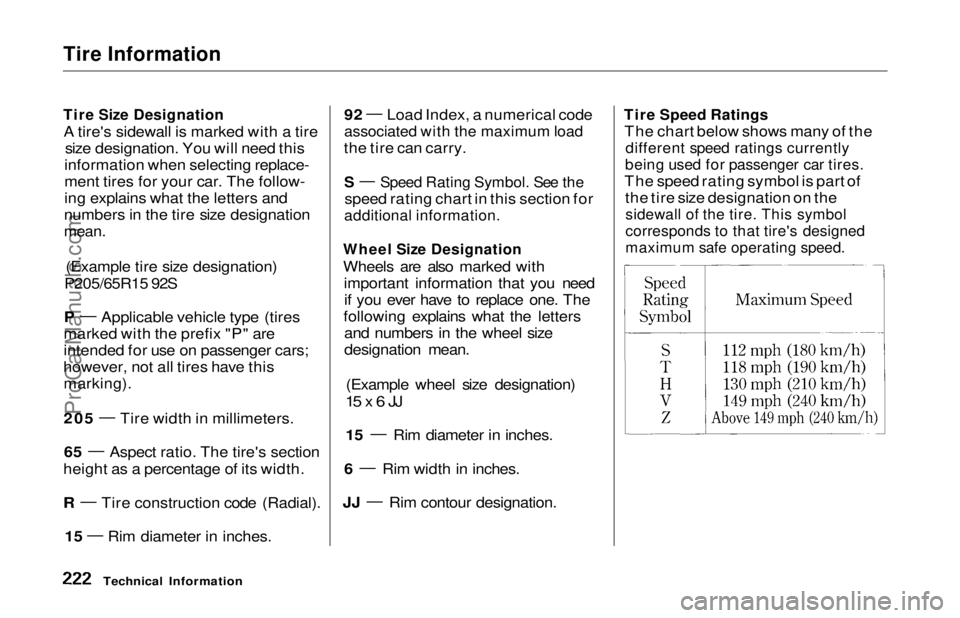
Tire Speed Ratings
The chart below shows many of the
different speed ratings currently
being used for passenger car tires.
The speed rating symbol is part of the tire size designation on the
sidewall of the tire. This symbol
corresponds to that tire's designed
maximum safe operating speed.
Technical InformationProCarManuals.comMain Menu Table of Contents s t
Page 229 of 241

Warranty Coverages
U.S. Owners
Your new Honda is covered by these
warranties:
New Car Limited Warranty — covers
your new car, except for the battery, emissions control systems and
accessories, against defects in
materials and workmanship.
Emissions Control Systems Defects
Warranty and Emissions
Performance Warranty — these two
warranties cover your car's emis- sions control systems. Time, mileage,
and coverage are conditional. Please
read the warranty manual for exact information.
Original Equipment Battery Limited
Warranty — this warranty gives up
to 100 percent credit toward a
replacement battery.
Seat Belt Limited Warranty — a seat
belt that fails to function properly is
covered for the useful life of the car.
Rust Perforation Limited Warranty
— all exterior body panels are
covered for rust-through from the
inside for the specified time period
with no mileage limit.
Accessory Limited Warranty —
Genuine Honda Accessories are
covered under this warranty. Time
and mileage limits depend on the
type of accessory and other factors. Please read your warranty manual
for details.
Replacement Parts Limited
Warranty — covers all Genuine
Honda replacement parts against defects in materials and workman-
ship.
Replacement Battery Limited
Warranty — provides prorated
coverage for a replacement battery
purchased from a Honda dealer.
Replacement Muffler Lifetime
Limited Warranty — provides
coverage for as long as the pur-
chaser of the muffler owns the car.
Restrictions and exclusions apply to
all these warranties. Please read the 1997 Honda Warranties booklet that
came with your car for precise
information on warranty coverages.
Your Honda's original tires are covered by their manufacturer. Tire
warranty information is in a separate
booklet.
Canadian Owners
Please refer to the 1997 Warranty
Manual that came with your car.
Warranty and Customer RelationsProCarManuals.comMain Menu Table of Contents s t
Page 239 of 241
Index
Seats
Folding the Third Seats.............. 60
Head Restraints........................... 56
Passenger Seating....................... 54
Reclining the Second Seat.......... 59
Removing the Second Seats....... 57
Third Seat Access........................ 56
Serial Number................................ 218
Service Intervals*.......................... 142
Service Manual.............................. 235
Service Station Procedures .......... 110
Setting the Clock............................. 66
Shifting the Automatic
Transmission.............................. 120
Shift Lever Position Indicator...... 120
Shift Lever Positions..................... 120
Side Marker Lights, Bulb
Replacement in.......................... 180
Signaling Turns................................ 41
Snow Tires...................................... 176
Solvent-type Cleaners.................... 186
Sound System................................... 83
Spare Tire
Inflating....................................... 194
Specifications............................. 221
Spark Plugs, Replacing................. 162 Specifications Charts..................... 220
Speed Control................................... 46
Speedometer.................................... 37
SRS Indicator.............................. 16, 34
START (Ignition Key Position)..... 50
Starting the Engine........................ 119 In Cold Weather at HighAltitude................................... 119
With a Dead Battery................. 202
Steam Coming from Engine......... 204
Steering Wheel
Adjustment................................... 44
Anti-theft Column Lock.............. 49
Stereo Sound System...................... 83
Storing Your Car............................ 184
Sunroof.............................................. 63
Closing Manually....................... 209
Operation...................................... 63
Supplemental Restraint System Service Precautions..................... 17
Servicing....................................... 16
SRS Indicator.......................... 16, 34
System Components.................... 12
Synthetic Oil................................... 149 Tailgate............................................. 52
Taillights, Changing Bulbs in....... 181
Taking Care of the Unexpected .. 193
Tape Player................................. 87, 99
Technical Descriptions Emission Control Systems........ 225
Three Way Catalytic Converter................................ 227
Tire Information........................ 222
Temperature Gauge........................ 38
Tether Attachment Points.............. 26 Three Way Catalytic Converter... 227
Time, Setting the............................. 66
Timing Belt..................................... 170
Tire Chains..................................... 176
Tire, How to Change a Flat.......... 195
Tires................................................ 171 Air Pressure............................... 171
Checking Wear.......................... 173
Compact Spare........................... 194
DOT Tire Quality Grading....... 223
Inflation....................................... 171
CONTINUEDProCarManuals.comMain Menu s t