engine oil HONDA ODYSSEY 1998 User Guide
[x] Cancel search | Manufacturer: HONDA, Model Year: 1998, Model line: ODYSSEY, Model: HONDA ODYSSEY 1998Pages: 272, PDF Size: 2.67 MB
Page 173 of 272
Engine Oil
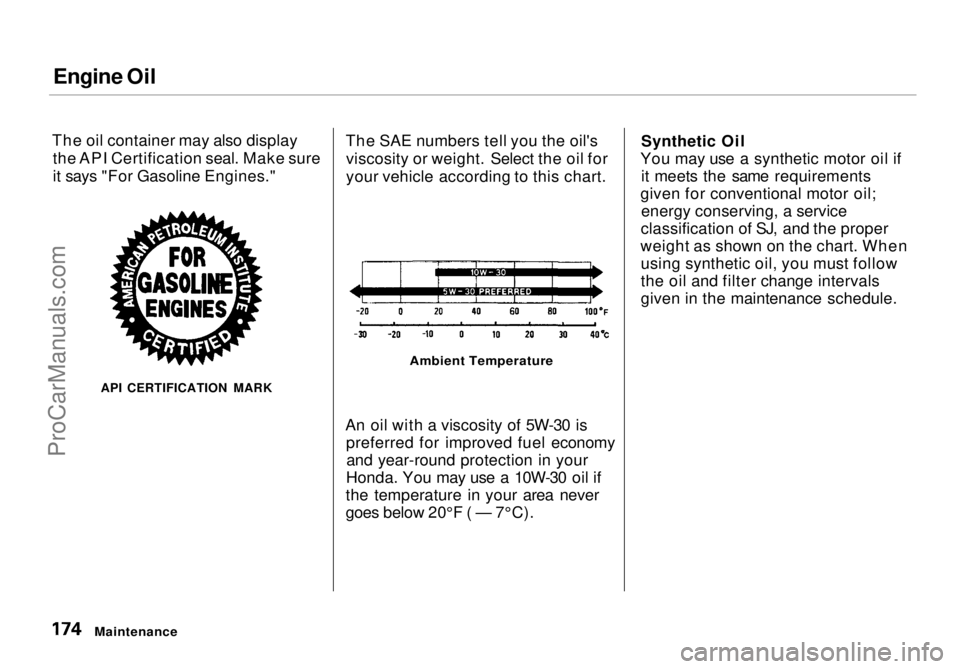
The oil container may also display the API Certification seal. Make sure
it says "For Gasoline Engines."
API CERTIFICATION MARK The SAE numbers tell you the oil's
viscosity or weight. Select the oil for
your vehicle according to this chart.
An oil with a viscosity of 5W-30 is preferred for improved fuel economyand year-round protection in your
Honda. You may use a 10W-30 oil if
the temperature in your area never
goes below 20°F ( — 7°C). Synthetic Oil
You may use a synthetic motor oil if it meets the same requirements
given for conventional motor oil; energy conserving, a service
classification of SJ, and the proper
weight as shown on the chart. When using synthetic oil, you must follow
the oil and filter change intervals
given in the maintenance schedule.
Maintenance
Ambient TemperatureProCarManuals.comMain Menu Table of Contents s t
Page 174 of 272
Engine Oil
Additives Your Honda does not need any oil
additives. Purchasing additives for
the engine or transmission will not
increase your vehicle's performance
or longevity. It only increases the
cost of operating your vehicle. Changing the Oil and Filter
Always change the oil and filter according to the time and distance (miles/kilometers) recommenda-
tions in the maintenance schedule.
The oil and filter collect contami- nants that can damage your engine if
they are not removed regularly.
Changing the oil and filter requires
special tools and access from
underneath the vehicle. The vehicle should be raised on a service station-
type hydraulic lift for this service. Unless you have the knowledge and
proper equipment, you should have
this maintenance done by a skilled
mechanic.
1. Run the engine until it reaches normal operating temperature,
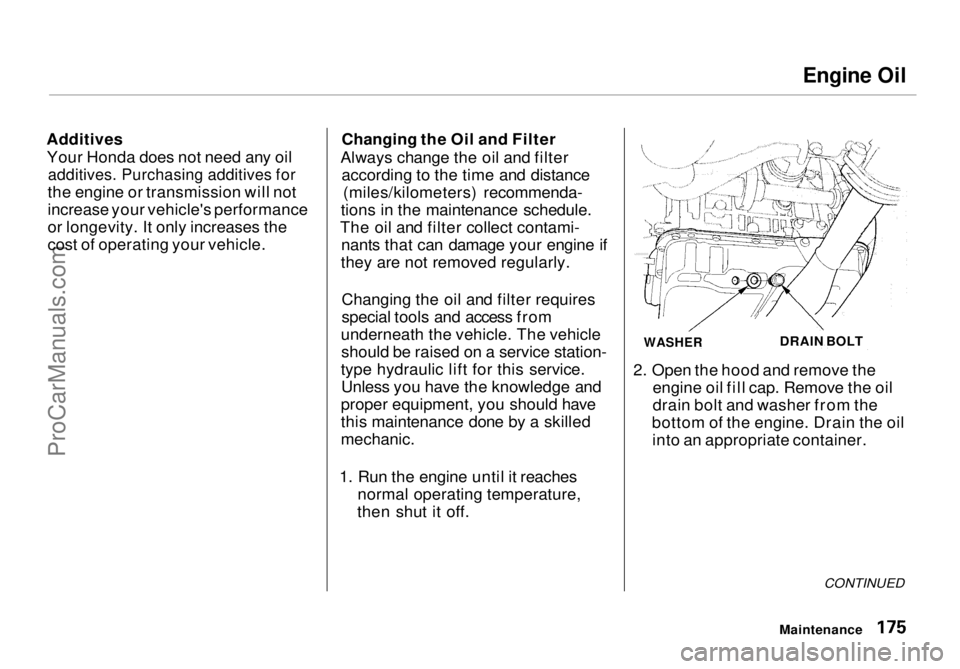
then shut it off. 2. Open the hood and remove the
engine oil fill cap. Remove the oil
drain bolt and washer from the
bottom of the engine. Drain the oil into an appropriate container.
CONTINUED
Maintenance
WASHER
DRAIN BOLTProCarManuals.comMain Menu Table of Contents s t
Page 175 of 272
Engine Oil
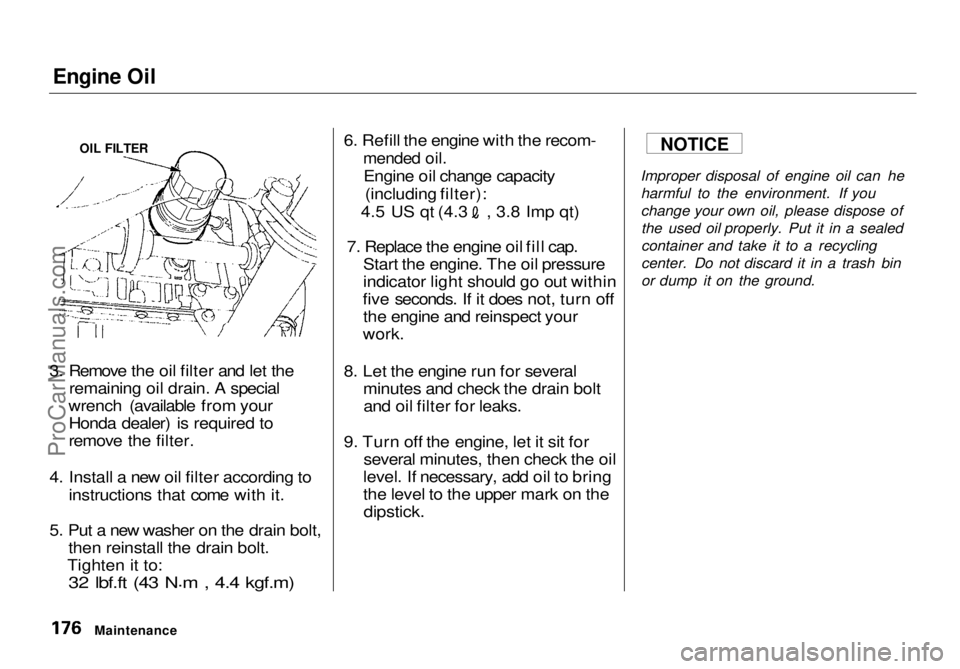
3. Remove the oil filter and let the remaining oil drain. A special
wrench (available from your Honda dealer) is required to
remove the filter.
4. Install a new oil filter according to instructions that come with it.
5. Put a new washer on the drain bolt, then reinstall the drain bolt.
Tighten it to:32 lbf.ft (43 N .
m , 4.4 kgf.m)
6. Refill
the engine with the recom-
mended oil.
Engine oil change capacity (including filter): 4.5 US qt (4.3 , 3.8 Imp qt)
7. Replace the engine oil fill cap. Start the engine. The oil pressure
indicator light should go out within
five seconds. If it does not, turn off the engine and reinspect your
work.
8. Let the engine run for several minutes and check the drain boltand oil filter for leaks.
9. Turn off the engine, let it sit for several minutes, then check the oil
level. If necessary, add oil to bring
the level to the upper mark on the
dipstick.
Improper disposal of engine oil can he
harmful to the environment. If you
change your own oil, please dispose ofthe used oil properly. Put it in a sealed
container and take it to a recycling
center. Do not discard it in a trash bin
or dump it on the ground.
Maintenance
OIL FILTER
NOTICEProCarManuals.comMain Menu Table of Contents s t
Page 193 of 272
Air Conditioning System
Your vehicle's air conditioning is a sealed system. Any major mainte-
nance, such as recharging, should be done by a qualified mechanic. You
can do a couple of things to make sure the air conditioning works
efficiently.
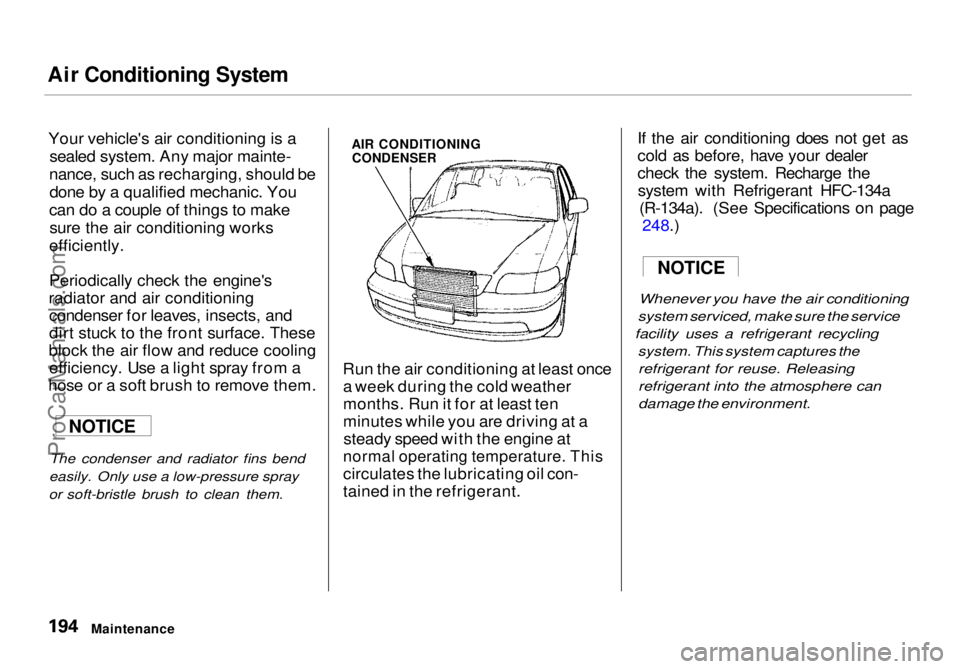
Periodically check the engine's
radiator and air conditioning condenser for leaves, insects, and
dirt stuck to the front surface. These
block the air flow and reduce cooling efficiency. Use a light spray from a
hose or a soft brush to remove them.
The condenser and radiator fins bend
easily. Only use a low-pressure spray
or soft-bristle brush to clean them.
AIR CONDITIONING
CONDENSER
Run the air conditioning at least once a week during the cold weather
months. Run it for at least ten
minutes while you are driving at asteady speed with the engine at
normal operating temperature. This
circulates the lubricating oil con-
tained in the refrigerant. If the air conditioning does not get as
cold as before, have your dealer
check the system. Recharge the
system with Refrigerant HFC-134a (R-134a). (See Specifications on page 248.
)
Whenever you
have the air conditioning
system serviced, make sure the service
facility uses a refrigerant recycling
system. This system captures the
refrigerant for reuse. Releasing
refrigerant into the atmosphere can
damage the environment.
Maintenance
NOTICE
NOTICEProCarManuals.comMain Menu Table of Contents s t
Page 210 of 272
Storing Your Vehicle
If you need to park your vehicle for
an extended period (more than one
month), there are several things you
should do to prepare it for storage.
Proper preparation helps prevent
deterioration and makes it easier to
get your vehicle back on the road. If
possible, store your vehicle indoors.
Fill the fuel tank.
Change the engine oil and filter(see page 175 ). Wash and dry the exterior
completely.
Clean the interior. Make sure the
carpeting, floor mats, etc. are
completely dry. Leave the parking brake off. Put
the transmission in Park. Block the rear wheels. If the vehicle is to be stored for a
longer period, it should be supported on jackstands so the
tires are off the ground.
Leave one window open slightly (if
the vehicle is being stored
indoors).
Disconnect the battery.
Support the front and rear wiper
blade arms with a folded towel or rag so they do not touch the
windshield.
To minimize sticking, apply a
silicone spray lubricant to all door
and trunk seals. Also, apply a body
wax to the painted surfaces that mate with the door and trunk seals. Cover the vehicle with a
"breathable" vehicle cover, one
made from a porous material such as cotton. Nonporous materials,
such as plastic sheeting, trap
moisture, which can damage the
paint. If possible, run the engine for a
while periodically (preferably once a month).
If you store your vehicle for 12
months or longer, have your Honda dealer perform the inspections called
for in the 24 months/30,000 miles (48,000 km) maintenance schedule
(Normal Conditions) as soon as you
take it out of storage (see page 164 ).
The replacements called for in the maintenance schedule are not
needed unless the vehicle has
actually reached that time or mileage.
MaintenanceProCarManuals.comMain Menu Table of Contents s t
Page 218 of 272

Taking Care of the Unexpected
This section covers the more- common problems that motorists
experience with their vehicles. It
gives you information about how to safely evaluate the problem and what
to do to correct it. If the problem has stranded you on the side of the road,
you may be able to get going again. If not, you will also find instructionson getting your vehicle towed. Compact Spare Tire....................... 222
Changing a Flat Tire..................... 223
If Your Engine Won't Start........... 229 Nothing Happens or theStarter Motor OperatesVery Slowly......................... 229
The Starter Operates Normally................................. 230
Jump Starting................................. 230 If Your Engine Overheats............. 232
Low Oil Pressure Indicator .......... 234Charging System Indicator........... 235
Malfunction Indicator Lamp ........ 236
Brake System Indicator................ 237 Closing the Sunroof....................... 238
Fuses............................................... 239 Checking and Replacing........... 240
Towing............................................ 244
Taking Care of the UnexpectedProCarManuals.comMain Menu s t
Page 231 of 272
Low Oil Pressure Indicator
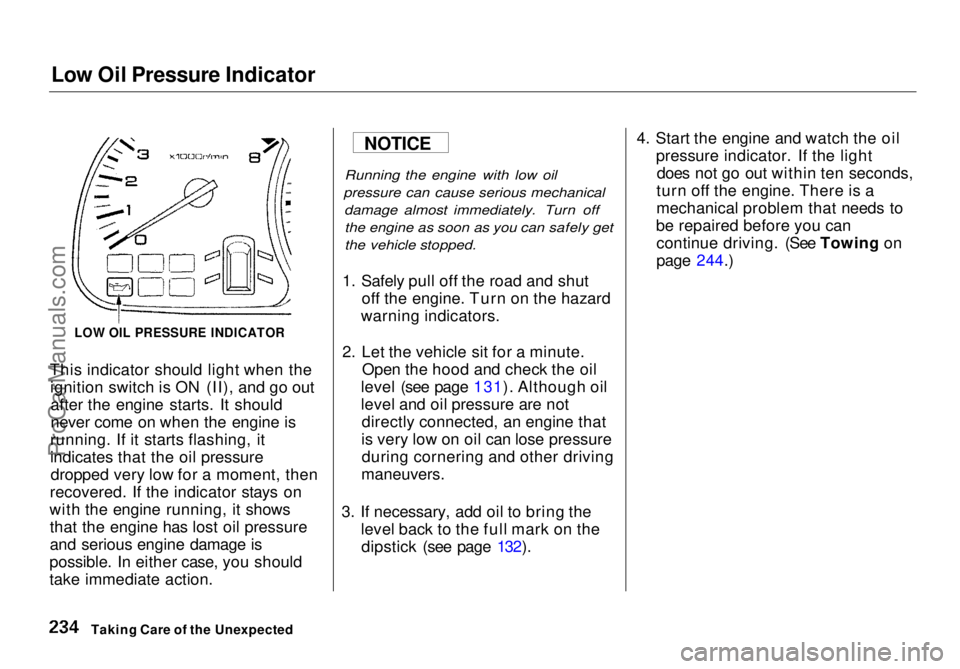
This indicator should light when the ignition switch is ON (II), and go outafter the engine starts. It should
never come on when the engine is
running. If it starts flashing, it
indicates that the oil pressure dropped very low for a moment, then
recovered. If the indicator stays on
with the engine running, it shows that the engine has lost oil pressure
and serious engine damage is
possible. In either case, you should
take immediate action.
Running the engine with low oil
pressure can cause serious mechanical damage almost immediately. Turn offthe engine as soon as you can safely get
the vehicle stopped.
1. Safely pull off the road and shut off the engine. Turn on the hazard
warning indicators.
2. Let the vehicle sit for a minute. Open the hood and check the oil
level (see page 131). Although oil
level and oil pressure are not directly connected, an engine that
is very low on oil can lose pressure during cornering and other driving
maneuvers.
3. If necessary, add oil to bring the level back to the full mark on thedipstick (see page 132). 4. Start the engine and watch the oil
pressure indicator. If the lightdoes not go out within ten seconds,
turn off the engine. There is a
mechanical problem that needs to
be repaired before you can continue driving. (See Towing on
page 244.)
Taking Care of the Unexpected
LOW OIL PRESSURE INDICATOR
NOTICEProCarManuals.comMain Menu Table of Contents s t
Page 245 of 272
Specifications
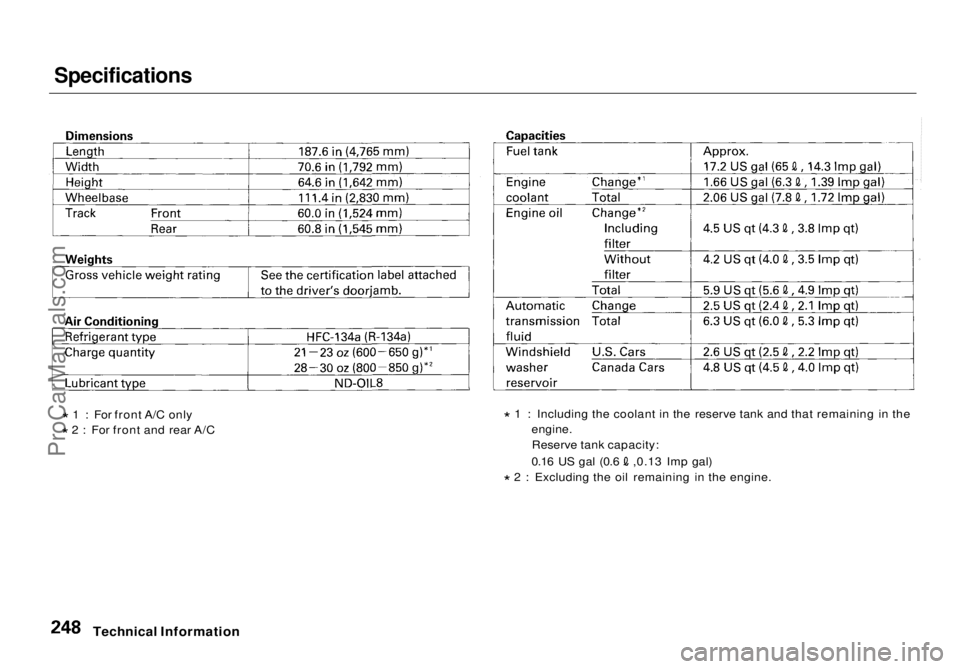
* 1 : For front A/C only
* 2 : For front and rear A/C *
1 : Including the coolant in the reserve tank and that remaining in the
engine.
Reserve tank capacity: 0.16 US gal (0.6 ,0.13 Imp gal)
* 2 : Excluding the oil remaining in the engine.
Technical InformationProCarManuals.comMain Menu Table of Contents s t
Page 263 of 272
Index
Accessories and Modifications.... 134 Accessories................................. 134
Additional Safety Precaution.... 135Modifications............................. 135
ACCESSORY (Ignition Key
Position)........................................ 70
Adding Automatic Transmission
Fluid........................................ 177
Brake Fluid................................. 183
Engine Coolant........................... 177
Engine Oil................................... 173
Power Steering Fluid................. 184
Windshield Washer Fluid......... 181
Additional Information About
Your Seat Belts........................ 41
Lap Belt......................................... 42
Lap/Shoulder Belt....................... 41
Seat Belt Maintenance................ 42
Seat Belt System Components... 41
Additional Information About
Your SRS.................................. 42
Additional Safety Precautions.... 46 How Your Airbags Work............ 44
How Your SRS Indicator
Works........................................ 46
SRS Components......................... 44
Additives, Engine Oil..................... 175
Adjustments
Mirrors.......................................... 84
Head Restraints........................... 76
Seats.............................................. 74
Steering Wheel............................ 62
Airbag (SRS) ...................................... 7
Air Cleaner Element...................... 185
Air Conditioning............................... 94
Maintenance............................... 194
Usage............................................. 94
Air Outlets (Vents).......................... 96
Air Pressure, Tires........................ 196
Alcohol in Gasoline........................ 128
Antifreeze....................................... 177
Anti-lock Brakes (ABS) Indicator Light..................... 53, 149Operation.................................... 148
Anti-theft Steering Column Lock.. 70
Appearance Care........................... 213
Ashtray.............................................. 89
Audio System................................. 103
Automatic Speed Control................ 64
Automatic Transmission............... 142
Capacity, Fluid........................... 248
Checking Fluid Level................ 182
Shifting........................................ 142
Shift Lever Positions................. 142
Shift Position Indicator............. 142
Shift Lock Release..................... 145
Battery
Charging System
Indicator............................ 52, 235
Jump Starting............................. 230
Maintenance............................... 189
Specifications............................. 249
Before Driving............................... 127
Belts, Seat........................................... 6
Beverage Holder.............................. 86
Body Repair.................................... 219
CONTINUEDProCarManuals.comMain Menu s t
Page 264 of 272
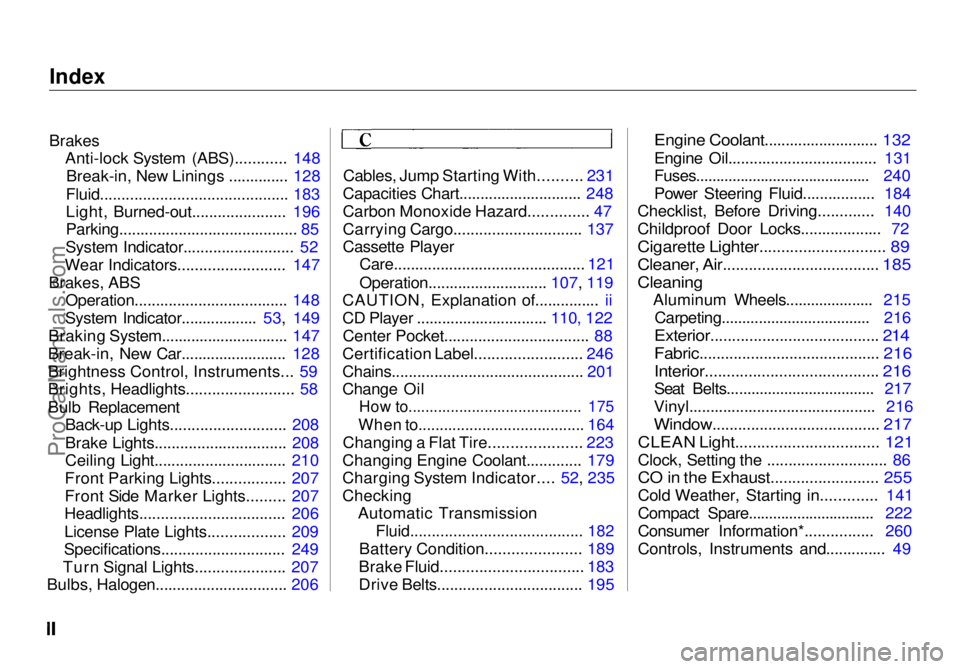
Index
Brakes Anti-lock System (ABS)............ 148
Break-in, New Linings .............. 128
Fluid............................................ 183
Light, Burned-out...................... 196
Parking.......................................... 85
System Indicator.......................... 52
Wear Indicators......................... 147
Brakes, ABS Operation.................................... 148
System Indicator.................. 53, 149
Braking System.............................. 147
Break-in, New Car......................... 128
Brightness Control, Instruments... 59
Brights, Headlights......................... 58
Bulb Replacement Back-up Lights........................... 208
Brake Lights............................... 208
Ceiling Light............................... 210
Front Parking Lights................. 207
Front Side Marker Lights......... 207
Headlights.................................. 206
License Plate Lights.................. 209
Specifications............................. 249
Turn Signal Lights..................... 207
Bulbs, Halogen............................... 206 Cables, Jump Starting With.......... 231
Capacities Chart............................. 248
Carbon Monoxide Hazard.............. 47
Carrying Cargo.............................. 137
Cassette Player Care............................................. 121
Operation............................ 107, 119
CAUTION, Explanation of............... ii
CD Player ............................... 110, 122
Center Pocket.................................. 88
Certification Label......................... 246
Chains............................................. 201
Change Oil
How to......................................... 175
When to....................................... 164
Changing a Flat Tire..................... 223
Changing Engine Coolant............. 179
Charging System Indicator.... 52, 235
Checking Automatic Transmission
Fluid........................................ 182
Battery Condition...................... 189
Brake Fluid................................. 183
Drive Belts.................................. 195
Engine Coolant........................... 132
Engine Oil................................... 131
Fuses........................................... 240
Power Steering Fluid................. 184
Checklist, Before Driving............. 140
Childproof Door Locks................... 72
Cigarette Lighter............................. 89
Cleaner, Air.................................... 185
Cleaning
Aluminum Wheels..................... 215
Carpeting.................................... 216
Exterior....................................... 214
Fabric.......................................... 216
Interior........................................ 216
Seat Belts.................................... 217
Vinyl............................................ 216
Window....................................... 217
CLEAN Light................................. 121
Clock, Setting the ............................ 86
CO in the Exhaust......................... 255
Cold Weather, Starting in............. 141
Compact Spare............................... 222
Consumer Information*................ 260
Controls, Instruments and.............. 49ProCarManuals.comMain Menu s t