door lock HONDA ODYSSEY 1998 Owners Manual
[x] Cancel search | Manufacturer: HONDA, Model Year: 1998, Model line: ODYSSEY, Model: HONDA ODYSSEY 1998Pages: 272, PDF Size: 2.67 MB
Page 4 of 272
Driver and Passenger Safety
This section gives you important information about how to protect
yourself and your passengers. It
shows you how to use seat belts
properly. It explains your Supple-
mental Restraint System. And it tells
you how to properly restrain infants
and children in your vehicle.
Important Safety Precautions .......... 4
Your Vehicle's Safety Features........ 5
Seat Belts........................................ 6
Airbags............................................ 7
Seats & Seat-Backs........................ 8
Head Restraints............................. 8
Door Locks..................................... 9
Pre-Drive Safety Checklist........... 9
Protecting Adults............................. 10 1. Close and Lock the Doors...... 10
2. Adjust the Front Seats............ 10
3. Adjust the Seat-Backs............. 11
4. Adjust the Head Restraints.... 12
5. Fasten and Position the Seat
Belts...................................... 13
6. Adjust the Steering Wheel..... 16
7. Maintain a Proper Sitting
Position................................. 16
Advice for Pregnant Women...... 17
Additional Safety Precautions.... 17
Protecting Children......................... 19
All Children Must Be Restrained................................ 19
Children Should Sit in the Back
Seat............................................ 20
The Passenger's Airbag Poses Serious Risks to Children....... 20
If You Must Drive with Several Children.................................... 21 If a Child Requires Close
Attention................................... 22
Additional Safety Precautions.... 22
General Guidelines for Using
Child Seats................................ 23
Protecting Infants........................ 27
Protecting Small Children.......... 31
Protecting Larger Children........ 35 Using Child Seats with Tethers...................................... 38
Additional Information About Your Seat Belts.................................. 41
Seat Belt System Components... 41
Lap/Shoulder Belt....................... 41
Lap Belt......................................... 42
Seat Belt Maintenance................ 42
Additional Information About Your
SRS........................................... 44
SRS Components......................... 44
How Your Airbags Work............ 44
How Your SRS Indicator Light
Works........................................ 45
SRS Service................................... 46
Additional Safety Precautions.... 46
Carbon Monoxide Hazard.............. 47
Safety Labels.................................... 48
Driver and Passenger SafetyProCarManuals.comMain Menu s t
Page 6 of 272
Your Vehicle's Safety Features
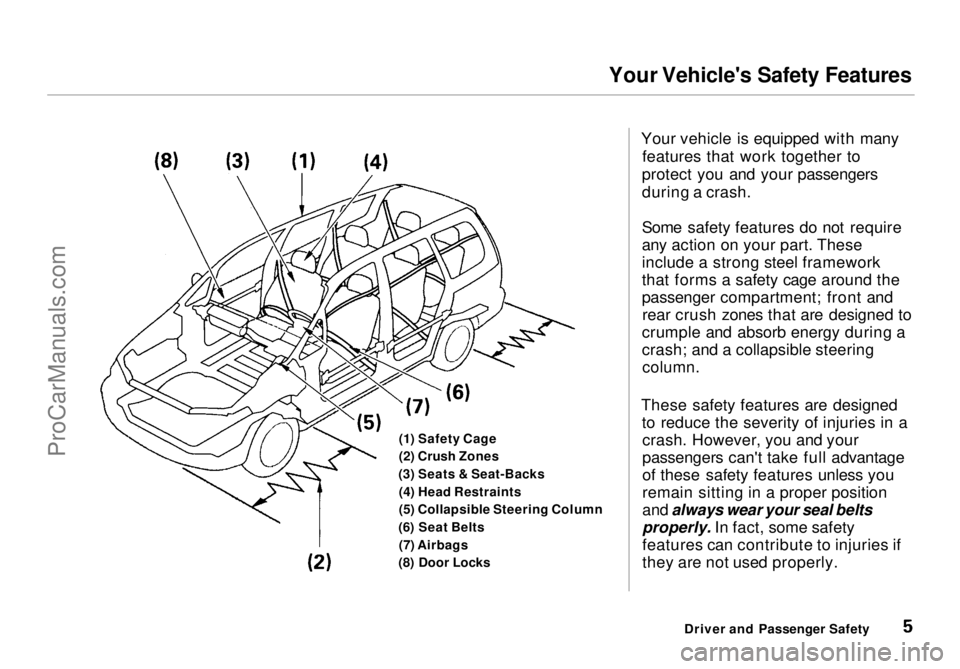
(1) Safety Cage
(2) Crush Zones
(3) Seats & Seat-Backs (4) Head Restraints
(5) Collapsible Steering Column
(6) Seat Belts (7) Airbags
(8) Door Locks Your vehicle is equipped with many
features that work together to
protect you and your passengers
during a crash.
Some safety features do not require
any action on your part. These
include a strong steel framework
that forms a safety cage around the
passenger compartment; front and rear crush zones that are designed to
crumple and absorb energy during a
crash; and a collapsible steering
column.
These safety features are designed to reduce the severity of injuries in acrash. However, you and your
passengers can't take full advantage
of these safety features unless you
remain sitting in a proper position
and always wear your seal belts
properly. In fact, some safety
features can contribute to injuries if
they are not used properly.
Driver and Passenger SafetyProCarManuals.comMain Menu Table of Contents s t
Page 10 of 272
Your Vehicle's Safety Features
Door Locks
Keeping your doors locked reduces
the chance of being thrown out of
the vehicle during a crash. It also
helps prevent occupants from accidentally opening a door and
falling out, and outsiders from unexpectedly opening your doors.
Pre-Drive Safety Checklist
To make sure you and your passengers get the maximum
protection from your vehicle's safety
features, check the following each
time before you drive away: All adults, and children who have
outgrown child safety seats, are
wearing their seat belts and
wearing them properly (see page
13).
Any infant or small child is
properly restrained in a child seat
in a back seat (see page 19 ). Front seat occupants are sitting as
far back as possible from the steering wheel and dashboard (see page 10). Seat-backs are upright (see page
11).
Head restraints are properly
adjusted (see page 12 ). All doors and the tailgate are
closed and locked (see page 10). All cargo is properly stored or
secured (see page 136).
The rest of this section gives more detailed information about how you
can maximize your safety.
Remember, however, that no safety system can prevent all injuries ordeaths that can occur in severe
crashes, even when seat belts are
properly worn and the airbags deploy.
Driver and Passenger SafetyProCarManuals.comMain Menu Table of Contents s t
Page 11 of 272
Protecting Adults
Introduction
The following pages provide instructions on how to properly
protect the driver and other adult
occupants.
These instructions also apply to children who have outgrown childseats and are large enough to wear
lap/shoulder belts. (See page 35 for
important additional guidelines on
how to properly protect larger children.)
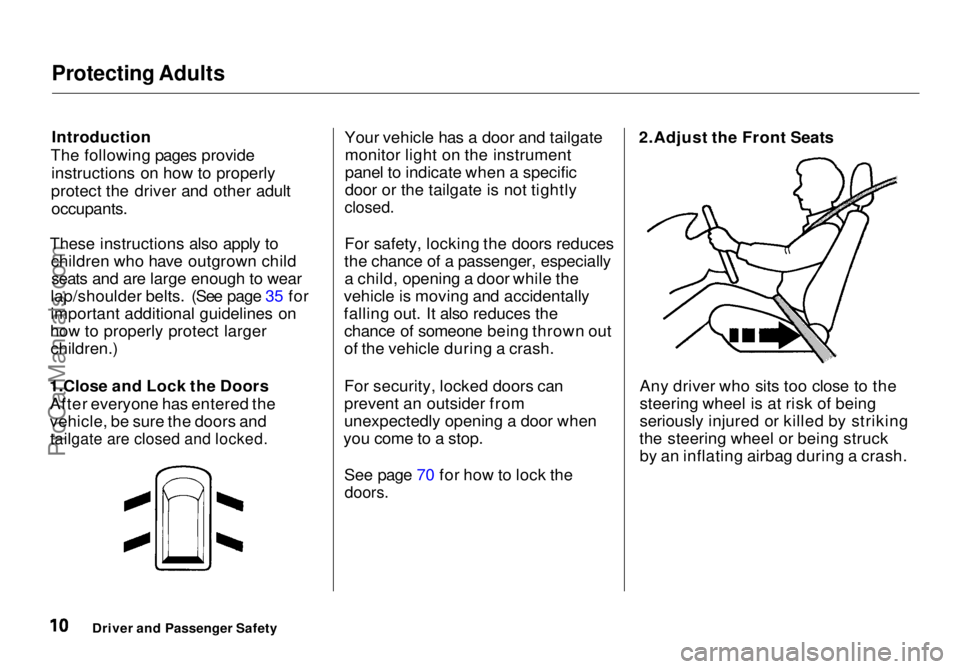
1.Close and Lock the Doors After everyone has entered the
vehicle, be sure the doors and
tailgate are closed and locked.
Your vehicle has a door and tailgate
monitor light on the instrument
panel to indicate when a specific
door or the tailgate is not tightly
closed.
For safety, locking the doors reduces
the chance of a passenger, especially a child, opening a door while the
vehicle is moving and accidentally
falling out. It also reduces the chance of someone being thrown out
of the vehicle during a crash.
For security, locked doors can
prevent an outsider from
unexpectedly opening a door when
you come to a stop.
See page 70 for how to lock the
doors.
2.Adjust the Front Seats
Any driver who sits too close to thesteering wheel is at risk of being
seriously injured or killed by striking
the steering wheel or being struck by an inflating airbag during a crash.
Driver and Passenger SafetyProCarManuals.comMain Menu Table of Contents s t
Page 23 of 272
Protecting Children
If a Child Requires Close
Attention
Many parents say they prefer to put
an infant or small child in the front
passenger seat so they can watch the child, or because the child requires
attention.
Placing a child in the front seat
exposes them to hazards from the
airbag, and paying close attention to
a child distracts the driver from the
important tasks of driving, creating serious safety risks.
If a child requires physical attention
or frequent visual contact, westrongly recommend that another
adult ride with the child in a back seat. A back seat is far safer for a
child than the front. Additional Safety Precautions
Use childproof door locks to
prevent children from opening the
doors. Using this feature will
prevent children from opening the doors and accidentally falling out (see page 72 ).
Use the main power window
switch to prevent children from opening the rear windows. Using
this feature will prevent children
from playing with the windows,
which could expose them to
hazards or distract the driver (see
page 82 ). Do not leave children alone in your
vehicle. Leaving children without
adult supervision is illegal in most states and can be very hazardous.
For example, infants and small
children left in a vehicle on a hot day can die from heatstroke. And
children left alone with the key in
the ignition can accidentally set
the vehicle in motion, possibly
injuring themselves or others.
Driver and Passenger SafetyProCarManuals.comMain Menu Table of Contents s t
Page 42 of 272
Additional Information About Your Seat Belts
Seat Belt System Components
All the seat belts in the 6-passenger model are lap/shoulder belts. In the7-passenger model, the center
position of the bench-type second seat has a lap belt.
The system also includes alight on the instrument
panel to remind you and your
passengers to fasten your belts. If
the driver's seat belt is not fastened
before the ignition is turned ON (II), the light will come on and a beeper
will also sound. The beeper will stop after a few seconds, but the light will
stay on until the driver's seat belt is
fastened.
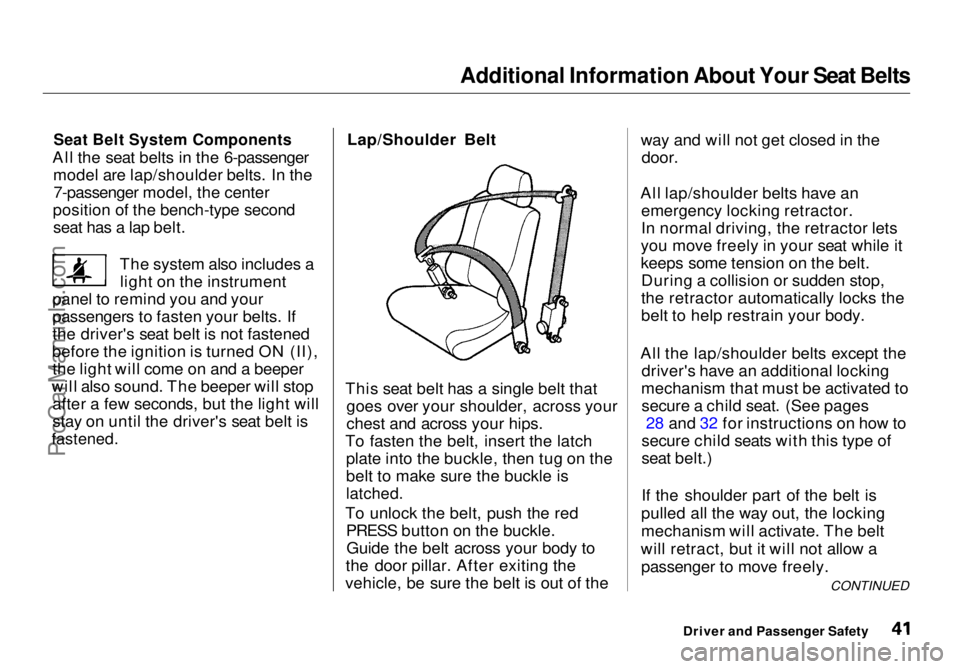
Lap/Shoulder Belt
This seat belt has a single belt that goes over your shoulder, across your
ches
t and
across your hips.
To fasten the belt, insert the latch plate into the buckle, then tug on the
belt to make sure the buckle is
latched.
To unlock the belt, push the red PRESS button on the buckle.Guide the belt across your body to
the door pillar. After exiting the
vehicle, be sure the belt is out of the way and will not get closed in the
door.
All lap/shoulder belts have an emergency locking retractor.
In normal driving, the retractor lets
you move freely in your seat while it
keeps some tension on the belt. During a collision or sudden stop,
the retractor automatically locks the
belt to help restrain your body.
All the lap/shoulder belts except the driver's have an additional locking
mechanism that must be activated to secure a child seat. (See pages 28 and 32 for instructions on how to
secure child seats with this type of
seat belt.)
If the shoulder part of the belt is
pulled all the way out, the locking
mechanism will activate. The belt
will retract, but it will not allow a passenger to move freely.
Driver and Passenger Safety CONTINUEDProCarManuals.comMain Menu Table of Contents s t
Page 50 of 272
Instruments and Controls
This section gives information about
the controls and displays thatcontribute to the daily operation of
your Honda. All the essential
controls are within easy reach.
Control Locations............................ 50
Indicator Lights................................ 51
Gauges.............................................. 54
Tachometer.................................. 54
Trip Meter.................................... 54
Speedometer................................ 55
Odometer...................................... 55
Temperature Gauge.................... 55
Fuel Gauge................................... 55
Maintenance Required
Indicator.................................... 56
Controls Near the Steering
Wheel........................................ 57
Headlights.................................... 58
Daytime Running Lights............. 58
Instrument Panel Brightness..... 59
Turn Signals................................. 59
Windshield Wipers...................... 60
Windshield Washers................... 61
Rear Window Wiper and
Washer...................................... 61
Hazard Warning........................... 61
Rear Window Defogger.............. 62
Steering Wheel Adjustment....... 62
Steering Wheel Controls ................ 64
Cruise Control.............................. 64
Keys and Locks................................ 67
Keys............................................... 67
Immobilizer System..................... 68
Ignition Switch............................. 69
Power Door Locks....................... 70
Remote Transmitter.................... 71
Childproof Door Locks............... 72
Tailgate......................................... 72
Glove Box..................................... 73
Seats.................................................. 74
Passenger Seating....................... 74
Seat Adjustments......................... 74
Driver's Seat Power Height
Adjustment............................... 75
Armrests....................................... 76
Head Restraints........................... 76
Third Seat Access........................ 77
Removing the Second Seats
in the Six-Passenger Model.... 78
Folding the Second Seats
in the Seven-Passenger
Model.................................... 78
Reclining the Second Seat.......... 79
Folding the Third Seat
in All Models............................ 80
Power Windows............................... 82
Sunroof.............................................. 83
Mirrors.............................................. 84
Adjusting the Power Mirrors..... 84
Parking Brake.................................. 85
Digital Clock..................................... 86 Beverage Holder.............................. 86
Dashboard Compartment............... 88
Center Pocket.................................. 88
Vanity Mirror................................... 88
Cigarette Lighter............................. 89
Ashtrays............................................ 89 Interior Lights.................................. 90
Ceiling Lights............................... 90
Spotlights...................................... 90
Tailgate Light............................... 91 Courtesy Lights........................... 91
Instruments and ControlsProCarManuals.comMain Menu s t
Page 51 of 272
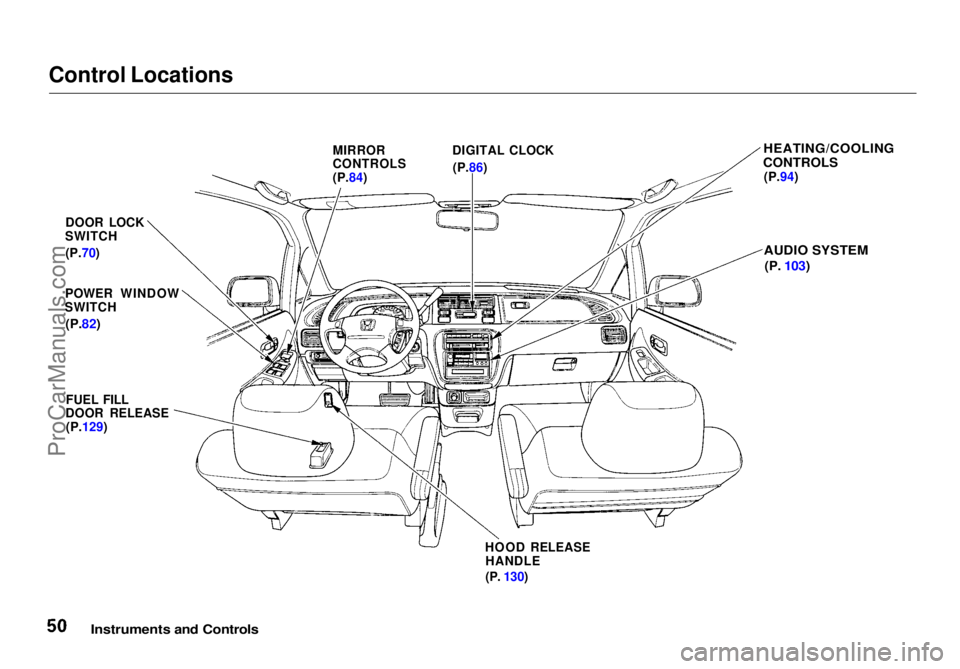
Control Locations
Instruments and Controls
MIRROR
CONTROLS
(P.84)
DIGITAL CLOCK
(P.86)
HEATING/COOLING
CONTROLS
(P.94)
AUDIO SYSTEM
(P.
103)
DOOR LOCK
SWITCH
(P.70)
POWER WINDOW
SWITCH
(P.82)
FUEL FILL
DOOR RELEASE
(P.129)
HOOD RELEASEHANDLE
(P.
130)ProCarManuals.comMain Menu Table of Contents s t
Page 52 of 272
Indicator Lights
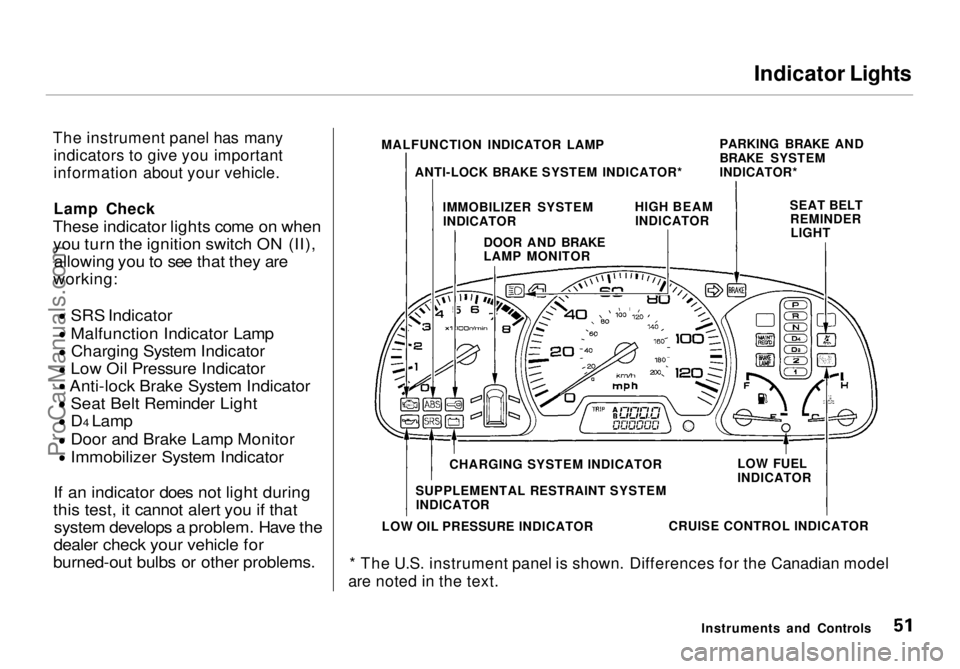
The instrument panel has many indicators to give you important
information about your vehicle.
Lamp Check
These indicator lights come on when you turn the ignition switch ON (II), allowing you to see that they are
working:
SRS Indicator
Malfunction Indicator Lamp
Charging System Indicator
Low Oil Pressure Indicator
Anti-lock Brake System Indicator
Seat Belt Reminder Light
D4 Lamp
Door and Brake Lamp Monitor
Immobilizer System Indicator
If an indicator does not light during
this test, it cannot alert you if that system develops a problem. Have the
dealer check your vehicle for
burned-out bulbs or other problems.
* The U.S. instrument panel is shown. Differences for the Canadian model
are noted in the text.
Instruments and Controls
MALFUNCTION INDICATOR LAMP
ANTI-LOCK BRAKE SYSTEM INDICATOR* PARKING BRAKE AND
BRAKE SYSTEM
INDICATOR*
IMMOBILIZER SYSTEM INDICATOR HIGH BEAM
INDICATOR SEAT BELT
REMINDERLIGHT
DOOR AND BRAKE
LAMP MONITOR
CHARGING SYSTEM INDICATOR
SUPPLEMENTAL RESTRAINT SYSTEM INDICATOR
LOW OIL PRESSURE INDICATOR CRUISE CONTROL INDICATORLOW FUEL
INDICATORProCarManuals.comMain Menu Table of Contents s t
Page 54 of 272
Indicator Lights
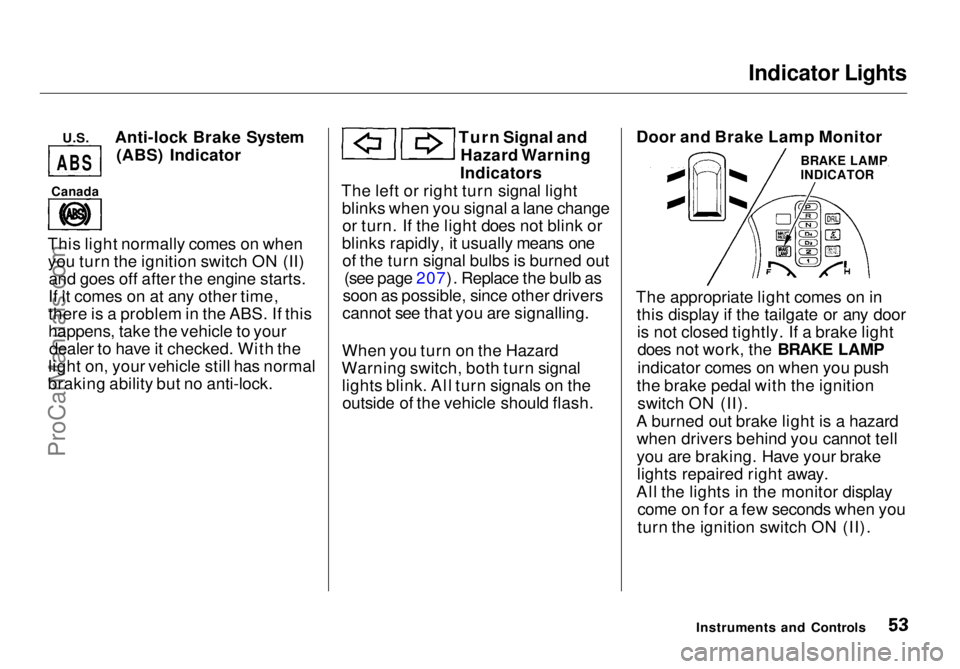
U.S.
Anti-lock Brake System
(ABS) Indicator
This light normally comes on when you turn the ignition switch ON (II) and goes off after the engine starts.
If it comes on at any other time,
there is a problem in the ABS. If this
happens, take the vehicle to your dealer to have it checked. With the
light on, your vehicle still has normal
braking ability but no anti-lock. Turn Signal and
Hazard Warning
Indicators
The left or right turn signal light blinks when you signal a lane changeor turn. If the light does not blink or
blinks rapidly, it usually means one of the turn signal bulbs is burned out (see page 207). Replace the bulb as
soon as possible, since other drivers
cannot see that you are signalling.
When you turn on the Hazard
Warning switch, both turn signal lights blink. All turn signals on theoutside of the vehicle should flash. Door and Brake Lamp Monitor
The appropriate light comes on in this display if the tailgate or any dooris not closed tightly. If a brake lightdoes not work, the BRAKE LAMP
indicator comes on when you push
the brake pedal with the ignition switch ON (II).
A burned out brake light is a hazard when drivers behind you cannot tell
you are braking. Have your brakelights repaired right away.
All the lights in the monitor display come on for a few seconds when you
turn the ignition switch ON (II).
Instruments and Controls
BRAKE LAMP
INDICATOR
ABS
CanadaProCarManuals.comMain Menu Table of Contents s t