roof HONDA ODYSSEY 1998 Owners Manual
[x] Cancel search | Manufacturer: HONDA, Model Year: 1998, Model line: ODYSSEY, Model: HONDA ODYSSEY 1998Pages: 272, PDF Size: 2.67 MB
Page 23 of 272
Protecting Children
If a Child Requires Close
Attention
Many parents say they prefer to put
an infant or small child in the front
passenger seat so they can watch the child, or because the child requires
attention.
Placing a child in the front seat
exposes them to hazards from the
airbag, and paying close attention to
a child distracts the driver from the
important tasks of driving, creating serious safety risks.
If a child requires physical attention
or frequent visual contact, westrongly recommend that another
adult ride with the child in a back seat. A back seat is far safer for a
child than the front. Additional Safety Precautions
Use childproof door locks to
prevent children from opening the
doors. Using this feature will
prevent children from opening the doors and accidentally falling out (see page 72 ).
Use the main power window
switch to prevent children from opening the rear windows. Using
this feature will prevent children
from playing with the windows,
which could expose them to
hazards or distract the driver (see
page 82 ). Do not leave children alone in your
vehicle. Leaving children without
adult supervision is illegal in most states and can be very hazardous.
For example, infants and small
children left in a vehicle on a hot day can die from heatstroke. And
children left alone with the key in
the ignition can accidentally set
the vehicle in motion, possibly
injuring themselves or others.
Driver and Passenger SafetyProCarManuals.comMain Menu Table of Contents s t
Page 50 of 272
Instruments and Controls
This section gives information about
the controls and displays thatcontribute to the daily operation of
your Honda. All the essential
controls are within easy reach.
Control Locations............................ 50
Indicator Lights................................ 51
Gauges.............................................. 54
Tachometer.................................. 54
Trip Meter.................................... 54
Speedometer................................ 55
Odometer...................................... 55
Temperature Gauge.................... 55
Fuel Gauge................................... 55
Maintenance Required
Indicator.................................... 56
Controls Near the Steering
Wheel........................................ 57
Headlights.................................... 58
Daytime Running Lights............. 58
Instrument Panel Brightness..... 59
Turn Signals................................. 59
Windshield Wipers...................... 60
Windshield Washers................... 61
Rear Window Wiper and
Washer...................................... 61
Hazard Warning........................... 61
Rear Window Defogger.............. 62
Steering Wheel Adjustment....... 62
Steering Wheel Controls ................ 64
Cruise Control.............................. 64
Keys and Locks................................ 67
Keys............................................... 67
Immobilizer System..................... 68
Ignition Switch............................. 69
Power Door Locks....................... 70
Remote Transmitter.................... 71
Childproof Door Locks............... 72
Tailgate......................................... 72
Glove Box..................................... 73
Seats.................................................. 74
Passenger Seating....................... 74
Seat Adjustments......................... 74
Driver's Seat Power Height
Adjustment............................... 75
Armrests....................................... 76
Head Restraints........................... 76
Third Seat Access........................ 77
Removing the Second Seats
in the Six-Passenger Model.... 78
Folding the Second Seats
in the Seven-Passenger
Model.................................... 78
Reclining the Second Seat.......... 79
Folding the Third Seat
in All Models............................ 80
Power Windows............................... 82
Sunroof.............................................. 83
Mirrors.............................................. 84
Adjusting the Power Mirrors..... 84
Parking Brake.................................. 85
Digital Clock..................................... 86 Beverage Holder.............................. 86
Dashboard Compartment............... 88
Center Pocket.................................. 88
Vanity Mirror................................... 88
Cigarette Lighter............................. 89
Ashtrays............................................ 89 Interior Lights.................................. 90
Ceiling Lights............................... 90
Spotlights...................................... 90
Tailgate Light............................... 91 Courtesy Lights........................... 91
Instruments and ControlsProCarManuals.comMain Menu s t
Page 58 of 272
Controls Near the Steering Wheel
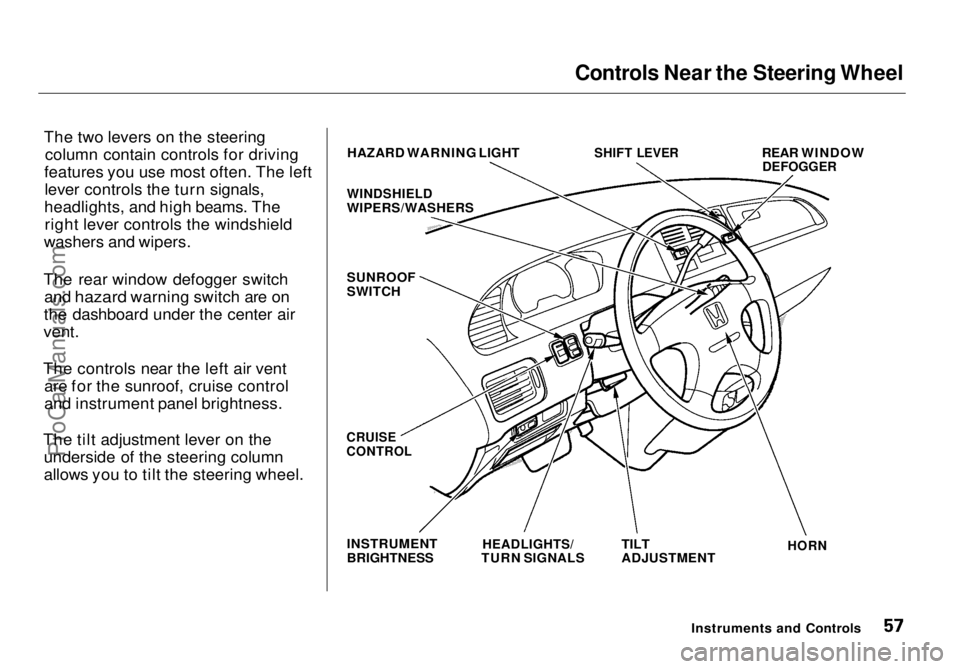
The two levers on the steering column contain controls for driving
features you use most often. The left lever controls the turn signals,
headlights, and high beams. The right lever controls the windshield
washers and wipers.
The rear window defogger switch and hazard warning switch are on
the dashboard
under the center air
vent.
The controls near the left air vent are for the sunroof, cruise control
and instrument panel brightness.
The tilt adjustment lever on the underside of the steering column
allows you to tilt the steering wheel. HAZARD WARNING LIGHT
WINDSHIELD
WIPERS/WASHERS
SUNROOF
SWITCH
SHIFT LEVER
REAR WINDOW
DEFOGGER
CRUISE
CONTROL
INSTRUMENT
BRIGHTNESS
HEADLIGHTS/
TURN SIGNALS
TILT
ADJUSTMENT
HORN
Instruments and ControlsProCarManuals.comMain Menu Table of Contents s t
Page 73 of 272
Keys and Locks
If you use the unlock feature on the
remote transmitter, and a door or the
tailgate is not opened within 20 seconds, all doors and the tailgate
will automatically lock. The remote transmitter will not work if the key isin the ignition.
As required by the FCC: This device complies with Part 15 of the
FCC rules. Operation is subject to the
following two conditions: (1) This device may not cause harmful interference, and (2) this device must accept any
interference received, including
interference that may cause undesired operation.
Changes or modifications not expressly
approved by the party responsible for compliance could void the user's
authority to operate the equipment. Childproof Door Locks
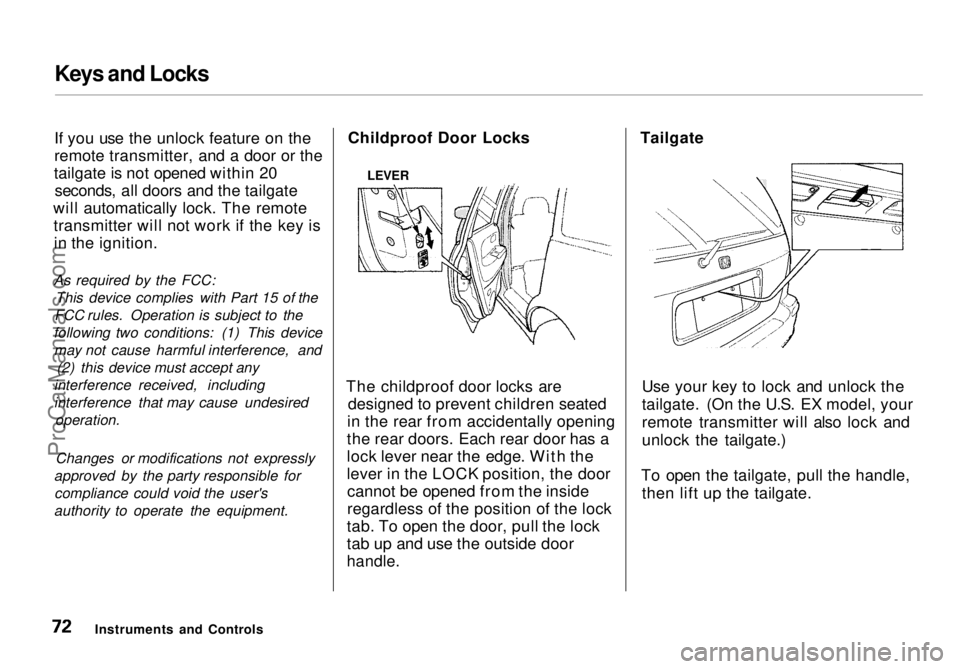
The childproof door locks are designed to prevent children seated
in the rear from accidentally opening
the rear doors. Each rear door has a
lock lever near the edge. With the
lever in the LOCK position, the door cannot be opened from the inside
regardless of the position of the lock
tab. To open the door, pull the lock
tab up and use the outside door
handle.
Tailgate
Use your key to lock and unlock the
tailgate. (On the U.S. EX model, your
remote transmitter will also lock and
unlock the tailgate.)
To open the tailgate, pull the handle, then lift up the tailgate.
Instruments and Controls
LEVERProCarManuals.comMain Menu Table of Contents s t
Page 84 of 272
Power Windows, Sunroof
The MAIN switch controls power to the passengers' windows. With thisswitch off, the passengers' windows
cannot be raised or lowered. The
MAIN switch does not affect the
driver's window. Keep the MAIN
switch off when you have children in
the vehicle so they do not injure
themselves by operating the
windows unintentionally.
Sunroof
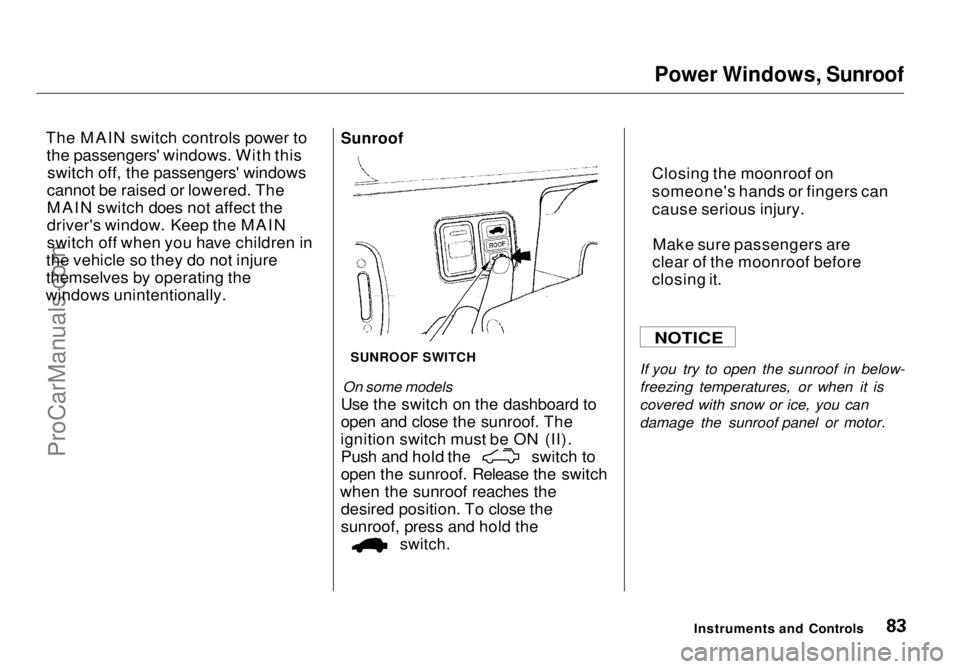
SUNROOF SWITCH
On some models
Use the switch on the dashboard to
open and close the sunroof. The
ignition switch must be ON (II). Push and hold the switch to
open the sunroof. Release the switch
when th
e sunroof reaches the
desired position. To close the
sunroof, press and hold the
switch.
If you try
to open the sunroof in below-
freezing temperatures, or when it is
covered with snow or ice, you can
damage the sunroof panel or motor.
Instruments and Controls
NOTICE
Closing the moonroof on
someone's hand
s or fingers can
cause serious injury.
Make sure passengers are
clear of the moonroof before
closing it.
ProCarManuals.comMain Menu Table of Contents s t
Page 138 of 272
Carrying Cargo
Carrying Cargo in the Cargo Area
or on a Roof Rack Distribute cargo evenly on the
floor of the cargo area, placing the
heaviest items on the bottom and
as far forward as possible. Tie down items that could be thrown
about the vehicle during a crash or
sudden stop. If you carry large items that
prevent you from closing the
tailgate, exhaust gas can enter the
passenger area. To avoid the
possibility of carbon monoxide poisoning, follow the instructionson page 47. If you can carry any items on a
roof rack, be sure the total weight
of the rack and the items does not
exceed the maximum allowable
weight. Please contact your Honda
dealer.
Before DrivingProCarManuals.comMain Menu Table of Contents s t
Page 146 of 272
Parking
Always use the parking brake when
you park your vehicle. The indicator on the instrument panel shows that
the parking brake is not fully
released; it does not indicate that the
parking brake is firmly set. Make sure the parking brake is set firmly
or your vehicle may roll if it is
parked on an incline.
Set the parking brake before you put
the transmission in Park. This keeps
the vehicle from moving and putting
pressure on the parking mechanism
in the transmission — making it
easier to move the shift lever out of
Park when you want to drive away. If the vehicle is facing uphill, turn
the front wheels away from the curb.
If the vehicle is facing downhill, turn
the front wheels toward the curb.
Make sure the parking brake is fully
released before driving away.
Driving with the parking brake
partially set can overheat or damage
the rear brakes. Parking Tips Make sure the sunroof and the
windows are closed. Turn off the lights.
Place any packages, valuables, etc.,
in the cargo area or take them
with you. Lock the doors with the key or the
remote transmitter.
Never park over dry leaves, tall
grass, or other flammable
materials. The three way catalytic
converter gets very hot, and could
cause these materials to catch on
fire.
DrivingProCarManuals.comMain Menu Table of Contents s t
Page 162 of 272

Maintenance Schedule
Your authorized Honda dealer knows your vehicle best and can
provide competent, efficient service.
However, service at a dealer is not
mandatory to keep your warranties
in effect. Maintenance may be done
by any qualified service facility or
person who is skilled in this type of automotive service. Keep all the
receipts as proof of completion, and
have the person who does the work
fill out the Maintenance Record. Check your warranty booklet for
more information. We recommend the use of Genuine
Honda parts and fluids whenever you
have maintenance done. These are manufactured to the same high-
quality standards as the original
components, so you can be confident
of their performance and durability.
U.S. Vehicles:
Maintenance, replacement or
repair of emissions control devices and systems may be done
by any automotive repair establishment or individual using
parts that are "certified" to EPA standards. According to state and federal
regulations, failure to perform
maintenance on the items marked
with # will not void your emissions
warranties. However, Honda recommends that all maintenance services be performed at the
recommended time or mileage
period to ensure long-term reliability.
MaintenanceProCarManuals.comMain Menu Table of Contents s t
Page 165 of 272
Maintenance Schedule (Severe Conditions)
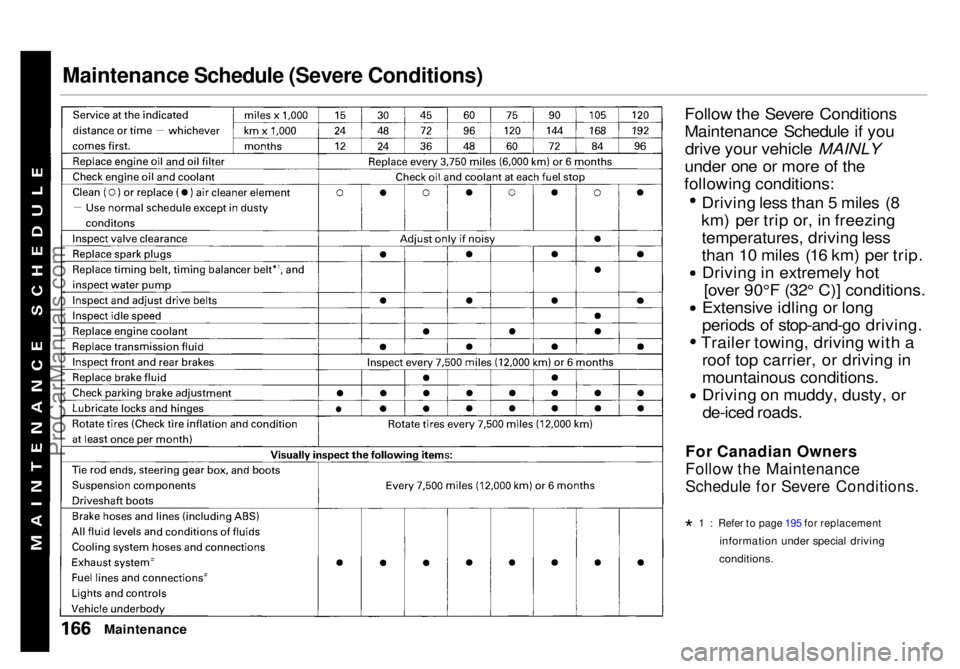
Follow the Severe Conditions
Maintenance Schedule if youdrive your vehicle MAINLY
under one or more of the
following conditions:
Driving less than 5 miles (8
km) per trip or, in freezing temperatures, driving less
than 10 miles (16 km) per trip. Driving in extremely hot
[over 90°F (32° C)] conditions. Extensive idling or long
periods of stop-and-go driving.
Trailer towing, driving with a roof top carrier, or driving in
mountainous conditions. Driving on muddy, dusty, or
de-iced roads.
For Canadian Owners
Follow the Maintenance
Schedule for Severe Conditions.
* 1: Refer to page 195 for replacement
information under special driving
conditions.
MaintenanceProCarManuals.comMain Menu Table of Contents s t
Page 166 of 272
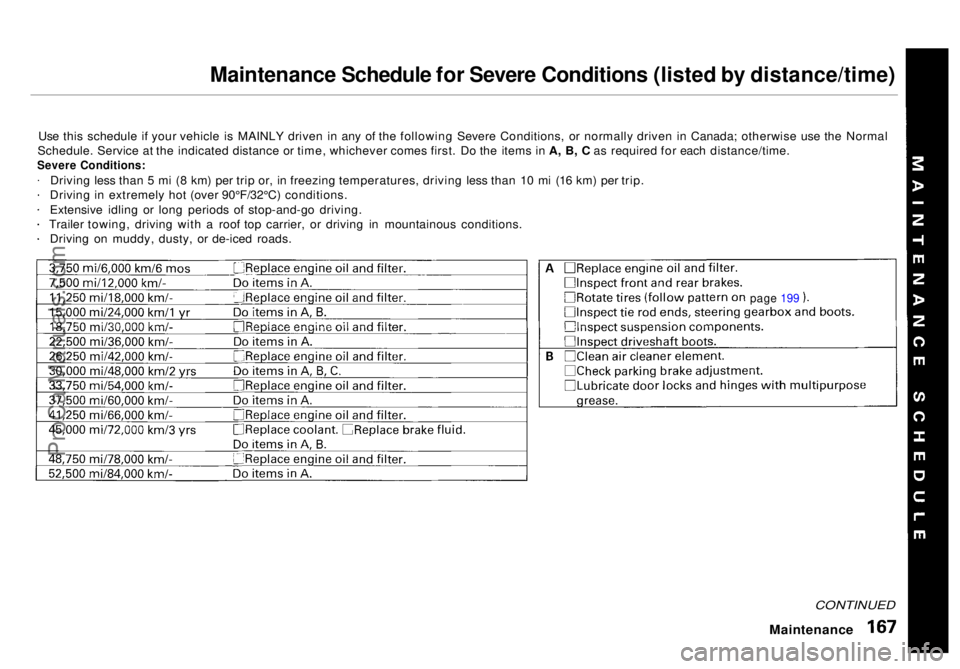
Maintenance Schedule for Severe Conditions (listed by distance/time)
Use this schedule if your vehicle is MAINLY driven in any of the following Severe Conditions, or normally driven in Canada; otherwise use the Normal
Schedule. Service at the indicated distance or time, whichever comes first. Do the items in A, B, C as required for each distance/time.
Severe Conditions:
Driving less than 5 mi (8 km) per trip or, in freezing temperatures, driving less than 10 mi (16 km) per trip.
Driving in extremely hot (over 90°F/32°C) conditions.
Extensive idling or long periods of stop-and-go driving.
Trailer towing, driving with a roof top carrier, or driving in mountainous conditions. Driving on muddy, dusty, or de-iced roads.
CONTINUED
Maintenance
page 199ProCarManuals.comMain Menu Table of Contents s t