maintenance HONDA ODYSSEY 1999 Workshop Manual
[x] Cancel search | Manufacturer: HONDA, Model Year: 1999, Model line: ODYSSEY, Model: HONDA ODYSSEY 1999Pages: 343, PDF Size: 3.73 MB
Page 259 of 343
Tires
Use a gauge to measure the air
pressure at least once a month. Even
tires that are in good condition may
lose one to two psi (10 to 20 kPa, 0.1
to 0.2 kgf/cm2) per month. Remember to check the spare tire at
the same time you check all the other tires.
Check the pressure in the tires when
they are cold. This means the vehicle
has been parked for at least three hours. If you have to drive the
vehicle before checking the tire pressure, the tires can still be
considered "cold" if you drive less
than 1 mile (1.6 km). If you check the pressure when the
tires are hot (the vehicle has been
driven several miles), you will see
readings 4 to 6 psi (30 to 40 kPa, 0.3
to 0.4 kgf/cm2) higher than the cold
reading. This is normal. Do not let air out to match the specified cold
pressure. The tire will be
underinflated.
You should get your own tire pressure gauge and use it whenever
you check your tire pressures. This
will make it easier for you to tell if a pressure loss is due to a tire problemand not due to a variation between
gauges.
Recommended Tire Pressures for
Normal Driving
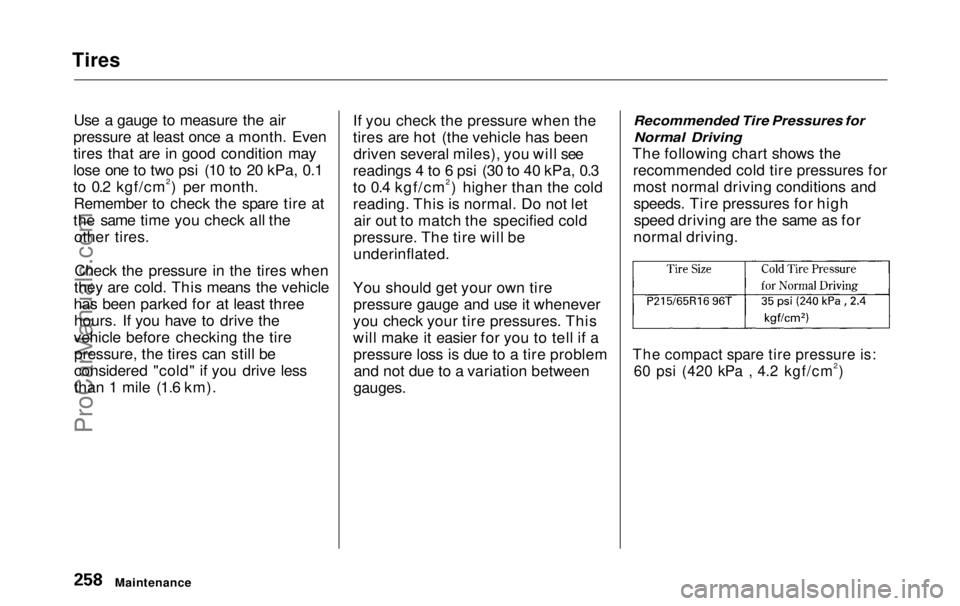
The following chart shows the recommended cold tire pressures for
most normal driving conditions andspeeds. Tire pressures for highspeed driving are the same as for
normal driving.
The compact spare tire pressure is: 60 psi (420 kPa , 4.2 kgf/cm2)
MaintenanceProCarManuals.comMain Menu Table of Contents s t
Page 260 of 343
Tires
These pressures are also given on the tire information label on thedriver's doorjamb.
Tubeless tires have some ability to self-seal if they are punctured.
However, because leakage is often
very slow, you should look closely for punctures if a tire starts losing
pressure.
Inspection
Every time you check inflation, you
should also examine the tires for
damage, foreign objects, and wear.
You should look for: Bumps or bulges in the tread or
side of the tire. Replace the tire if
you find either of these conditions. Cuts, splits, or cracks in the side
of the tire. Replace the tire if you
can see fabric or cord. Excessive tread wear.
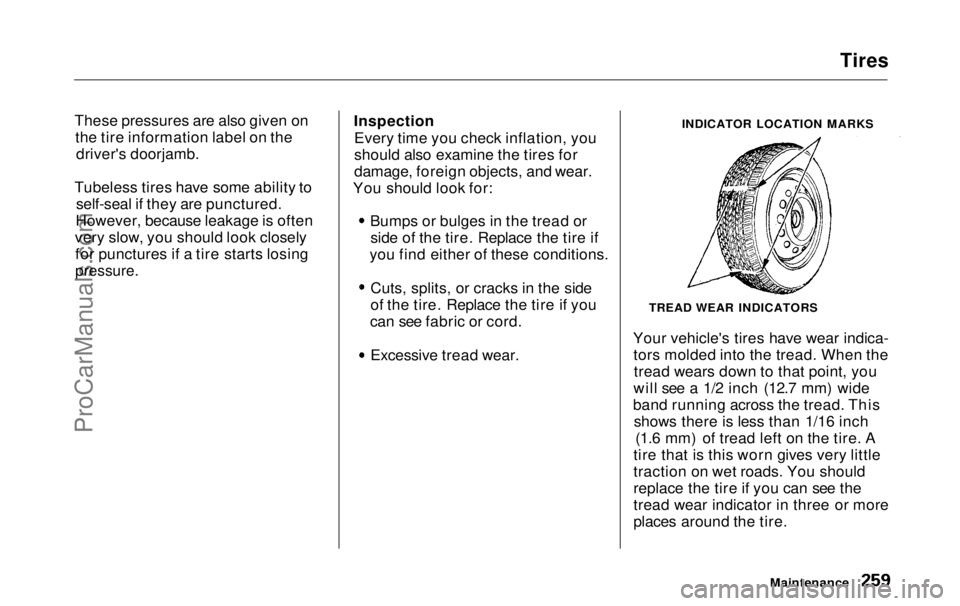
INDICATOR LOCATION MARKS
TREAD WEAR INDICATORS
Your vehicle's tires have wear indica- tors molded into the tread. When thetread wears down to that point, you
will see a 1/2 inch (12.7 mm) wide
band running across the tread. This shows there is less than 1/16 inch (1.6 mm) of tread left on the tire. A
tire that is this worn gives very little
traction on wet roads. You should
replace the tire if you can see the
tread wear indicator in three or more
places around the tire.
MaintenanceProCarManuals.comMain Menu Table of Contents s t
Page 261 of 343
Tires
Maintenance
In addition to proper inflation,correct wheel alignment helps to
decrease tire wear. If you find a tire
is worn unevenly, have your dealer
check the wheel alignment.
The tires were properly balanced by the factory. They may need to berebalanced at some time before they
are worn out. Have your dealer
check the tires if you feel a consis-
tent vibration while driving. A tire should always be rebalanced if it is
removed from the wheel for repair. Make sure the installer balances the
wheels when you have new tires installed. This increases riding
comfort and tire life. Your vehicle's
original tires were dynamic or "spin"
balanced at the factory. For best results, have the installer perform adynamic balance.
On some models
Improper wheel weights can damage
your vehicle 'x aluminum wheels. Use only Genuine Honda wheel weights for
balancing.
Tire Rotation
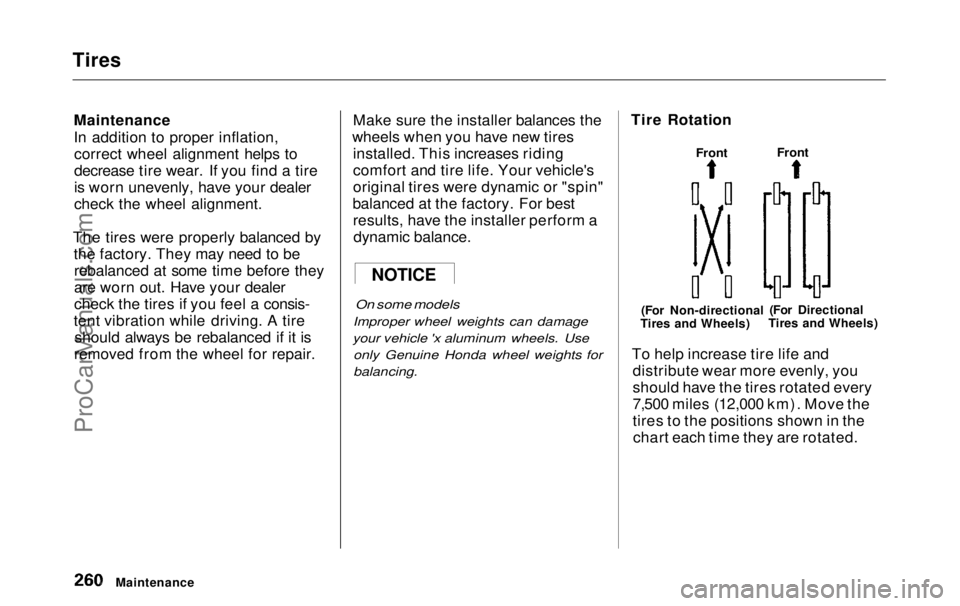
To help increase tire life anddistribute wear more evenly, you
should have the tires rotated every
7,500 miles (12,000 km). Move the
tires to the positions shown in thechart each time they are rotated.
Maintenance
NOTICE
(For Non-directional
Tires and Wheels) (For Directional
Tires and Wheels)
Front
FrontProCarManuals.comMain Menu Table of Contents s t
Page 262 of 343

Tires
When shopping for replacement tires, you may find that some tiresare "directional." This means they
are designed to rotate only in onedirection. If you use directional tires,
they should be rotated only front-to-
back. Replacing Tires and Wheels
The tires that came with your vehicle were selected to match theperformance capabilities of the
vehicle while providing the best combination of handling, ride
comfort, and long life. You should
replace them with radial tires of the same size, load range, speed rating,
and maximum cold tire pressure
rating (as shown on the tire's sidewall). Mixing radial and bias-ply
tires on your vehicle can reduce its
braking ability, traction, and steering
accuracy.
It is best to replace all four tires at
the same time. If that is not possible or necessary, then replace the two
front tires or the two rear tires as a
pair. Replacing just one tire can seriously affect your vehicle's han-
dling.
CONTINUED
Maintenance
Installing improper tires on your
vehicle can affect handling and stability. This can cause a crashin which you can be seriously
hurt or killed.
Always use the size and type of
tires recommended in this owner's manual.ProCarManuals.comMain Menu Table of Contents s t
Page 263 of 343
Tires
The ABS works by comparing the speed of the wheels. When replacing
tires, use the same size originally supplied with the vehicle. Tire size
and construction can affect wheel speed and may cause the system to
work inconsistently.
If you ever need to replace a wheel,make sure the wheel's specifications
match those of the original wheel
that came on your vehicle. Re-
placement wheels are available at
your Honda dealer. Wheels and Tires
Wheel:16 x 6 1/2 JJ
Tire:
P215/65R16 96T
See Tire Information
on page 318 for
additional information about tire and
wheel size designations. See page 319 for information about DOT Tire
Quality Grading.
Winter Driving
Tires that are marked "M + S" or
"All Season" on the sidewall have an
all-weather tread design. They
should be suitable for most winter
driving conditions. Tires without
these markings are designed for optimum traction in dry conditions.
They may not provide adequate performance in winter driving.For the best performance in snowy
or icy conditions, you should install
snow tires or tire chains. They may
be required by local laws under certain conditions.
MaintenanceProCarManuals.comMain Menu Table of Contents s t
Page 264 of 343
Tires
Snow Tires
If you mount snow tires on your
Honda, make sure they are radial
tires of the same size and load range
as the original tires. Mount snow
tires on all four wheels to balance
your vehicle's handling in all weather conditions. Keep in mind the traction
provided by snow tires on dry roads
may not be as high as your vehicle'soriginal equipment tires. You should
drive cautiously even when the roads
are clear. Check with the tire dealer
for maximum speed recommenda-
tions.
Tire Chains
Mount snow chains on your vehicle
when warranted by driving condi- tions or required by local laws. Youshould use only SAE class "S" cable-
type traction devices on your vehicle, mounted on the front wheels. Make
sure they are the correct size for
your tires.
Metal link-type "chains" should not
be used. No matter how tight they seem to be installed, they can come
into contact with the body and suspension, causing serious damage.
When installing chains, follow the manufacturer's instructions andmount them as tightly as you can.
Drive slowly with chains installed. If
you hear the chains contacting the
body or chassis, stop and investigate. Make sure the chains are installed
tightly, and that they are not contacting the brake lines or
suspension. Remove the chains as
soon as you begin driving on cleared
roads.
Traction devices that are the wrong
size or improperly installed can
damage your vehicle's brake lines,
suspension, body, and wheels. Stop
driving if they are hitting any part of the vehicle.
Maintenance
NOTICEProCarManuals.comMain Menu Table of Contents s t
Page 265 of 343
Lights
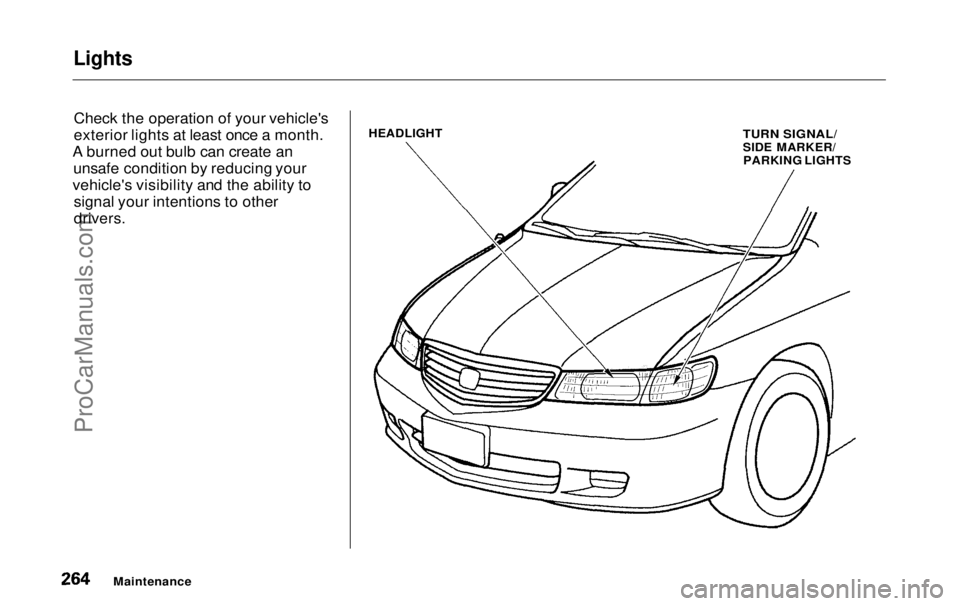
Check the operation of your vehicle's
exterior lights at least once a month.
A burned out bulb can create an unsafe condition by reducing your
vehicle's visibility and the ability to signal your intentions to other
drivers.
HEADLIGHT
TURN SIGNAL/
SIDE MARKER/
PARKING LIGHTS
MaintenanceProCarManuals.comMain Menu Table of Contents s t
Page 266 of 343
Lights
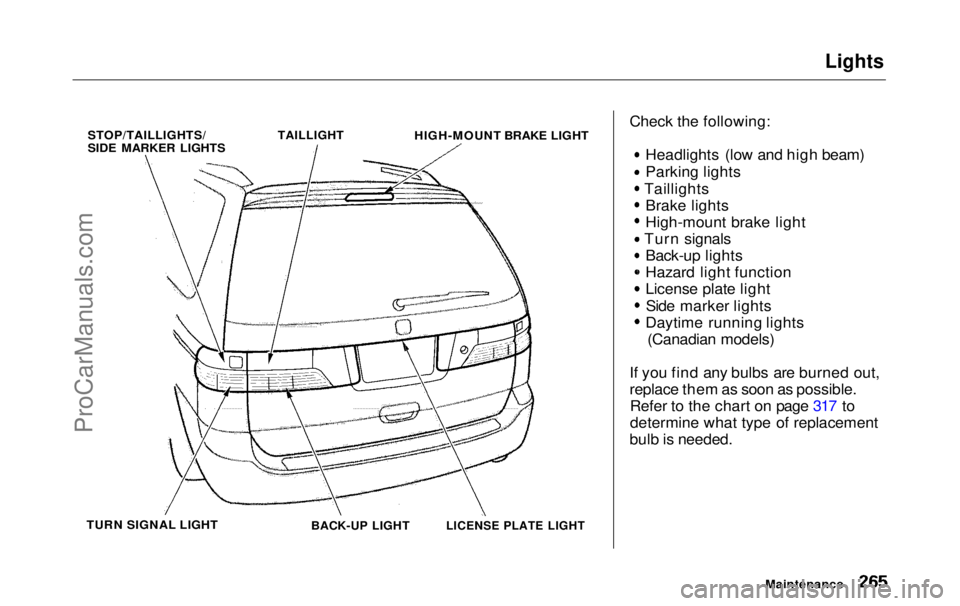
STOP/TAILLIGHTS/
SIDE MARKER LIGHTS
TAILLIGHT
HIGH-MOUNT BRAKE LIGHT
TURN SIGNAL LIGHT
BACK-UP LIGHT
LICENSE PLATE LIGHT
Check the following: Headlights (low and high beam)
Parking lights
Taillights Brake lights High-mount brake light
Turn signals
Back-up lights
Hazard light function
License plate light
Side marker lights
Daytime running lights
(Canadian models)
If you find any bulbs are burned out,
replace them as soon as possible. Refer to the chart on page 317 to
determine what type of replacement
bulb is needed.
MaintenanceProCarManuals.comMain Menu Table of Contents s t
Page 267 of 343
Lights
Headlight Aiming
The headlights were properly aimed when your vehicle was new. If youregularly carry heavy items in thecargo area or pull a trailer,
readjustment may be required.
Adjustment of the headlights should be performed by a Honda technicianor other qualified mechanic. Replacing a Headlight Bulb
Your vehicle has halogen headlight bulbs, one on each side. When
replacing a bulb, handle it by its steel
base and protect the glass fromcontact with your skin or hard
objects. If you touch the glass, clean
it with denatured alcohol and a clean cloth.
Halogen headlight bulbs get very hot when lit. Oil, perspiration, or a scratch
on the glass can cause the bulb to
overheat and shatter.
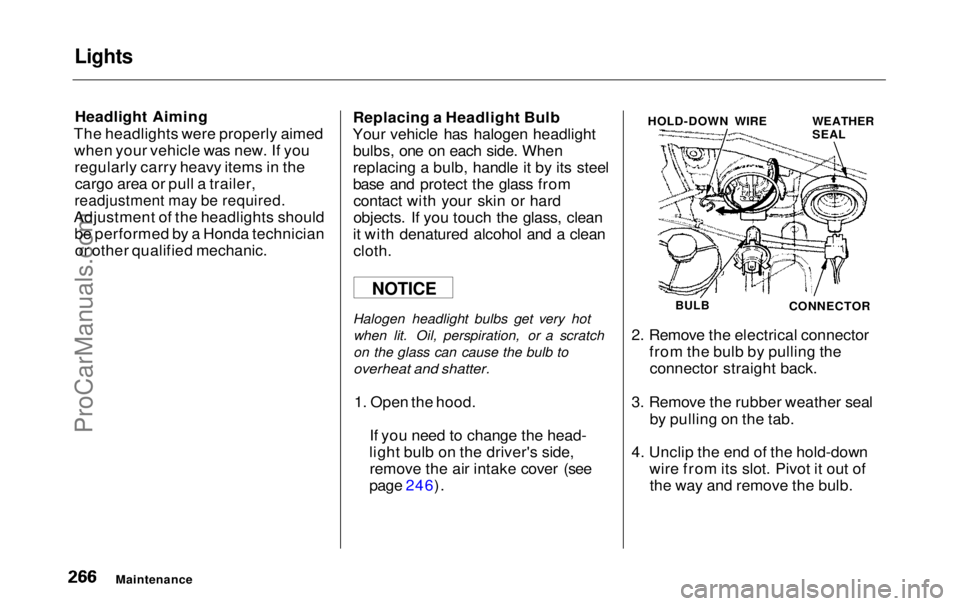
1. Open the hood. If you need to change the head-
light bulb on the driver's side, remove the air intake cover (see
page 246). HOLD-DOWN WIRE
WEATHER
SEAL
BULB
CONNECTOR
2. Remove the electrical connector from the bulb by pulling theconnector straight back.
3. Remove the rubber weather seal by pulling on the tab.
4. Unclip the end of the hold-down wire from its slot. Pivot it out ofthe way and remove the bulb.
Maintenance
NOTICEProCarManuals.comMain Menu Table of Contents s t
Page 268 of 343
Lights
5. Insert the new bulb into the hole, making sure the tabs are in theirslots. Pivot the hold-down wire
back in place and clip the end into
the slot.
6. Install the rubber seal over the back of the headlight assembly.
Make sure it is right side up; it is
marked "TOP."
7. Push the electrical connector onto the new bulb.
Turn on the headlights to test the new bulb.
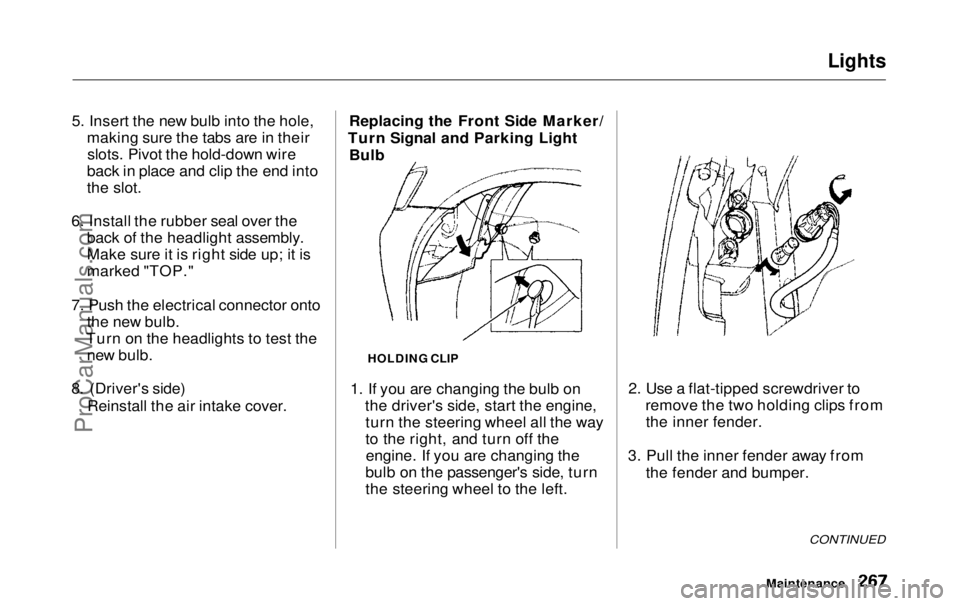
8. (Driver's side) Reinstall the air intake cover. Replacing the Front Side Marker/
Turn Signal and Parking Light Bulb
HOLDING CLIP
1. If you are changing the bulb on the driver's side, start the engine,turn the steering wheel all the way
to the right, and turn off theengine. If you are changing the
bulb on the passenger's side, turn
the steering wheel to the left. 2. Use a flat-tipped screwdriver to
remove the two holding clips fromthe inner fender.
3. Pull the inner fender away from the fender and bumper.
CONTINUED
MaintenanceProCarManuals.comMain Menu Table of Contents s t