wheel HONDA ODYSSEY 1999 Workshop Manual
[x] Cancel search | Manufacturer: HONDA, Model Year: 1999, Model line: ODYSSEY, Model: HONDA ODYSSEY 1999Pages: 343, PDF Size: 3.73 MB
Page 279 of 343

Exterior Care
Waxing Always wash and dry the whole
vehicle before waxing it. You shouldwax your vehicle, including the metal
trim, whenever water sits on thesurface in large patches. It should
form into beads or droplets after
waxing.
You should use a quality liquid or paste wax. Apply it according to theinstructions on the container. In
general, there are two types of
products:
Waxes — A wax coats the finish and protects it from damage by exposure
to sunlight, air pollution, etc. Youshould use a wax on your Honda
when it is new.
Polishes — Polishes and cleaner/
waxes can restore the shine to paint that has oxidized and lost some of itsshine. They normally contain mild
abrasives and solvents that remove the top layer of the finish. You
should use a polish on your Honda if
the finish does not have its original shine after using a wax.
Cleaning tar, insects, etc. with
removers also takes off the wax.
Remember to re-wax those areas,
even if the rest of the vehicle does
not need waxing.
Aluminum Wheels On some models
Clean your Honda's aluminum alloy
wheels as you do the rest of the exterior. Wash them with the samesolution, and rinse them thoroughly.
The wheels have a protective clear- coat that keeps the aluminum from
corroding and tarnishing. Using
harsh chemicals, including some commercial wheel cleaners, or stiff
brushes can damage this clear-coat. Only use a mild detergent and soft
brush or sponge to clean the wheels. Paint Touch-up
Your dealer has touch-up paint to match your vehicle's color. The color
code is printed on a sticker on thedriver's doorjamb. Take this code to
your dealer so you are sure to get the correct color.
Inspect your vehicle frequently forchips or scratches in the paint.
Repair them right away to prevent
corrosion of the metal underneath.
Use the touch-up paint only on small chips and scratches. More extensive
paint damage should be repaired by a professional.
Appearance CareProCarManuals.comMain Menu Table of Contents s t
Page 282 of 343
Corrosion Protection
Two factors normally contribute to causing corrosion in your vehicle:
1. Moisture trapped in body cavities. Dirt and road salt that collects in
hollows on the underside of the
vehicle stays damp, promoting corrosion in that area.
2. Removal of paint and protective coatings from the exterior and
underside of the vehicle. Many corrosion-preventive measures
are built into your Honda. You can
help keep your vehicle from corroding by performing some
simple periodic maintenance: Repair chips and scratches in the
paint as soon as you discover them. Inspect and clean out the drain
holes in the bottom of the doors
and body. Check the floor coverings for
dampness. Carpeting and floor
mats may remain damp for a long
time, especially in winter. This dampness can eventually cause
the floor panels to corrode. Use a high-pressure spray to clean
the underside of your vehicle. This is especially important in areas
that use road salt in winter. It is also a good idea in humid climates
and areas subject to salt air. Be
careful of the ABS wheel sensors
and wiring at each wheel. Have the corrosion-preventive
coatings on the underside of your
vehicle inspected and repaired periodically.
Appearance CareProCarManuals.comMain Menu Table of Contents s t
Page 285 of 343
Compact Spare Tire
Your vehicle has a compact spare tire that takes up less space. Use thisspare tire as a temporary replace-
ment only. Get your regular tire
repaired or replaced and put back on
your vehicle as soon as you can.
Check the inflation pressure of the
compact spare tire every time you
check the other tires. It should be
inflated to: 60 psi (420 kPa , 4.2 kgf/cm2)
Follow these precautions whenever
you are using the compact spare tire: Do not exceed 50 mph (80 km/h)
under any circumstances. This tire gives a harsher ride and
less traction on some road sur-
faces than the regular tire. Use
greater caution while driving on this tire. Do not mount snow chains on the
compact spare.
Do not use the compact spare tire
if you are towing a trailer. The wheel of the compact spare
tire is designed especially to fit
your vehicle. Do not use your spare tire on another vehicle
unless it is the same make and
model.
On EX model
Turn off the Traction Control
System (see page 207 ). Driving
with the compact spare tire may activate the TCS.
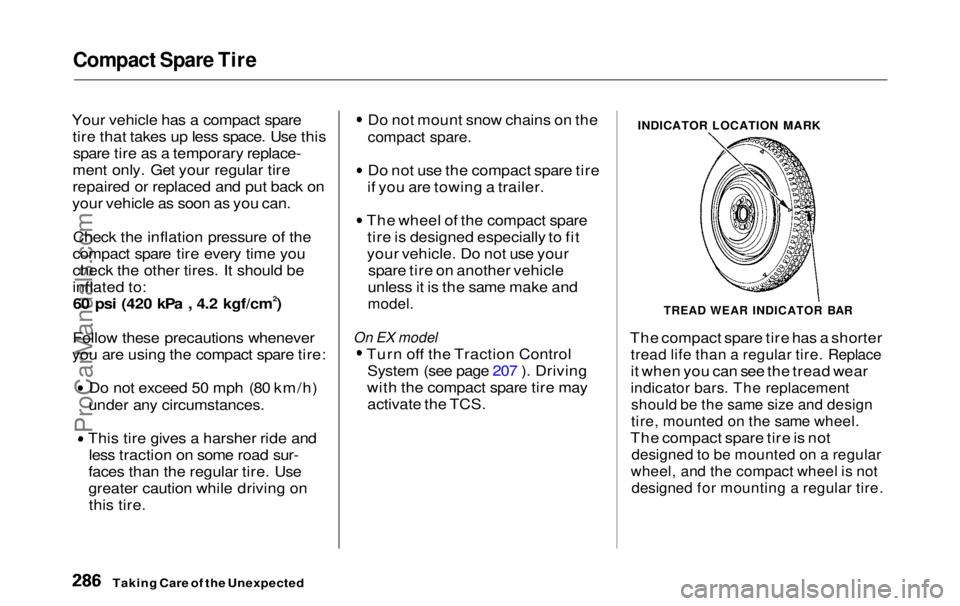
INDICATOR LOCATION MARK
TREAD WEAR INDICATOR BAR
The compact spare tire has a shorter
tread life than a regular tire. Replace
it when you can see the tread wear
indicator bars. The replacement
should be the same size and design
tire, mounted on the same wheel.
The compact spare tire is not
designed to be mounted on a regular
wheel, and the compact wheel is not
designed for mounting a regular tire.
Taking Care of the UnexpectedProCarManuals.comMain Menu Table of Contents s t
Page 288 of 343
Changing a Flat Tire
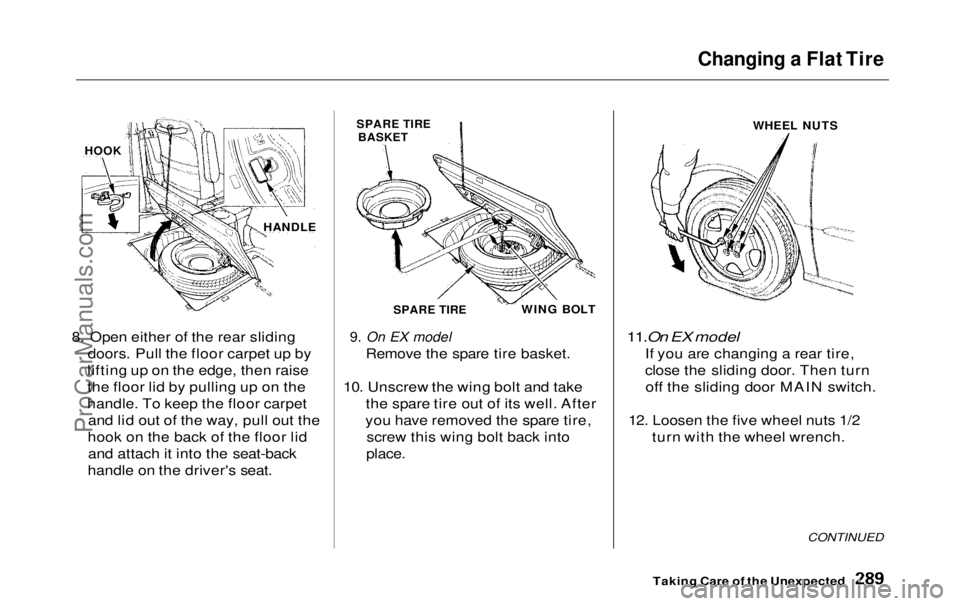
8. Open either of the rear sliding doors. Pull the floor carpet up by
lifting up on the edge, then raise
the floor lid by pulling up on the
handle. To keep the floor carpet and lid out of the way, pull out the
hook on the back of the floor lid and attach it into the seat-back
handle on the driver's seat.
SPARE TIRE
BASKET
SPARE TIRE
WING BOLT
9. On EX model
Remove the spare tire basket.
10. Unscrew the wing bolt and take the spare tire out of its well. After
you have removed the spare tire, screw this wing bolt back into
place.
WHEEL NUTS
11.On EX model
If you are changing a rear tire,
close the sliding door. Then turnoff the sliding door MAIN switch.
12. Loosen the five wheel nuts 1/2 turn with the wheel wrench.
CONTINUED
Taking Care of the Unexpected
HOOK
HANDLEProCarManuals.comMain Menu Table of Contents s t
Page 289 of 343
Changing a Flat Tire
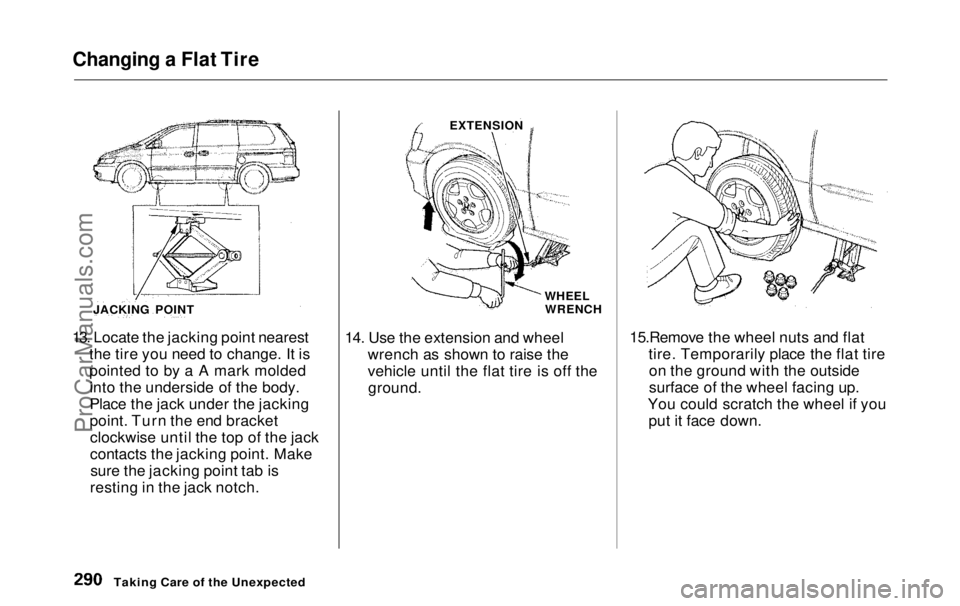
13. Locate the jacking point nearest the tire you need to change. It is
pointed to by a A mark moldedinto the underside of the body.
Place the jack under the jacking
point. Turn the end bracketclockwise until the top of the jack
contacts the jacking point. Makesure the jacking point tab is
resting in the jack notch. WHEEL
WRENCH
14. Use the extension and wheel wrench as shown to raise the
vehicle until the flat tire is off theground. 15.Remove the wheel nuts and flat
tire. Temporarily place the flat tireon the ground with the outside
surface of the wheel facing up.
You could scratch the wheel if you put it face down.
Taking Care of the Unexpected
JACKING POINT
EXTENSIONProCarManuals.comMain Menu Table of Contents s t
Page 290 of 343
Changing a Flat Tire
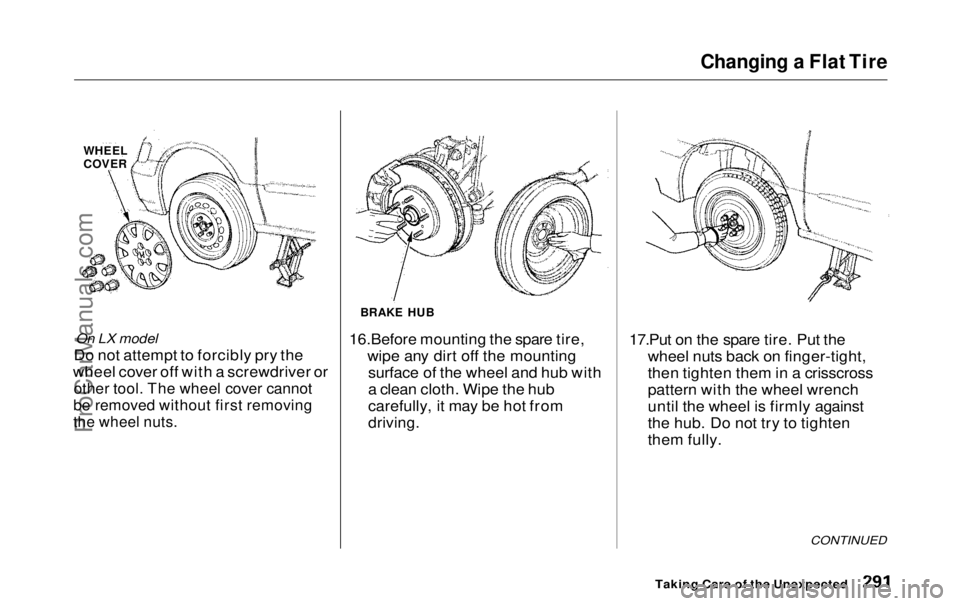
On LX model
Do not attempt to forcibly pry the
wheel cover off with a screwdriver or
other tool. The wheel cover cannot
be removed without first removing
the wheel nuts.
16.Before mounting the spare tire,
wipe any dirt off the mountingsurface of the wheel and hub with
a clean cloth. Wipe the hub
carefully, it may be hot from
driving.
17.Put on the spare tire. Put the
wheel nuts back on finger-tight,
then tighten them in a crisscross
pattern with the wheel wrench
until the wheel is firmly against
the hub. Do not try to tighten
them fully.
CONTINUED
Taking Care of the Unexpected
WHEEL
COVER
BRAKE HUBProCarManuals.comMain Menu Table of Contents s t
Page 291 of 343
Changing a Flat Tire
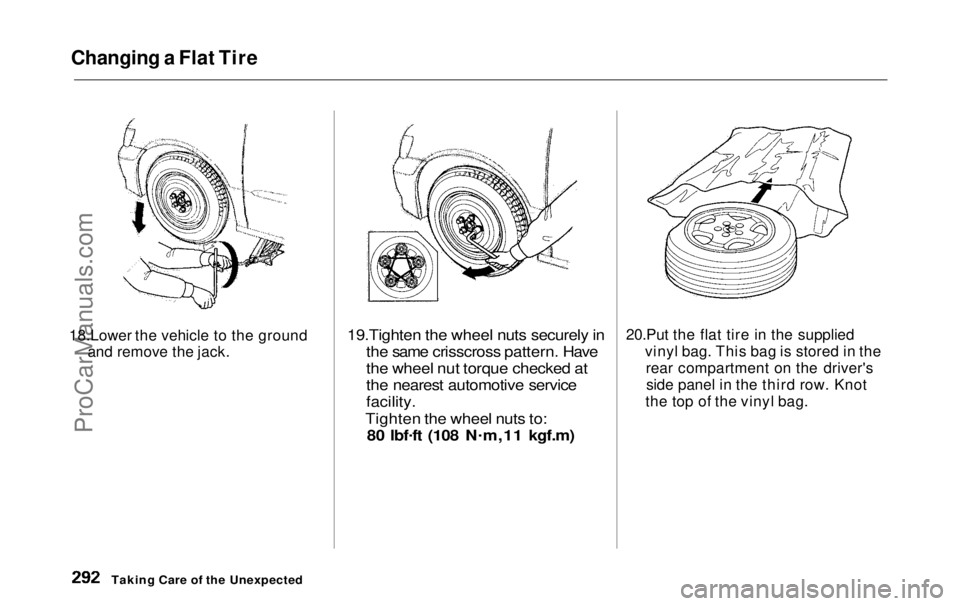
18.Lower the vehicle to the ground and remove the jack.
19.Tighten the wheel nuts securely in
the same crisscross pattern. Have
the wheel nut torque checked at
the nearest automotive service
facility.
Tighten the wheel nuts to: 80 lbf .
ft (108 N .
m,11 kgf.m)
20.Put the flat tire in the supplied
vinyl bag. This bag is stored in therear compartment on the driver'sside panel in the third row. Knot
the top of the vinyl bag.
Taking Care of the UnexpectedProCarManuals.comMain Menu Table of Contents s t
Page 293 of 343
Changing a Flat Tire
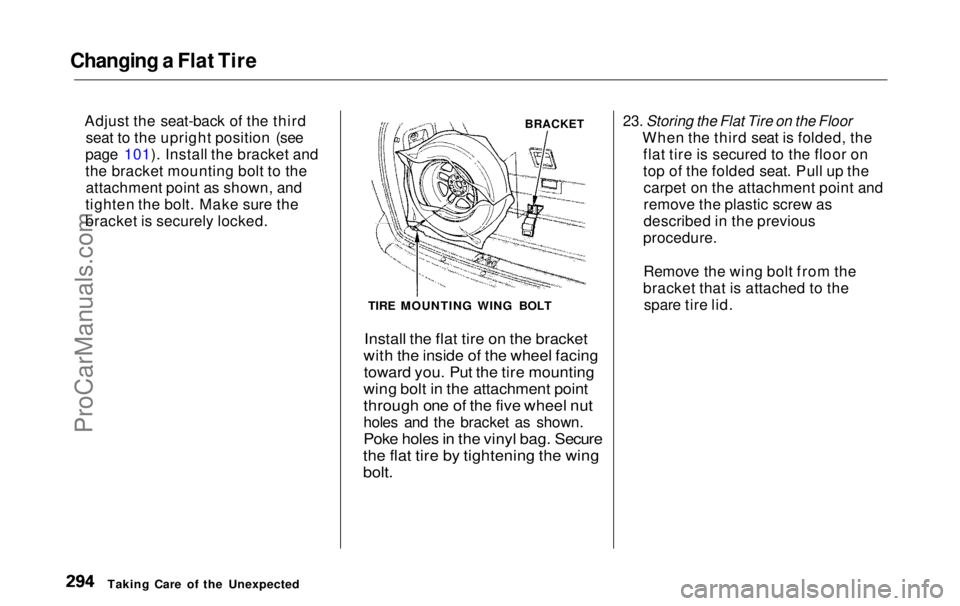
Adjust the seat-back of the thirdseat to the upright position (see
page 101). Install the bracket and
the bracket mounting bolt to the attachment point as shown, and
tighten the bolt. Make sure the
bracket is securely locked.
BRACKET
TIRE MOUNTING WING BOLT
Install the flat tire on the bracket
with the inside of the wheel facing toward you. Put the tire mounting
wing bolt in the attachment point
through one of the five wheel nut
holes and the bracket as shown.
Poke holes in the vinyl bag. Secure
the flat tire by tightening the wing
bolt.
23. Storing the Flat Tire on the Floor
When the third seat is folded, theflat tire is secured to the floor on
top of the folded seat. Pull up thecarpet on the attachment point and
remove the plastic screw as
described in the previous
procedure.
Remove the wing bolt from the
bracket that is attached to the spare tire lid.
Taking Care of the UnexpectedProCarManuals.comMain Menu Table of Contents s t
Page 294 of 343
Changing a Flat Tire
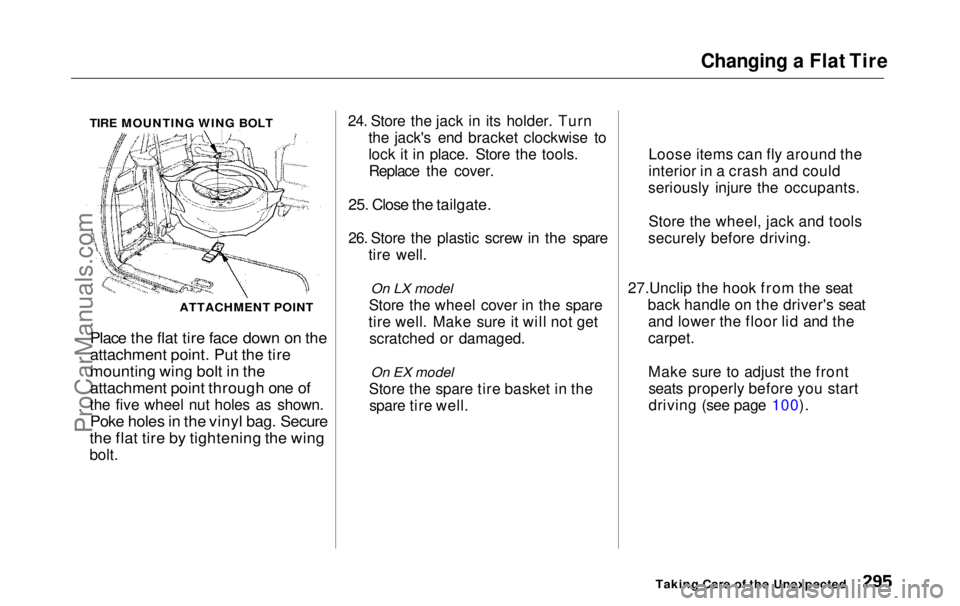
TIRE MOUNTING WING BOLT
Place the flat tire face down on the
attachment point. Put the tire
mounting wing bolt in the
attachment point through one of
the five wheel nut holes as shown.
Poke holes in the vinyl bag. Secure
the flat tire by tightening the wing
bolt. 24. Store the jack in its holder. Turn
the jack's end bracket clockwise to
lock it in place. Store the tools.Replace the cover.
25. Close the tailgate.
26. Store the plastic screw in the spare tire well.
On LX model
Store the wheel cover in the spare
tire well. Make sure it will not get scratched or damaged.
On EX model
Store the spare tire basket in the spare tire well. 27.Unclip the hook from the seat
back handle on the driver's seatand lower the floor lid and the
carpet.
Make sure to adjust the frontseats properly before you start
driving (see page 100).
Taking Care of the Unexpected
ATTACHMENT POINT
Loose items can fly around the
interior in a crash and could
seriously injure the occupants.
Store the wheel, jack and tools
securely before driving.ProCarManuals.comMain Menu Table of Contents s t
Page 303 of 343
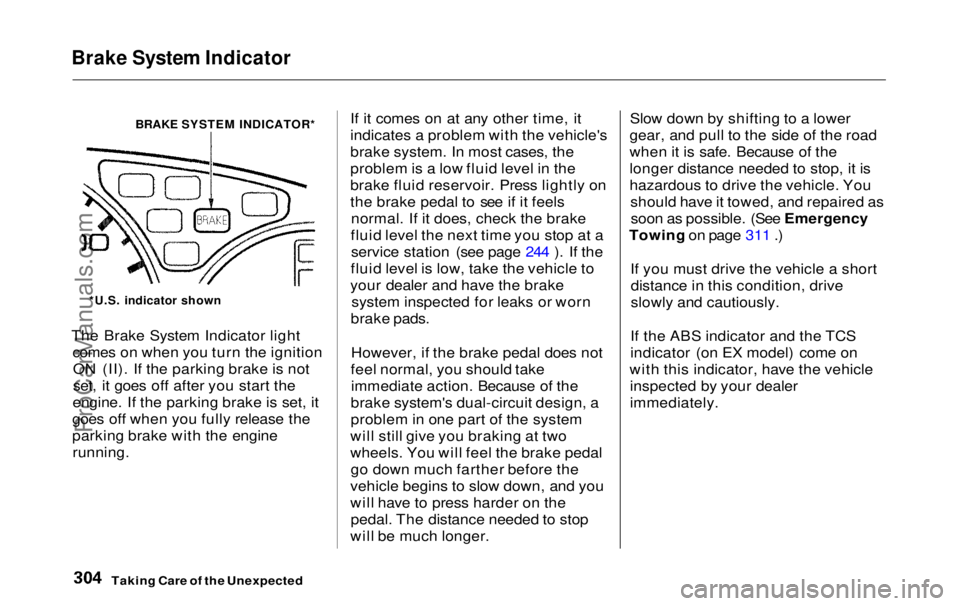
Brake System Indicator
BRAKE SYSTEM INDICATOR*
The Brake System Indicator light comes on when you turn the ignitionON (II). If the parking brake is not
set, it goes off after you start the
engine. If the parking brake is set, it
goes off when you fully release the
parking brake with the engine
running.
If it comes on at any other time, it
indicates a problem with the vehicle's
brake system. In most cases, the
problem is a low fluid level in the
brake fluid reservoir. Press lightly on
the brake pedal to see if it feels
normal. If it does, check the brake
fluid level the next time you stop at a service station (see page 244 ). If the
fluid level is low, take the vehicle to
your dealer and have the brake system inspected for leaks or worn
brake pads.
However, if the brake pedal does not
feel normal, you should take immediate action. Because of the
brake system's dual-circuit design, a
problem in one part of the system
will still give you braking at two
wheels. You will feel the brake pedal go down much farther before the
vehicle begins to slow down, and you
will have to press harder on the pedal. The distance needed to stop
will be much longer. Slow down by shifting to a lower
gear, and pull to the side of the road
when it is safe. Because of the
longer distance needed to stop, it is
hazardous to drive the vehicle. You should have it towed, and repaired assoon as possible. (See Emergency
Towing on page 311 .)
If you must drive the vehicle a shortdistance in this condition, drive
slowly and cautiously.
If the ABS indicator and the TCS
indicator (on EX model) come on
with this indicator, have the vehicle inspected by your dealer
immediately.
Taking Care of the Unexpected
*U.S. indicator shownProCarManuals.comMain Menu Table of Contents s t