catalytic converter HONDA ODYSSEY 1999 Owners Manual
[x] Cancel search | Manufacturer: HONDA, Model Year: 1999, Model line: ODYSSEY, Model: HONDA ODYSSEY 1999Pages: 343, PDF Size: 3.73 MB
Page 204 of 343
Parking
Always use the parking brake when you park your vehicle. The indicator on the instrument panel shows that
the parking brake is not fully released; it does not indicate that the
parking brake is firmly set. Make sure the parking brake is set firmly
or your vehicle may roll if it is
parked on an incline.
Set the parking brake before you put
the transmission in Park. This keeps
the vehicle from moving and putting
pressure on the parking mechanism
in the transmission — making it easier to move the shift lever out of
Park when you want to drive away. If the vehicle is facing uphill, turn
the front wheels away from the curb.
If the vehicle is facing downhill, turn
the front wheels toward the curb.
Make sure the parking brake is fully
released before driving away.
Driving with the parking brake
partially set can overheat or damage
the rear brakes. Parking Tips
Make sure the windows are closed.
Turn off the lights.
Place any packages, valuables, etc.,
in the cargo area or take them
with you.
Lock the doors with the key or the
remote transmitter.
Never park over dry leaves, tall
grass, or other flammable
materials. The three way catalytic
converter gets very hot, and could
cause these materials to catch on
fire.
DrivingProCarManuals.comMain Menu Table of Contents s t
Page 312 of 343
Technical Information
The diagrams in this section give you the dimensions and capacities of
your Honda, and the locations of the identification numbers. The expla-
nations of several electronic and
mechanical systems on your Honda
are for the more technically-orientedowner. Identification Numbers................. 314
Specifications................................. 316
Tire Information............................ 318 Tire Size Designation................ 318
Wheel Size Designation............ 318
Tire Speed Ratings.................... 318DOT Tire Quality Grading....... 319 Treadwear.............................. 319
Traction.................................. 319
Temperature.......................... 320 Oxygenated Fuels.......................... 321
Driving in Foreign Countries....... 322
Emissions Controls........................ 323 The Clean Air Act...................... 323Crankcase Emissions Control
System.....................................323
Evaporative Emissions Control System..................................... 323
Exhaust Emissions Controls.... 324 PGM-FI System..................... 324
Ignition Timing Control
System.................................324
Exhaust Gas Recirculation (EGR) System.................... 324
Three Way Catalytic Converter............................ 324
Replacement Parts................ 324
Three Way Catalytic Converter... 325
Technical InformationProCarManuals.comMain Menu s t
Page 321 of 343

Driving in Foreign Countries
If you are planning to take your
Honda outside the U.S. or Canada,
contact the tourist bureaus in the
areas you will be traveling in to find out about the availability of unleaded
gasoline with the proper octane
rating.
If unleaded gasoline is not available,
be aware that using leaded gasoline
in your Honda will affect perfor- mance and fuel mileage, and damage
its emissions controls. It will no
longer comply with U.S. andCanadian emissions regulations, and
will be illegal to operate in North
America. To bring your vehicle back into compliance will require the re-
placement of several components, such as the oxygen sensors and the
three way catalytic converter. These
replacements are not covered under
warranty.
Technical InformationProCarManuals.comMain Menu Table of Contents s t
Page 323 of 343
Emissions Controls
Exhaust Emissions Controls
The exhaust emissions controls include four systems: PGM-FI,Ignition Timing Control, ExhaustGas Recirculation and Three Way
Catalytic Converter. These four
systems work together to control the
engine's combustion and minimize
the amount of HC, CO, and NOx that comes out the tailpipe. The exhaust
emissions control systems areseparate from the crankcase and
evaporative emissions control
systems.
PGM-FI System
The PGM-FI System uses sequential multiport fuel injection.
It has three subsystems: Air Intake,Engine Control, and Fuel Control.
The Powertrain Control Module (PCM) uses various sensors to
determine how much air is going
into the engine. It then controls how
much fuel to inject under all operat-
ing conditions. Ignition Timing Control System
This system constantly adjusts the ignition timing, reducing the amountof HC, CO and NOx produced.
Exhaust Gas Recirculation (EGR) System
The Exhaust Gas Recirculation (EGR) system takes some of the
exhaust gas and routes it back into
the intake manifold. Adding exhaust gas to the air/fuel mixture reduces
the amount of NOx produced when
the fuel is burned.
Three Way Catalytic Converter
The three way catalytic converter is in the exhaust system. Through
chemical reactions, it converts HC,CO, and NOx in the engine's exhaust
to carbon dioxide (CO2), dinitrogen (N 2), and water vapor. Replacement Parts
The emissions control systems are designed and certified to work to-
gether in reducing emissions to
levels that comply with the Clean Air
Act. To make sure the emissions remain low, you should use only new Genuine Honda replacement parts or
their equivalent for repairs. Using
lower quality parts may increase the emissions from your vehicle.
The emissions control systems are covered by warranties separate from
the rest of your vehicle. Read your
warranty manual for more informa- tion.
Technical InformationProCarManuals.comMain Menu Table of Contents s t
Page 324 of 343
Three Way Catalytic Converter
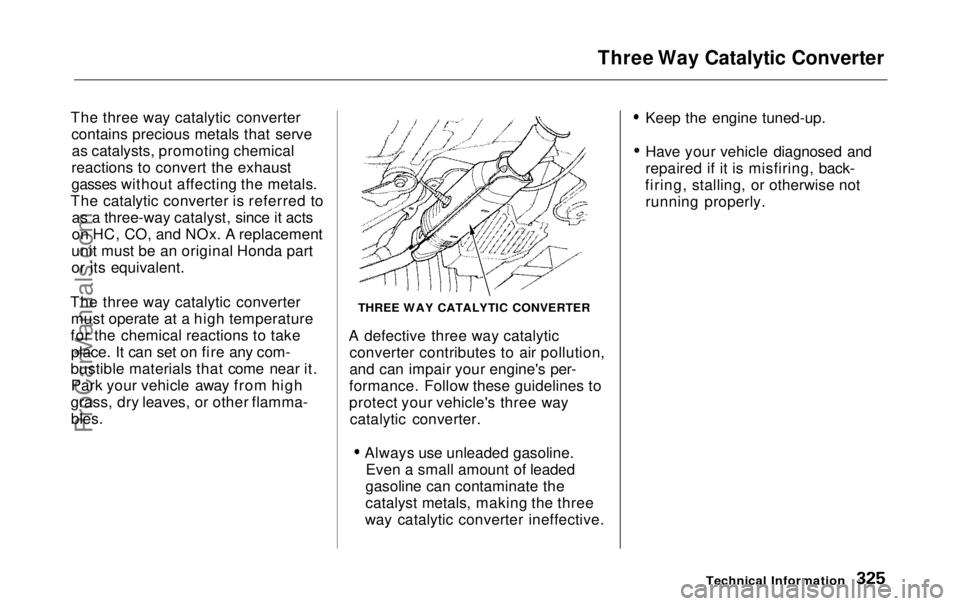
The three way catalytic converter contains precious metals that serveas catalysts, promoting chemical
reactions to convert the exhaust
gasses without affecting the metals.
The catalytic converter is referred to as a three-way catalyst, since it acts
on HC, CO, and NOx. A replacement
unit must be an original Honda part
or its equivalent.
The three way catalytic converter must operate at a high temperature
for the chemical reactions to take place. It can set on fire any com-
bustible materials that come near it. Park your vehicle away from high
grass, dry leaves, or other flamma-
bles.
A defective three way catalytic
converter contributes to air pollution,
and can impair your engine's per-
formance. Follow these guidelines to
protect your vehicle's three way catalytic converter.
Always use unleaded gasoline.Even a small amount of leaded
gasoline can contaminate the
catalyst metals, making the three
way catalytic converter ineffective. Keep the engine tuned-up.
Have your vehicle diagnosed and
repaired if it is misfiring, back-
firing, stalling, or otherwise not running properly.
Technical Information
THREE WAY CATALYTIC CONVERTERProCarManuals.comMain Menu Table of Contents s t
Page 341 of 343
Index
Tachometer...................................... 62
Tailgate............................................. 85
Opening the.................................. 85
Open Monitor Light.................... 60
Taillights, Changing Bulbs in....... 269
Taking Care of the Unexpected .. 285
Tape Player ........................... 154, 175
Technical Descriptions Driving in Foreign Countries... 322
Emissions Control Systems...... 323
Oxygenated Fuels...................... 321
Three Way Catalytic
Converter................................ 325
Tire Information........................ 318
Temperature Gauge........................ 63
Tensioners, Seat Belts .................... 50
Tether Attachment Points.............. 43
Theft Protection............................. 180 Three Way Catalytic Converter... 325
Time, Setting the........................... 117
Timing Belt..................................... 257
Tire Chains..................................... 263
Tire, How to Change a Flat.......... 287 Tires................................................ 257
Air Pressure............................... 257Balancing.................................... 260Checking Wear.......................... 259
Compact Spare........................... 286
DOT Tire Quality Grading....... 319
Inflation....................................... 257
Inspection................................... 259
Replacing.................................... 261
Rotating....................................... 260
Snow............................................ 263 Specifications............................. 317
Tire Chains................................. 263
Technical Information.............. 318
Towing
ATrailer..................................... 212
Emergency Wrecker.................
311
Traction Contro l
System (TCS)... 207
Transmission
Checking Fluid Level................ 243
Fluid Selection............................ 243
Identification Number............... 315
Shifting the Automatic..............199
Treadwear...................................... 319
Trip Meter........................................ 63
Turn Signals..................................... 68
Tools, Tire Changing.................... 287
Underside, Cleaning...................... 282
Unexpected, Taking Care
of the........................................... 285
Uniform Tire Quality Grading..... 319
Unleaded Gasoline......................... 182
Upholstery Cleaning...................... 280
Used Oil, How to Dispose of........ 236
Vanity Mirror................................. 121
Vehicle Capacity Load......... 192, 212
Vehicle Dimensions....................... 316
Vehicle Identification Number..... 314
Vehicle Storage.............................. 275
Ventilation............................. 133, 138
VIN.................................................. 314
Vinyl Cleaning................................ 280
Viscosity, Oil................................... 234
CONTINUEDProCarManuals.comMain Menu s t