belt HONDA ODYSSEY 2000 RA6-RA9 / 2.G User Guide
[x] Cancel search | Manufacturer: HONDA, Model Year: 2000, Model line: ODYSSEY, Model: HONDA ODYSSEY 2000 RA6-RA9 / 2.GPages: 352, PDF Size: 4.43 MB
Page 17 of 352
Protecting Adult s
A front passenger should also adjust
the seat-back to an upright position,
but as far from the dashboard as possible. A passenger who sits tooclose to the dashboard could be
injured if the airbag inflates.
Reclining a seat-back so that the
shoulder part of the belt no longer
rests against the occupant's chest reduces the protective capability of
the belt. It also increases the chance
of sliding under the belt in a crashand being seriously injured. The
farther a seat-back is reclined, the greater the risk of injury.
See page 101 for how to adjust seat-
backs.
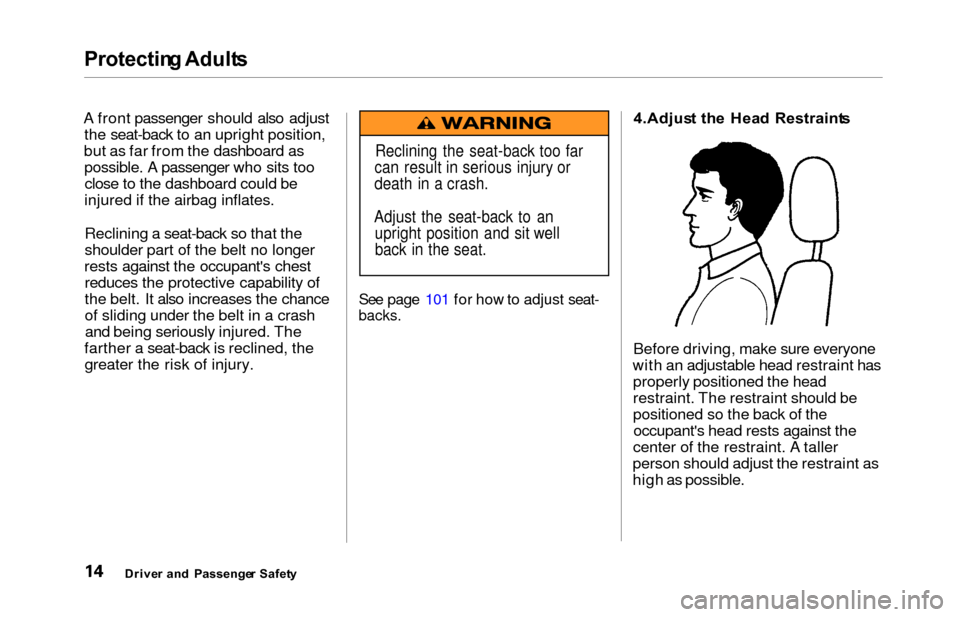
4.Adjus t th e Hea d Restraint s
Before driving, make sure everyone
with an adjustable head restraint has properly positioned the head
restraint. The restraint should be
positioned so the back of theoccupant's head rests against the
center of the restraint. A taller
person should adjust the restraint as
high as possible.
Drive r an d Passenge r Safet y
Reclining the seat-back too far
can result in serious injury or
death in a crash.
Adjust the seat-back to an upright position and sit well
back in the seat.
Page 18 of 352

Protecting Adult s
Properly adjusted head restraints
will help protect occupants from
whiplash and other crash injuries.
See page 104 for how to adjust the
head restraints. 5.Faste
n an d Positio n th e Sea t
Belt s
Using a Lap/Shoulder Belt
(Except the center position of the
third row)
Insert the latch plate into the buckle,
then tug on the belt to make sure the
belt is securely latched. Also check that the belt is not twisted, because a
twisted belt can cause serious injuries in a crash.
Position the lap part of the belt as
low as possible across your hips,
then pull up on the shoulder part of
the belt so the lap part fits snugly.
This lets your strong pelvic bones take the force of a crash and reduces
the chance of internal injuries.
CONTINUED
Drive r an d Passenge r Safet y
Improperly positioning head
restraints reduces their
effectiveness and you can be
seriously injured in a crash.
Make sure head restraints are
in place and positioned properly
before driving.
Page 19 of 352

Protectin
g Adult s
If necessary, pull up on the belt again
to remove any slack from the shoulder part, then check that the
belt rests across the center of your chest and over your shoulder. Thisspreads the forces of a crash over
the strongest bones in your upper
body. If the seat belt touches or crosses
your neck, or if it crosses your arm instead of your shoulder, you need to
adjust the seat belt anchor height.
RELEAS E
BUTTO N
The front seats and middle row seats have adjustable seat belt anchors. Toadjust the height of a seat belt
anchor, press the release button and
slide the anchor up or down as
needed (it has four positions). Never place the shoulder portion of a
lap/shoulder belt under your arm orbehind your back. This could cause
very serious injuries in a crash.
Drive r an d Passenge r Safet y
Improperly positioning the seat
belts can cause serious injury
or death in a crash.
Make sure all seat belts are
properly positioned before
driving.
Page 20 of 352

Protecting Adult s
Using the Lap/Shoulder Belt in the
Center Position of the Third Row
Unlatch the metal plate of the
shoulder belt from the anchor on the
ceiling and extend the belt by pulling
the metal plate.
META L
HOO K
LATC H PLAT E
Attach the metal hook on the edge of
the shoulder belt to the metal loop
on the latch plate of the lap belt
marked CENTER. Make sure the shoulder belt is securely attached
and it is not twisted. A twisted belt
can cause serious injuries in a crash. Insert the latch plate of the lap belt
into the buckle marked CENTER. If
the belt is too short, hold the latch
plate at a right angle and pull on the
plate to extend the belt. Then insert
the latch plate into the buckle, and
tug on the lap and shoulder belts to
make sure the belt is securely
latched.
Drive r an d Passenge r Safet y
META
L PLAT E
CONTINUED
Page 21 of 352

Protecting Adult s
Position the lap belt as low as
possible across your hips, then pull on the loose end of the lap belt for a
snug but comfortable fit. This lets
your strong pelvic bones take the
force of a crash and reduces the chance of internal injuries. If necessary, pull up on the shoulder
belt again to remove any slack from
the shoulder belt, then check that
the belt rests across the center of
your chest and over your shoulder.
This spreads the forces of a crash over the strongest bones in your
upper body.
Never place the shoulder portion of a
lap/shoulder belt under your arm or
behind your back. This could cause
very serious injuries in a crash.
If a Seat Belt Doesn't Work Properly
If a seat belt does not seem to work
as it should, it may not protect the
occupant in a crash. No one should
sit in a seat with an inoperative seat
belt. Anyone using a seat belt that is
not working properly can be seriously injured or killed. Have your
Honda dealer check the belt as soon
as possible.
See page 45 for additional
information about your seat belt system and how to take care of your
belts.
Drive r an d Passenge r Safet y
Page 22 of 352
Protecting Adult s
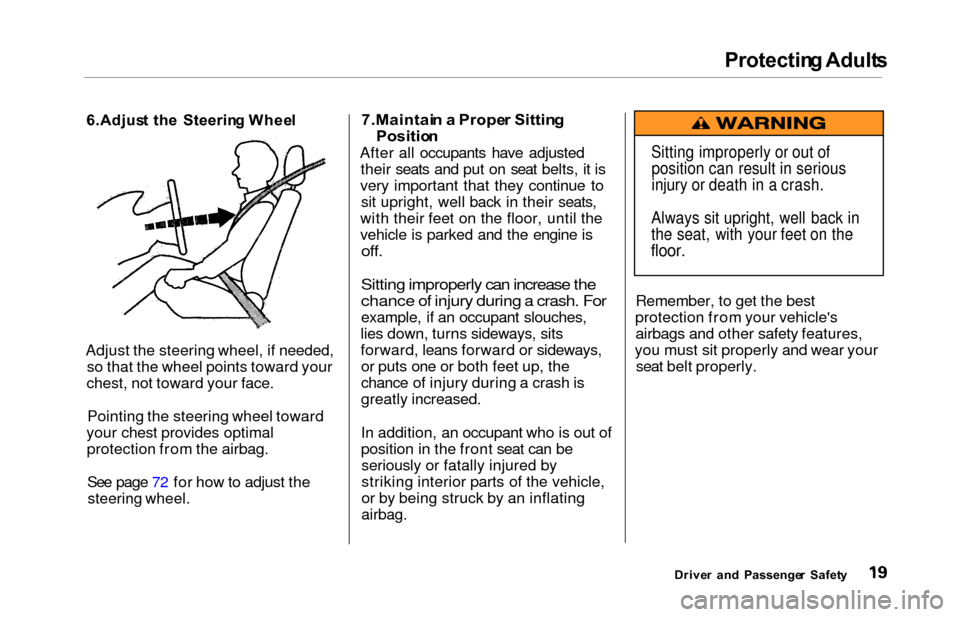
6.Adjus t th e Steerin g Whee l
Adjust the steering wheel, if needed, so that the wheel points toward your
chest, not toward your face.
Pointing the steering wheel toward
your chest provides optimal protection from the airbag.
See page 72 for how to adjust the
steering wheel.
7.Maintai n a Prope r Sittin g
Positio n
After all occupants have adjusted
their seats and put on seat belts, it is
very important that they continue to sit upright, well back in their seats,
with their feet on the floor, until the
vehicle is parked and the engine is
off.
Sitting improperly can increase the
chance of injury during a crash. For
example, if an occupant slouches,
lies down, turns sideways, sits
forward, leans forward or sideways, or puts one or both feet up, the
chance of injury during a crash is
greatly increased.
In addition, an occupant who is out of
position in the front seat can beseriously or fatally injured by
striking interior parts of the vehicle,
or by being struck by an inflating
airbag.
Remember, to get the best
protection from your vehicle's airbags and other safety features,
you must sit properly and wear your seat belt properly.
Drive r an d Passenge r Safet y
Sitting improperly or out of
position can result in serious
injury or death in a crash.
Always sit upright, well back in
the seat, with your feet on the
floor.
Page 23 of 352

Protecting Adult s
Advice fo r Pregnan t Wome n
Because protecting the mother is the
best way to protect her unborn child, a pregnant woman should always
wear a seat belt whenever she drives or rides in a vehicle.
Remember to keep the lap portion of
the belt as low as possible across
your hips. Pregnant women should also sit
upright and as far back as possible
from the steering wheel or dashboard. This will reduce the risk
of injuries to both the mother and
her unborn child that can be caused
by a crash or an inflating airbag.
Each time you have a check-up, ask
your doctor if it's okay for you to drive.Additiona l Safet y Precaution s
Never let passengers ride in the
cargo area or on top of a folded-
down back seat. All passengers
must sit in locked, upright seats
and be properly restrained by seat
belts.
Passengers should not stand up or
change seats while the vehicle is
moving. A passenger who is not
wearing a seat belt during a crash or emergency stop can be thrown
against the inside of the vehicle,
against other occupants, or out of
the vehicle.
Two people should never use the
same seat belt. If they do, they
could be very seriously injured in a
crash.
Drive r an d Passenge r Safet y
Page 24 of 352

Protecting Adult s
Do not put any accessories on seat
belts. Devices intended to improve
occupant comfort or reposition the shoulder part of a seat belt can
severely compromise the
protective capability of the seat
belt and increase the chance of serious injury in a crash.
Do not place hard or sharp objects
between yourself and an airbag.
Carrying hard or sharp objects on
your lap, or driving with a pipe or other sharp object in your mouth,
can result in injuries if your
airbags inflate.
Keep your hands and arms away
from the airbag covers. If your
hands or arms are close to the airbag covers in the center of thesteering wheel and on top of the
dashboard, they could be injured if
the airbags inflate.
Do not attach or place objects on
the airbag covers. Any object
attached to or placed on the covers
marked "SRS AIRBAG," in the center of the steering wheel and
on top of the dashboard, could
interfere with the proper operation of the airbags. Or, if the airbags
inflate, the objects could be
propelled inside the car and hurt
someone.
Drive r an d Passenge r Safet y
Page 25 of 352

Protecting Childre n
Children depend on adults to protect
them. However, despite their best intentions, many parents and other
adults may not know how to properly
protect young passengers.
So if you have children, or if you ever
need to drive with a grandchild or other children in your vehicle, be
sure to read this section. Al
l Childre n Mus t B e Restraine d
Each year, many children are injured
or killed in vehicle crashes because
they are either unrestrained or not
properly restrained. In fact, vehicle accidents are the number one cause
of death of children ages 12 and
under.
To reduce the number of child deaths and injuries, every state andCanadian province requires that
infants and children be restrained
whenever they ride in a vehicle.
Any child who is too small to wear a
seat belt should be properly
restrained in a child seat. (See page
26.)
A larger child should always be restrained with a seat belt. (See page 39.)
Drive r an d Passenge r Safet y
Children who are unrestrained
or improperly restrained can be
seriously injured or killed in a
crash.
Any child too small for a seat belt should be properlyrestrained in a child seat. A
larger child should be properlyrestrained with a seat belt.
Page 26 of 352
Protecting Childre n
Children Shoul d Si t i n th e Bac k
Seat
According to accident statistics,
children of all ages and sizes ar e
safer when they are restrained in the
back seat, not the front seat. The National Highway Traffic Safety
Administration and Transport Canada recommend that all children
ages 12 and under be properly
restrained in a back seat.
In a back seat, children are less
likely to be injured by striking hard interior parts during a collision or
hard braking. Also, children cannot
be injured by an inflating airbag
when they ride in the back.
Th e Passenger' s Airba g Pose s
Seriou s Risk s t o Childre n
Airbags have been designed to help protect adults in a moderate tosevere frontal collision. To do this,
the passenger's airbag is quite large, and it inflates with tremendous
speed.
Infants
Never put a rear-facing child seat in the front seat of a vehicle equipped
with a passenger's airbag. If the
airbag inflates, it can hit the back of
the child seat with enough force to
kill or very seriously injure an infant.
Small Children
Placing a forward-facing child seat in the front seat of a vehicle equipped
with a passenger's airbag can be
hazardous. If the vehicle seat is too
far forward, or the child's head is thrown forward during a collision, an
inflating airbag can strike the child
with enough force to kill or very seriously injure a small child.
Larger Children
Children who have outgrown child
seats are also at risk of being injured or killed by an inflating passenger's
airbag. Whenever possible, larger
children should sit in a back seat,
properly restrained with a seat belt. (See page 39 for important
information about protecting larger children.)
CONTINUED
Drive r an d Passenge r Safet y