Interior HONDA ODYSSEY 2000 RA6-RA9 / 2.G Owners Manual
[x] Cancel search | Manufacturer: HONDA, Model Year: 2000, Model line: ODYSSEY, Model: HONDA ODYSSEY 2000 RA6-RA9 / 2.GPages: 352, PDF Size: 4.43 MB
Page 22 of 352
Protecting Adult s
6.Adjus t th e Steerin g Whee l
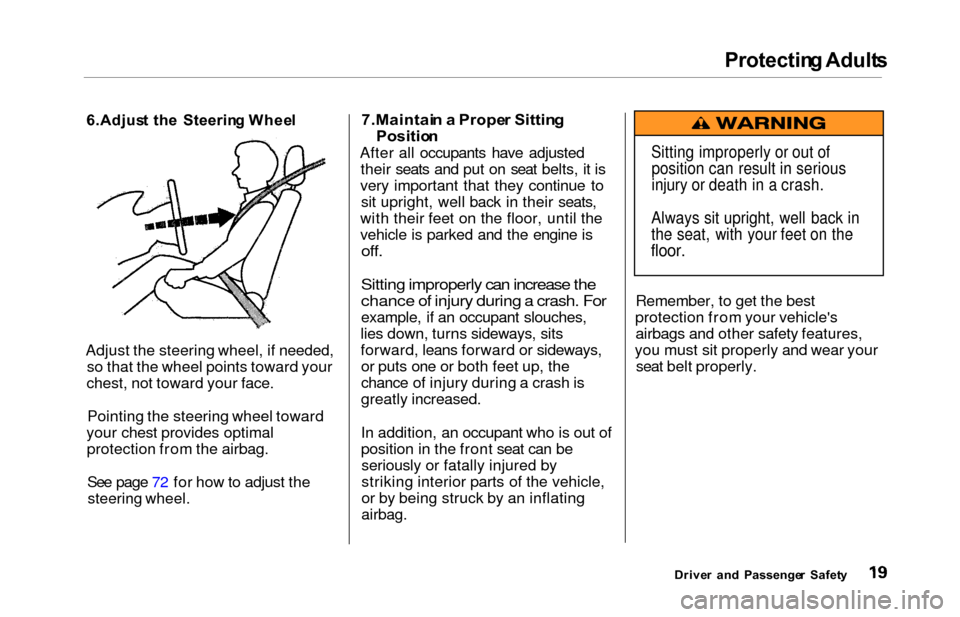
Adjust the steering wheel, if needed, so that the wheel points toward your
chest, not toward your face.
Pointing the steering wheel toward
your chest provides optimal protection from the airbag.
See page 72 for how to adjust the
steering wheel.
7.Maintai n a Prope r Sittin g
Positio n
After all occupants have adjusted
their seats and put on seat belts, it is
very important that they continue to sit upright, well back in their seats,
with their feet on the floor, until the
vehicle is parked and the engine is
off.
Sitting improperly can increase the
chance of injury during a crash. For
example, if an occupant slouches,
lies down, turns sideways, sits
forward, leans forward or sideways, or puts one or both feet up, the
chance of injury during a crash is
greatly increased.
In addition, an occupant who is out of
position in the front seat can beseriously or fatally injured by
striking interior parts of the vehicle,
or by being struck by an inflating
airbag.
Remember, to get the best
protection from your vehicle's airbags and other safety features,
you must sit properly and wear your seat belt properly.
Drive r an d Passenge r Safet y
Sitting improperly or out of
position can result in serious
injury or death in a crash.
Always sit upright, well back in
the seat, with your feet on the
floor.
Page 26 of 352
Protecting Childre n
Children Shoul d Si t i n th e Bac k
Seat
According to accident statistics,
children of all ages and sizes ar e
safer when they are restrained in the
back seat, not the front seat. The National Highway Traffic Safety
Administration and Transport Canada recommend that all children
ages 12 and under be properly
restrained in a back seat.
In a back seat, children are less
likely to be injured by striking hard interior parts during a collision or
hard braking. Also, children cannot
be injured by an inflating airbag
when they ride in the back.
Th e Passenger' s Airba g Pose s
Seriou s Risk s t o Childre n
Airbags have been designed to help protect adults in a moderate tosevere frontal collision. To do this,
the passenger's airbag is quite large, and it inflates with tremendous
speed.
Infants
Never put a rear-facing child seat in the front seat of a vehicle equipped
with a passenger's airbag. If the
airbag inflates, it can hit the back of
the child seat with enough force to
kill or very seriously injure an infant.
Small Children
Placing a forward-facing child seat in the front seat of a vehicle equipped
with a passenger's airbag can be
hazardous. If the vehicle seat is too
far forward, or the child's head is thrown forward during a collision, an
inflating airbag can strike the child
with enough force to kill or very seriously injure a small child.
Larger Children
Children who have outgrown child
seats are also at risk of being injured or killed by an inflating passenger's
airbag. Whenever possible, larger
children should sit in a back seat,
properly restrained with a seat belt. (See page 39 for important
information about protecting larger children.)
CONTINUED
Drive r an d Passenge r Safet y
Page 56 of 352
Carbon Monoxid e Hazar d
Your vehicle's exhaust contains
carbon monoxide gas. You should
hav e no problem with carbon
monoxide entering the vehicle in
normal driving if you maintain your
vehicle properly.
Have the exhaust system inspected
for leaks whenever:
The vehicle is raised for an oil
change.
You notice a change in the soundof the exhaust.
The vehicle was in an accident that may have damaged the under-
side.
High levels of carbon monoxide can
collect rapidly in enclosed areas,such as a garage. Do not run the
engine with the garage door closed.
Even with the door open, run the engine only long enough to move the
vehicle out of the garage. With the tailgate open, air flow can
pull exhaust gas into your vehicle'sinterior and create a hazardous
condition. If you must drive with the
tailgate open, open all the windowsand set the heating and cooling
system/climate control system as
shown below.
If you must sit in your parked vehicle,
even in an unconfined area, with the
engine running, adjust the heating
and cooling system/climate controlsystem as follows:
1. Select the Fresh Air mode.
2. Select the mode.
3. Turn the fan on high speed.
4. Set the temperature control to a comfortable setting.
Drive r an d Passenge r Safet y
Carbon monoxide gas is toxic.
Breathing it can cause
unconsciousness and even kill
you.
Avoid any enclosed areas or activities that expose you to
carbon monoxide.
Page 58 of 352
Instrument
s an d Control s
This section gives information about
the controls and displays that
contribute to the daily operation of
your Honda. All the essential
controls are within easy reach.
Control Locations............................
56
Indicator Lights...............................
. 57
Gauges.............................................. 62
Controls Near the Steering
Wheel........................................ 65
Headlights.................................... 66
Automatic Lighting Off
Feature......................................
67
Daytime Runnin
g Lights.............
67
Instrument
Pane
l Brightness.....
67
Turn
Signals................................
.
68
Windshield
Wipers.....................
. 68
Windshield Washers................... 70
Rear Window Wiper and Washer...................................... 70
Hazard Warning........................ 70
Rear Windo
w Defogger.............. 71
Steering Wheel Adjustment....... 72
Steering Wheel Controls................ 73
Cruise Control.............................. 73
Remote Audio Controls .............. 76
Keys and Locks................................ 76
Keys............................................... 76
Immobilizer System..................... 77
Ignition Switch............................. 78
Power Door Locks....................... 79
Remote Transmitter.................... 81
Childproof Door Locks............... 85
Tailgate......................................... 85
Glove Box..................................... 87
Manual Sliding Doors...................... 88
Power Sliding Doors........................ 89
HomeLink Universal Transmitter.................................. 95
Seats.................................................. 99
Passenger Seating....................... 99
Seat Adjustments....................... 100
Driver's Seat Power
Adjustments........................... 102
Armrests..................................... 103
Head Restraints......................... 104
Third Seat Access...................... 105 Moving the Second Row Bucket Seat............................ 106
Removing the Bucket Seats in the Second Row................. 108
Folding the Third Seat.............. 109
Power Windows............................. 112
Mirrors............................................ 115
Parking Brake................................ 116
Digital Clock................................... 117 Center Table................................... 117
Beverage Holder............................ 118
Sunglasses Holder......................... 120
Sun Visor......................................... 121
Vanity Mirror................................. 121 Rear Compartment........................ 122
Center Pocket................................ 122Coin Holder.................................... 122
Storage Box.................................... 123
Coat Hook....................................... 123
Accessory Power Sockets............. 124 Interior Lights................................ 125
Instrument s an d Control s
Page 89 of 352
Keys an d Lock s
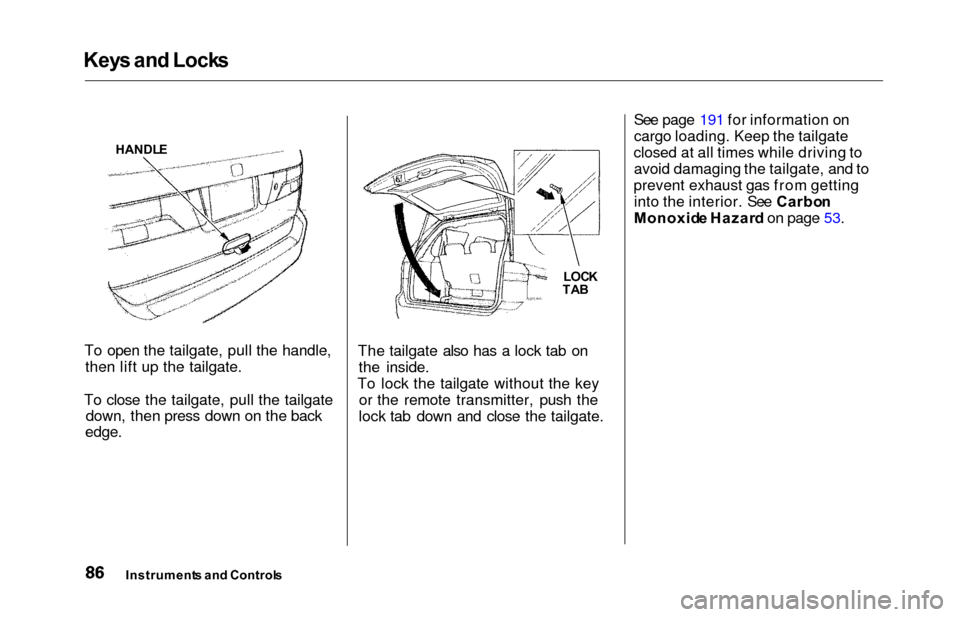
To open the tailgate, pull the handle,
then lift up the tailgate.
To close the tailgate, pull the tailgate down, then press down on the back
edge.
The tailgate also has a lock tab on
the inside.
To lock the tailgate without the key or the remote transmitter, push the
lock tab down and close the tailgate. See page 191 for information on
cargo loading. Keep the tailgate
closed at all times while driving to avoid damaging the tailgate, and to
prevent exhaust gas from getting into the interior. See Carbo n
Monoxid e Hazar d on page 53.
Instrument s an d Control s
LOCK
TA B
HANDL
E
Page 122 of 352
Beverage Holde r
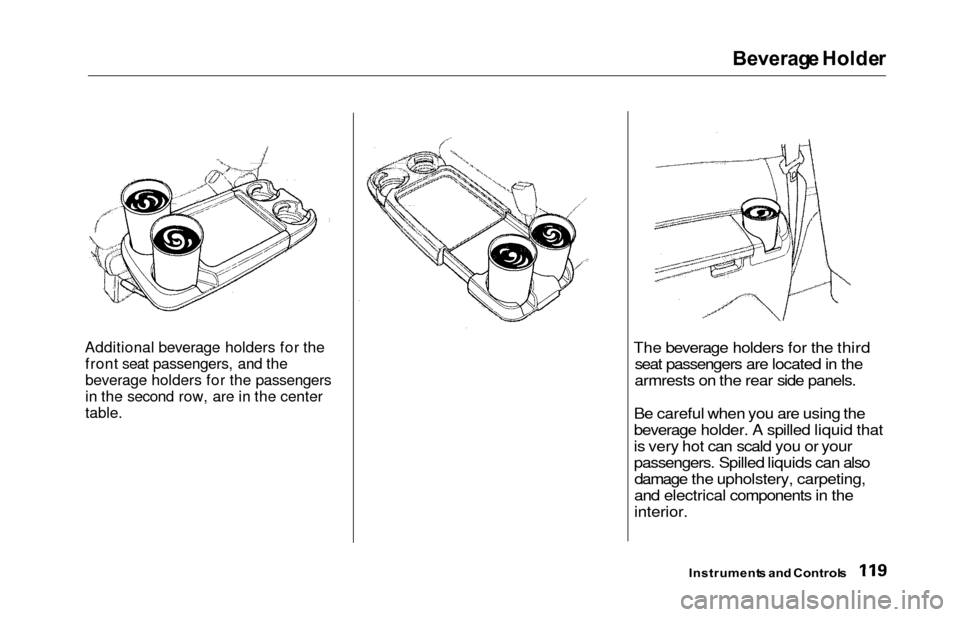
Additional beverage holders for the
front seat passengers, and the
beverage holders for the passengers
in the second row, are in the center
table.The beverage holders for the third seat passengers are located in the
armrests on the rear side panels.
Be careful when you are using the
beverage holder. A spilled liquid that
is very hot can scald you or your
passengers. Spilled liquids can also damage the upholstery, carpeting,
and electrical components in the
interior.
Instrument s an d Control s
Page 128 of 352
Interior Light s
Light Contro l Switc h
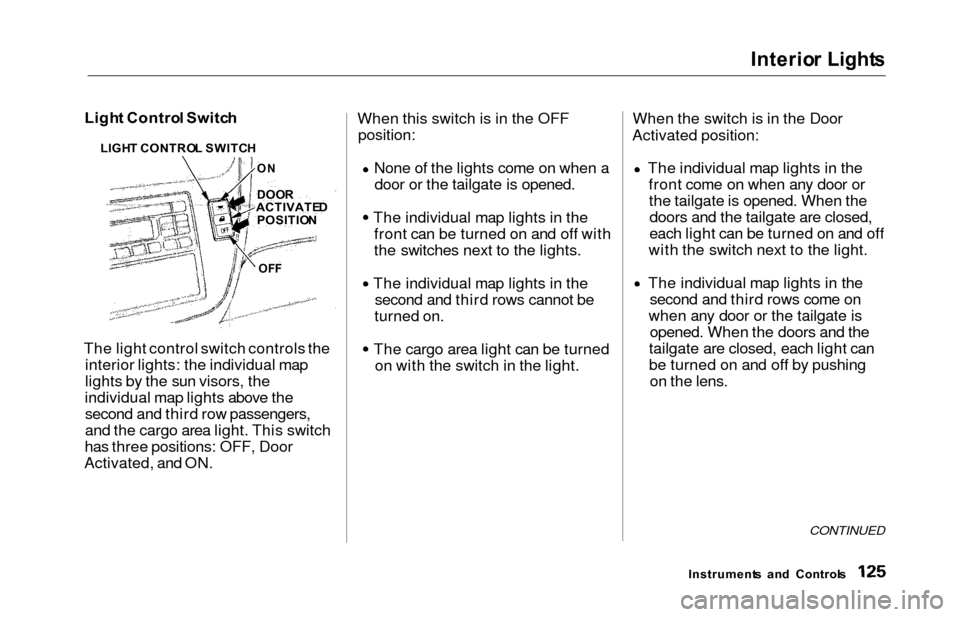
The light control switch controls the interior lights: the individual map
lights by the sun visors, the
individual map lights above the second and third row passengers,
and the cargo area light. This switch
has three positions: OFF, Door
Activated, and ON. When this switch is in the OFF
position:
None of the lights come on when a
door or the tailgate is opened.
The individual map lights in the front can be turned on and off with
the switches next to the lights.
The individual map lights in the second and third rows cannot be
turned on.
The cargo area light can be turned on with the switch in the light. When the switch is in the Door
Activated position:
The individual map lights in thefront come on when any door orthe tailgate is opened. When thedoors and the tailgate are closed,
each light can be turned on and off
with the switch next to the light.
The individual map lights in the second and third rows come on
when any door or the tailgate is opened. When the doors and the
tailgate are closed, each light can
be turned on and off by pushing on the lens.
CONTINUED
Instrument s an d Control s
LIGH
T CONTRO L SWITC H
DOO R
ACTIVATE D
POSITIO N
OFF
O
N
Page 130 of 352
Interior Light s
Individua l Ma p Light s
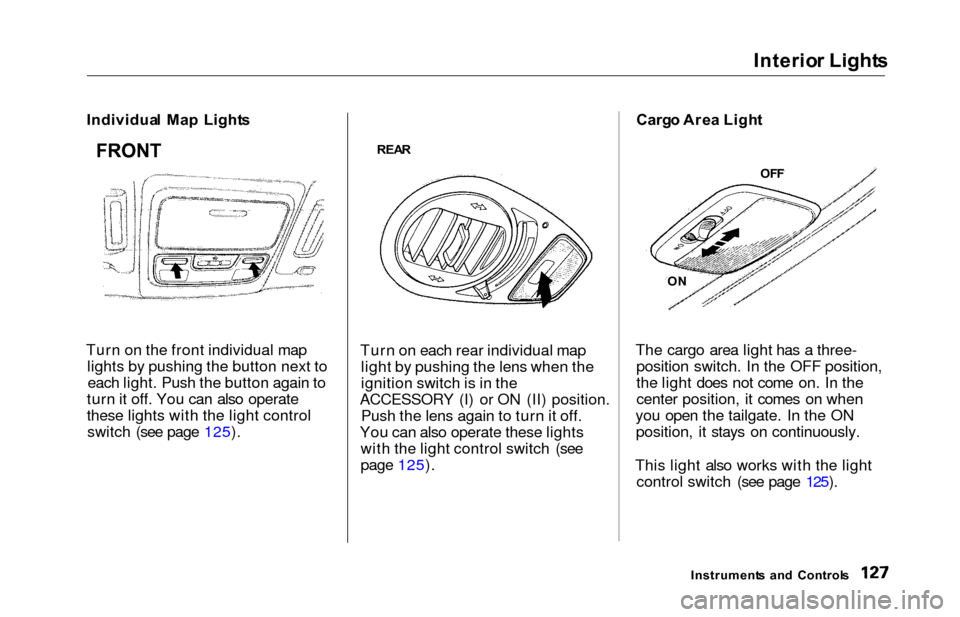
Turn on the front individual map lights by pushing the button next toeach light. Push the button again to
turn it off. You can also operate
these lights with the light control switch (see page 125).
REA R
Turn on each rear individual map
light by pushing the lens when the
ignition switch is in the
ACCESSORY (I) or ON (II) position. Push the lens again to turn it off.
You can also operate these lights with the light control switch (see
page 125). Carg
o Are a Ligh t
The cargo area light has a three- position switch. In the OFF position,
the light does not come on. In the
center position, it comes on when
you open the tailgate. In the ON position, it stays on continuously.
This light also works with the light control switch (see page 125).
Instrument s an d Control s
FRONT
OFF
O N
Page 131 of 352
Interior Light s
Ignitio n Switc h Ligh t
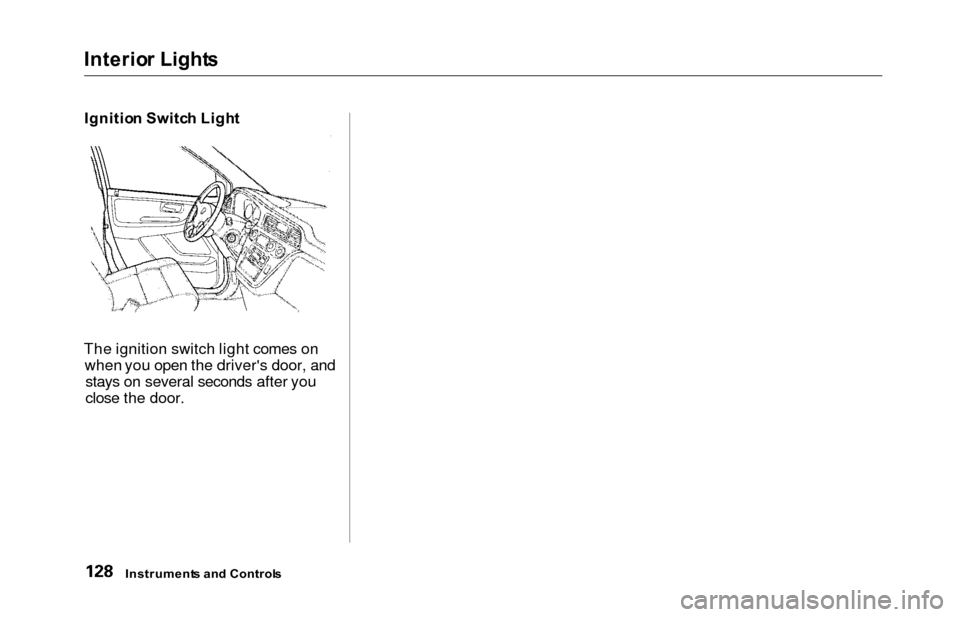
The ignition switch light comes on when you open the driver's door, andstays on several seconds after you
close the door.
Instrument s an d Control s
Page 133 of 352
Heating an d Coolin g
On LX model
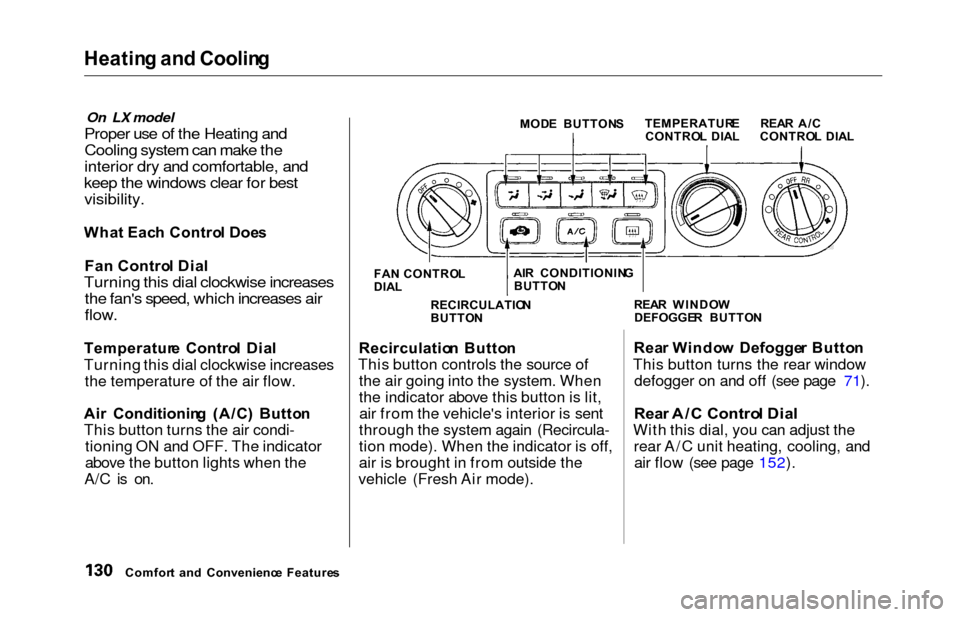
Proper use of the Heating and
Cooling system can make the
interior dry and comfortable, and
keep the windows clear for best
visibility.
Wha t Eac h Contro l Doe s
Fa n Contro l Dia l
Turning this dial clockwise increases
the fan's speed, which increases air
flow.
Temperatur e Contro l Dia l
Turning this dial clockwise increases the temperature of the air flow.
Ai r Conditionin g (A/C ) Butto n
This button turns the air condi- tioning ON and OFF. The indicator
above the button lights when the
A/C is on.
MOD E BUTTON S
FA N CONTRO L
DIA L
Recirculatio n Butto n
This button controls the source of the air going into the system. When
the indicator above this button is lit,air from the vehicle's interior is sent
through the system again (Recircula-
tion mode). When the indicator is off,
air is brought in from outside the
vehicle (Fresh Air mode). Rea
r Windo w Defogge r Butto n
This button turns the rear window defogger on and off (see page 71).
Rea r A/ C Contro l Dia l
With this dial, you can adjust the
rear A/C unit heating, cooling, andair flow (see page 152).
Comfor t an d Convenienc e Feature s RECIRCULATIO
N
BUTTO N REA
R WINDO W
DEFOGGE R BUTTO N
TEMPERATUR
E
CONTRO L DIA L REA
R A/ C
CONTRO L DIA L
AI R CONDITIONIN G
BUTTO N