wiring HONDA ODYSSEY 2000 RA6-RA9 / 2.G Owners Manual
[x] Cancel search | Manufacturer: HONDA, Model Year: 2000, Model line: ODYSSEY, Model: HONDA ODYSSEY 2000 RA6-RA9 / 2.GPages: 352, PDF Size: 4.43 MB
Page 51 of 352
Additional Informatio n Abou t You r SR S
SRS Component s
Your Supplemental Restraint System
(SRS) includes:
Two front airbags. The driver'sairbag is stored in the center of
the steering wheel; the front
passenger's airbag is stored in the dashboard. Both are marked "SRS
AIRBAG."
Automatic seat belt tensioners that tighten the front seat beltsduring a moderate to severe
frontal collision.
Sensors that can detect a
moderate to severe frontal
collision.
A sophisticated electronic system that continually monitors and
records information about thesensors, the control unit, the
airbag activators, driver and
passenger seat belt use, and all
related wiring when the ignition is
ON (II).
An indicator light on the
instrument panel that alerts you to
a possible problem with the
system (see page 50 ).
Emergency backup power in case
your vehicle's electrical system is
disconnected in a crash.
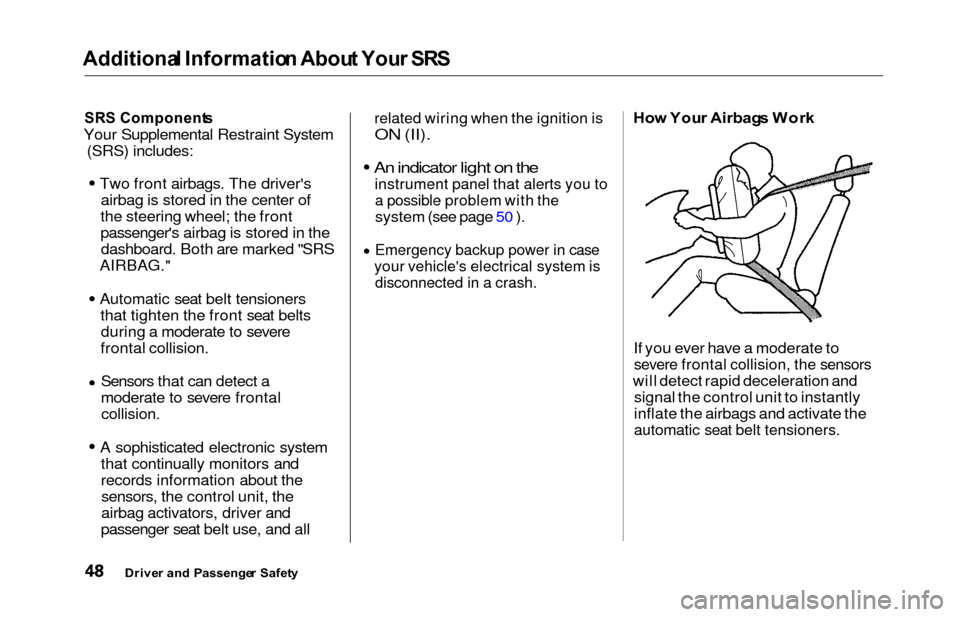
Ho w You r Airbag s Wor k
If you ever have a moderate to
severe frontal collision, the sensors
will detect rapid deceleration and signal the control unit to instantly
inflate the airbags and activate the
automatic seat belt tensioners.
Drive r an d Passenge r Safet y
Page 55 of 352

Additional Informatio n Abou t You r SR S
Additiona l Safet y Precaution s
Do not attempt to deactivate your
airbags. Together, airbags andseat belts provide the best
protection in a moderate to severe
frontal collision.
Do not tamper with SRS
components or wiring for any
reason. Tampering could cause
the airbags to deploy, possibly
causing very serious injury.
See page 196 for further information
and precautions relating to your SRS.
Drive r an d Passenge r Safet y
Page 224 of 352
Towing a Traile r
Trailer Brakes
Honda recommends that any trailer
having a total weight of 1,000 Ibs (450 kg) or more be equipped with
its own electric or surge-type brakes.
If you choose electric brakes, be sure they are electronically actuated.
Do not attempt to tap into your
vehicle's hydraulic system. No matter how successful it may seem,any attempt to attach trailer brakes
to your vehicle's hydraulic system
will lower braking effectiveness and create a potential hazard.
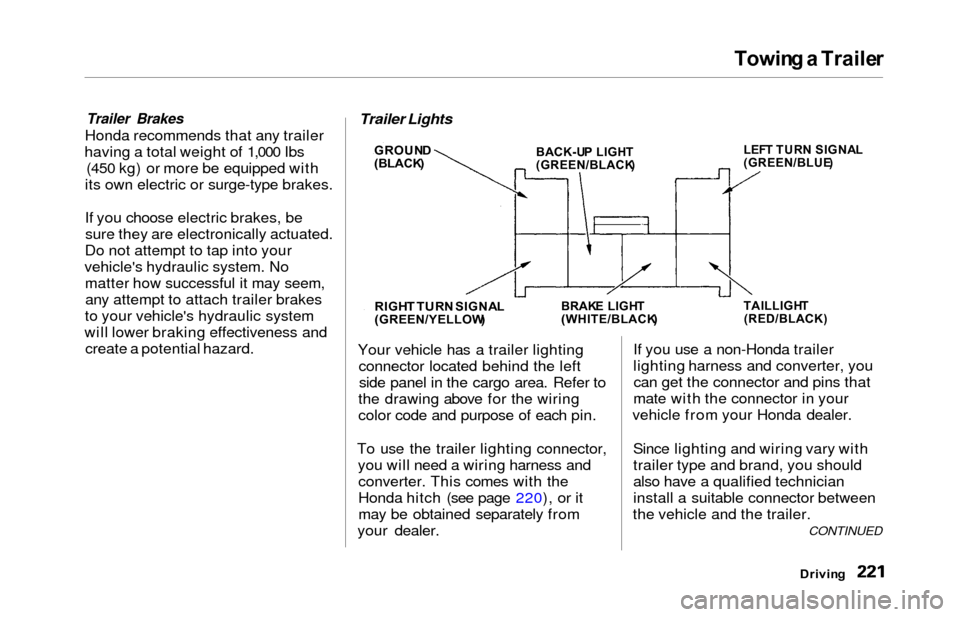
Your vehicle has a trailer lightingconnector located behind the leftside panel in the cargo area. Refer to
the drawing above for the wiring
color code and purpose of each pin.
To use the trailer lighting connector, you will need a wiring harness andconverter. This comes with the
Honda hitch (see page 220), or it
may be obtained separately from
your dealer. If you use a non-Honda trailer
lighting harness and converter, you
can get the connector and pins that
mate with the connector in your
vehicle from your Honda dealer.
Since lighting and wiring vary with
trailer type and brand, you should
also have a qualified technician
install a suitable connector between
the vehicle and the trailer.
Drivin g
CONTINUED
Trailer Lights
GROUN
D
(BLACK )
RIGHT TUR N SIGNA L(GREEN/YELLOW )
BACK-UP LIGH T(GREEN/BLACK ) LEF
T TUR N SIGNA L
(GREEN/BLUE )
BRAKE LIGH T(WHITE/BLACK )TAILLIGHT(RED/BLACK)
Page 291 of 352
Corrosion Protectio n
Two factors normally contribute to
causing corrosion in your vehicle:
1. Moisture trapped in body cavities. Dirt and road salt that collects in
hollows on the underside of the
vehicle stays damp, promoting corrosion in that area.
2. Removal of paint and protective coatings from the exterior and
underside of the vehicle. Many corrosion-preventive measures
are built into your Honda. You can
help keep your vehicle from corroding by performing somesimple periodic maintenance:
Repair chips and scratches in the
paint as soon as you discover them.
Inspect and clean out the drain
holes in the bottom of the doors and body.
Check the floor coverings fordampness. Carpeting and floor
mats may remain damp for a long
time, especially in winter. This dampness can eventually cause
the floor panels to corrode. Use a high-pressure spray to clean
the underside of your vehicle. This
is especially important in areas
that use road salt in winter. It is also a good idea in humid climates
and areas subject to salt air. Be
careful of the ABS wheel sensors
and wiring at each wheel.
Have the corrosion-preventive
coatings on the underside of your
vehicle inspected and repaired periodically.
Appearanc e Car e