check engine light HONDA PASSPORT 2000 2.G User Guide
[x] Cancel search | Manufacturer: HONDA, Model Year: 2000, Model line: PASSPORT, Model: HONDA PASSPORT 2000 2.GPages: 267, PDF Size: 3.03 MB
Page 156 of 267

switch is turned to the "ON"
or "START" position.
5. Check all gauges (including
the fuel gauge).
6. Release the parking brake
(and make sure the "BRAKE"
light turns off).
See related topics in this manual if
you find any problems.
Startin g th e Engin e
1. Apply the parking brake.
2. Manual Transmission: Press
the clutc
h pedal to the floor
and shift the transmission to
the Neutral position. Hold the
clutch pedal to the floor while
you are starting the engine. A starter safety switch keeps the
starter from operating if the
clutch pedal is not fully
depressed.
Automatic Transmission:
Place the shift lever in "P"
or "N" position ("P" is
preferred). A starter safety switch prevents the starter
from operating if the shift lever is in any drive position.
If it is necessary to restart the
engine with the vehicle
moving, place the shift lever in "N" (never in "P").
3. Do not touch the accelerator pedal. Start the engine byturning the ignition switch to
"START."
If the engine does not start in 10 seconds, wait 15 seconds to let
the starter cool down. Then crank
the engine at wide open throttle
for a maximum of 10 seconds. If
the engine still does not start, wait
another 15 seconds and repeat the
entire procedure. Do not crank the engine for more
than 10 seconds at a time. Wait 15
seconds before trying again.
4. Return the ignition switch to
the "ON" position as soon as
the engine starts.
5. Apply the regular brakes and shift into the proper gear.
Release the parking brake and
brake pedal and drive off.
In models with an automatic
transmission, you cannot shift
from "P" (Park) position to any other position unless the
brake pedal is applied.
Driving Tip s
Page 157 of 267
Ne
w Vehicl e Break-I n
You may drive your new vehicle
from its very first mile/kilometer without following a formal
"break-in" schedule. However,
there are things you can do during
the first few hundred miles/
kilometers of driving that will add
to the future performance and
economy of your vehicle.
It is recommended that your speed
during the first 500 miles (800
kilometers) be limited to a
maximum of 55 mph (90 km/h) and that you do not drive for long
periods at any one constant speed, either fast or slow. During this
period, avoid full-throttle starts and, if possible, avoid hard stops;
especially during the first 200
miles (320 kilometers) of driving.
Always drive at moderate speed
until the engine has completely warmed up.
Parkin
g
When leaving your vehicle
unattended:
Set the parking brake.
Place the shift lever in "P" (Park) position for automatic
transmission.
When parking a vehicle equipped
with a manual transmission on an
upward slope, or on a level surface, place the shift lever in
the "1st" position.
When parking a vehicle
equipped with a manual
transmission on a downward slope, place the shift lever in
the "R" (Reverse) position. Turn the key to the "LOCK"
position.
Remove the key. The beeper
will remind you. Close all windows and lock all
doors.
Check to make certain the
lights are turned off. The
beeper will remind you. If your vehicle is equipped with
a transfer case (4WD), make
sure the shift lever is in 4H or
4L.
Parkin g Tip s
Never drive the vehicle with
the parking brake set. This can
overheat the rear brakes,
reducing their effectiveness and
causing excessive wear or
damage.
Always apply the parking brake
whenever you leave the vehicle,
whether it is equipped with a
manual or automatic transmission.
Drivin g Tip s
Page 159 of 267
hazard. This is sometimes referred
to as "stomp and steer."
You will feel a pulsation in the
brake pedal when the ABS activates, and you may hear some
noise. This is normal, it is theABS rapidly pumping the brakes.
Activation varies with the amount
of traction your tires have. On dry
pavement, you will need to press on the brake pedal very hard
before you activate the ABS. However, you may feel the ABSactivate immediately if you are
trying to stop on snow or ice.
Important Safety Reminders AB S doe s no t reduc e th e tim e
o r distanc e it take s t o sto p th e
vehicle , it only helps with steering
control during braking. You
should always maintain a safe following distance from other
vehicles.
AB
S wil l no t preven t a ski d tha t
result s fro m changin g directio n
abruptly , such as trying to take a
corner too fast or making a sudden lane change. Always drive
at a safe, prudent speed for the
road and weather conditions.
AB S canno t preven t a los s o f
stability . Always steer moderately
when you are braking hard. Severe or sharp steering wheel
movement can still cause your
vehicle to veer into oncoming traffic or off the road.
A vehicl e wit h AB S ma y requir e
a longe r distanc e t o sto p o n
loose or uneven surfaces, such as
gravel or snow, than a vehicle
without anti-lock. Slow down and allow a greater distance between
vehicles under those conditions.
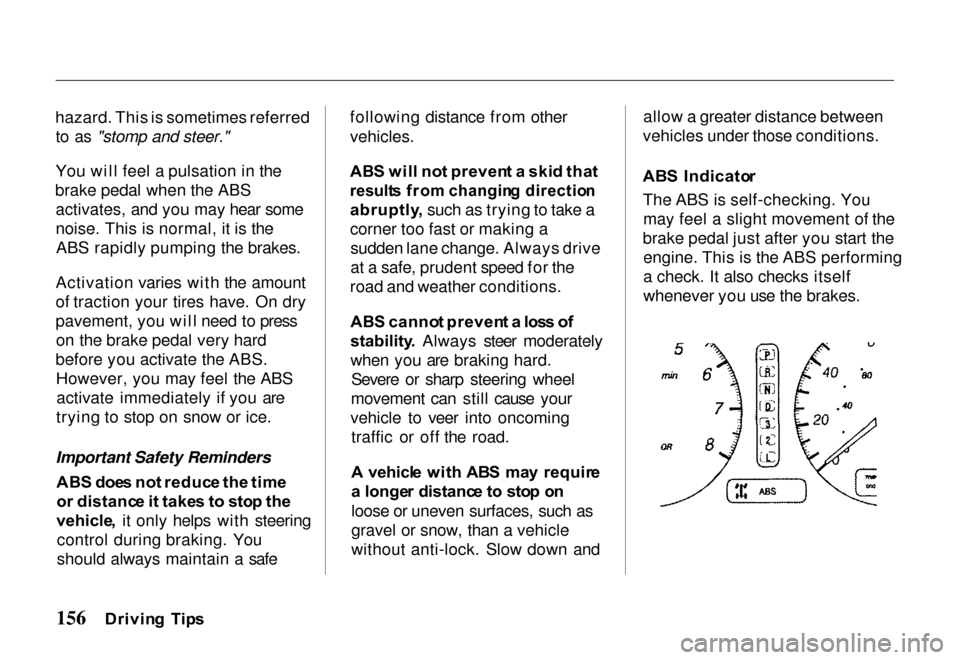
AB S Indicato r
The ABS is self-checking. You may feel a slight movement of the
brake pedal just after you start the engine. This is the ABS performing
a check. It also checks itself
whenever you use the brakes.
Drivin g Tip s
Page 199 of 267
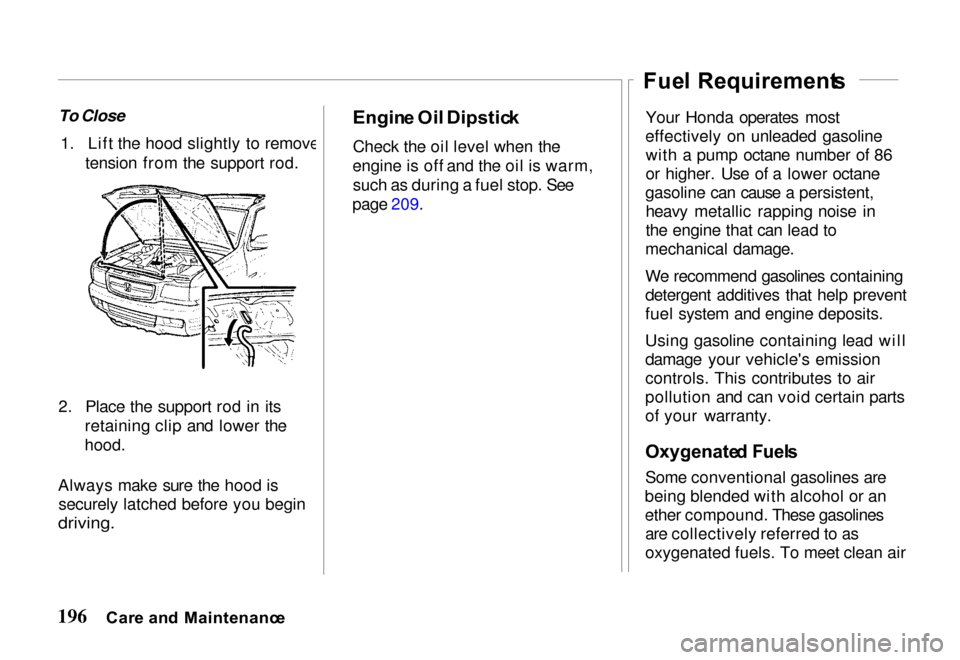
To Close
1. Lift the hood slightly to remove tension from the support rod.
2. Place the support rod in its retaining clip and lower the
hood.
Always make sure the hood is securely latched before you begin
driving.
Engin
e Oi l Dipstic k
Check the oil level when the
engine is off and the oil is warm, such as during a fuel stop. See
page 209. Your Honda operates most
effectively on unleaded gasoline with a pump octane number of 86
or higher. Use of a lower octane
gasoline can cause a persistent, heavy metallic rapping noise in
the engine that can lead to
mechanical damage.
We recommend gasolines containing
detergent additives that help prevent
fuel system and engine deposits.
Using gasoline containing lead will
damage your vehicle's emission
controls. This contributes to air
pollution and can void certain parts
of your warranty.
Oxygenate d Fuel s
Some conventional gasolines are
being blended with alcohol or an
ether compound. These gasolines are collectively referred to as
oxygenated fuels. To meet clean air
Car e an d Maintenanc e
Fue
l Requirement s
Page 207 of 267
Owne
r Safet y Check s
Promptly take any safety
problems to your Honda dealer for service advice.
Parkin g brak e — Park on a fairly
steep hill and hold the vehicle
with the parking brake only. This
checks its holding ability.
Starte r safet y switc h (automati c
transmission ) — Check the safety
switch by trying to start the
engine in each gear. The starter should work only with the shift
lever in the "P" (Park) or "N" (Neutral) position.
Starte r safet y switc h (manua l
transmission ) — To check the
safety switch, place the shift lever
in "Neutral," push the clutch
pedal halfway and try to start the engine. The starter should not
work. The starter should work only when the clutch pedal is fully
depressed.
Transmissio n shif t indicato r
(automati c transmission ) —
Check that the indicator points to
the gear chosen.
Steerin g — Be alert for any
changes in steering action. An inspection or service is needed
when the steering wheel is harder
to turn or has too much free play,
or if there are unusual sounds when turning or parking.
Whee l alignment , balanc e an d
tire s — Uneven or abnormal tire
wear, or pulling to the right or left
on a straight and level road may show the need for a wheel
alignment. A vibration of the
steering wheel or seat at normal
highway speeds means wheel balancing is needed. Check tire
pressures (including the spare) at
least monthly and whenever the
vehicle is serviced (see page 159).
Brake s — Watch for the
"BRAKE" light coming on. Other signs of possible brake trouble are
such things as repeated pulling to
one side when braking, unusual sounds when braking or between
brake applications, or increased
brake pedal travel. If you note one
of these conditions, have the system checked at once and
repaired if needed.
Car e an d Maintenanc e
Page 211 of 267
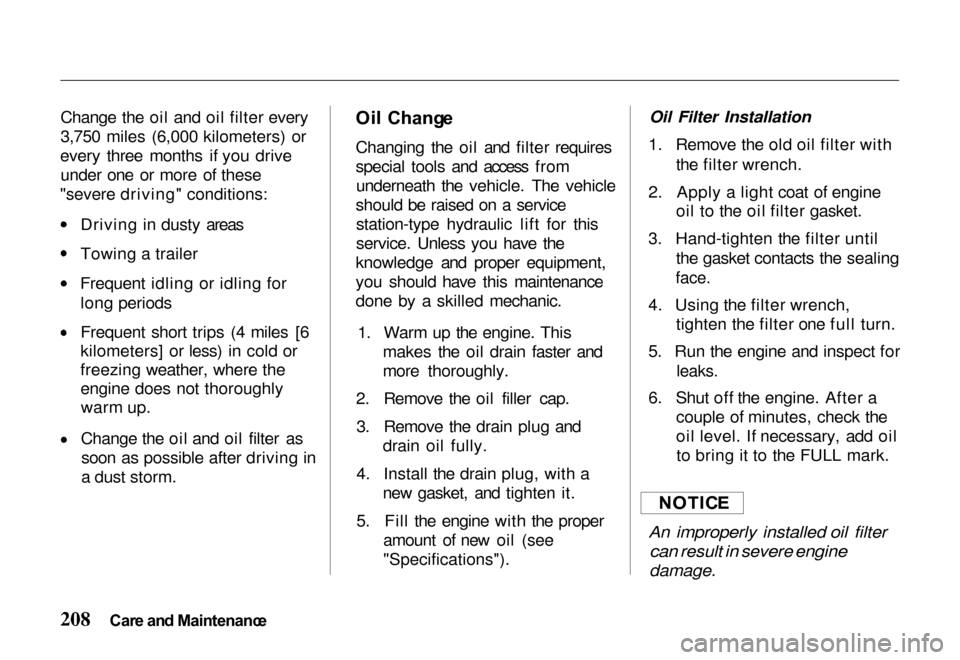
Change the oil and oil filter every
3,750 miles (6,000 kilometers) or
every three months if you drive under one or more of these
"severe driving" conditions: Driving in dusty areas
Towing a trailer
Frequent idling or idling for
long periods Frequent short trips (4 miles [6
kilometers] or less) in cold or
freezing weather, where the
engine does not thoroughly
warm up. Change the oil and oil filter as
soon as possible after driving in
a dust storm.
Oi
l Chang e
Changing the oil and filter requires
special tools and access from underneath the vehicle. The vehicle
should be raised on a service station-type hydraulic lift for this
service. Unless you have the
knowledge and proper equipment,
you should have this maintenance
done by a skilled mechanic.
1. Warm up the engine. This makes the oil drain faster and
more thoroughly.
2. Remove the oil filler cap.
3. Remove the drain plug and drain oil fully.
4. Install the drain plug, with a new gasket, and tighten it.
5. Fill the engine with the proper amount of new oil (see
"Specifications"). Oil Filter Installation
1. Remove the old oil filter with the filter wrench.
2. Apply a light coat of engine oil to the oil filter gasket.
3. Hand-tighten the filter until the gasket contacts the sealing
face.
4. Using the filter wrench, tighten the filter one full turn.
5. Run the engine and inspect for
leaks.
6. Shut off the engine. After a couple of minutes, check the
oil level. If necessary, add oilto bring it to the FULL mark.
An improperly installed oil filter can result in severe engine
damage.
Car e an d Maintenanc e
NOTIC
E
Page 220 of 267

Hoo
d Latc h an d Hinge s
Lubricate the hood latch assembly
and hood hinge assembly as
follows:
1. Wipe off any accumulatio n of
dirt o
r contamination on the
latch parts.
2. Apply multipurpose-type grease (NLGI No. 1 or 2) to
the hood latch pin cam.
3. Apply light engine oil to all pivot points in the release
mechanism.
4. Lubricate hood hinges with multipurpose-type grease
(NLGI No. 1 or 2).
5. Check the hood hinges and
latch mechanism to assure
they are working correctly.
Ai
r Conditionin g
Periodically have your Honda dealer check your air conditioning
system to be sure there has been
no loss in cooling output. See
your Honda dealer if you suspect
that the system is not performing
as it should.
Bod y Lubricatio n
Normal use of a vehicle causes
metal-to-metal movement at certain
points in the body. Noise, wear and improper operation at these points
will result when a protective film of lubricant is not provided.
For exposed surfaces such as door
checks, door lock bolts, lock striker plates, etc., apply a thin
film of light engine oil.
Any lubricant should be used
sparingly. After application, all excess lubricant should be
carefully wiped off.
The seat adjusters and seat track should be lubricated with water-
resistant EP chassis lubricant.
There are other points on the
vehicle body which may occasionally require lubrication.
Window regulators and controls are confined in the space between
the upholstery and the outside
door panel. Easy access to the
working parts may be made by
removing the trim. Door weatherstrips and rubber hood
bumpers should be lightly coatedwith a rubber lubricant.
Car e an d Maintenanc e
Page 256 of 267
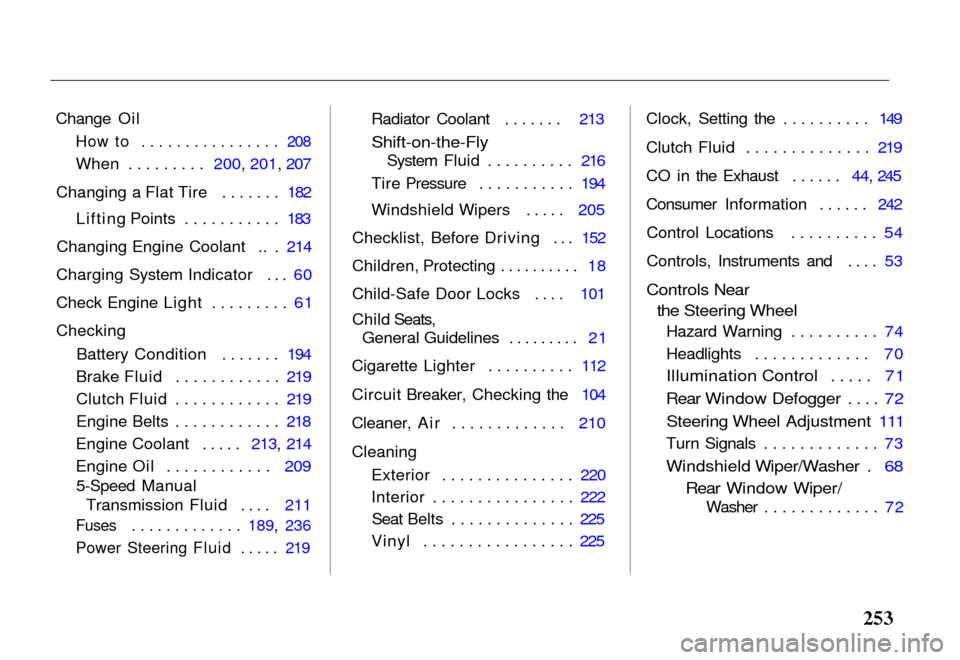
Change Oil
How to ................ 208
When ......... 200, 201, 207
Changing a Flat Tire ....... 182 Lifting Points ........... 183
Changing Engine Coolant .. . 214
Charging System Indicator ... 60
Check Engine Light ......... 61
Checking Battery Condition ....... 194
Brake Fluid ............ 219
Clutch Fluid ............ 219
Engine Belts ............ 218
Engine Coolant ..... 213, 214
Engine Oil ............ 209 5-Speed Manual Transmission Fluid .... 211
Fuses .............
189, 236
Power Steering Fluid .....
219
Radiator Coolan
t ....... 213
Shift-on-the-Fly
System Fluid .......... 216
Tire Pressure ........... 194
Windshield Wipers ..... 205
Checklist, Before Driving ... 152
Children, Protecting .......... 18
Child-Safe Door Locks .... 101
Child Seats, General Guidelines ......... 21
Cigarette Lighter .......... 112
Circuit Breaker, Checking the 104
Cleaner, Air ............. 210
Cleaning Exterior ............... 220
Interior ................ 222Seat Belts .............. 225
Vinyl ................. 225 Clock, Setting the .......... 149
Clutch Fluid .............. 219
CO in the Exhaust ......
44, 245
Consumer Information ...... 242 Control Locations .......... 54
Controls, Instruments and .... 53
Controls Near the Steering Wheel
Hazard Warning .......... 74
Headlights ............. 70
Illumination Control ..... 71
Rear Window Defogger .... 72
Steering Wheel Adjustment 111
Turn Signals ............. 73
Windshield Wiper/Washer . 68
Rear Window Wiper/
Washer ............. 72
Page 257 of 267
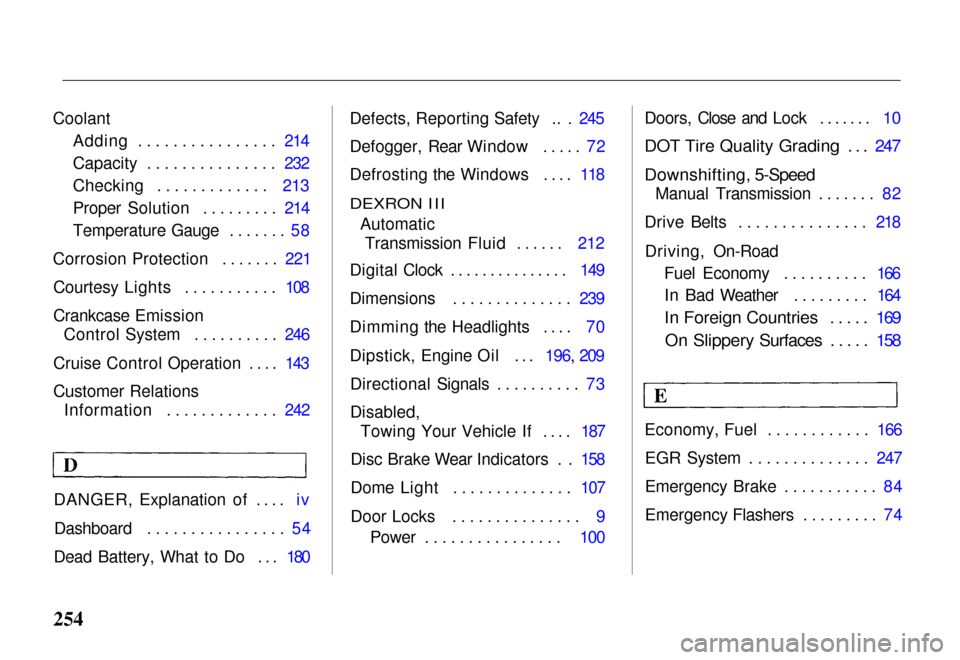
Coolant
Adding ................ 214
Capacity ............... 232
Checking ............. 213
Proper Solution ......... 214
Temperature Gauge ....... 58
Corrosion Protection ....... 221 Courtesy Lights ........... 108
Crankcase Emission Control System .......... 246
Cruise Control Operation .... 143
Customer Relations Information ............. 242
DANGER, Explanation of .... iv Dashboard ................ 54
Dead Battery, What to Do ... 180 Defects, Reporting Safety .. . 245
Defogger, Rear Window ..... 72
Defrosting the Windows .... 118
DEXRON III
AutomaticTransmission Fluid ...... 212
Digital Clock ............... 149
Dimensions .............. 239
Dimming the Headlights .... 70
Dipstick, Engine Oil ... 196, 209
Directional Signals .......... 73
Disabled, Towing Your Vehicle If .... 187
Disc Brake Wear Indicators . . 158
Dome Light .............. 107
Door Locks ............... 9 Power ................ 100 Doors, Close and Lock ....... 10
DOT Tire Quality Grading ... 247
Downshifting, 5-Speed
Manual Transmission ....... 82
Drive Belts ............... 218
Driving, On-Road Fuel Economy .......... 166In Bad Weather ......... 164
In Foreign Countries ..... 169
On Slippery Surfaces ..... 158
Economy, Fuel ............ 166 EGR System .............. 247
Emergency Brake ........... 84
Emergency Flashers ......... 74
Page 258 of 267
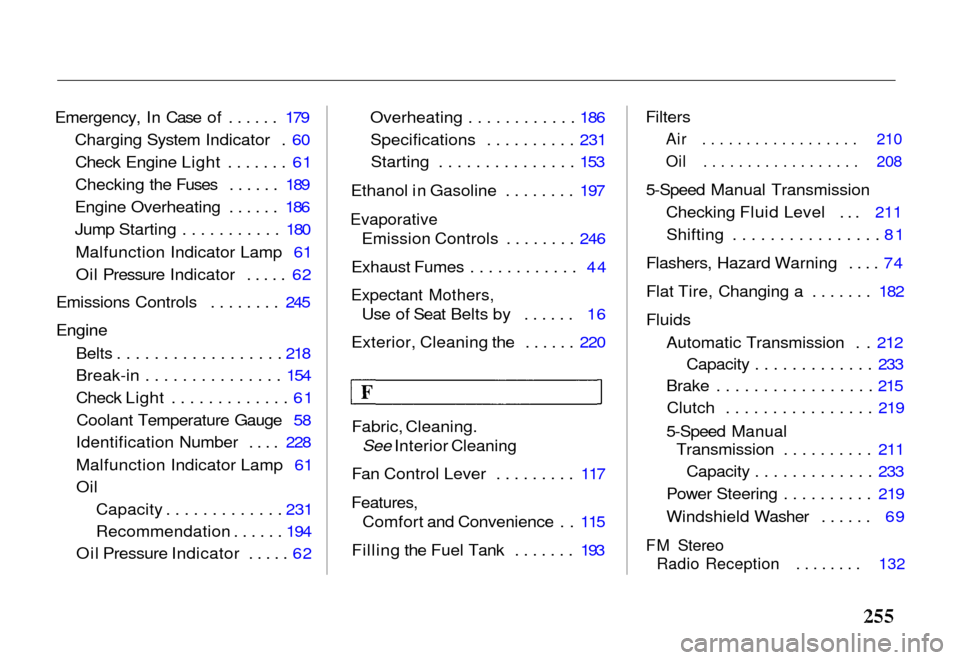
Emergency, In Case of ...... 179
Charging System Indicator . 60Check Engine Light ....... 61
Checking the Fuses ...... 189
Engine Overheating ...... 186 Jump Starting ........... 180
Malfunction Indicator Lamp 61Oil Pressure Indicator ..... 62
Emissions Controls ........ 245
Engine
Belts .................. 218
Break-in ............... 154
Check Light ............. 61Coolant Temperature Gauge 58
Identification Number .... 228
Malfunction Indicator Lamp 61 Oil
Capacity ............. 231
Recommendation ...... 194
Oil Pressure Indicator ..... 62 Overheating ............ 186
Specifications .......... 231
Starting ............... 153
Ethanol in Gasoline ........ 197
Evaporative
Emission Controls ........ 246
Exhaust Fumes ............ 44
Expectant Mothers,
Use of Seat Belts by ...... 16
Exterior, Cleaning the ...... 220
Fabric, Cleaning.
See Interior Cleaning
Fan Control Lever ......... 117
Features,
Comfort and Convenience . . 115
Filling the Fuel Tank ....... 193 Filters
Air .................. 210
Oil .................. 208
5-Speed Manual Transmission Checking Fluid Level ... 211Shifting ................ 81
Flashers, Hazard Warning ....
74
Flat Tire
, Changing a ....... 182
Fluids Automatic Transmission . .
212
Capacity ............
. 233
Brake ................. 215
Clutch ................ 219
5-Speed Manual Transmission .......... 211
Capacity ............. 233
Power Steering .......... 219
Windshield Washer ...... 69
FM Stereo
Radio Reception ........ 132