service HONDA PASSPORT 2000 2.G Owner's Manual
[x] Cancel search | Manufacturer: HONDA, Model Year: 2000, Model line: PASSPORT, Model: HONDA PASSPORT 2000 2.GPages: 267, PDF Size: 3.03 MB
Page 211 of 267
Change the oil and oil filter every
3,750 miles (6,000 kilometers) or
every three months if you drive under one or more of these
"severe driving" conditions: Driving in dusty areas
Towing a trailer
Frequent idling or idling for
long periods Frequent short trips (4 miles [6
kilometers] or less) in cold or
freezing weather, where the
engine does not thoroughly
warm up. Change the oil and oil filter as
soon as possible after driving in
a dust storm.
Oi
l Chang e
Changing the oil and filter requires
special tools and access from underneath the vehicle. The vehicle
should be raised on a service station-type hydraulic lift for this
service. Unless you have the
knowledge and proper equipment,
you should have this maintenance
done by a skilled mechanic.
1. Warm up the engine. This makes the oil drain faster and
more thoroughly.
2. Remove the oil filler cap.
3. Remove the drain plug and drain oil fully.
4. Install the drain plug, with a new gasket, and tighten it.
5. Fill the engine with the proper amount of new oil (see
"Specifications"). Oil Filter Installation
1. Remove the old oil filter with the filter wrench.
2. Apply a light coat of engine oil to the oil filter gasket.
3. Hand-tighten the filter until the gasket contacts the sealing
face.
4. Using the filter wrench, tighten the filter one full turn.
5. Run the engine and inspect for
leaks.
6. Shut off the engine. After a couple of minutes, check the
oil level. If necessary, add oilto bring it to the FULL mark.
An improperly installed oil filter can result in severe engine
damage.
Car e an d Maintenanc e
NOTIC
E
Page 212 of 267
Oi
l Viscosit y
Engine oil viscosity (thickness) has an effect on fuel economy. Lower
viscosity engine oils can provideincreased fuel economy; however,
higher temperature weather
conditions require higher viscosity
engine oils for satisfactory lubrication. To get the best fuel
economy with your vehicle, you should use a fuel-saving engine oil
of the proper viscosity. These oils
can be found in service stations and other retail stores. They are
identified by words such as
"Energy Saving," "Conserves
Gasoline," "Gas Saving,"
"Gasoline Saving," "Friction
Reducing," "Improved Gasoline Mileage" or "Fuel Saving."
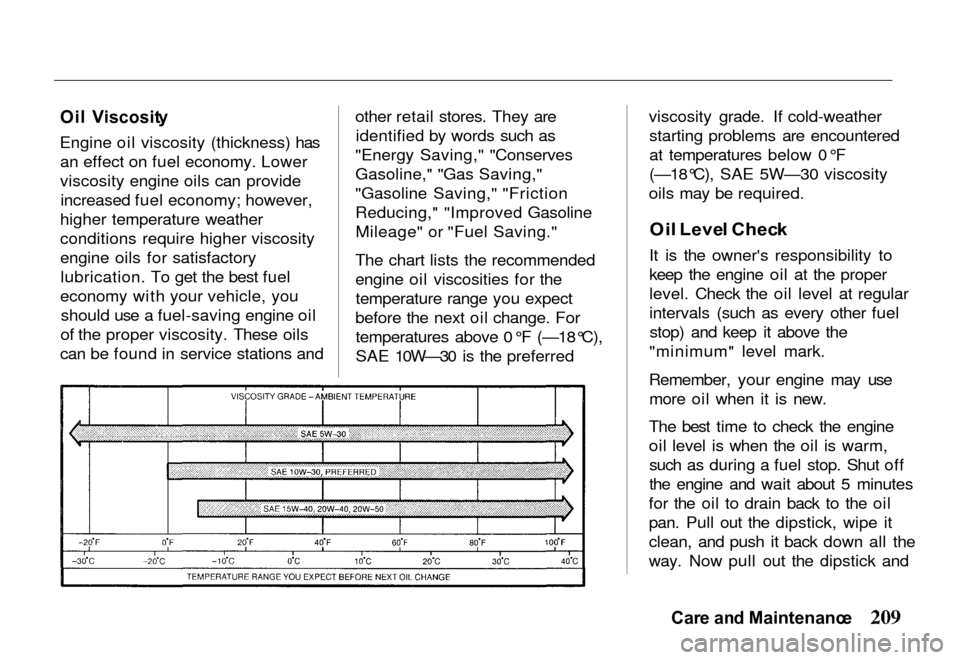
The chart lists the recommended
engine oil viscosities for the temperature range you expect
before the next oil change. For temperatures above 0°F (—18°C),
SAE 10W—30 is the preferred viscosity grade. If cold-weather
starting problems are encountered
at temperatures below 0°F
(—18°C), SAE 5W—30 viscosity
oils may be required.
Oi l Leve l Chec k
It is the owner's responsibility to
keep the engine oil at the proper
level. Check the oil level at regular
intervals (such as every other fuel stop) and keep it above the
"minimum" level mark.
Remember, your engine may use more oil when it is new.
The best time to check the engine
oil level is when the oil is warm, such as during a fuel stop. Shut off
the engine and wait about 5 minutes
for the oil to drain back to the oil
pan. Pull out the dipstick, wipe it
clean, and push it back down all the
way. Now pull out the dipstick and
Car e an d Maintenanc e
Page 217 of 267
You usually do not need to remove
the radiator cap to check the engine
coolant level.
Addin g Engin e Coolan t
To add engine coolant, remove the cap on the radiator reserve tank
and fill the tank up to the
maximum level mark. Add a
50/50 mixture of water and a good
quality ethylene glycol antifreeze. If you need to add engine coolant
frequently, see your Honda dealer
for a cooling system check.
If the proper quality antifreezeis used, there is no need to add
extra inhibitors or additives. They may be harmful to the proper
operation of the system.
Coolin g Syste m Servic e
The cooling system should be serviced at the intervals specified in the Maintenance Schedule as
follows:
Wash the radiator cap and filler
neck with clean water.
Check the engine coolant level
in the radiator and have it tested
for freeze protection. Add
ethylene glycol antifreeze, if
needed, to maintain freeze
protection at —33°F (—36°C).
Have the cooling system and
radiator cap tested for a pressure capacity of 15 psi (105
kPa). If a replacement cap is
needed, use a cap specified for
your model. Tighten all radiator and heater
hose clamps and inspect all
hoses. Replace the hoses if they
are swollen, "checked," or
otherwise worn. Carefully tighten the hose clamps at the
radiator. Overtightening could bend or collapse the radiator
fittings. Clean the front of the radiator
core and air conditioning
condenser.
It is the owner's responsibility to: Maintain the cooling system
freeze protection at —33°F
Car e an d Maintenanc e
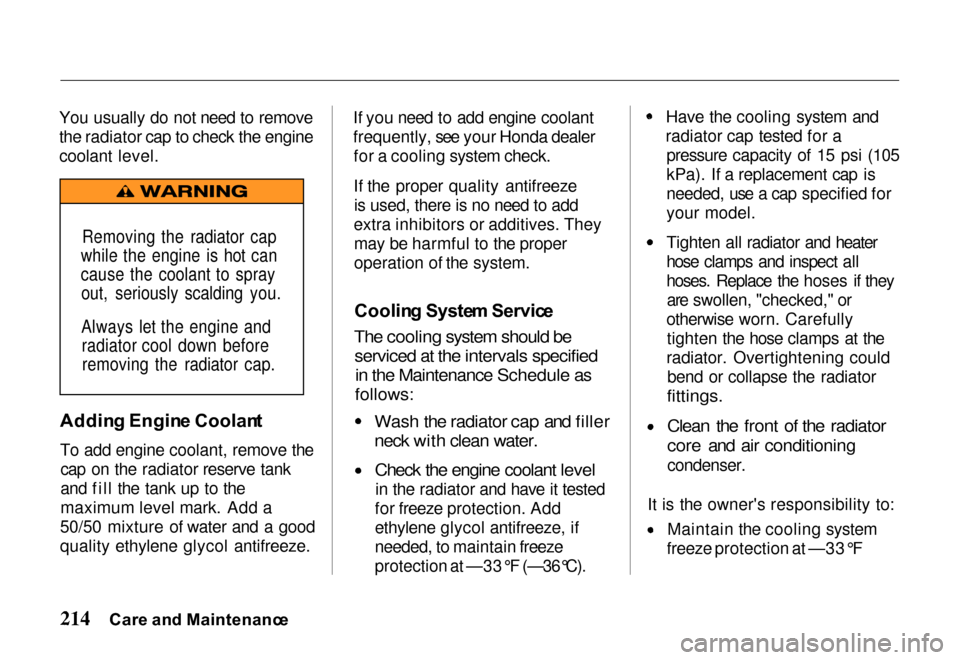
Removing the radiator cap
while the engine is hot can
cause the coolant to spray out, seriously scalding you.
Always let the engine andradiator cool down beforeremoving the radiator cap.
Page 231 of 267
Vehicl
e Identificatio n
Vehicl e Identificatio n
Numbe r (VIN )
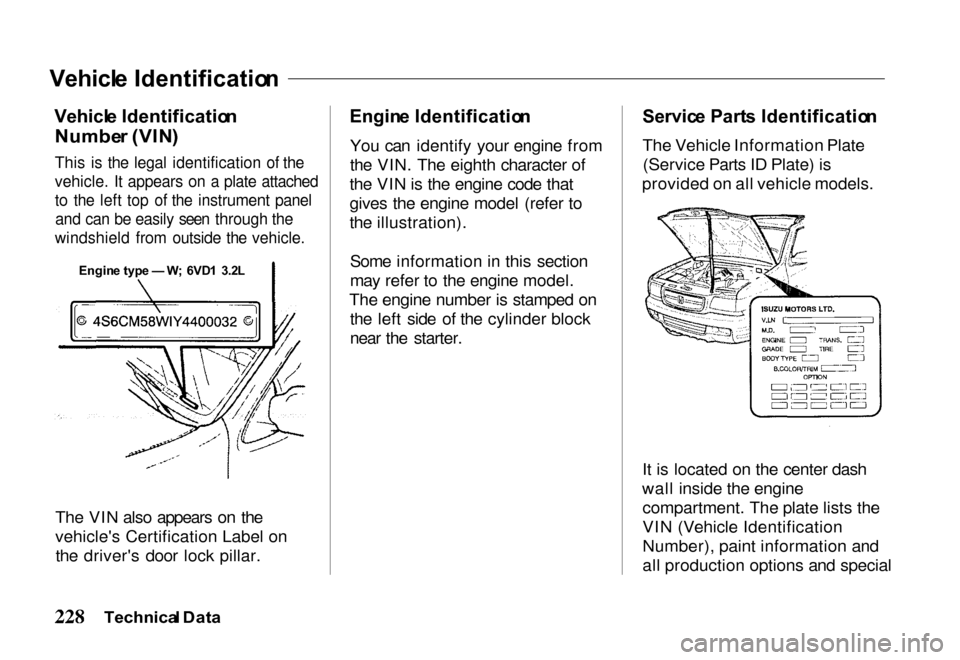
This is the legal identification of the
vehicle. It appears on a plate attached
to the left top of the instrument panel
and can be easily seen through the
windshield from outside the vehicle.
The VIN also appears on the
vehicle's Certification Label onthe driver's door lock pillar.
Engin
e Identificatio n
You can identify your engine from
the VIN. The eighth character of
the VIN is the engine code that
gives the engine model (refer to
the illustration).
Some information in this section
may refer to the engine model.
The engine number is stamped on the left side of the cylinder block
near the starter.
Servic
e Part s Identificatio n
The Vehicle Information Plate (Service Parts ID Plate) is
provided on all vehicle models.
It is located on the center dash
wall inside the engine compartment. The plate lists the
VIN (Vehicle Identification
Number), paint information and
all production options and special
Technica l Dat a
Engin
e typ e — W; 6VD 1 3.2 L
Page 232 of 267
equipment on the vehicle when it
was shipped from the factory. Be
sure to provide this information to
your authorized Honda dealer when it is necessary to order
parts.
Vehicl
e Loadin g
Vehicl e Loadin g Informatio n
The components of your vehicle are designed to providesatisfactory service only if the
vehicle is not loaded in excess of
either the Gross Vehicle Weight
Rating (GVWR) or the maximum
front and rear Gross Axle Weight
Ratings (GAWRs). These ratings are listed on the Vehicle
Certification Label located on the
left door lock pillar.
Your Honda dealer can advise you
of the proper loading conditions
for your vehicle. The use of
selected heavier suspension
components for added durability
purposes does not increase any of the weight ratings printed on the
Vehicle Certification Label. Maximu
m Fron t an d Rea r
Axl e Weigh t
The weight of the cargo load must be properly distributed over both
the front and rear axles. The
Certification Label shows themaximum weight that the front
axle (front GAWR) can carry. It also shows the maximum weight
that the rear axle (rear GAWR) can
carry. The GVWR represents the
maximum permissible loaded
weight of the vehicle and takes
into account the engine,
transmission, frame, springs,
brake, axle, and tire capabilities.
Actual loads on the front and rear
axles can only be determined by
weighing the vehicle. This can be
done at highway weight stations
or other such commercial weigh stations. Consult your Honda
dealer for assistance. The cargo
Technical Dat a
Page 234 of 267
Specification
s
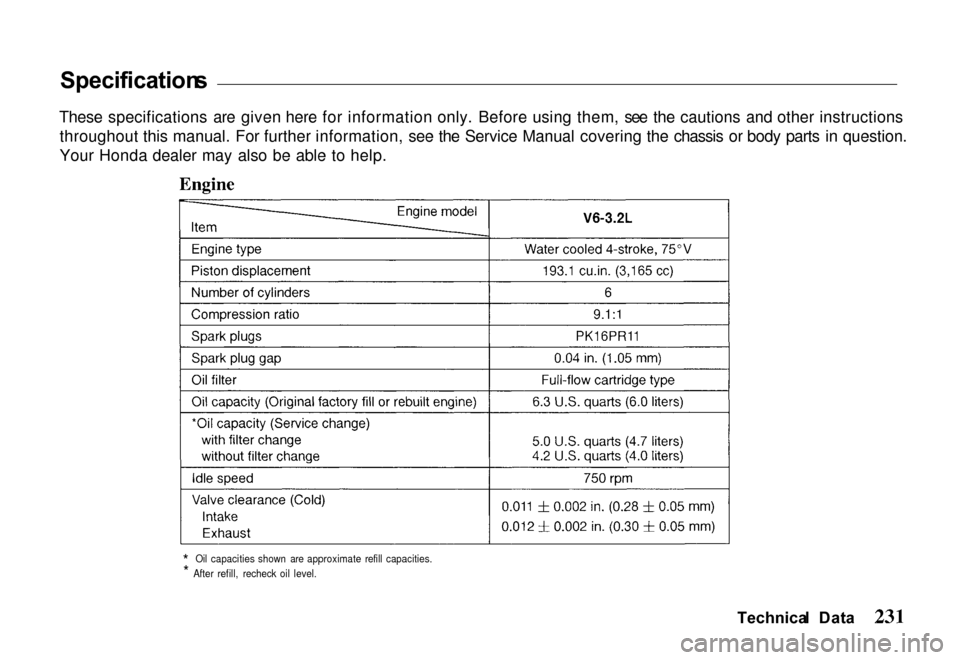
These specifications are given here for information only. Before using them, see the cautions and other instructions throughout this manual. For further information, see the Service Manual covering the chassi s or body parts in question.
Your Hond
a dealer may also be able to help.
* Oil capacities shown are approximate refill capacities.
* After refill, recheck oil level.
Technical Dat a
Page 245 of 267
Custome
r Relation s Informatio n
Your satisfaction and goodwill are important to your Honda dealer
and to us, American Honda Motor Co., Inc. Honda dealership
personnel are trained
professionals. They should be able to answer all your questions.
If you encounter a problem that
your dealership does not solve to your satisfaction, please discuss it
with the dealership's
management. The ServiceManager or General Manager can
help. Almost all problems are solved in this way. If you are dissatisfied with the
decision made by the dealership's
management, contact your HondaCustomer Relations Zone Office.
Refer to the U.S. Zone Office map on the following page. When you call or write, please
give us this information:
1. Your name, address and telephone number
2. Vehicle Identification Number (see page 228)
3. The name and address of the dealer who services your
vehicle
4. Date of purchase
5. Mileage on your vehicle
6. Name and address of the dealer who sold you the
vehicle
7. A detailed description of the problem
Owne r Assistanc e
Page 251 of 267
Treadwea
r
The treadwear grade is a comparative rating based on the
wear rate of the tire when tested
under controlled conditions on a specified government test course.
For example, a tire graded 150
would wear one-and-a-half (1-1/2) times as well on the
government course as a tire
graded 100. The relative
performance of tires depends upon the actual conditions of their
use, however, and may departsignificantly from the norm due to
variation in driving habits, service
practices and differences in road characteristics and climate.
Tractio n
The traction grades from highest
to lowest are AA, A, B, and C.
Those grades represent the tire's ability to stop on wet pavement as
measured under controlled
conditions on specified
government test surfaces of
asphalt and concrete. A tire
marked C may have poor traction
performance.
Warning: The traction grade assigned to this tire is based on
straight-ahead braking traction
tests, and does not include
acceleration, cornering,
hydroplaning, or peak traction
characteristics.
Temperatur e
The temperature grades are A (the highest), B and C, representing
the tire's resistance to the
generation of heat and its ability
to dissipate heat when tested
under controlled conditions on a specified indoor laboratory test
wheel. Sustained high temperature
can cause the material of the tire
to degenerate and reduce tire life and excessive temperature can
lead to sudden tire failure. The
grade C corresponds to a level of
performance which all vehicle tires must meet under the FederalMotor Vehicle Safety Standard
No. 109. Grades Band A
represent higher levels of
performance on the laboratory test wheel than the minimum required
by law.
Warning: The temperature grade for this tire is established for a tire
that is properly inflated and not overloaded. Excessive speed,
underinflation, or excessive
loading either separately or in
combination, can cause heat
build-up and possible tire failure.
Owne r Assistanc e
Page 253 of 267
These publications cannot be returned for credit without receiving advance authorization within 14 days of
delivery. On returns, a restocking fee may be applied against the original order.
P.O. BOX 07280 DETROIT, Ml 48207 1-800-782-4356
Servic
e Manua l
This manual covers maintenance and recommended
procedures for repair to engine and chassis
components. It is written for the journeyman mechanic, but is simple enough for most mechanicallyinclined owners to understand.
Electrica l Troubleshootin g Manua l
This manual complements the Service Manual by
providing in-depth troubleshooting information for
each electrical circuit in your car.
Page 262 of 267
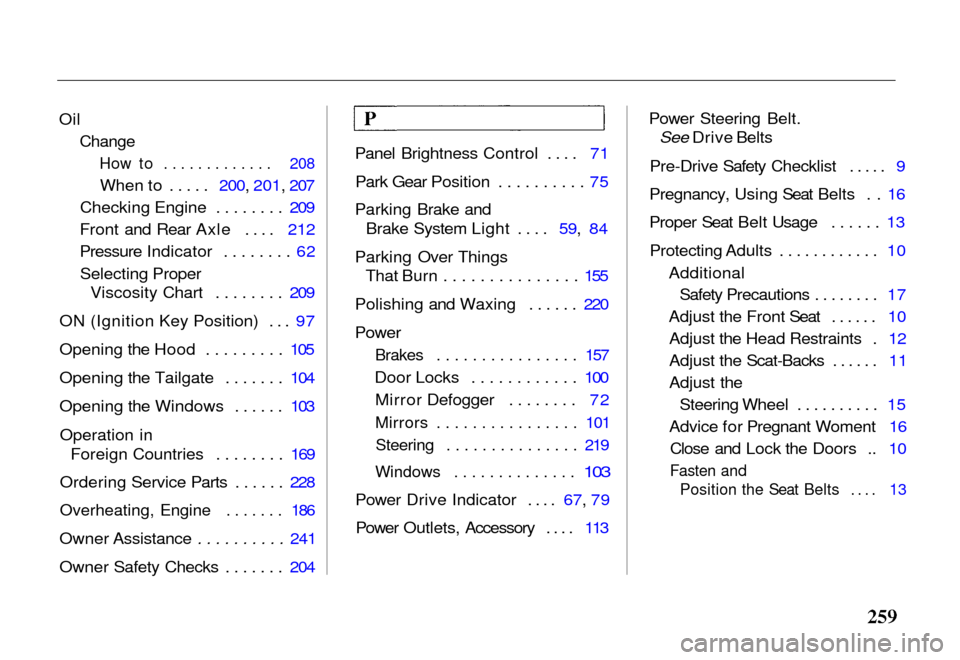
Oil
Change
How to ............. 208
When to ..... 200, 201, 207
Checking Engine ........ 209
Front and Rear Axle .... 212
Pressure Indicator ........ 62
Selecting Proper Viscosity Chart ........ 209
ON (Ignition Key Position) ... 97
Opening the Hood ......... 105
Opening the Tailgate ....... 104
Opening the Windows ...... 103
Operation in Foreign Countries ........ 169
Ordering Service Parts ...... 228
Overheating, Engine ....... 186
Owner Assistance .......... 241
Owner Safety Checks ....... 204 Panel Brightness Control .... 71
Park Gear Position .......... 75
Parking Brake and Brake System Light .... 59, 84
Parking Over Things That Burn ............... 155
Polishing and Waxing ...... 220
Power
Brakes ................ 157
Door Locks ............ 100 Mirror Defogger ........ 72
Mirrors ................ 101Steering ............... 219
Windows .............. 103
Power Drive Indicator .... 67, 79
Power Outlets, Accessory .... 113 Power Steering Belt.
See Drive Belts
Pre-Drive Safety Checklist ..... 9
Pregnancy, Using Seat Belts . . 16
Proper Seat Belt Usage ...... 13
Protecting Adults ............ 10 AdditionalSafety Precautions ........ 17
Adjust the Front Seat ...... 10 Adjust the Head Restraints . 12
Adjust the Scat-Backs ...... 11
Adjust the Steering Wheel .......... 15
Advice for Pregnant Woment 16 Close and Lock the Doors .. 10
Fasten and Position the Seat Belts .... 13