brake HONDA PASSPORT 2000 2.G Owner's Guide
[x] Cancel search | Manufacturer: HONDA, Model Year: 2000, Model line: PASSPORT, Model: HONDA PASSPORT 2000 2.GPages: 267, PDF Size: 3.03 MB
Page 194 of 267
Car
e an d Maintenanc e
This section explains why it is important to keep your vehicle
well maintained and to follow
basic maintenance safety
precautions.
This section also includes Maintenance Schedules for
normal driving and severe driving
conditions, a Maintenance
Record, and instructions for simple maintenance tasks you
may want to take care of yourself.
If you have the skills and tools
required to perform more complex
maintenance tasks on your Honda,
you may want to purchase the Service Manual. See page 249 for
information on how to obtain a
copy, or see your Honda dealer. Service Station Information . 193
Fuel Fill Cap .......... 193Fuel Recommendation ... 194
Fuel Tank Capacity ..... 194
Engine Oil Recommendation ...... 194
Windshield Washer ..... 194
Tire Inflation Pressures .. 194 Battery ............... 194
Hood Release .......... 195
Engine Oil Dipstick ..... 196
Fuel Requirements ........ 196 Oxygenated Fuels ...... 196
Maintenance Safety ....... 197 Important Safety
Precautions .......... 198
Maintenance Schedule ..... 199
Required Maintenance Record 202
Owner Safety Checks ...... 204
Engine Oil and Filter ...... 207 Proper Quality Oil ...... 207 Change Interval ........ 207
Oil
Change ........... 208
Oil Filter Installation . 208
Oil Viscosity .......... 209
Oil Level Check ....... 209
Engine Oil Additives ... 210
Air Cleaner Filter ........ 210
Manual Transmission Fluid 211
Automatic Transmission Fluid .................. 212
Front (4WD) and Rear Axles ............. 212
Engine Cooling System ... 213
Other Required Maintenance 215 Brake Master Cylinder . . 215
Shift-on-the-Fly System
. 216
Front Whee
l Bearings ... 216
Hood Latch and Hinges . 217
Air Conditioning ....... 217 Body Lubrication ...... 217
Car e an d Maintenanc e
Page 196 of 267
Servic
e Statio n Informatio n
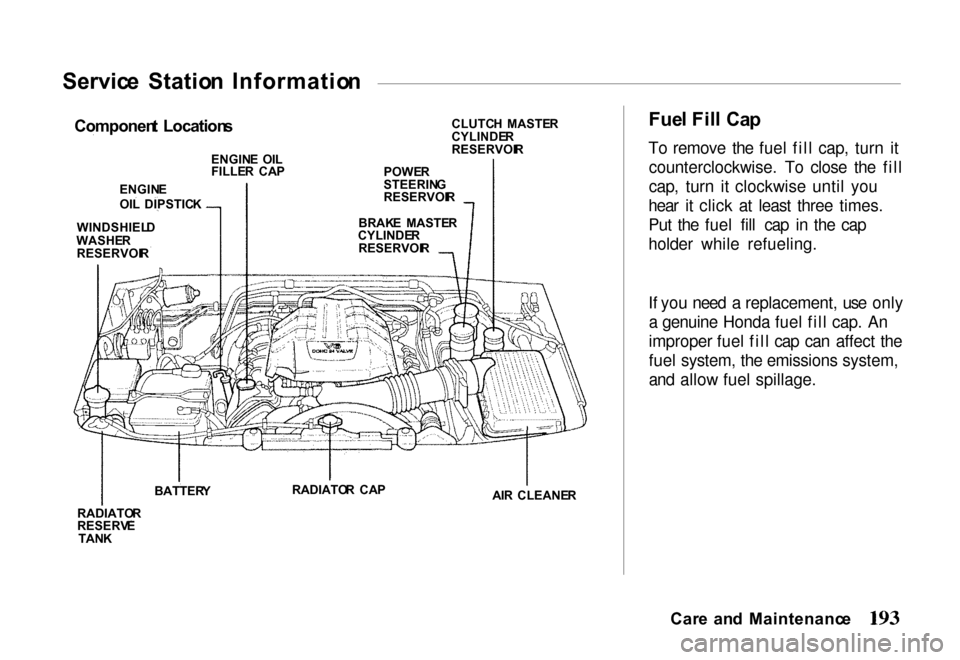
Fuel Fil l Ca p
To remove the fuel fill cap, turn it counterclockwise. To close the fill
cap, turn it clockwise until you
hear it click at least three times.
Put the fuel fill cap in the cap
holder while refueling.
If you need a replacement, use only a genuine Honda fuel fill cap. An
improper fuel fill cap can affect the
fuel system, the emissions system,
and allow fuel spillage.
Car e an d Maintenanc e
Componen t Location s
ENGIN E
OI
L
FILLE R CA P CLUTC
H MASTE R
CYLINDE R
RESERVOI R
POWE R
STEERIN G
RESERVOI R
ENGIN
E
OI L DIPSTIC K
BRAKE MASTE R
CYLINDE R
RESERVOI R
WINDSHIEL
D
WASHE R
RESERVOI R
BATTER Y
RADIATO R
RESERV E
TAN K
RADIATO
R CA P
AIR CLEANE R
Page 201 of 267
This section includes instructions
for simple maintenance tasks,
such as checking and adding oil.
Any service items not detailed in
this section should be performed
by a Honda technician or other qualified mechanic.
Some of the most important safety
precautions are given below. However, we cannot warn you of
every conceivable hazard that can arise in performing maintenance.
Only you can decide whether or
not you should perform a given
task.
Importan
t Safet y Precaution s
Before you begin any
maintenance, make sure your
vehicle is parked on level ground and that the parking brake is on.
Also, be sure the engine is off.
This will help to eliminate several
potential hazards:
Carbo
n monoxid e poisonin g
fro m engin e exhaust . Be sure
there is adequate ventilation
whenever you operate the engine.
Burn
s fro m ho t parts . Let the
engine and exhaust system cool
before touching any parts.
Injur y fro m movin g parts . D o
not run the engine unless instructed to do so.
Read the instructions before you
begin, and make sure you have
the tools and skills required.
To reduce the possibility of fire or
explosion, be careful when
working around gasoline or
batteries. Use a commercially
available degreaser or parts
cleaner, not gasoline, to clean
parts. Keep cigarettes, sparks, and
flames away from the battery and
all fuel-related parts.
You should wear eye protection
and protective clothing when
working near the battery or when
using compressed air.
Car e an d Maintenanc e
Failure t
o properly follow
maintenance instructions and
precautions can cause you to
be seriously hurt or killed.
Always follow the procedures and precautions in this owner's
manual.
Page 202 of 267
Maintenanc
e Schedul e
The Maintenance Schedule specifies how often you should
have your vehicle serviced and what things need attention. It is
essential that you have your vehicle serviced as scheduled to
retain its high level of safety, dependability, and emission
control performance.
The services and time or distanceintervals shown in the
maintenance schedule assume you will use your vehicle as normal
transportation. You should: Avoid exceeding your vehicle's
load limit. This puts excess
stress on the engine, brakes, and
many other parts of your vehicle.
The load limit is shown on the label on the driver's doorjamb. Operate your vehicle on
reasonable roads within the
legal speed limit. Drive your vehicle regularly over
a distance of several miles
(kilometers).
Always use unleaded gasoline
with the proper octane rating
(see page 196).
Your authorized Honda dealer
knows your vehicle best and can
provide competent, efficient service. However, service at a
dealer is not mandatory to keep
your warranties in effect.
Maintenance may be done by any
qualified service facility or person
who is skilled in this type of automotive service. Keep all the
receipts as proof of completion, and have the person who does the
work fill out the Maintenance Record. Check your warranty
booklet for more information.
We recommend the use of Genuine Honda parts and fluids
whenever you have maintenance
done. These are manufactured to
the same high-quality standards as
the original components, so you
can be confident of their
performance and durability.
U.S . Vehicles :
Maintenance , replacemen t o r repai r
o f emissio n contro l device s an d
system s ma y b e don e b y an y
automotiv e repai r establishmen t o r
individua l usin g part s tha t ar e
"certified " t o EP A standards .
Car e an d Maintenanc e
Page 203 of 267
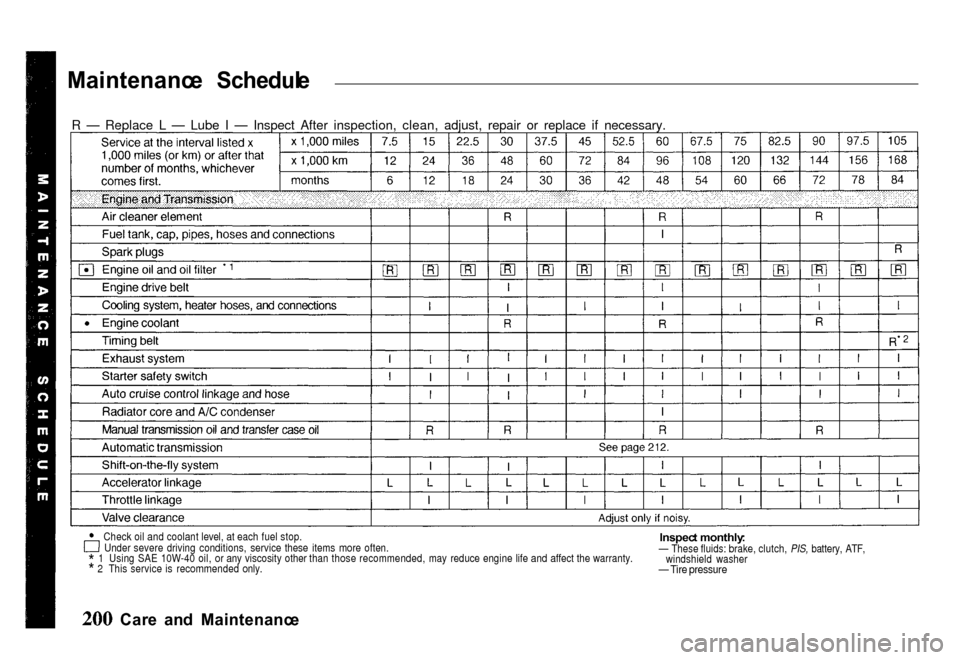
Maintenanc
e Schedul e
Check oil and coolant level, at each fuel stop. Under severe driving conditions, service these items more often.
* 1 Using SAE 10W-40 oil, or any viscosity other than those recommended, may reduce engine life and affect the warranty.
* 2 This service is recommended only.
Inspec
t monthly :
— These fluids: brake, clutch, PIS, battery, ATF, windshield washer
— Tire pressure
Car e an d Maintenanc e
R — Replace L — Lube I — Inspect After inspection, clean, adjust, repair or replace if necessary.
Page 207 of 267
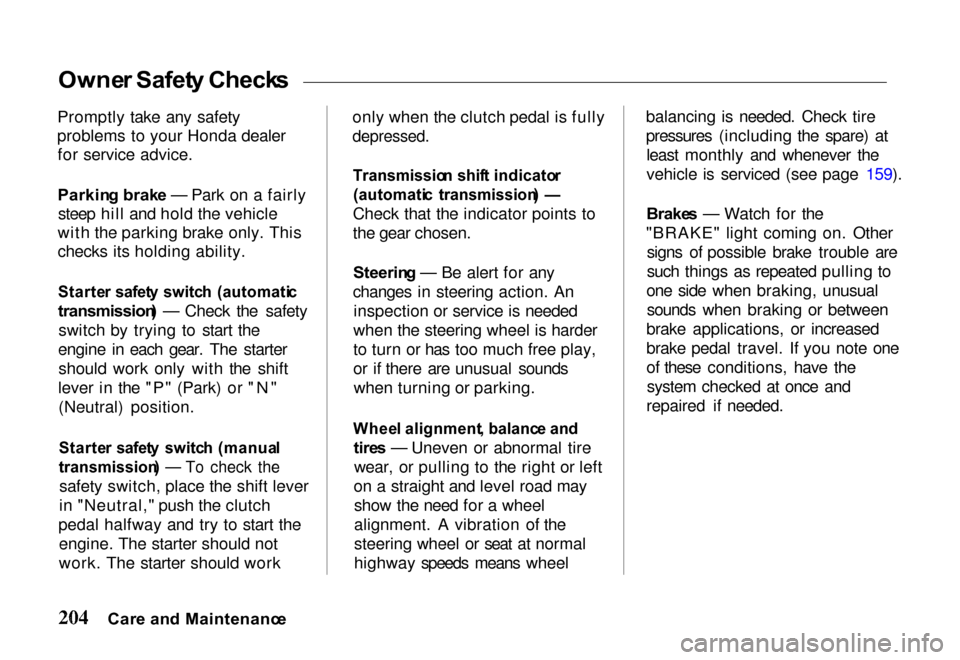
Owne
r Safet y Check s
Promptly take any safety
problems to your Honda dealer for service advice.
Parkin g brak e — Park on a fairly
steep hill and hold the vehicle
with the parking brake only. This
checks its holding ability.
Starte r safet y switc h (automati c
transmission ) — Check the safety
switch by trying to start the
engine in each gear. The starter should work only with the shift
lever in the "P" (Park) or "N" (Neutral) position.
Starte r safet y switc h (manua l
transmission ) — To check the
safety switch, place the shift lever
in "Neutral," push the clutch
pedal halfway and try to start the engine. The starter should not
work. The starter should work only when the clutch pedal is fully
depressed.
Transmissio n shif t indicato r
(automati c transmission ) —
Check that the indicator points to
the gear chosen.
Steerin g — Be alert for any
changes in steering action. An inspection or service is needed
when the steering wheel is harder
to turn or has too much free play,
or if there are unusual sounds when turning or parking.
Whee l alignment , balanc e an d
tire s — Uneven or abnormal tire
wear, or pulling to the right or left
on a straight and level road may show the need for a wheel
alignment. A vibration of the
steering wheel or seat at normal
highway speeds means wheel balancing is needed. Check tire
pressures (including the spare) at
least monthly and whenever the
vehicle is serviced (see page 159).
Brake s — Watch for the
"BRAKE" light coming on. Other signs of possible brake trouble are
such things as repeated pulling to
one side when braking, unusual sounds when braking or between
brake applications, or increased
brake pedal travel. If you note one
of these conditions, have the system checked at once and
repaired if needed.
Car e an d Maintenanc e
Page 208 of 267
Sit in the driver's seat and
perform these checks:
1. With the engine stopped, depress the brake pedal severaltimes; the travel distance and
effective pedal stroke should
remain unchanged.
2. Start the engine with the brake pedal fully depressed.
The brake pedal should go downa little as the engine starts.
3. Depress the brake pedal, stop the engine and hold the pedal
depressed for about 30
seconds; the brake pedal
should remain in position
without rising or going down.
4. Restart the engine and run it for about a minute, then turn it
off and depress the brake
pedal firmly several times; the
brake pedal travel should decrease each time the brake
pedal is depressed.
If the brakes do not operate
normally, have them checked and
corrected by your Honda dealer.
Exhaus t syste m — Be alert to any
changes in the sound of the exhaust system or any smell of fumes.
These are signs the system may be leaking or overheating. Have the
system checked and/or repaired at
once if these conditions exist. (Also see "Carbon Monoxide Hazard" in
the "Driver and Passenger Safety"
section and "Three-Way Catalytic
Converter" in the "Driving Tips"
section.)
Windshiel d wiper s an d
washer s — Check the operation
and condition of the wiper blades.
Check the flow and aim of the
washer spray.
Defroster
s — Check performance
by moving the controls to the
defrost setting and noting the amount of air directed against the
windshield.
Rea r vie w mirror s an d su n
visor s — Check that the friction
joints hold the mirrors and sun visors firmly in place.
Hor n — Blow the horn now and
then to be sure it works.
La p an d shoulde r belt s — Check
the belt system, including
webbing, buckles, latch plates,
retractors, guide loops and anchors for proper operation and
damage.
Sea t adjuster s — When adjusting
a seat, be sure the seat adjusters
latch securely by pushing the seat
forward and backward.
Car e an d Maintenanc e
Page 209 of 267
Seat-bac
k latche s — Seat-back
latches are designed to prevent
forward motion of the seat-back when the vehicle stops suddenly.
Check to see that the seat-backlatches are holding by pulling
forward on the top of the folding
seat-back.
Also check to see that the
reclining seats are operating properly.
Light s an d beepers — Check
panel lighting, warning lights, and
the seat belt reminder light and
beeper. Also check the key beeper and interior lights. On the outside,
check the license plate light, sidemarker lights, headlights, parking
lights, taillights, brake lights, turnsignals, backup lights and hazard
warning flashers. Have the
headlight aim checked promptly if the beams seem to be aimed
improperly.
Glas
s — Check for broken,
scratched or damaged glass that
could reduce visibility or cause injury.
Doo r latches — Check that the
doors close, latch and lock
securely.
Hoo d latc h — Check that the
hood closes firmly. Check for
broken, damaged, or missing parts that might prevent secure
latching. Make sure the secondarylatch keeps the hood from
opening all the way when first
released.
Flui
d leaks — Check for fuel,
water, oil or other fluid leaks by
looking at the surface beneath the
vehicle after it has been parked
for awhile. Water dripping from
the air conditioning system after use is normal. If you notice
gasoline fumes or fluid at any
time, locate the source and have it
corrected at once.
Spar e tir e an d jac k — Check that
the spare tire and all jack gear are securely stowed at all times.
Tailgat e latc h — Check that the
tailgate closes, latches and locks
securely.
Car e an d Maintenanc e
Page 219 of 267
If the diaphragm inside the
reservoir cap is deformed, return
it to the original (collapsed)
condition, then tighten the cap.
It is normal for the brake fluid
level to go down slightly as the
front brake pads wear. So be sure
to keep the reservoir fluid at the
proper level.
If the reservoir needs frequent
refilling, it may indicate a serious mechanical problem.
Brake fluid absorbs water from
the air. Never use brake fluid that
has been open to the air for an
extended period. Throw it away and use new brake fluid from a
sealed container.
Brake fluid can damage your vehicle's paint. Thoroughly clean
up any brake fluid spills.
Shift-on-the-Fl
y Syste m
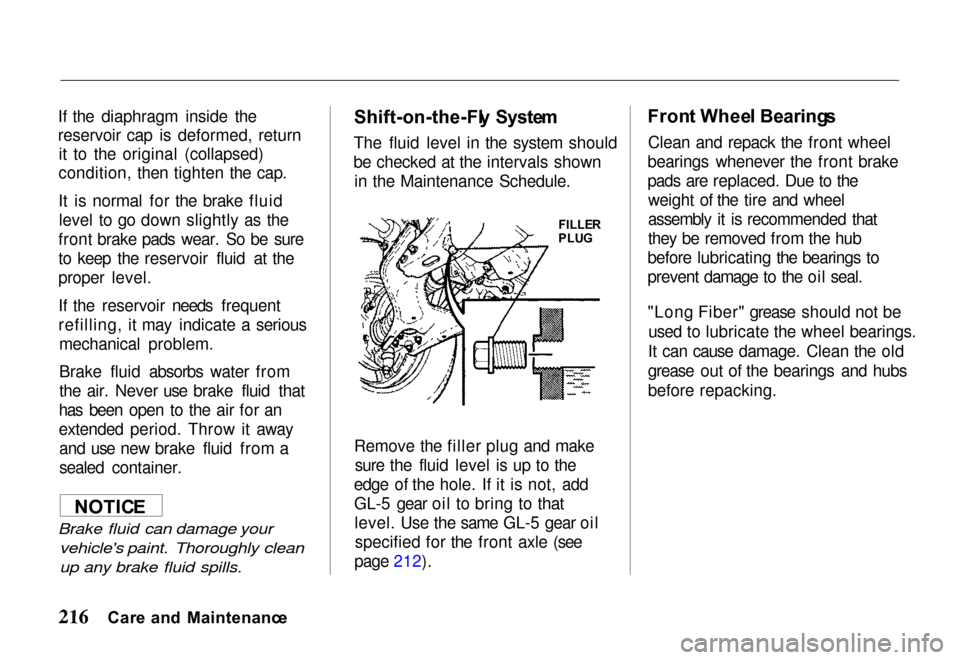
The fluid level in the system should
be checked at the intervals shown in the Maintenance Schedule.
Remove the filler plug and make sure the fluid level is up to the
edge of the hole. If it is not, add
GL-5 gear oil to bring to that level. Use the same GL-5 gear oilspecified for the front axle (see
page 212). Fron
t Whee l Bearing s
Clean and repack the front wheel
bearings whenever the front brake
pads are replaced. Due to the weight of the tire and wheel
assembly it is recommended that
they be removed from the hub
before lubricating the bearings to
prevent damage to the oil seal.
"Long Fiber" grease should not be
used to lubricate the wheel bearings.
It can cause damage. Clean the old
grease out of the bearings and hubs
before repacking.
Car e an d Maintenanc e
NOTIC
E
FILLE
R
PLU G
Page 222 of 267
Spar
k Plug s
Replace the spark plugs with the
type specified in the "Technical
Data" section.
Clutc h
Check the clutch play at the pedal.
Lubricate the clutch pedal bushing and clevis pin, at the intervalsshown in the Maintenance
Schedule, with water-resistant
chassis lubricant. If you hear a squeaking noise coming from the
area of the bushing or clevis pin at
the clutch pedal arm when the
clutch pedal is depressed,
lubricate it with water-resistant EP
chassis grease.
Check the fluid level in the clutch
reservoir at the interval shown in
the Maintenance Schedule. If the fluid is low in the reservoir, it
should be filled to the
maximum
level lin
e with DOT-3 or DOT-4
fluid.
Flui d o r Lubrican t Level s
Check the fluid or lubricant level in the brake master cylinder,
clutch master cylinder, power steering reservoir, rear axle,
engine and transmission, windshield washer reservoir and
engine coolant at specified
intervals.
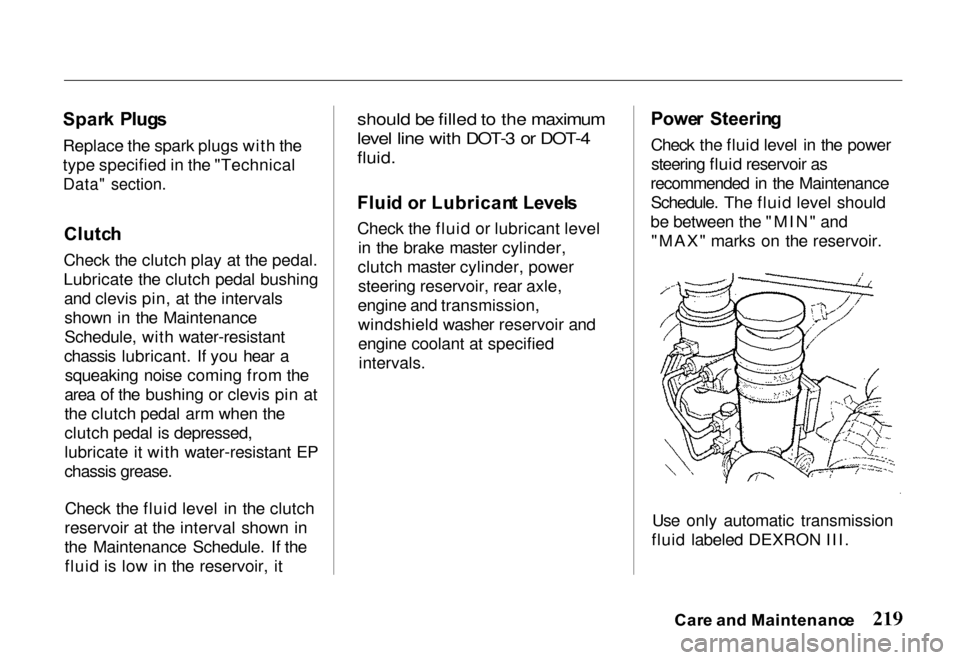
Powe
r Steerin g
Check the fluid level in the power steering fluid reservoir as
recommended in the Maintenance Schedule. The fluid level should
be between the "MIN" and "MAX" marks on the reservoir.
Use only automatic transmission
fluid labeled DEXRON III.
Car e an d Maintenanc e