belt HONDA PASSPORT 2000 2.G Service Manual
[x] Cancel search | Manufacturer: HONDA, Model Year: 2000, Model line: PASSPORT, Model: HONDA PASSPORT 2000 2.GPages: 267, PDF Size: 3.03 MB
Page 62 of 267
Indicato
r Light s
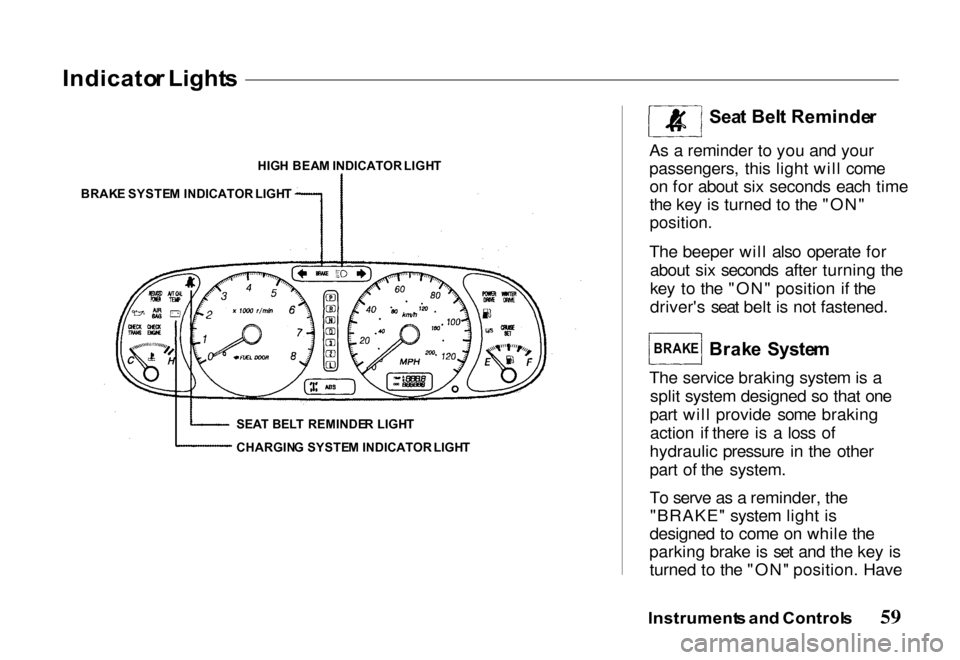
SEA T BEL T REMINDE R LIGH T Sea
t Bel t Reminde r
As a reminder to you and your
passengers, this light will come on for about six seconds each time
the key is turned to the "ON"
position.
The beeper will also operate for about six seconds after turning the
key to the "ON" position if the
driver's seat belt is not fastened.
Brake Syste m
The service braking system is a split system designed so that one
part will provide some braking action if there is a loss of
hydraulic pressure in the other
part of the system.
To serve as a reminder, the "BRAKE" system light is
designed to come on while the
parking brake is set and the key is turned to the "ON" position. Have
Instrument s an d Control s
BRAK
E
HIG
H BEA M INDICATOR LIGHT
BRAK E SYSTE M INDICATOR LIGHT
CHARGIN G SYSTE M INDICATOR LIGHT
Page 63 of 267
the system repaired if the light
does not come on when the key is
turned to the "ON" position
without the engine running or
when the parking brake is set.
This light does not eliminate the need for brake inspection and
maintenance. The brake fluid
level must be checked regularly.See the maintenance section of
this manual for other brake
checks.
If the light remains on after
engine start up with the parking
brake released, or comes on during operation of the vehicle, it
may mean that there is something
wrong with the brake system.
What to do?1. Check to see if the parking
brake has been fully released.
2. If it has, pull off the road and
stop carefully. Remember that: Stopping distances may be
longer.
You may have to push
harder on the pedal. The pedal may go down
farther than normal.
3. Have the vehicle towed to the nearest Honda dealer for
repair.
Do not continue to drive with the
brake system light on. There may
be a serious problem with the braking system. Driving under
this condition is hazardous and
could lead to an accident.
The brake system light does not indicate that the parking brake is
fully set. When applying the
parking brake, always pull it up as
far as possible. Hig
h Bea m
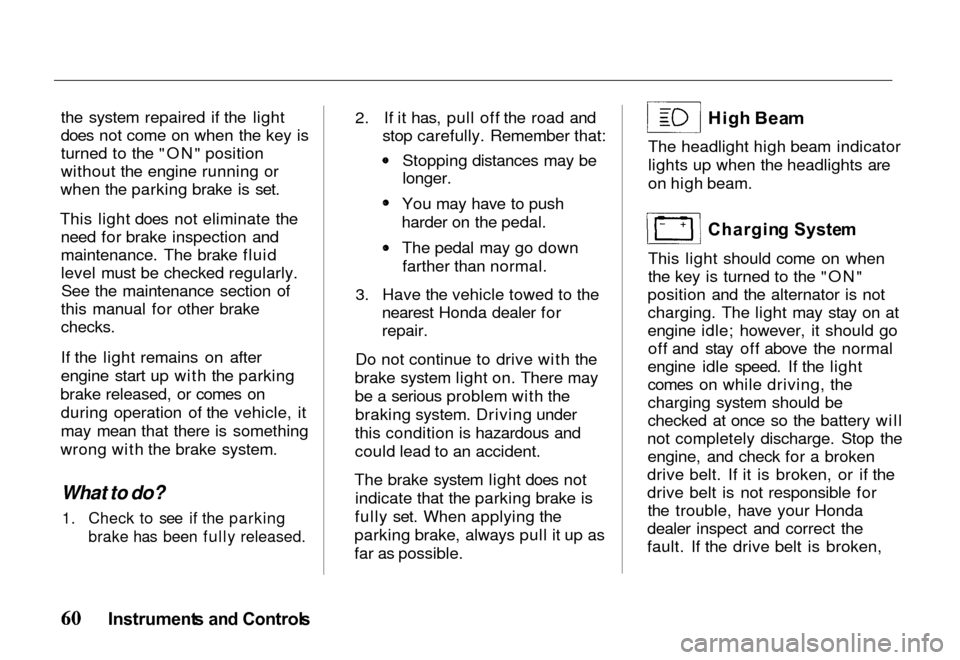
The headlight high beam indicator
lights up when the headlights are
on high beam.
Chargin g Syste m
This light should come on when
the key is turned to the "ON"
position and the alternator is not
charging. The light may stay on at
engine idle; however, it should go off and stay off above the normal
engine idle speed. If the light
comes on while driving, the
charging system should be
checked at once so the battery will
not completely discharge. Stop the engine, and check for a broken
drive belt. If it is broken, or if the
drive belt is not responsible for the trouble, have your Honda
dealer inspect and correct the
fault. If the drive belt is broken,
Instrument s an d Control s
Page 93 of 267
Keep the seat belt's webbing and
latch clear of the seat parts when
you tilt the folding seats forward
or backward. This helps to
prevent damage to the seat belt
system.
Adjust the seat-back before you
start driving. Trying to adjust the
seat-back with the vehicle in
motion could cause you to lose
control.
Hea d Restraint s
See page 12 for important safety information and warnings about
how to properly position the head
restraints.
Head restraints are designed to
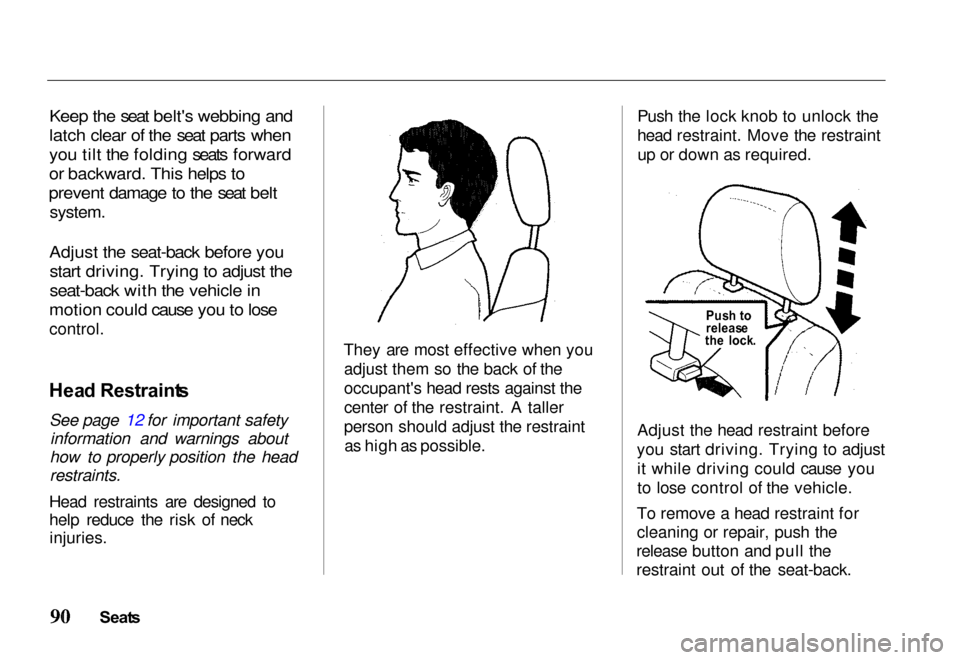
help reduce the risk of neck injuries. They are most effective when you
adjust them so the back of the
occupant's head rests against the
center of the restraint. A taller
person should adjust the restraintas high as possible. Push the lock knob to unlock the
head restraint. Move the restraint
up or down as required.
Adjust the head restraint before
you start driving. Trying to adjust it while driving could cause you
to lose control of the vehicle.
To remove a head restraint for
cleaning or repair, push the
release button and pull the
restraint out of the seat-back.
Seat s
Pus
h t o
releas e
th e lock .
Page 95 of 267
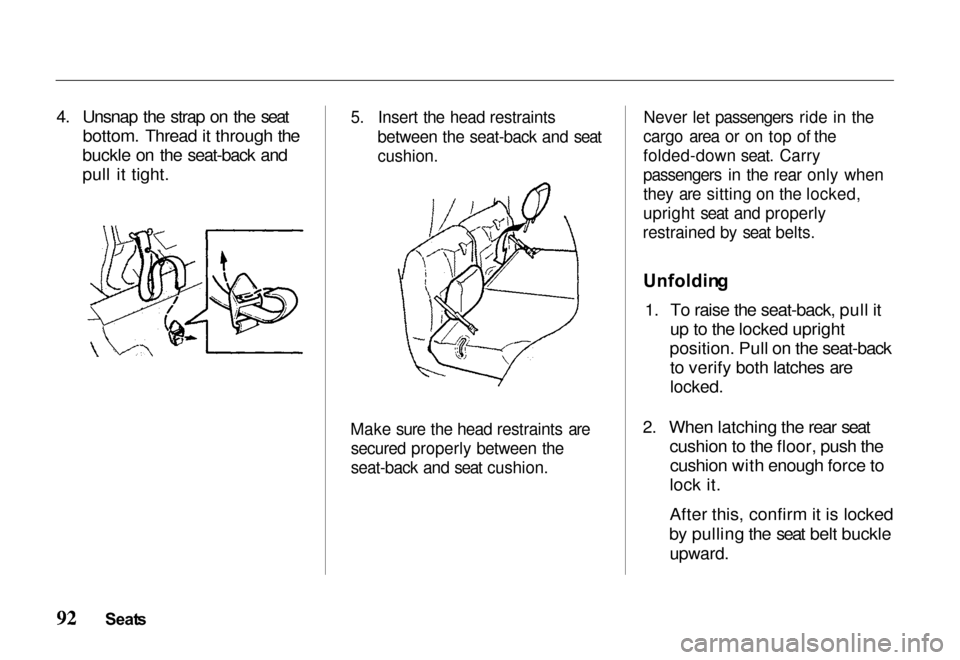
4. Unsnap the strap on the seat
bottom. Thread it through the
buckle on the seat-back and
pull it tight.
5. Insert the head restraints
between the seat-back and seat
cushion.
Make sure the head restraints are secured properly between the
seat-back and seat cushion. Never let passengers ride in the
cargo area or on top of the
folded-down seat. Carry
passengers in the rear only when
they are sitting on the locked,
upright seat and properly
restrained by seat belts.
Unfoldin g
1. To raise the seat-back, pull it up to the locked upright
position. Pull on the seat-back to verify both latches are
locked.
2. When latching the rear seat cushion to the floor, push thecushion with enough force to
lock it.
After this, confirm it is locked
by pulling the seat belt buckle
upward.
Seat s
Page 96 of 267
3. Make sure that the head
restraints are properly
reinstalled on the top of the
seat-backs.
4. Verify that the seat belts are routed properly and nottwisted.
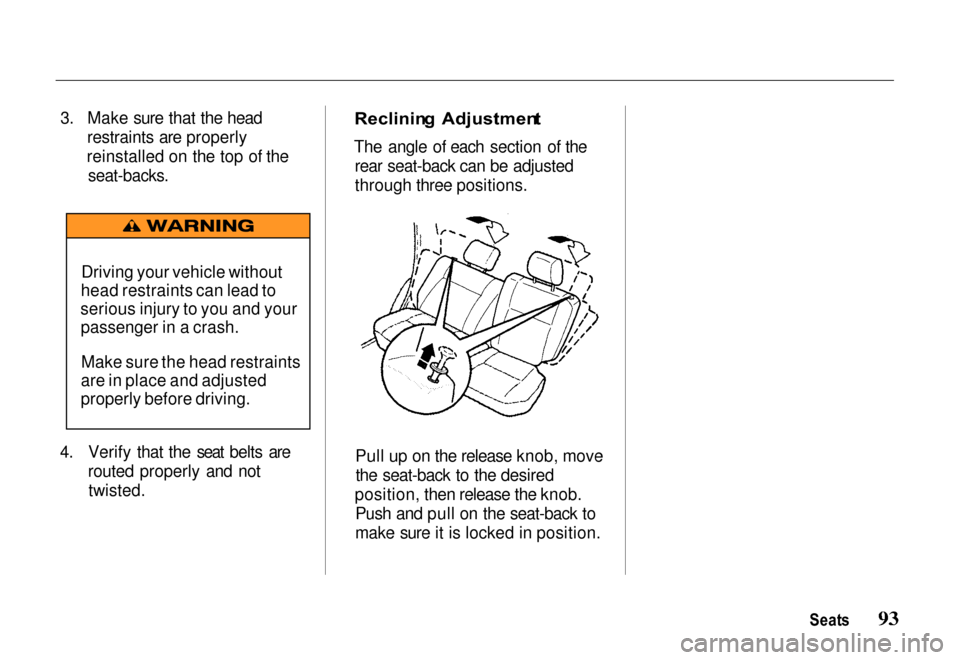
Reclinin
g Adjustmen t
The angle of each section of the rear seat-back can be adjusted
through three positions.
Pull up on the release knob, movethe seat-back to the desired
position, then release the knob. Push and pull on the seat-back to
make sure it is locked in position.
Seats
Driving your vehicle without
head restraints can lead to
serious injury to you and your passenger in a crash.
Make sure the head restraints
are in place and adjusted
properly before driving.
Page 113 of 267
Be careful when you are using the
beverage holder. A spilled liquid
that is very hot can scald you or
your passengers. Spilled liquids can also damage the upholstery,
carpeting, and electrical
components in the interior.
Su n Viso r
The sun visor can be pivoted to the side when unhooked.
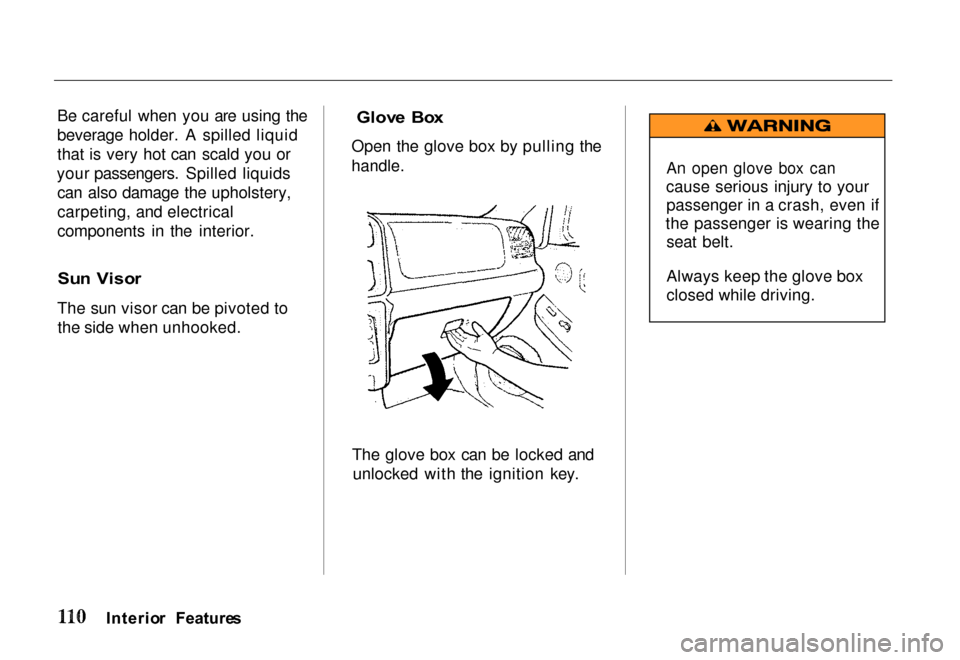
Glov
e Bo x
Open the glove box by pulling the
handle.
The glove box can be locked and unlocked with the ignition key.
Interio r Feature s
An open glove box can
cause serious injury to your passenger in a crash, even if
the passenger is wearing the seat belt.
Always keep the glove box
closed while driving.
Page 195 of 267
Front (4WD Only) and
Rear Propeller Shaft ... 218
Exhaust System ....... 218 Fuel Line and Fuel Tank/Cap ............ 218
Drive Belt ............ 218
Timing Belt ........... 218 Valve Clearance ........ 218SparkPlugs ........... 219
Clutch ............... 219
Fluid or Lubricant Levels 219
Power Steering ........ 219 Accelerator Pedal Linkage 220
Wheel Alignment ...... 220
Exterior ................ 220 Washing Your Vehicle . . 220
Polishing and Waxing Your Vehicle ......... 220
Protection of Exterior Bright Metal Parts ..... 220
Care of Aluminum Wheels 220 Foreign Material Deposits 220
Finish Damage ........ 221
Corrosion Protection .... 221
Sheet Metal Damage .... 221
Underbody Maintenance 221
Interior ................ 222 Basic StepsBefore Cleaning ...... 222
Cleaning Fabric ........ 223 Cleaning General Soilageor Water Spots From
Fabric Trim ........ 223
Spot Cleaning Fabric With Solvent Cleaner 223
Removal of Specific Stains ...... 224
Cleaning Vinyl or Leather Trim ....... 225
Seat Belt Care ......... 225
Cleaning Glass Surfaces . 226
Car e an d Maintenanc e
Page 208 of 267
Sit in the driver's seat and
perform these checks:
1. With the engine stopped, depress the brake pedal severaltimes; the travel distance and
effective pedal stroke should
remain unchanged.
2. Start the engine with the brake pedal fully depressed.
The brake pedal should go downa little as the engine starts.
3. Depress the brake pedal, stop the engine and hold the pedal
depressed for about 30
seconds; the brake pedal
should remain in position
without rising or going down.
4. Restart the engine and run it for about a minute, then turn it
off and depress the brake
pedal firmly several times; the
brake pedal travel should decrease each time the brake
pedal is depressed.
If the brakes do not operate
normally, have them checked and
corrected by your Honda dealer.
Exhaus t syste m — Be alert to any
changes in the sound of the exhaust system or any smell of fumes.
These are signs the system may be leaking or overheating. Have the
system checked and/or repaired at
once if these conditions exist. (Also see "Carbon Monoxide Hazard" in
the "Driver and Passenger Safety"
section and "Three-Way Catalytic
Converter" in the "Driving Tips"
section.)
Windshiel d wiper s an d
washer s — Check the operation
and condition of the wiper blades.
Check the flow and aim of the
washer spray.
Defroster
s — Check performance
by moving the controls to the
defrost setting and noting the amount of air directed against the
windshield.
Rea r vie w mirror s an d su n
visor s — Check that the friction
joints hold the mirrors and sun visors firmly in place.
Hor n — Blow the horn now and
then to be sure it works.
La p an d shoulde r belt s — Check
the belt system, including
webbing, buckles, latch plates,
retractors, guide loops and anchors for proper operation and
damage.
Sea t adjuster s — When adjusting
a seat, be sure the seat adjusters
latch securely by pushing the seat
forward and backward.
Car e an d Maintenanc e
Page 209 of 267
Seat-bac
k latche s — Seat-back
latches are designed to prevent
forward motion of the seat-back when the vehicle stops suddenly.
Check to see that the seat-backlatches are holding by pulling
forward on the top of the folding
seat-back.
Also check to see that the
reclining seats are operating properly.
Light s an d beepers — Check
panel lighting, warning lights, and
the seat belt reminder light and
beeper. Also check the key beeper and interior lights. On the outside,
check the license plate light, sidemarker lights, headlights, parking
lights, taillights, brake lights, turnsignals, backup lights and hazard
warning flashers. Have the
headlight aim checked promptly if the beams seem to be aimed
improperly.
Glas
s — Check for broken,
scratched or damaged glass that
could reduce visibility or cause injury.
Doo r latches — Check that the
doors close, latch and lock
securely.
Hoo d latc h — Check that the
hood closes firmly. Check for
broken, damaged, or missing parts that might prevent secure
latching. Make sure the secondarylatch keeps the hood from
opening all the way when first
released.
Flui
d leaks — Check for fuel,
water, oil or other fluid leaks by
looking at the surface beneath the
vehicle after it has been parked
for awhile. Water dripping from
the air conditioning system after use is normal. If you notice
gasoline fumes or fluid at any
time, locate the source and have it
corrected at once.
Spar e tir e an d jac k — Check that
the spare tire and all jack gear are securely stowed at all times.
Tailgat e latc h — Check that the
tailgate closes, latches and locks
securely.
Car e an d Maintenanc e
Page 221 of 267
Fron
t (4W D Only ) an d Rea r
Propelle r Shaf t
Lubricate the sliding yoke with
EP chassis grease. Lubricate
universal joints with grease
containing MoS 2 (molybdenum
disulfide-type grease) at the intervals shown in the
Maintenance Schedule. Also
check the propeller shaft
flange-to-pinion bolts for proper
torque of 64 N.m (46.3 Ib-ft).
Most lubrication recommendations
and procedures for four-wheel drive-
equipped vehicles are the same
for the corresponding components in conventional drive vehicles.
Exhaus t Syste m
Check the complete exhaust
system and nearby body areas for
damaged, missing, or
mispositioned parts, open seams, holes, loose connections, or other
deterioration that could allow
exhaust fumes to seep into the
passenger compartment or cause
heat build-up in the floor pan. Any
necessary corrections should be made immediately. For continuedsafety, exhaust system pipes and
resonators rearward of the muffler must be replaced whenever a new
muffler is installed.
Fue l Lin e an d Fue l Tank/Ca p
Inspect the fuel tank, cap and lines
for damage that could cause
leakage. Inspect the fuel cap and
gasket for correct sealing ability
and indications of physical
damage. Replace any damaged or
malfunctioning parts.
Driv
e Bel t
Check the belt driving the
alternator, power steering pump,
and air conditioning compressor.
Look for cracks, fraying, and wear. Replace as necessary.
Timin g Bel t
The timing belt should normally
be replaced at the intervals shown
in the Maintenance Schedule.
Valv e Clearanc e
Incorrect valve clearance will
result in increased engine noise and lower engine output, thereby
adversely affecting engine
performance.
Car e an d Maintenanc e