ESP HONDA PASSPORT 2001 2.G User Guide
[x] Cancel search | Manufacturer: HONDA, Model Year: 2001, Model line: PASSPORT, Model: HONDA PASSPORT 2001 2.GPages: 317, PDF Size: 4.85 MB
Page 162 of 317
Yo
u ma y driv e you r ne w vehicl e
fro m its ver y firs t mile/kilomete r
withou t followin g a forma l
"break-in " schedule. However ,
ther e ar e thing s yo u ca n d o durin g
th e firs t fe w hundre d miles /
kilometer s o f drivin g tha t wil l ad d
t o th e futur e performanc e an d
econom y o f you r vehicle.
I t i s recommende d tha t you r speed
durin g th e firs t 50 0 mile s (80 0
kilometers ) b e limite d to a
maximu m o f 5 5 mp h (9 0 km/h )
an d tha t yo u d o no t driv e fo r lon g
period s a t an y one constant speed,
eithe r fas t o r slow . Durin g thi s
period , avoi d full-throttl e start s
and , i f possible , avoi d har d stops ;
especiall y durin g th e firs t 20 0
mile s (32 0 kilometers ) o f driving .
Alway s driv e a t moderate speed
unti l th e engin e ha s completel y
warme d up .
Parkin
g
Whe n leavin g you r vehicl e
unattended :
Set
th e parkin g brake . Place
th e shif t leve r i n "P "
(Park ) positio n fo r automati c
transmission .
Whe
n parkin g a vehicl e equippe d
wit h a manua l transmissio n o n a n
upwar d slope , o r o n a leve l
surface , plac e th e shif t leve r i n
th e "1st " position . Whe
n parkin g a vehicl e
equippe d wit h a manua l
transmissio n o n a downwar d
slope , plac e the shif t leve r i n
th e "R " (Reverse ) position . Tur
n the ke y t o th e "LOCK "
position .
Remov
e th e key . Th e beeper
wil l remin d you . Clos
e al l window s an d loc k al l
doors .
Chec
k to mak e certai n th e
light s ar e turne d off . Th e
beeper wil l remin d you . I
f you r vehicl e is equippe d wit h
a transfe r case (4WD) , mak e
sur e th e shif t leve r i s in 4 H o r
4L .
Parkin g Tip s
Neve
r driv e th e vehicl e wit h
th e parkin g brak e set . Thi s ca n
overhea t th e rea r brakes ,
reducin g thei r effectivenes s an d
causin g excessiv e wea r o r
damage .
Alway
s appl y th e parkin g brak e
wheneve r yo u leav e th e vehicle ,
whethe r i t i s equippe d wit h a
manua l o r automati c transmission .
Drivin g Tip s
Ne
w Vehicl e Break-I n
Page 217 of 317
Oi
l Viscosit y
Engin e oi l viscosit y (thickness ) ha s
a n effec t o n fue l economy . Lowe r
viscosit y engin e oil s ca n provid e
increase d fue l economy ; however ,
highe r temperatur e weathe r
condition s requir e highe r viscosit y
engin e oil s fo r satisfactor y
lubrication . T o ge t th e bes t fue l
econom y wit h you r vehicle , yo u
shoul d us e a fuel-savin g engin e oi l
o f th e prope r viscosity . Thes e oil s
ca n b e foun d in servic e station s an d othe
r retai l stores . The y ar e
identifie d b y word s suc h a s
"Energ y Saving, " "Conserve s
Gasoline, " "Ga s Saving, "
"Gasolin e Saving, " "Frictio n
Reducing, " "Improve d Gasolin e
Mileage " o r "Fue l Saving. "
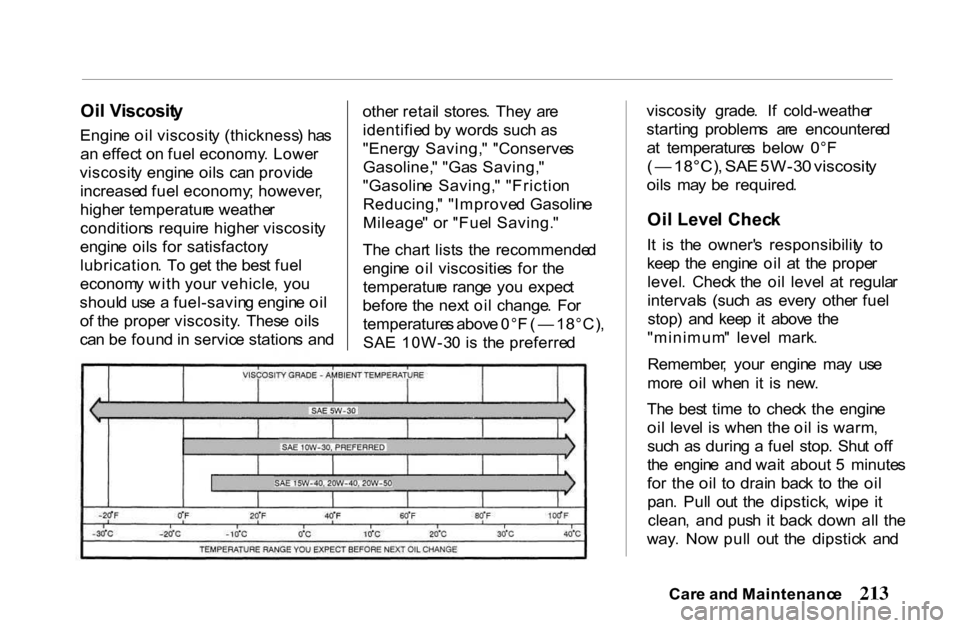
Th e char t list s th e recommende d
engin e oi l viscositie s fo r th e
temperatur e rang e yo u expec t
befor e th e nex t oi l change . Fo r
temperature s abov e 0° F ( — 18°C) ,
SA E 10W-3 0 i s th e preferre d viscosit
y grade . I f cold-weathe r
startin g problem s ar e encountere d
a t temperature s belo w 0° F
( — 18°C) , SA E 5W-3 0 viscosit y
oil s ma y b e required .
Oi l Leve l Chec k
I t i s th e owner' s responsibilit y t o
kee p th e engin e oi l a t th e prope r
level . Chec k th e oi l leve l a t regula r
interval s (suc h a s ever y othe r fue l
stop ) an d kee p i t abov e th e
"minimum " leve l mark .
Remember , you r engin e ma y us e
mor e oi l whe n i t i s new .
Th e bes t tim e t o chec k the engin e
oi l leve l i s whe n the oi l i s warm ,
suc h a s durin g a fue l stop . Shu t of f
th e engin e and wai t about 5 minute s
fo r the oi l t o drai n bac k t o th e oi l
pan . Pul l ou t th e dipstick , wip e i t
clean , and pus h i t bac k dow n al l th e
way . No w pul l ou t th e dipstic k an d
Car e an d Maintenanc e
Page 222 of 317
Yo
u usuall y d o no t nee d t o remov e
th e radiato r ca p to chec k th e engin e
coolan t level .
Addin g Engin e Coolan t
T o ad d engin e coolant , remov e th e
ca p o n th e radiato r reserv e tan k
an d fil l th e tan k u p t o th e
maximu m leve l mark . Ad d a
50/5 0 mixtur e o f wate r an d a goo d
qualit y ethylen e glyco l antifreeze .I
f yo u nee d t o ad d engin e coolan t
frequently , se e you r Hond a deale r
fo r a coolin g syste m check .
I f th e prope r qualit y antifreez e
i s used , ther e is n o nee d t o ad d
extr a inhibitor s o r additives . The y
ma y b e harmfu l t o th e prope r
operatio n o f th e system .
Coolin g Syste m Servic e
Th e coolin g syste m shoul d b e
service d a t th e interval s specifie d
i n th e Maintenanc e Schedul e a s
follows :
Was
h th e radiato r ca p an d fille r
nec k wit h clea n water .
Chec
k th e engin e coolan t leve l
i n th e radiato r an d hav e i t teste d
fo r freez e protection . Ad d
ethylen e glyco l antifreeze , i f
needed , t o maintai n freez e
protectio n a t -33° F (-36°C) . Hav
e th e coolin g syste m an d
radiato r ca p teste d fo r a
pressur e capacit y of 15 ps i (10 5
kPa) . I f a replacemen t ca p i s
needed , us e a ca p specifie d fo r
you r model . Tighte
n al l radiato r an d heate r
hos e clamp s an d inspec t al l
hoses . Replac e th e hose s i f the y
ar e swollen , "checked, " o r
otherwis e worn . Carefull y
tighte n th e hos e clamp s a t th e
radiator . Overtightenin g coul d
ben d o r collaps e th e radiato r
fittings .
Clean
the fron t o f the radiato r
core and ai r conditionin g
condenser.
I t i s th e owner' s responsibilit y to : Maintai
n th e coolin g syste m
freez e protectio n a t -33° F
Car e an d Maintenanc e
Removin
g th e radiato r ca p
whil e th e engin e i s ho t ca n
caus e th e coolan t t o spra y
out , seriousl y scaldin g you .
Alway s le t th e engin e an d
radiato r coo l dow n befor e
removin g th e radiato r cap .
Page 226 of 317
Fron
t (4W D Only ) an d Rea r
Propelle r Shaf t
Lubricat e th e slidin g yok e wit h
E P chassi s grease. Lubricat e
universa l joint s wit h grease
containin g MoS 2 (molybdenu m
disulfide-typ e grease ) a t th e
interval s show n in th e
Maintenanc e Schedule . Als o
chec k th e propelle r shaf t
flange-to-pinio n bolt s fo r prope r
torqu e o f 6 4 N. m (46. 3 Ib-ft) .
Mos t lubricatio n recommendation s
an d procedure s fo r four-whee l drive -
equippe d vehicle s ar e th e same
fo r th e correspondin g component s
i n conventiona l driv e vehicles .
Exhaus t Syste m
Chec k th e complet e exhaust
syste m an d nearb y bod y areas fo r
damaged , missing , o r
mispositione d parts , ope n seams ,
holes
, loos e connections , o r othe r
deterioratio n tha t coul d allo w
exhaus t fume s t o see p int o th e
passenger compartmen t o r cause
hea t build-u p in th e floo r pan . An y
necessary correction s shoul d b e
mad e immediately . Fo r continued
safety , exhaus t syste m pipe s an d
resonator s rearwar d o f th e muffle r
mus t b e replace d wheneve r a ne w
muffle r i s installed .
Fue l Lin e an d Fue l Tank/Ca p
Inspec t th e fue l tank , ca p an d line s
fo r damag e tha t coul d caus e
leakage . Inspec t th e fue l ca p an d
gaske t fo r correc t sealin g abilit y
an d indication s o f physica l
damage . Replac e an y damage d o r
malfunctionin g parts .
Driv
e Bel t
Chec k th e bel t drivin g th e
alternator , powe r steerin g pump ,
an d ai r conditionin g compressor .
Loo k fo r cracks , fraying , an d
wear . Replac e a s necessary .
Timin g Bel t
Th e timin g bel t shoul d normall y
b e replace d a t th e interval s show n
i n th e Maintenanc e Schedule .
Valv e Clearanc e
Incorrec t valv e clearanc e wil l
resul t i n increase d engin e nois e
an d lowe r engin e output , thereb y
adversel y affectin g engin e
performance .
Car e an d Maintenanc e
Page 230 of 317
bee
n coate d wit h corrosio n
protectants .
A t leas t ever y spring , flus h thes e
material s fro m th e underbod y
wit h plai n water . Tak e car e t o
thoroughl y clea n an y area s wher e
mu d an d othe r debri s ca n collect .
Sedimen t packe d in close d area s
o f th e fram e shoul d b e loosene d
befor e bein g flushed .
Wit
h th e us e o f moder n tri m
material s i t i s ver y importan t tha t
prope r cleanin g technique s an d
cleaner s b e used . Failur e to d o
thi s o n th e firs t cleanin g ma y
resul t i n wate r spots , spo t ring s o r
settin g o f stains , al l o f whic h
mak e it mor e difficul t t o remov e
o n a secon d cleaning .
Th e portio n o f th e followin g
cleanin g instruction s tha t ar e in
AL L CAPITA L LETTER S ar e
especiall y importan t an d MUS T
b e followed .
Dus t an d loos e dir t tha t
accumulat e o n interio r fabric s
shoul d b e remove d ofte n wit h a
vacuu m cleane r o r sof t brush .
Viny l o r leathe r tri m shoul d b e
wipe d regularl y wit h a clea n
dam p cloth . Norma l tri m soil ,
spot s o r stain s ca n b e cleane d wit h
conventiona l cleaners .
Remembe
r Thes e Basi c Step s
Befor e Cleanin g
1 . Remov e stain s a s quickl y a s
possibl e befor e the y becom e
"set. "
2 . Us e a clea n clot h o r spong e
an d chang e t o a clea n are a
often . ( A SOF T brus h ma y b e
use d i f stain s persist. )
3 . Us e solvent-typ e cleaner s onl y
i n a wel l ventilate d area ; also ,
d o no t saturat e th e staine d
area .
4 . I f a rin g form s afte r spo t
cleaning , clea n th e entir e are a
IMMEDIATELY .
5 . Follo w specifi c instruction s o n
th e cleanin g products ' labels .
Car e an d Maintenanc e
Interio
r
Page 256 of 317
Treadwea
r
Th e treadwea r grad e is a
comparativ e ratin g base d o n th e
wea r rat e o f th e tir e whe n teste d
unde r controlle d condition s o n a
specifie d governmen t tes t course .
Fo r example , a tir e grade d 15 0
woul d wea r one-and-a-hal f
(1-1/2 ) time s a s wel l o n th e
governmen t cours e a s a tir e
grade d 100 . Th e relativ e
performanc e o f tire s depend s
upo n th e actua l condition s o f thei r
use , however , an d ma y depar t
significantl y fro m th e nor m du e t o
variatio n in drivin g habits , servic e
practice s an d difference s i n roa d
characteristic s an d climate .
Tractio n - AA , A , B , C
Th e tractio n grade s fro m highes t
t o lowes t ar e AA , A , B , an d C .
Thos e grade s represen t th e tire' s
abilit
y t o sto p o n we t pavemen t a s
measure d unde r controlle d
condition s o n specifie d
governmen t tes t surface s o f
asphal t an d concrete . A tir e
marke d C ma y hav e poo r tractio n
performance .
Warning : Th e tractio n grad e
assigne d to thi s tir e is base d o n
straight-ahea d brakin g tractio n
tests , and does no t includ e
acceleration , cornering ,
hydroplaning , o r pea k tractio n
characteristics .
Temperatur e - A , B , C
Th e temperatur e grade s ar e A (th e
highest) , B an d C , representin g
th e tire' s resistanc e t o th e
generatio n o f hea t an d it s abilit y
t o dissipat e hea t whe n teste d
unde r controlle d condition s o n a specifie
d indoo r laborator y tes t
wheel . Sustaine d hig h temperatur e
ca n caus e th e materia l o f th e tir e
t o degenerat e an d reduc e tir e lif e
an d excessiv e temperatur e ca n
lea d t o sudde n tir e failure . Th e
grad e C correspond s t o a leve l o f
performanc e whic h al l vehicl e
tire s mus t mee t unde r th e Federa l
Moto r Vehicl e Safet y Standar d
No . 109 . Grade s B an d A
represen t highe r level s o f
performanc e o n th e laborator y tes t
whee l tha n th e minimu m require d
b y law .
Warning : Th e temperatur e grad e
fo r thi s tir e i s establishe d fo r a tir e
tha t i s properl y inflate d an d no t
overloaded . Excessiv e speed ,
underinflation , o r excessiv e
loadin g eithe r separatel y o r i n
combination , ca n caus e hea t
build-u p an d possibl e tir e failure .
Owne r Assistanc e
Page 276 of 317
an
d othe r usefu l information .
Recreationa l vehicl e club s ca n pu t
yo u i n touc h wit h othe r drivers ,
an d off-roa d magazine s publis h
first-han d description s o f drivin g
locations .
T o hel p kee p off-roa d drivin g
areas open , sta y o n roads , trail s
an d ope n areas approve d fo r
off-highwa y vehicle s (OHVs) .
Please respec t n o trespassing
signs , an d don' t driv e o n privat e
propert y withou t permission .Chec
k Ou t You r Vehicl e
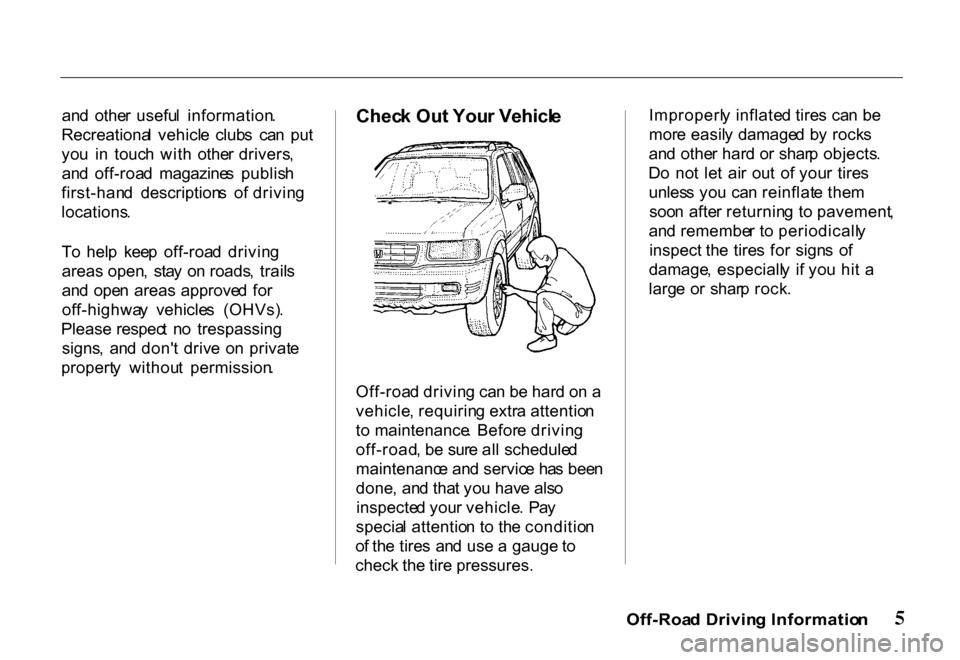
Off-roa d drivin g ca n b e har d o n a
vehicle , requirin g extr a attentio n
t o maintenance . Befor e drivin g
off-road , b e sur e al l schedule d
maintenanc e an d servic e ha s bee n
done , an d tha t yo u hav e als o
inspecte d you r vehicle . Pa y
specia l attentio n t o th e conditio n
o f th e tire s an d use a gauge to
check the tire pressures. Improperl
y inflate d tire s ca n b e
mor e easil y damage d b y rock s
an d othe r har d o r shar p objects .
D o no t le t ai r ou t o f you r tire s
unles s yo u ca n reinflat e the m
soo n afte r returnin g t o pavement ,
an d remembe r t o periodicall y
inspect the tire s fo r sign s o f
damage , especiall y i f yo u hi t a
larg e o r shar p rock .
Off-Roa d Drivin g Informatio n
Page 281 of 317
Readin
g th e Terrai n
I n nature , visua l informatio n come s
i n unpredictabl e ways . Tha t mean s
yo u nee d t o sta y alert , constantl y
surve y th e terrain , an d g o slo w
enoug h t o analyz e situation s an d
mak e goo d decisions .
A s you r eye s searc h th e terrai n
ahead , watc h fo r change s i n
surfac e conditions . Surface s ca n
var y widely , an d tractio n ca n
chang e quit e suddenly . On e
minut e yo u ca n b e o n fir m soi l
an d th e nex t minut e i n sof t san d
o r dee p mud . A trai l o r roa d ca n
quickl y chang e fro m leve l t o
bumpy . I t ca n suddenl y slop e a t a
dangerou s angle , o r eve n
disappea r i n a n unexpecte d
drop-off .
Road
s an d trail s aren' t banke d fo r
turns , an d th e edges can be steep
berm s o r drop-offs . Whe n yo u
driv e dow n a grade d road , watc h
ahea d fo r ruts , pothole s an d
washouts . Som e trail s ca n offe r
mor e surprises . A smooth ,
invitin g trai l ca n suddenl y twis t
u p o r down , become very narrow ,
b e blocke d b y a falle n tree ,
tangle d wit h roots , o r dwindl e t o a
tigh t dead-end .
Som e areas don't hav e road s o r
trail s - jus t wid e ope n spaces
wher e yo u mus t carefull y choos e
you r path . Controllin
g Spee d
Off-road , th e genera l rul e i s t o
kee p you r speed low. O f course ,
you'l l nee d enoug h speed to kee p
movin g forward , especiall y o n
sand , mud , sof t snow , an d whe n
startin g u p a hill . Bu t to o muc h
speed leads to problems .
A t highe r speeds you hav e les s
tim e t o rea d th e terrai n an d mak e
goo d decisions . You'l l als o
bounc e more , whic h make s
controllin g th e vehicl e mor e
difficult . An d there' s a greate r
chanc e o f slidin g i f yo u brak e o r
tur n quickl y o n we t soil , grave l o r
ice . In an y situation , neve r go
faste r tha n condition s allow .
Off-Roa d Drivin g Informatio n
Page 283 of 317
Drivin
g Off-Roa d
Drivin g off-roa d ca n b e hazardou s
i f yo u fai l t o tak e th e prope r
precautions . Fo r example , yo u ca n
hav e a n acciden t o r rol l ove r
durin g maneuver s suc h a s turning ,
drivin g o n hills , o r ove r obstacles .
Th e followin g page s contai n
practica l tip s o n basi c off-roa d
operations . The y als o giv e
importan t guideline s abou t
drivin g o n hills , avoidin g
obstacles , an d othe r situation s yo u
ma y encounter .
Startin
g Of f
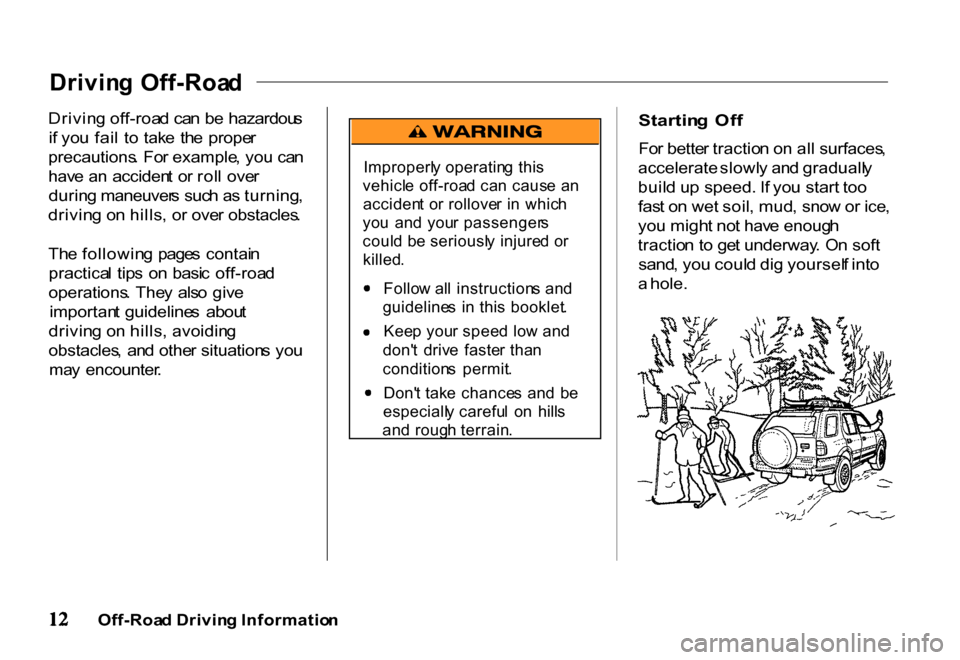
Fo r bette r tractio n o n al l surfaces ,
accelerate slowly an d graduall y
buil d u p speed. If yo u start too
fas t o n wet soil , mud , sno w o r ice ,
yo u migh t no t hav e enoug h
tractio n t o ge t underway . O n soft
sand , yo u coul d di g yoursel f int o
a hole.
Off-Roa d Drivin g Informatio n
Improperl
y operatin g thi s
vehicl e off-roa d ca n caus e a n
acciden t o r rollove r i n whic h
yo u an d you r passenger s
coul d b e seriousl y injure d o r
killed .
Follo w al l instruction s an d
guideline s i n thi s booklet .
Kee p you r spee d lo w an d
don' t driv e faste r tha n
condition s permit .
Don' t tak e chance s an d b e
especiall y carefu l o n hill s
an d roug h terrain .
Page 293 of 317
Ge
t a to w fro m anothe r vehicl e
b y usin g a towin g rope , stra p o r
chain . T o b e successful , th e
pullin g vehicl e wil l nee d
adequat e powe r an d traction .
B e sur e th e rope , stra p o r chai n
i s attache d t o th e frame s (no t
bumpers ) o f bot h vehicles , an d
kee p peopl e awa y i n cas e th e
connectin g devic e breaks . Us
e a winch . I f yo u hav e a
winch , yo u migh t b e abl e t o
attac h i t t o anothe r vehicl e o r a
sturdy , fixe d objec t (suc h a s a
tree) . O r anothe r vehicl e wit h a
winc h ma y b e abl e t o attac h it
t o you r vehicl e an d pul l yo u
out .
Ge t experience d help . Thi s i s
ofte n th e bes t solution ,
especiall y i f yo u hav e du g i n
deep , ar e stuc k i n mu d o r o n
slope d terrain .
Grounde
d o n a Bum p o r Lo g
Yo u hav e fewe r option s i f yo u
botto m ou t (o r high-center ) o n a
bump , log , o r othe r raise d
obstacle . Yo u ca n tr y gettin g a
to w (forwar d o r backward ) fro m
anothe r vehicle , us e a winc h (se e
abov e fo r additiona l tips) , o r ge t
experience d help .
Fla t Tir e
Chang e a fla t tir e onl y i f th e
vehicl e i s o n firm , leve l groun d
tha t ca n safel y suppor t th e jack . I f
thi s i s no t th e case , you r option s
are : driv e slowl y an d carefull y
unti l yo u reac h firm , leve l ground ;
ge t a to w fro m anothe r vehicl e (a s
describe d above) ; o r sen d fo r
experience d help .
Off-Roa d Drivin g Informatio n