steering HONDA PASSPORT 2001 2.G Owners Manual
[x] Cancel search | Manufacturer: HONDA, Model Year: 2001, Model line: PASSPORT, Model: HONDA PASSPORT 2001 2.GPages: 317, PDF Size: 4.85 MB
Page 1 of 317
 to navigate through\
this reference.
For a printed owners manual, click on authorized manuals or go")
2001 Passport Online Reference Owner's Manual Use these links (and links throughout this manual) to navigate through\
this reference.
For a printed owner's manual, click on authorized manuals or go to www.h\
elminc.com. Contents
Owner's Identification Form
A Word to the Owner
........................................................................\
................................................... i
Important Handling Information ........................................................................\
.............................. ii
A Few Words About Safety
........................................................................\
........................................ iv
Driver and Passenger Safety ........................................................................\
...................................... 3
Proper use and care of your vehicle's seat belts, and Supplemental Restr\
aint System.
Off to a Good Start
........................................................................\
..................................................... 49
Instruments and Controls
........................................................................\
......................................... 55
Instrument panel indicator and gauge, and how to use dashboard and steering co\
lumn controls.
Seats
........................................................................\
........................................................................\
.... 89
Interior Features
........................................................................\
....................................................... 99
Comfort and Convenience Features
........................................................................\
...................... 119
How to operate the climate control system, the audio system, and other c\
onvenience features.
Driving Tips
........................................................................\
.............................................................. 155
The proper way to start the engine, shift the transmission, and park, wh\
at gasoline to use, how to
break -in your new vehicle, and how to load luggage and other cargo.
In Case of Emergency
........................................................................\
.............................................. 183
This section covers several problems motorists sometimes experience, and how to handle them.
Care and Maintenance
........................................................................\
............................................ 195
The Maintenance Schedule shows you when you need to take your vehicle to\
the dealer and
tips on cleaning and protecting your vehicle. Things to look for if your\
car ever needs body
repairs.
Technical Data
........................................................................\
......................................................... 231
ID numbers, dimensions, capacities, and technical information.
Owner Assistance
........................................................................\
..................................................... 245
A summary of the warranties covering your new Honda, and how to contact \
us.
Authorized Manuals
........................................................................\
................................................ 253
How to order manuals and other technical literature.
Index ........................................................................\
.......................................................................
.....
I
Supplemental Restraint System Off Road Driving Information
Page 57 of 317
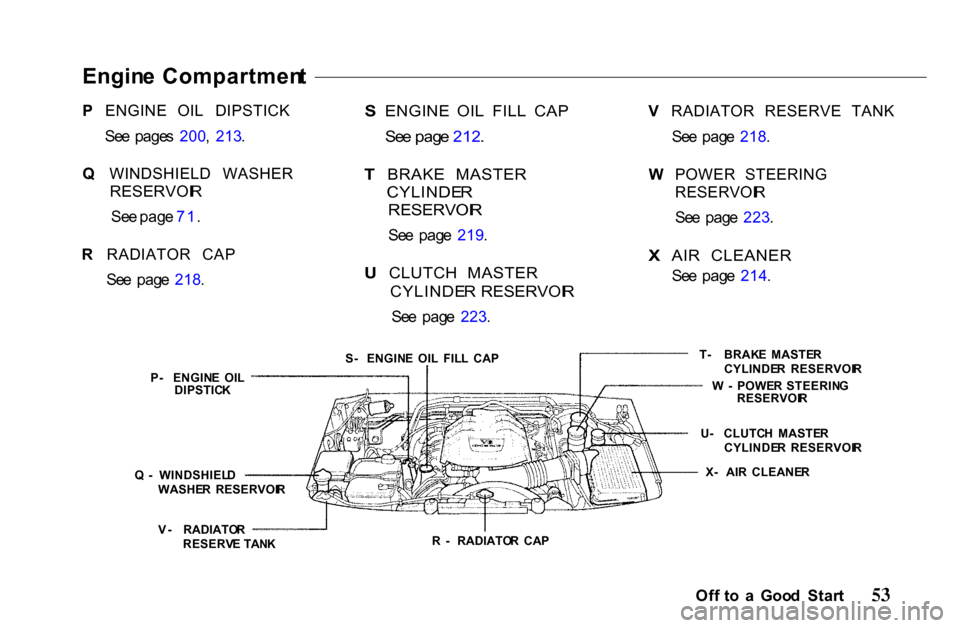
P ENGINE OIL DIPSTICK
Se e page s 200 , 213 .
Q WINDSHIELD WASHER
RESERVOI R
Se e pag e 71 .
R RADIATOR CAP
Se e pag e 218 .
S ENGINE OIL FILL CAP
See pag e 212 .
T BRAKE MASTER
CYLINDE R
RESERVOI R
Se e pag e 219 .
U CLUTCH MASTER
CYLINDE R RESERVOI R
Se e pag e 223 .
V RADIATOR RESERVE TANK
Se e pag e 218 .
W POWER STEERING
RESERVOI R
Se e pag e 223 .
X AIR CLEANER
Se e pag e 214 .
Of f t o a Goo d Star t
S
- ENGIN E OI L FIL L CA P
P - ENGIN E OI L
DIPSTIC K
Q - WINDSHIEL D
WASHE R RESERVOI R
R - RADIATO R CA P
V
- RADIATO R
RESERV E TAN K X
- AI R CLEANE R
U
- CLUTC H MASTE R
CYLINDE R RESERVOI R
W
- POWE R STEERIN G
RESERVOI R
T
- BRAK E MASTE R
CYLINDE R RESERVOI R
Engin
e Compartmen t
Page 105 of 317

Key
s an d Ignitio n
You r Passpor t come s wit h tw o
keys .
Th e ke y cod e numbe r i s stampe d
o n th e meta l plat e attache d to th e
ke y ring .
Fo r vehicl e security :
Recor d th e ke y cod e number .
Kee p th e ke y cod e numbe r
plat e in a saf e place , NO T IN
TH E VEHICLE . I
f th e origina l key s ar e lost ,
duplicate s ca n b e mad e usin g th e
ke y cod e number . Contac t an y
Hond a deale r o r a locksmith .
Steerin g Colum n
Lock/Ignitio n Switc h
Th e ignitio n switch , o n th e righ t
sid e o f th e steering column, ha s
fiv e positions : LOC
K — Th e norma l parkin g
position . Thi s lock s th e steerin g
an d prevent s norma l us e o f th e
steerin g wheel .
Th e ke y ca n b e remove d onl y
whe n th e ignitio n is i n thi s
position . O n automati c
transmissio n models , th e ignitio n
switc h canno t b e turne d to th e
"EOCK " positio n unles s th e shif t
leve r ha s firs t bee n place d in th e
"P " position . Th e shif t leve r i s
the n locked .
AC C (Accessory) — In thi s
position , yo u ca n us e som e
electrica l accessorie s whe n th e
engin e is no t running .
O N — Th e norma l drivin g
position .
START —This positio n start s th e
engine . Th e switc h return s t o O N
whe n yo u releas e th e key .
Interio r Feature s
META
L PLAT E
WIT H KE Y COD E
Page 106 of 317

Th
e anti-thef t steerin g colum n
loc k i s no t interconnecte d wit h th e
parkin g brake . Yo u mus t alway s
se t th e parkin g brak e whe n
leavin g th e vehicle .
T o preven t dischargin g th e battery ,
avoi d us e o f electrica l accessorie s
wit h th e engin e shu t off .
Fo r easie r ke y operatio n whe n
unlocking , rotat e th e steerin g
whee l slightl y t o reliev e pressur e
o n th e steerin g lock .
Ke y Remova l
Manual Transmission
Wit h th e vehicl e full y stopped ,
remov e th e ke y fro m th e switc h
b y turnin g i t t o th e "LOCK "
positio n an d removin g it . Automatic
Transmission
Wit h th e vehicl e full y stopped , plac e
th e automati c transmissio n shif t
leve r i n "P " (Park ) position . Tur n
th e ke y t o th e "LOCK " position .
Ke y Reminde r
Th e ke y reminde r circui t cause s a
beepe r t o soun d whe n th e doo r i s
hel d ope n wit h th e ke y lef t i n th e
ignitio n switch . Thi s i s t o hel p
preven t accidentall y lockin g th e
ke y insid e th e vehicle .
Th
e beepe r stop s whe n th e doo r i s
close d o r whe n th e ke y i s removed .
Guar d Agains t Thef t
You r ne w Passpor t ha s feature s t o
hel p preven t thef t o f th e vehicle ,
it s equipment , an d it s contents .
Thes e anti-thef t feature s wor k
dependin g o n ho w wel l yo u us e
them .
Par k i n a well-lighte d are a
wheneve r possible .
Loc k th e steerin g colum n an d
tak e th e ke y wit h you .
- Tur n th e ignitio n switc h t o
"LOCK " an d remov e th e key .
Thi s lock s bot h th e ignitio n
switc h an d steerin g control .
Interio r Feature s Removin
g th e ke y fro m th e
ignitio n switc h whil e drivin g
lock s th e steering . Thi s ca n
caus e yo u to los e control .
Remov e th e ke y fro m th e
ignitio n switc h onl y whe n
parked .
Page 119 of 317

Assis
t Gri p
A n assis t gri p i s locate d abov e
eac h window . Hor
n Butto n
T o soun d th e horn , pres s th e
cente r o f th e steerin g whee l
airbag .
HORN ARE A Til
t Steerin g Whee l
See page 15 for important
information about how to properly
position the steering wheel.
Th e releas e leve r fo r th e til t
steerin g whee l i s o n th e lef t sid e
o f th e steerin g column .
T o adjus t th e heigh t o f th e
steerin g wheel , pus h u p o n th e
lever . Th e steerin g whee l ha s si x
Interio r Feature s
Page 166 of 317
Self-Adjustin
g Brake s
Th e brake s o n thi s vehicl e ar e
self-adjusting . The y hav e bee n
designe d s o tha t periodi c brak e
adjustmen t i s no t needed .
Th e brakes adjus t themselve s eac h
tim e yo u firml y appl y them .
Thus , i f th e brak e peda l goe s dow n
farthe r tha n norma l du e t o a lac k o f
adjustment , driv e backwar d an d
forwar d a fe w times . Appl y th e
brake s intermittently .
Se e you r Hond a deale r i f th e
brak e peda l heigh t doe s no t retur n
t o norma l o r i f ther e i s a rapi d
increas e i n peda l travel . Eithe r i s a
sig n o f othe r brak e trouble . Also ,
se e you r Hond a deale r i f th e
parkin g brak e needs adjustment .
Brakin
g Tip s
Contro l you r vehicle' s spee d o n a
stee p o r lon g downhil l grad e b y
shiftin g th e transmissio n t o a
lowe r gear . Constantl y usin g th e
brake s ca n caus e the m to overhea t
an d los e effectiveness .
Restin g you r foo t o n th e brak e
peda l whe n yo u ar e no t intendin g
t o brak e ("ridin g th e brakes" ) ca n
caus e the m to overheat . Thi s
reduce s thei r effectiveness, wears
the m ou t faster , an d ca n reduc e
fue l mileage . I t als o causes you r
brak e light s t o sta y o n al l th e time ,
confusin g driver s behin d you .
Brak e Wea r Indicator s
Th e fron t an d rea r brake s hav e
built-i n wea r indicators . Thes e mak
e a high-pitche d squealin g o r
cricket-lik e warnin g soun d whe n
th e brak e pad s o r lining s ar e wor n
t o th e poin t o f replacement . Th e
soun d ma y com e an d g o o r b e
hear d al l th e tim e whe n th e vehicl e
i s moving , bu t ma y sto p whe n th e
brak e peda l i s pushe d dow n firmly .
Expensiv e damag e ca n resul t i f
pad s o r lining s ar e no t replace d
immediatel y whe n needed .
Drivin g o n Slipper y Surface s
Driving , steering , an d brakin g
tractio n ar e reduce d whe n th e
roa d is coate d wit h water , snow ,
ice , gravel , o r othe r materials .
Slo w dow n an d adjus t you r
drivin g t o suc h conditions . I t i s
importan t t o slo w dow n whe n i t i s
slipper y because stoppin g
Drivin g Tip s
Page 167 of 317
distance
s wil l b e longe r an d
vehicl e contro l mor e limited .
Whil e drivin g o n a surfac e wit h
reduce d traction , avoi d maneuver s
involvin g sudde n steering ,
acceleration , o r brakin g (includin g
engin e brakin g du e t o shiftin g t o
lowe r gear) , tha t coul d cause th e
tire s t o skid .
Driver s ma y no t realiz e th e
surfac e i s slipper y unti l th e
vehicl e i s skidding .
Lear n t o recogniz e warnin g
clues—suc h a s enoug h wate r o r
ic e o n th e roa d to mak e a
"mirrore d surface"—an d slo w
dow n whe n ther e is an y doubt .
Als o se e "Traction " unde r "Tires "
i n thi s section . T
o safel y operat e you r vehicle ,
you r tire s mus t b e th e prope r typ e
an d size , i n goo d conditio n wit h
adequat e tread , an d correctl y
inflated . Th e followin g page s giv e
mor e detaile d informatio n o n ho w
an d whe n t o chec k ai r pressure ,
ho w to inspec t you r tire s fo r
damag e an d wear , an d wha t t o d o
whe n you r tire s nee d t o b e
replaced .
Drivin g Tip s
Rapi
d slowin g dow n o r
speeding-u p ca n caus e los s
o f contro l o n slipper y
surfaces . I f yo u crash , yo u
ca n b e injured .
Us e extr a car e whe n drivin g
o n slipper y surfaces .
Using tire s tha t ar e excessivel y
wor n o r improperl y inflate d ca n
caus e a cras h in whic h yo u
ca n b e seriousl y hur t o r killed .
Follo w al l instruction s in thi s
owner' s manua l regardin g tir e
inflatio n an d maintenance .
Tire
s
Page 286 of 317
I
f yo u don' t kno w th e answer s t o
thes e question s befor e beginnin g
a n ascent , stop , wal k u p th e hil l
an d fin d out .
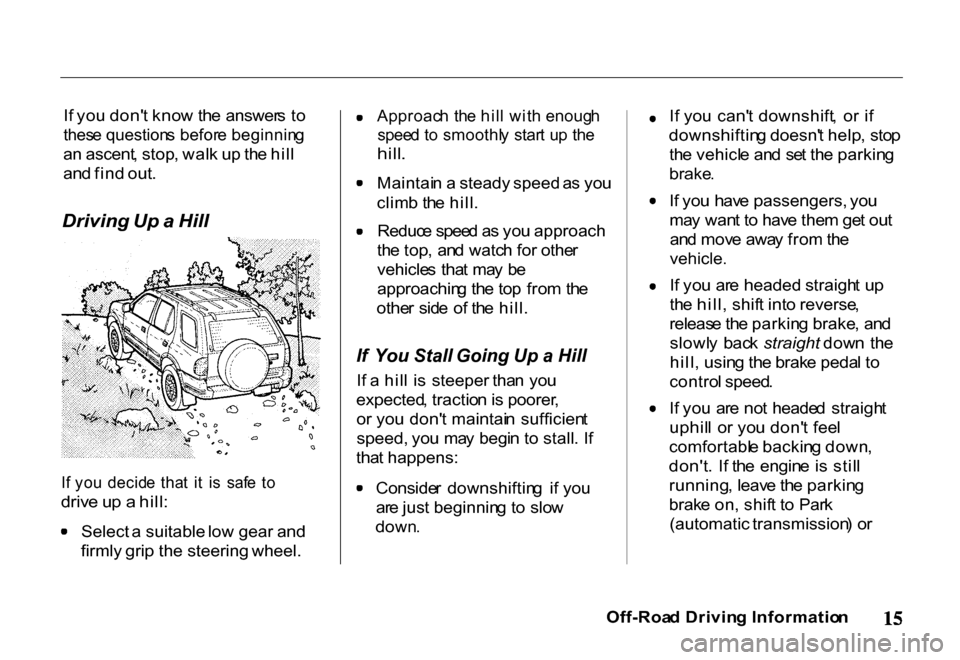
I f yo u decid e tha t i t i s saf e t o
driv e u p a hill :
Select a suitable low gear and
firmly grip the steering wheel.
Approach th e hil l wit h
enoug
h
spee d t o smoothl y star t u p th e
hill .
Maintai n a steady speed as yo u
clim b th e
hill .
Reduc e spee d
a
s yo u approach
th e top , an d watc h fo r othe r
vehicle s tha t ma y b e
approachin g th e to p fro m th e
othe r sid e o f th e hill .
If You Stall Going Up a Hill
I f a hil l i s steeper than yo u
expected , tractio n is poorer ,
o r yo u don' t maintai n sufficien t
speed, you ma y begi n t o stall . I f
tha t happens:
Conside r downshiftin g i f yo u
ar e jus t beginnin g t o slo w
down .
I
f yo u can' t downshift , o r i f
downshiftin g doesn' t help , sto p
th e vehicl e an d se t th e parkin g
brake .
I f yo u hav e passengers, you
ma y wan t t o hav e the m ge t ou t
an d mov e awa y fro m th e
vehicle.
I f yo u ar e headed straight u p
th e hill , shif t int o reverse ,
releas e th e parkin g brake , an d
slowl y bac k straight down th e
hill , usin g th e brak e peda l t o
contro l speed .
I f yo u ar e no t heade d straigh t
uphil l o r yo u don' t fee l
comfortabl e backin g down ,
don't . I f th e engin e i s stil l
running , leav e th e parkin g
brak e on , shif t t o Par k
(automatic transmission ) o r
Off-Roa d Drivin g Informatio n
Driving
Up a Hill
Page 301 of 317
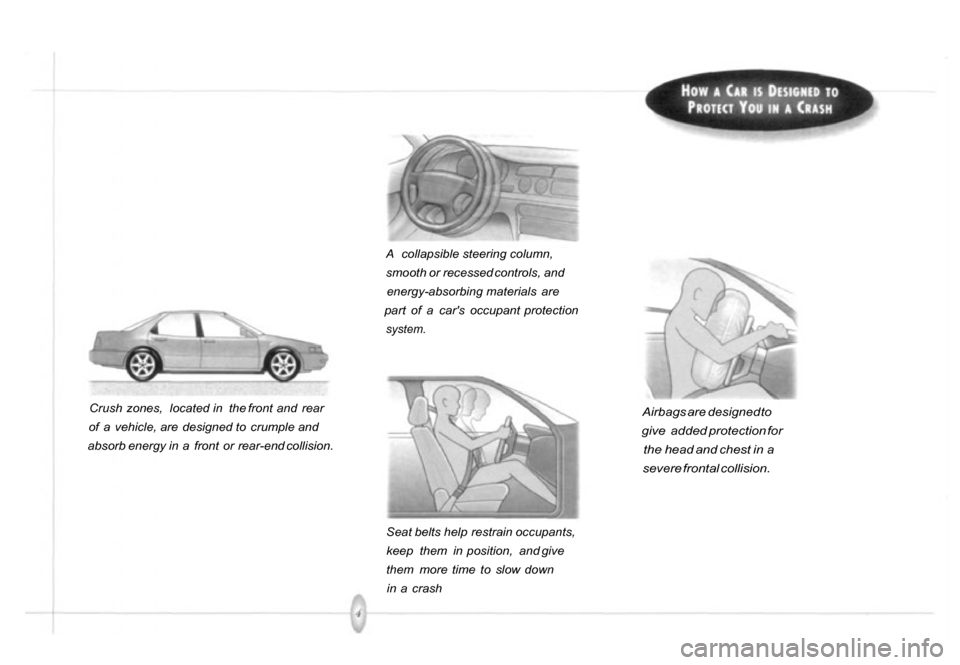
Crush
zones, located in the front and rear
of a vehicle, are designed to crumple and
absorb energy in a front or rear-end collision. A
collapsible steering column,
smooth or recessed controls, and
energy-absorbing materials are
part of a car's occupant protection
system.
Seat belts help restrain occupants,
keep them in position, and give
them more time to slow down
in a crash
Airbags
are designed to
give added protection for
the head and chest in a
severe frontal collision.
Page 312 of 317
T
o d o thei r job , airbag s inflat e wit h
tremendou s speed—ove r 10 0 mph . S o whil e
airbag s ca n sav e you r lif e an d reduc e th e
severit y o f injuries , the y ca n als o caus e
abrasion s an d bruises . An d i f yo u si t to o
close , or don' t wea r a sea t belt , or don' t si t in
a prope r position , a n inflatin g airba g ca n
caus e broke n bone s o r mor e seriou s injuries .
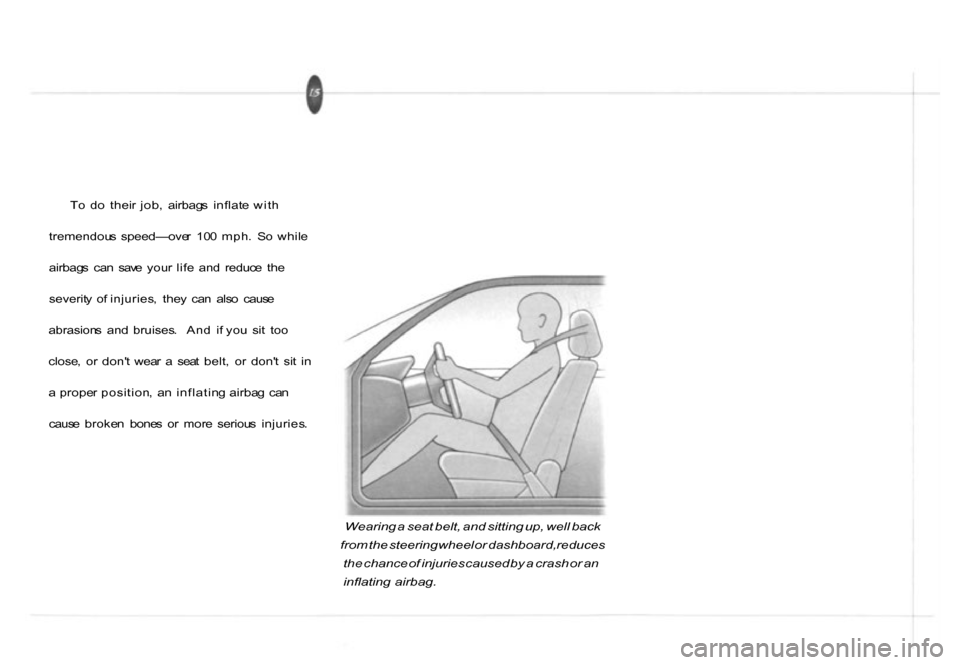
Wearing a seat belt, and sitting up, well back
from the steering wheel or dashboard, reduces
the chance of injuries caused by a crash or an
inflating airbag.