fuel HONDA PASSPORT 2002 2.G User Guide
[x] Cancel search | Manufacturer: HONDA, Model Year: 2002, Model line: PASSPORT, Model: HONDA PASSPORT 2002 2.GPages: 294, PDF Size: 3.97 MB
Page 87 of 294
MANUAL TRANSMISSION SHIFT SPEED CHART
Transmission Type
5-Speed Manual First to
Second Second to
Third Third to
Fourth Fourth to
Fifth
15 mph
(25 km/h) 25 mph
(40 km/h) 40 mph
(65 km/h) 45 mph
(70 km/h)
84Instruments and Controls
Shift Speed Chart
The lower gears of the
transmission are used for normal
acceleration of the vehicle to the
desired cruising speed. The
highest gear of the transmission is
used to maintain the desired
speed. The fifth gear is
recommended for use in
maintaining highway cruising
speeds. Use of the fifth gear in
city traffic is not recommended.
The shift speed chart shows the
speeds at which each upshift of
the transmission should be made
to get the best vehicle
performance and fuel economy. For cruising, choose the highest
gear for that speed (cruising speed
is defined as a relatively constant
speed operation).
The upshift indicator (
U/S) lights
to show recommended upshift
points. (Refer to “Indicator
Lights.”)
If the engine is “lugging” (the
speed you are traveling at is too
slow for the gear the transmission
is in), downshift to the next lower
gear. You may need to downshift
two or more gear positions to
keep the engine from “lugging” or
to keep the performance at a
satisfactory level.
Transfer Control
4WD Models
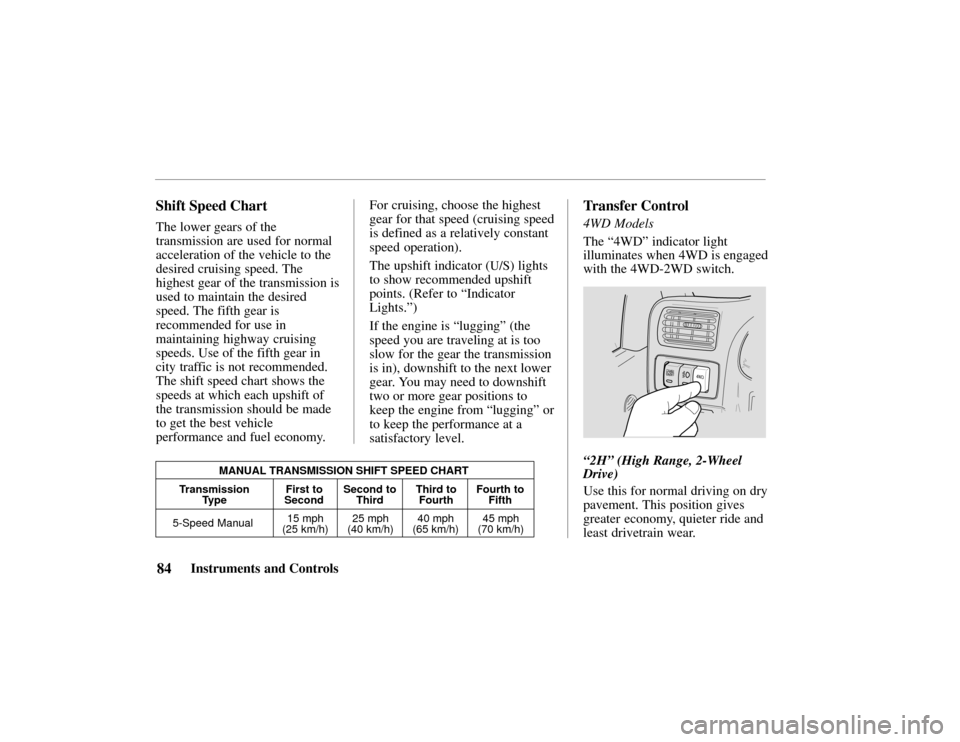
The “4WD” indicator light
illuminates when 4WD is engaged
with the 4WD-2WD switch.
“2H” (High Range, 2-Wheel
Drive)
Use this for normal driving on dry
pavement. This position gives
greater economy, quieter ride and
least drivetrain wear.
Page 103 of 294
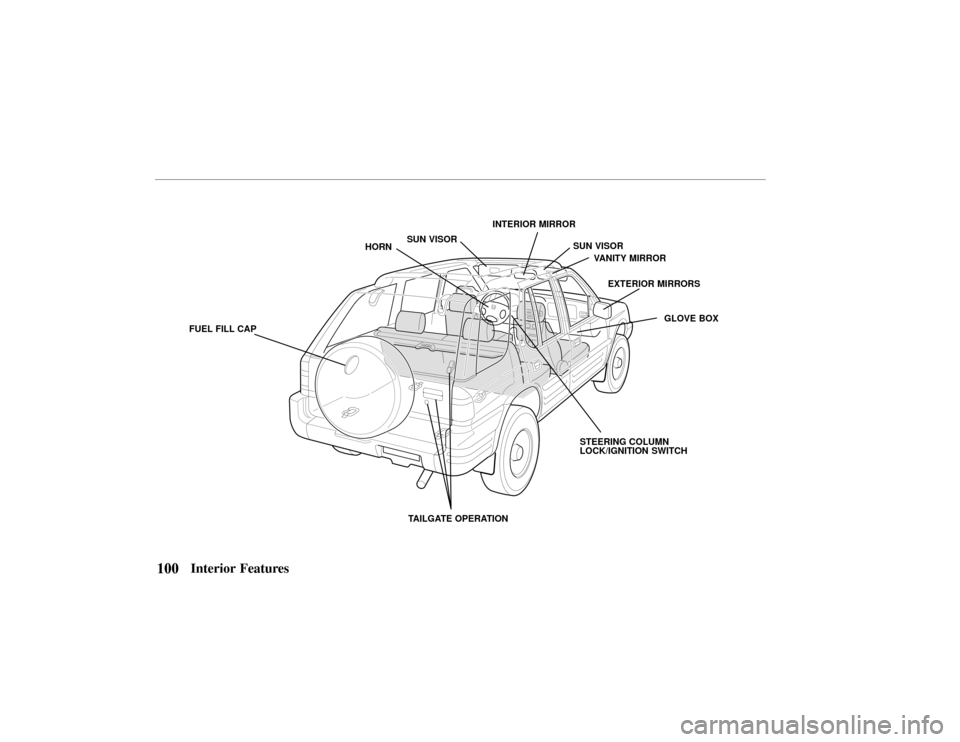
TAILGATE OPERATION
HORNSUN VISORINTERIOR MIRROR
SUN VISOR
EXTERIOR MIRRORS GLOVE BOX
STEERING COLUMN
LOCK/IGNITION SWITCH
FUEL FILL CAP
VANITY MIRROR
100Interior Features
Page 123 of 294
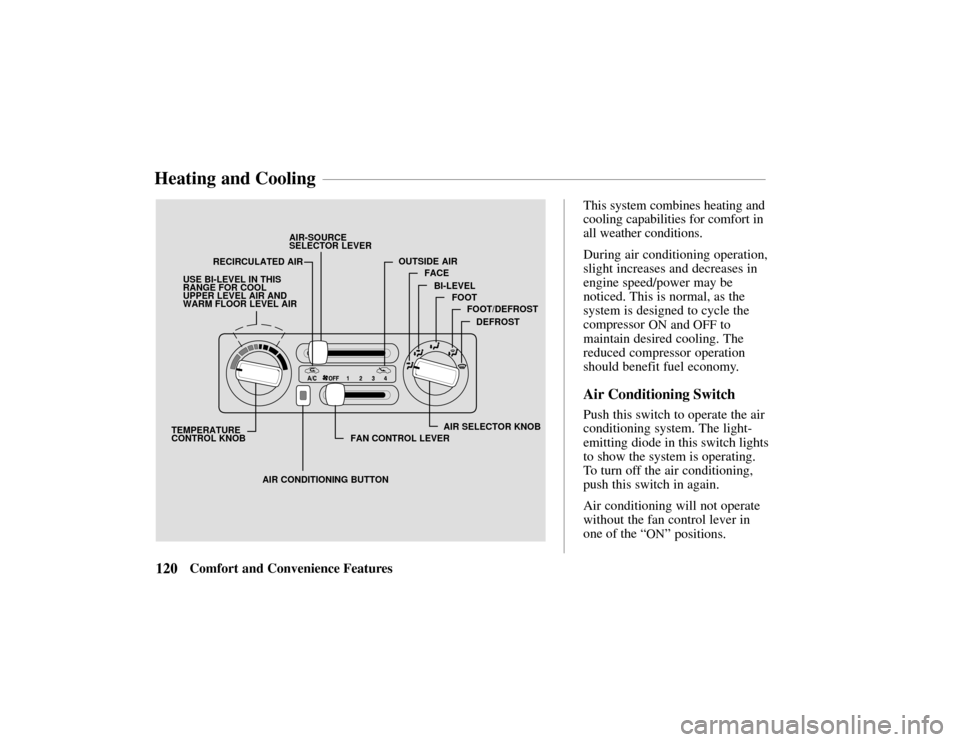
FACEFOOT
DEFROST
FOOT/DEFROST
AIR SELECTOR KNOB
BI-LEVEL
AIR-SOURCE
OUTSIDE AIR
FAN CONTROL LEVER
AIR CONDITIONING BUTTON
TEMPERATURE
SELECTOR LEVER
USE BI-LEVEL IN THIS
RANGE FOR COOL
UPPER LEVEL AIR AND
WARM FLOOR LEVEL AIR
CONTROL KNOB
RECIRCULATED AIR
120Comfort and Convenience Features This system combines heating and
cooling capabilities for comfort in
all weather conditions.
During air conditioning operation,
slight increases and decreases in
engine speed/power may be
noticed. This is normal, as the
system is designed to cycle the
compressor
ON and OFF to
maintain desired cooling. The
reduced compressor operation
should benefit fuel economy.
Air Conditioning Switch
Push this switch to operate the air
conditioning system. The light-
emitting diode in this switch lights
to show the system is operating.
To turn off the air conditioning,
push this switch in again.
Air conditioning will not operate
without the fan control lever in
one of the “
ON” positions.
Heating and Cooling
Page 158 of 294
155Driving Tips
Before Driving156
. . . . . . . . . . .
Starting the Engine157 . . . . .
New Vehicle Break-In 158 . . . . .
Parking 158 . . . . . . . . . . . . . . . .
Brakes 159 . . . . . . . . . . . . . . . . .
Tires 163 . . . . . . . . . . . . . . . . . .
Inflation 164 . . . . . . . . . . . . .
Inspection 165 . . . . . . . . . . . .
Maintenance 166 . . . . . . . . . .
Tire Rotation 166 . . . . . . . . . .
Replacing Tires
and Wheels 166 . . . . . . . . . .
Wheels and Tires 167 . . . . . .
Traction 168 . . . . . . . . . . . . . .
Tire Chains 168 . . . . . . . . .
Wheel Replacement
Considerations 169 . . . . . . .
Fuel Economy 170 . . . . . . . . . . .
Three-Way Catalytic
Converter 172 . . . . . . . . . . . . . Operation in
Foreign Countries 173
. . . . . . .
Accessories & Modifications173
Carrying Cargo175 . . . . . . . . . . .
Trailer Towing 178 . . . . . . . . . . .
Trailer Hitches 180 . . . . . . . .
Safety Chain181 . . . . . . . . . .
Trailer Lights181 . . . . . . . . . .
Tires181 . . . . . . . . . . . . . . . . .
Trailer Brakes181 . . . . . . . . .
Equipment Check182 . . . . . .
Limited Slip Differential 182 . . .
Driving Tips
Page 160 of 294

157Driving Tips
switch is turned to the “
ON”
or “
START” position.
5. Check all gauges (including the fuel gauge).
6. Release the parking brake (and make sure the “
BRAKE”
light turns off).
See related topics in this manual if
you find any problems.
Starting the Engine
1. Apply the parking brake.
2. Manual Transmission: Press
the clutch pedal to the floor
and shift the transmission to
the Neutral position. Hold the
clutch pedal to the floor while
you are starting the engine. A
starter safety switch keeps the
starter from operating if the
clutch pedal is not fully
depressed. Automatic Transmission:
Place the shift lever in “P”
or “N” position (“P” is
preferred). A starter safety
switch prevents the starter
from operating if the shift
lever is in any drive position.
If it is necessary to restart the
engine with the vehicle
moving, place the shift lever
in “N” (never in “P”).
3. Do not touch the accelerator pedal. Start the engine by
turning the ignition switch to
“
START.”
If the engine does not start in
10 seconds, wait 15 seconds to let
the starter cool down. Then crank
the engine at wide open throttle
for a maximum of 10 seconds. If
the engine still does not start, wait
another 15 seconds and repeat the
entire procedure. Do not crank the engine for more
than 10 seconds at a time. Wait 15
seconds before trying again.
4. Return the ignition switch to
the “
ON” position as soon as
the engine starts.
5. Apply the regular brakes and shift into the proper gear.
Release the parking brake and
brake pedal and drive off.
In models with an automatic
transmission, you cannot shift
from “P” (Park) position to
any other position unless the
brake pedal is applied.
Page 165 of 294

162Driving Tips
Self-Adjusting Brakes
The brakes on this vehicle are
self-adjusting. They have been
designed so that periodic brake
adjustment is not needed.
The brakes adjust themselves each
time you firmly apply them.
Thus, if the brake pedal goes down
farther than normal due to a lack of
adjustment, drive backward and
forward a few times. Apply the
brakes intermittently.
See your Honda dealer if the
brake pedal height does not return
to normal or if there is a rapid
increase in pedal travel. Either is a
sign of other brake trouble. Also,
see your Honda dealer if the
parking brake needs adjustment.
Braking Tips
Control your vehicle’s speed on a
steep or long downhill grade by
shifting the transmission to a
lower gear. Constantly using the
brakes can cause them to overheat
and lose effectiveness.
Resting your foot on the brake
pedal when you are not intending
to brake (“riding the brakes”) can cause them to overheat. This
reduces their effectiveness, wears
them out faster, and can reduce
fuel mileage. It also causes your
brake lights to stay on all the time,
confusing drivers behind you.
Brake Wear Indicators
The front and rear brakes have
built-in wear indicators. These make a high-pitched squealing or
cricket-like warning sound when
the brake pads or linings are worn
to the point of replacement. The
sound may come and go or be
heard all the time when the vehicle
is moving, but may stop when the
brake pedal is pushed down firmly.
Expensive damage can result if
pads or linings are not replaced
immediately when needed.
Driving on Slippery Surfaces
Driving, steering, and braking
traction are reduced when the
road is coated with water, snow,
ice, gravel, or other materials.
Slow down and adjust your
driving to such conditions. It is
important to slow down when it is
slippery because stopping
Page 167 of 294

164Driving Tips
Inflation
Keeping the tires properly inflated
provides the best combination of
handling, tread life, and riding
comfort. Underinflated tires wear
unevenly, adversely affect handling
and fuel economy, and are more
likely to fail from being overheated.
Overinflated tires can make your
vehicle ride more harshly, are
more prone to damage from road
hazards, and wear unevenly.
We recommend that you visually
check your tires every day. If you
think a tire might be low, check it
immediately with a tire gauge.
Use a gauge to measure the air
pressure at least once a month.
Even tires that are in good
condition may lose one to two psi
per month. Remember to check
the spare tire at the same time you
check all the other tires.Check the pressure in the tires
when they are cold. This means
the vehicle has been parked for at
least three hours. If you have to
drive the vehicle before checking
the tire pressure, the tires can still
be considered “cold” if you drive
less than 1 mile (1.6 km).
If you check the pressure when
the tires are hot (the vehicle has
been driven several miles), you
will see readings 4 to 6 psi (28 to
41 kPa, 0.3 to 0.4 kg/cm
2) higher
than the cold reading. This is
normal. Do not let air out to
match the specified cold pressure.
The tire will be underinflated.
You should get your own tire
pressure gauge and use it at all
times. That makes it easier for
you to tell if a pressure loss is
caused by a tire problem and not a
variation between gauges. Recommended Tire Pressures for
Normal Driving
The following chart shows the
recommended cold tire pressures
for most normal driving
conditions and speeds.
Tire SizeCold Tire Pressure for
Normal Driving
225/75R1629psi (200 kPa)225/75R1629 psi (200 kPa)
245/70R1626 psi (180 kPa)
Page 173 of 294

170Driving Tips
Driving for Best Fuel
Economy
How, where, and when you drive
all affect how many miles/
kilometers you can get from a
gallon/liter of fuel. The careful
attention you give your vehicle as
far as maintenance and repairs
will also help fuel economy.
Fuel Selection
Use only unleaded gasoline
meeting federal government
regulations. The federal
government specifies the
minimum octane rating number of
unleaded gasoline. Unleaded
gasoline must be used for proper
emissions control system
operation. It will also minimize
spark plug fouling. The use of
leaded gasoline can damage the
emissions control system andcould result in loss of warranty
coverage.
“Jackrabbit” Starts
You can save fuel (and prolong
engine and tire life) by avoiding
fast starts away from lights and
stop signs.
Stop-and-Go Driving
Frequent stop-and-go driving
during a trip will cut down on
your miles per gallon (kilometers
per liter). Plan even your short
shopping trips to take advantage
of through streets to avoid traffic
lights. Pace your driving to avoid
unplanned stops.
Excessive Idling
An idling engine uses fuel, too. If
you’re faced with more than a few
minutes wait and you
’re not intraffic, it is better to turn off the
key and start the engine again
later.
Repetitive Harsh Stopping
Harsh stops can also waste fuel;
instead of moving the vehicle, the
energy is wasted as heat in
braking. Energy in the form of
fuel is also needed to accelerate
back to driving speed.
Lubricants
A well-lubricated vehicle means
less friction between moving
parts. This manual lists the proper
lubrication intervals in the
“Care
and Maintenance ” section.
Air Cleaner
Your vehicle gets its power from a
mixture of fuel and air. The air is
taken into the engine through the
Fuel Economy
Page 174 of 294

171Driving Tips
air cleaner, so it’
s important to
replace the air cleaner filter at
required intervals. See “Care and
Maintenance.” A dirty air cleaner
filter reduces engine performance
and can waste fuel.
Air Conditioning
Turn off the air conditioning when
it is not needed. The air
conditioning compressor is not on
in this position and the reduced
engine load can improve fuel
economy.
Tuned Engine
An engine that is properly
maintained will provide better
fuel economy than one that is not.
One misfiring spark plug will cut
fuel economy significantly, and
will make a difference in the
amount of pollution emitted from
your vehicle. Excessive Weight
Fuel economy is related to the
work the engine must do. The
heavier the load, the more fuel it
takes to run your vehicle. Keep
weight to a minimum by removing
unnecessary luggage or cargo.
Tire Inflation
Underinflation not only causes
needless tire wear but can also
waste fuel. It’
s a good idea to
check tire pressure often and keep
your tires inflated to the pressures
shown on the tire placard located
on the driver ’s doorjamb. Wheel Alignment
Improper alignment will cause the
front tires to roll at an angle that
will result in faster tire wear. It
takes power to overcome this
improper alignment, which, in
turn, wastes fuel.
Use of 4-Wheel Drive
In normal driving, put the
4WD-2WD switch in the 2WD
position.
Page 175 of 294
172 Driving Tips
The
three-way catalytic converter
is an emissions control device
added to the exhaust system to
reduce exhaust gas pollutants. The
converter contains a ceramic
material coated with noble metal
catalysts. To prevent
contamination of the catalysts,
unleaded gasoline must be used.
Unleaded gasoline also reduces
combustion chamber deposits and
exhaust system corrosion.
The three-way catalytic converter
requires the use of unleaded
gasoline. Use of leaded gasoline
will cause the converter to lose its
effectiveness.
To Help Prevent Damage
1. Keep your engine properly
maintained. Engine
malfunctions involving the electrical,
electronic fuel
injection or ignition systems
may result in unusually high
converter and exhaust system
temperatures. Do not keep
driving your vehicle if you
detect engine misfire,
noticeable loss of performance,
or other unusual operating
conditions. Have it serviced
promptly. A properly
maintained engine will
minimize malfunctions that
could damage the converter. It
will also help provide good
emissions control and fuel
economy. (See the
Maintenance Schedule on page
204 for info rmation on
inspecting and maintaining the
engine, exhaust system and
other components.) 2. Do not push or tow your
vehicle to start it. This could
damage the converter.
3. Do not park your vehicle over high grass, dry leaves or other
combustible materials. The
catalytic converter gets very
hot and could set fire to these
materials.
Three-Way Catalytic Converter