airbag off HONDA PASSPORT 2002 2.G Owners Manual
[x] Cancel search | Manufacturer: HONDA, Model Year: 2002, Model line: PASSPORT, Model: HONDA PASSPORT 2002 2.GPages: 294, PDF Size: 3.97 MB
Page 10 of 294
7Driver and Passenger Safety
•Help keep you in a good
position should the airbags ever
deploy. A good position
reduces the risk of injury from
an inflating airbag, and allows
you to get the best advantage
from the airbag.
Of course, seat belts cannot
completely protect you in every
crash. But in most cases, seat belts
can reduce your risk of serious
injury.
What you should do: Always
wear your seat belt, and make
sure you wear it properly.Airbags
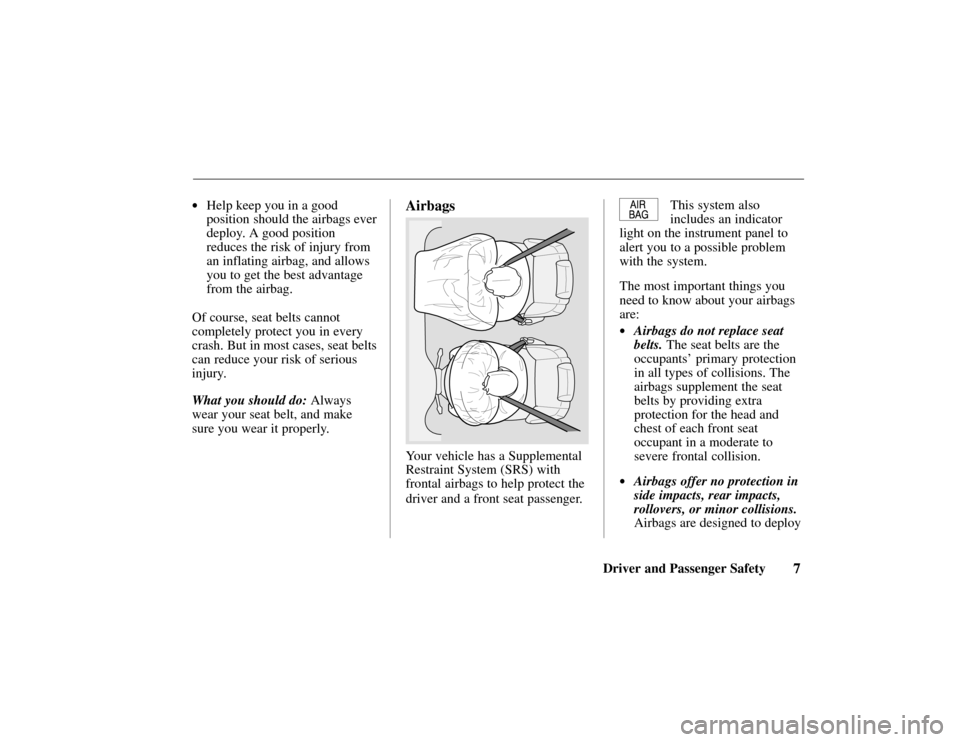
Your vehicle has a Supplemental
Restraint System (SRS) with
frontal airbags to help protect the
driver and a front seat passenger. This system also
includes an indicator
light on the instrument panel to
alert you to a possible problem
with the system.
The most important things you
need to know about your airbags
are:
•Airbags do not replace seat
belts. The seat belts are the
occupants’ primary protection
in all types of collisions. The
airbags supplement the seat
belts by providing extra
protection for the head and
chest of each front seat
occupant in a moderate to
severe frontal collision.
•Airbags offer no protection in
side impacts, rear impacts,
rollovers, or minor collisions.
Airbags are designed to deploy
Page 11 of 294

8Driver and Passenger Safety
only during a moderate to
severe frontal collision.
•Airbags can pose serious
hazards.
To do their job,
airbags must inflate with
tremendous force and speed. So
while airbags save lives, they
can cause serious injuries to
adults and larger children who
are not wearing seat belts, are
not wearing them properly, are
sitting too close to the airbag,
or are not sitting in a proper
position. Infants and small
children are at an even greater
risk of injury or death.
What you should do: Always
wear your seat belt properly, and
sit upright and as far back as
possible from the steering wheel
or dashboard.
Seats and Seat-Backs
Your vehicle’ s seats are designed
to keep you in a comfortable,
upright position so you can take
full advantage of the protection
offered by seat belts and the
energy-absorbing materials in the
seats.
How you adjust your seats and
seat-backs can also affect your
safety. For example, sitting too
close to the steering wheel or
dashboard increases the risk of
you or your passenger being
injured by striking the inside of
the vehicle, or by an inflating
airbag. Reclining a seat-back too far
reduces the seat belt
’s
effectiveness and increases the
chance that the seat’ s occupant
will slide under the seat belt in a
crash and be seriously injured.
What you should do: Move the
front seats as far back as possible,
and keep adjustable seat-backs in
an upright position whenever the
vehicle is moving.
Head Restraints
Head restraints can help protect
you from whiplash and other
injuries. For maximum protection,
the back of your head should rest
against the center of the head
restraint.
Page 19 of 294
16Driver and Passenger Safety
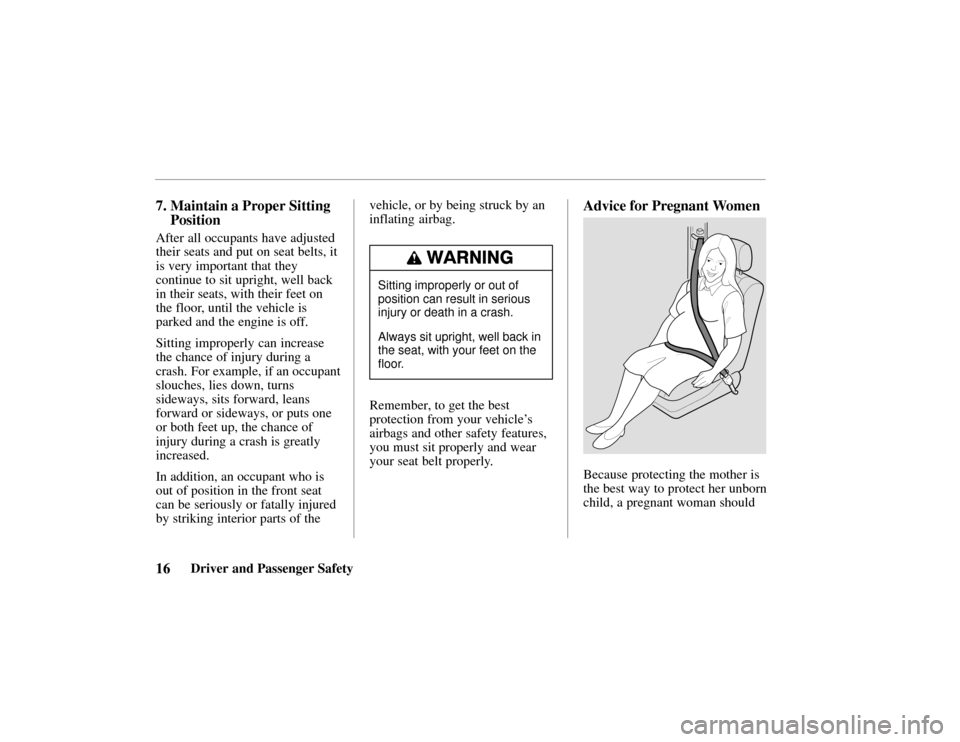
7. Maintain a Proper SittingPosition
After all occupants have adjusted
their seats and put on seat belts, it
is very important that they
continue to sit upright, well back
in their seats, with their feet on
the floor, until the vehicle is
parked and the engine is off.
Sitting improperly can increase
the chance of injury during a
crash. For example, if an occupant
slouches, lies down, turns
sideways, sits forward, leans
forward or sideways, or puts one
or both feet up, the chance of
injury during a crash is greatly
increased.
In addition, an occupant who is
out of position in the front seat
can be seriously or fatally injured
by striking interior parts of the vehicle, or by being struck by an
inflating airbag.
Sitting improperly or out of
position can result in serious
injury or death in a crash.
Always sit upright, well back in
the seat, with your feet on the
floor.
Remember, to get the best
protection from your vehicle
’s
airbags and other safety features,
you must sit properly and wear
your seat belt properly.
Advice for Pregnant Women
Because protecting the mother is
the best way to protect her unborn
child, a pregnant woman should
Page 46 of 294

43Driver and Passenger Safety
Honda provides a lifetime
warranty on seat belts. Honda will
repair or replace any seat belt
component that fails to function
properly during normal use.
Please see your Honda Warranty
Information
booklet for details.
Not checking or maintaining
seat belts can result in serious
injury or death if the seat belts
do not work properly when
needed.
Check your seat belts regularly
and have any problem
corrected as soon as possible.
If a seat belt is worn during a
crash, you should have your
dealer inspect the belt, and replace
it if necessary. A belt that has
been worn during a crash may not
provide the same level of
protection in a subsequent crash.
The dealer should also inspect the
anchors for damage and replace
them if needed.
For information on how to clean
your seat belts, see page 229. The SRS is designed to provide
protection under a wide range of
driving conditions, including
off-road driving. When driving
off-road, it is important that
everyone wear their seat belts
properly, and that you drive at
speeds that are safe for the terrain
and conditions. Refer to the
Off-Road Driving Information
booklet for tips on proper
operation.
SRS Components
Your Supplemental Restraint
System (SRS) includes:
•Two frontal airbags. The
driver ’
s airbag is stored in the
center of the steering wheel;
the front passenger ’s airbag is
stored in the dashboard. Both
are marked “SRS AIRBAG.”
Additional Information
About Your SRS
Page 49 of 294

46 Driver and Passenger Safety
• If the light stays on after the
engine starts.
• If the light comes on or flashes
on and off while you drive.
If you see any of these
indications, your airbags may not
deploy when you need them. See
your Honda dealer as soon as
possible.
Ignoring the SRS indicator light
can result in serious injury or
death if the airbags do not
inflate when needed.
Have your vehicle checked by a
dealer as soon as possible if
the SRS light alerts you to a
potential problem.
SRS Service
Your Supplemental Restraint
System is virtually maintenance-
free, and there are no parts you
can safely service. However, you
must have your vehicle serviced
if:
• Your airbags ever inflate. The
airbags and control unit must
be replaced. Do not try to
remove or replace the airbags
yourself. This must be done by
a Honda dealer or a
knowledgeable body shop.
• The SRS indicator light alerts
you to a problem. Take your
vehicle to an authorized Honda
dealer as soon as possible. If
you ignore this indication, the
airbags might not inflate when
you need them.
Additional Safety
Precautions
• Do not attempt to deactivate
your airbags. Together, airbags
and seat belts provide the best
protection in a moderate to
severe frontal collision.
• Do not tamper with SRS
components or wiring for any
reason. Tampering could cause
the airbags to deploy, possibly
causing very serious injury.
See page 174 for further
information and precautions
relating to your SRS.