height HONDA PASSPORT 2002 2.G Owners Manual
[x] Cancel search | Manufacturer: HONDA, Model Year: 2002, Model line: PASSPORT, Model: HONDA PASSPORT 2002 2.GPages: 294, PDF Size: 3.97 MB
Page 17 of 294
14Driver and Passenger Safety
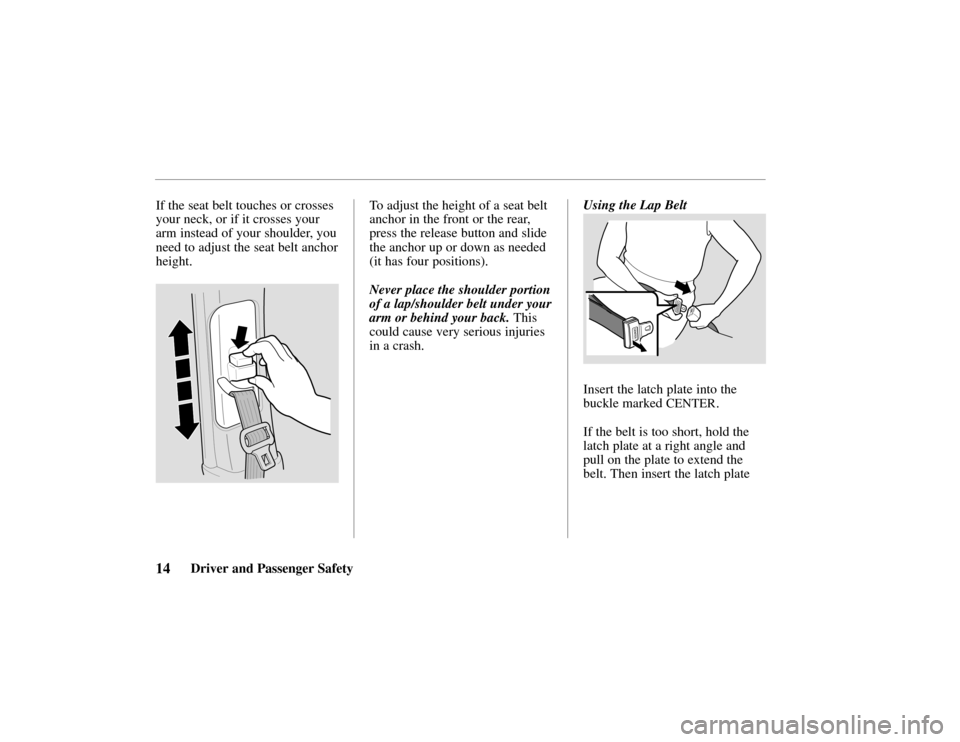
If the seat belt touches or crosses
your neck, or if it crosses your
arm instead of your shoulder, you
need to adjust the seat belt anchor
height.
To adjust the height of a seat belt
anchor in the front or the rear,
press the release button and slide
the anchor up or down as needed
(it has four positions).
Never place the shoulder portion
of a lap/shoulder belt under your
arm or behind your back.
This
could cause very serious injuries
in a crash. Using the Lap Belt
Insert the latch plate into the
buckle marked
CENTER.
If the belt is too short, hold the
latch plate at a right angle and
pull on the plate to extend the
belt. Then insert the latch plate
Page 29 of 294
Driver and Passenger Safety26
3.Secure the child in the child
seat. Make sure the child is
properly strapped in the child
seat according to the child seat
maker ’ s instructions. A child
who is not properly secured in
a child seat can be thrown out
of the seat in a crash and
seriously injured.
Storing a Child Seat
When you are not using a child
seat, either remove it and store it
in a safe place, or make sure it is
properly secured. An unsecured
child seat can be thrown around
the vehicle during a crash or
sudden stop and injure someone.Protecting Infants
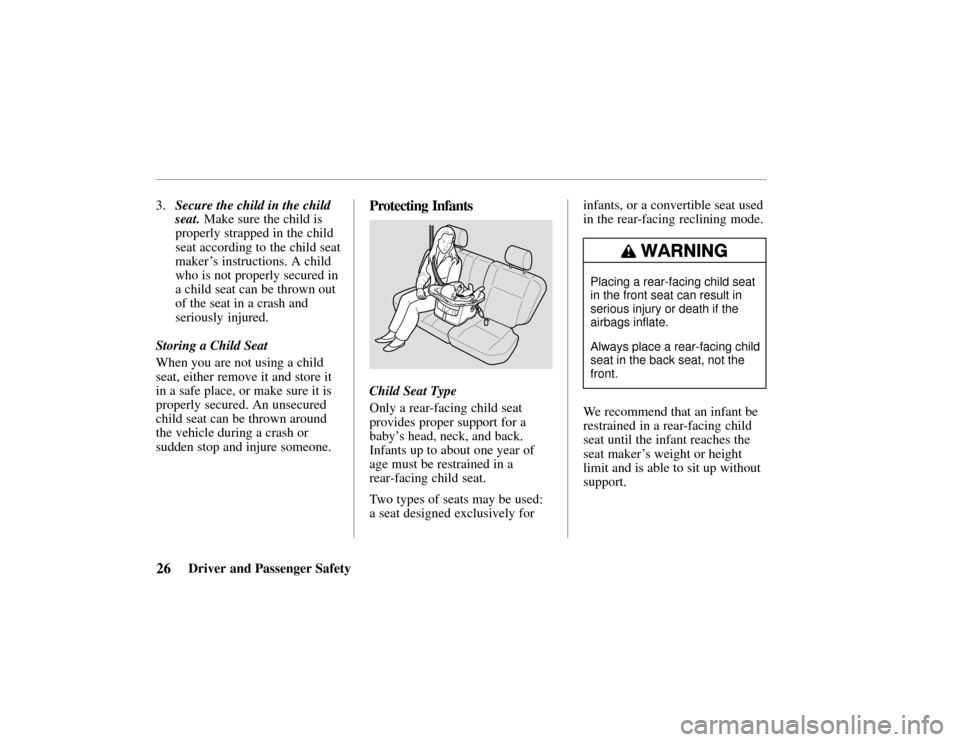
Child Seat Type
Only a rear-facing child seat
provides proper support for a
baby’ s head, neck, and back.
Infants up to about one year of
age must be restrained in a
rear-facing child seat.
Two types of seats may be used:
a seat designed exclusively for infants, or a convertible seat used
in the rear-facing reclining mode.
Placing a rear-facing child seat
in the front seat can result in
serious injury or death if the
airbags inflate.
Always place a rear-facing child
seat in the back seat, not the
front.
We recommend that an infant be
restrained in a rear-facing child
seat until the infant reaches the
seat maker
’s weight or height
limit and is able to sit up without
support.
Page 34 of 294
Driver and Passenger Safety31
Rear-Facing Seat Installation
Tips
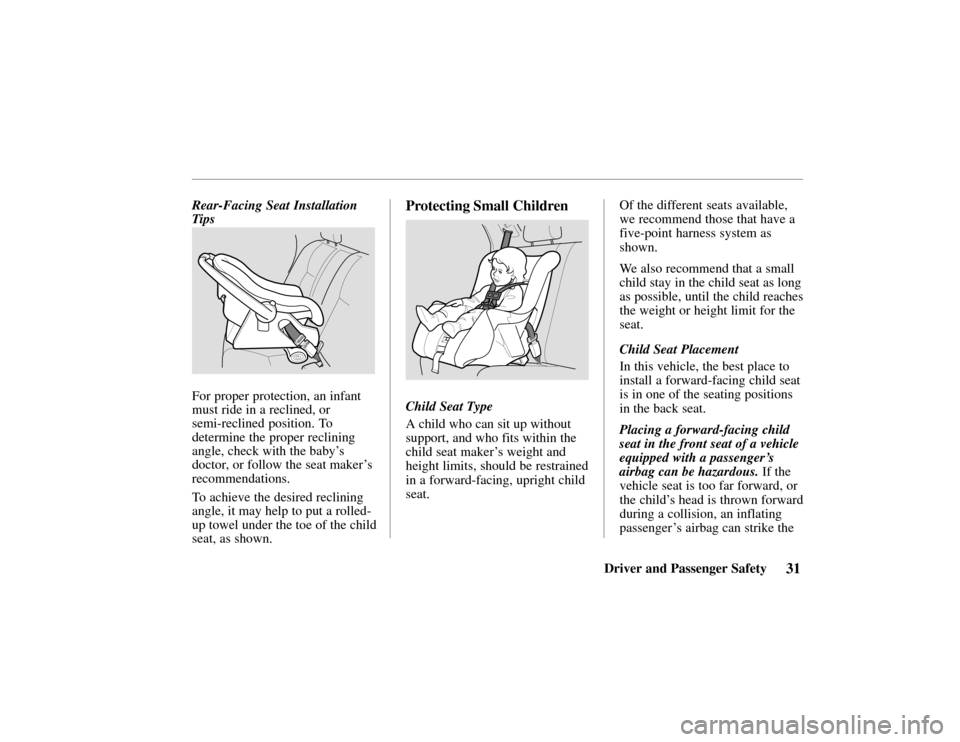
For proper protection, an infant
must ride in a reclined, or
semi-reclined position. To
determine the proper reclining
angle, check with the baby’s
doctor, or follow the seat maker’s
recommendations.
To achieve the desired reclining
angle, it may help to put a rolled-
up towel under the toe of the child
seat, as shown.
Protecting Small Children
Child Seat Type
A child who can sit up without
support, and who fits within the
child seat maker ’s weight and
height limits, should be restrained
in a forward-facing, upright child
seat. Of the different seats available,
we recommend those that have a
five-point harness system as
shown.
We also recommend that a small
child stay in the child seat as long
as possible, until the child reaches
the weight or height limit for the
seat.
Child Seat Placement
In this vehicle, the best place to
install a forward-facing child seat
is in one of the seating positions
in the back seat.
Placing a forward-facing child
seat in the front seat of a vehicle
equipped with a passenger
’s
airbag can be hazardous. If the
vehicle seat is too far forward, or
the child’ s head is thrown forward
during a collision, an inflating
passenger ’ s airbag can strike the
Page 37 of 294
Driver and Passenger Safety34
unlatch the belt, allow it to
retract fully, then repeat these
steps.
To deactivate the locking
mechanism in order to remove a
child seat, unlatch the buckle,
unroute the seat belt, and let the
belt fully retract. Installing a Child Seat With the
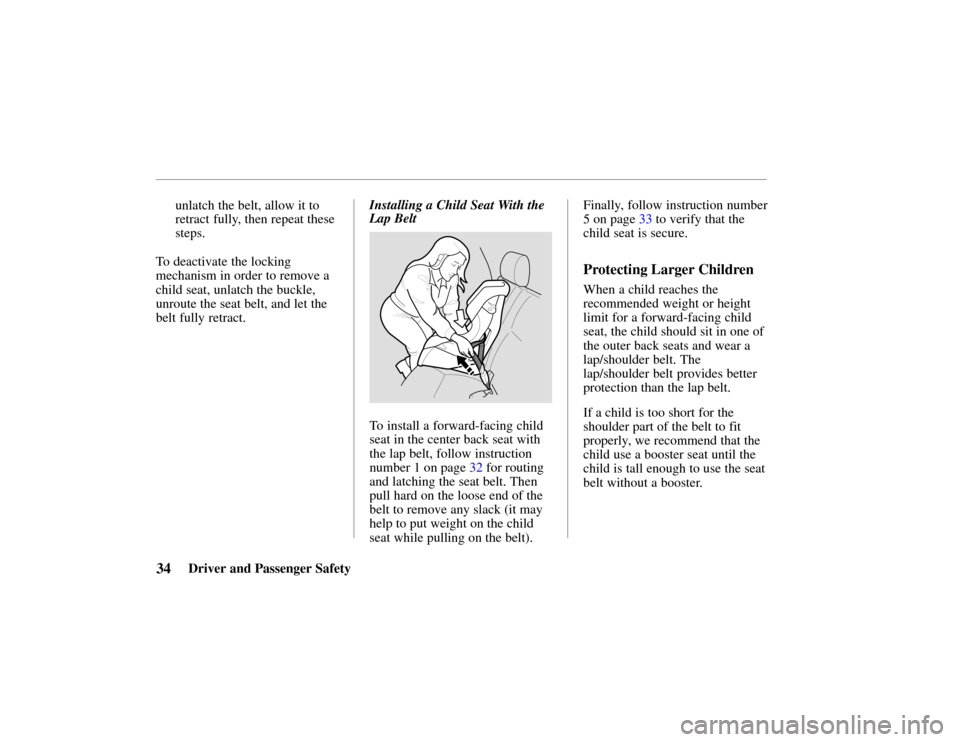
Lap Belt
To install a forward-facing child
seat in the center back seat with
the lap belt, follow instruction
number 1 on page 32 for routing
and latching the seat belt. Then
pull hard on the loose end of the
belt to remove any slack (it may
help to put weight on the child
seat while pulling on the belt). Finally, follow instruction number
5 on page 33 to verify that the
child seat is secure.
Protecting Larger Children
When a child reaches the
recommended weight or height
limit for a forward-facing child
seat, the child should sit in one of
the outer back seats and wear a
lap/shoulder belt. The
lap/shoulder belt provides better
protection than the lap belt.
If a child is too short for the
shoulder part of the belt to fit
properly, we recommend that the
child use a booster seat until the
child is tall enough to use the seat
belt without a booster.
Page 39 of 294
Driver and Passenger Safety36
Do not put any accessories on a
seat belt. Devices intended to
improve occupant comfort, or
reposition the shoulder part of a
seat belt, severely compromise the
protective capability of the seat
belt and increase the chance of
serious injury in a crash.
Two children should never use
the same seat belt. If they do,
they could be very seriously
injured in a crash. Using a Booster Seat
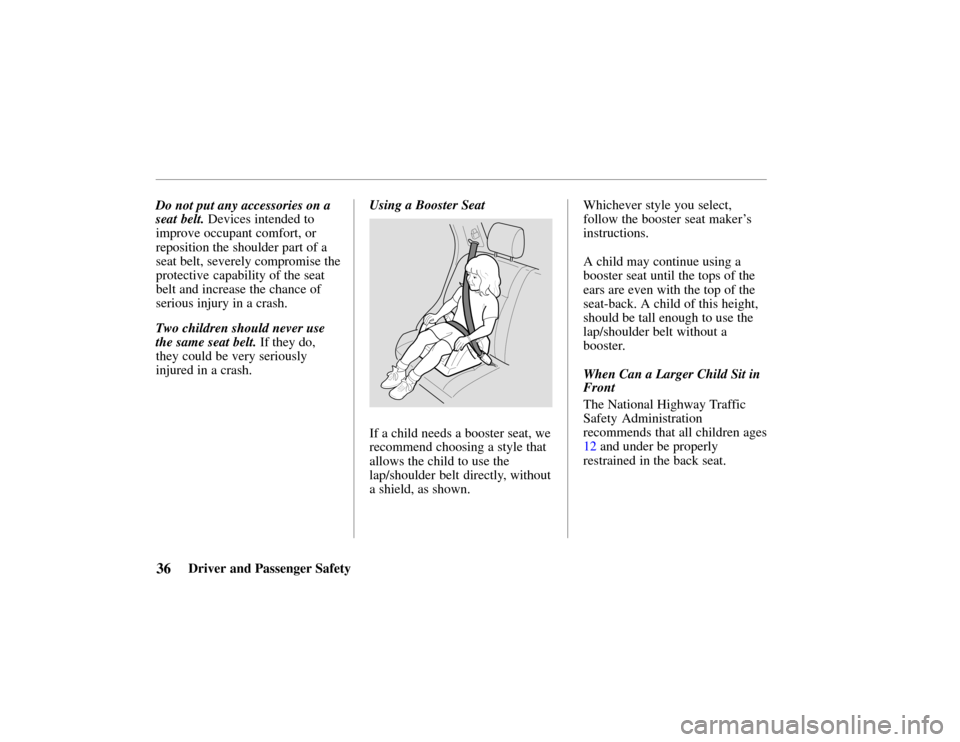
If a child needs a booster seat, we
recommend choosing a style that
allows the child to use the
lap/shoulder belt directly, without
a shield, as shown. Whichever style you select,
follow the booster seat maker
’s
instructions.
A child may continue using a
booster seat until the tops of the
ears are even with the top of the
seat-back. A child of this height,
should be tall enough to use the
lap/shoulder belt without a
booster.
When Can a Larger Child Sit in
Front
The National Highway Traffic
Safety Administration
recommends that all children ages
12 and under be properly
restrained in the back seat.
Page 118 of 294
115Interior Features
Assist Grip
An assist grip is located above
each window.
Horn Button
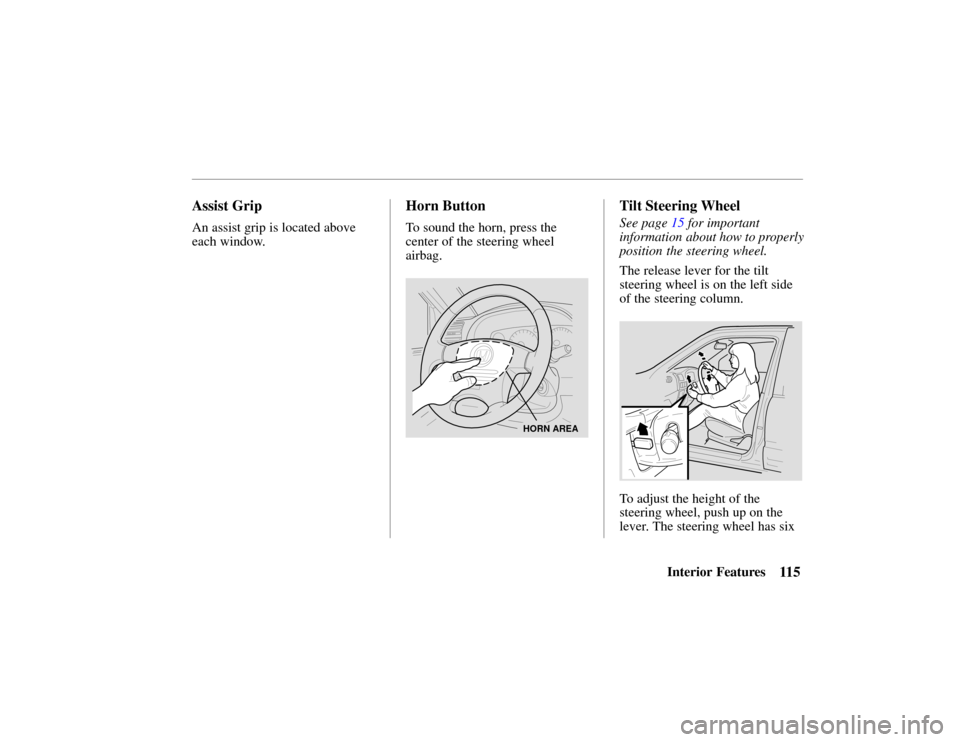
To sound the horn, press the
center of the steering wheel
airbag.
HORN AREA
Tilt Steering Wheel
See page 15 for important
information about how to properly
position the steering wheel.
The release lever for the tilt
steering wheel is on the left side
of the steering column.
To adjust the height of the
steering wheel, push up on the
lever. The steering wheel has six
Page 165 of 294

162Driving Tips
Self-Adjusting Brakes
The brakes on this vehicle are
self-adjusting. They have been
designed so that periodic brake
adjustment is not needed.
The brakes adjust themselves each
time you firmly apply them.
Thus, if the brake pedal goes down
farther than normal due to a lack of
adjustment, drive backward and
forward a few times. Apply the
brakes intermittently.
See your Honda dealer if the
brake pedal height does not return
to normal or if there is a rapid
increase in pedal travel. Either is a
sign of other brake trouble. Also,
see your Honda dealer if the
parking brake needs adjustment.
Braking Tips
Control your vehicle’s speed on a
steep or long downhill grade by
shifting the transmission to a
lower gear. Constantly using the
brakes can cause them to overheat
and lose effectiveness.
Resting your foot on the brake
pedal when you are not intending
to brake (“riding the brakes”) can cause them to overheat. This
reduces their effectiveness, wears
them out faster, and can reduce
fuel mileage. It also causes your
brake lights to stay on all the time,
confusing drivers behind you.
Brake Wear Indicators
The front and rear brakes have
built-in wear indicators. These make a high-pitched squealing or
cricket-like warning sound when
the brake pads or linings are worn
to the point of replacement. The
sound may come and go or be
heard all the time when the vehicle
is moving, but may stop when the
brake pedal is pushed down firmly.
Expensive damage can result if
pads or linings are not replaced
immediately when needed.
Driving on Slippery Surfaces
Driving, steering, and braking
traction are reduced when the
road is coated with water, snow,
ice, gravel, or other materials.
Slow down and adjust your
driving to such conditions. It is
important to slow down when it is
slippery because stopping
Page 170 of 294

167Driving Tips
We urge you not to install
oversize tires and wheels that
would change your vehicle’s
ride height and possibly affect
handling and stability.
Installing improper tires on
your vehicle can affect
handling and stability. This
can cause a crash in which
you can be seriously hurt or
killed.
Always use the size and type
of tires recommended in this
owner’s manual.
It is best to replace all four tires at
the same time. If that is not
possible
or necessary, then replace
the two front tires or the two rear
tires as a pair. Replacing just one
tire can seriously affect your
vehicle’s handling.
The
ABS works by comparing the
speed of the wheels. When
replacing tires, use the same size
originally supplied with the
vehicle. Tire size and construction
can affect wheel speed and may
cause the system to work
inconsistently.
If you ever need to replace a
wheel, make sure the
replacement’s specifications
match the wheels that originally
came on your Honda. Replacement wheels are available
at your Honda dealer.
Wheels and Tires
Wheels:
16 x 7 JJ
Tires:
Standard on
LX 2WD
225/75R16
Standard on all other models
245/70R16
See page 250 for information
about DOT Tire Quality Grading.
Page 172 of 294

169Driving Tips
Wheel Replacement
Considerations
Damaged wheels must be
replaced. For example, replace
wheels if they are bent, cracked or
heavily rusted, or if wheel nuts
often become loose. Also replace
wheels that leak air (except some
aluminum wheels that can be
repaired). See your Honda dealer.
Do not use bent wheels that have
been straightened, and do not use
tubes in leaking wheels designed
for tubeless tires. Such wheels
may have structural damage and
could fail without warning.
Maximum loads, maximum
inflation pressures, wheel
identification codes, and wheel
sizes are stamped on each wheel.
Service-tested and approvedwheels are available from your
Honda dealer.
When obtaining wheels for any
reason from any other source, the
replacement wheels should be
equal in load capacity, inflation
pressure capacity, diameter, width,
offset and mounting configuration
to those originally installed on
your vehicle. A wheel of the
wrong size or type may adversely
affect load carrying capacity,
wheel and bearing life, brake
cooling, speedometer/odometer
calibration, stopping ability,
headlight aim, bumper height,
vehicle ground clearance, and tire
or tire chain clearance to the body
and chassis. Replacement with
used wheels is not advised: They
may have been subjected to harsh
treatment or very high mileage and
could fail without warning.
Installing wheels and/or tires that
have a higher load carrying limit
than those that originally came on
your vehicle does not increase the
GAWR or GVWR of the vehicle.
Page 177 of 294

174 Driving Tips
systems, such as the
SRS
and
anti-lock brake system.
However, if electronic accessories
are improperly installed, or
exceed your vehicle ’s electrical
system capacity, they can interfere
with the operation of your vehicle,
or even cause the airbags to
deploy.
Before installing any accessory:
• Make sure the accessory does
not obscure any lights, or
interfere with proper vehicle
operation or performance.
• Be sure electronic accessories
do not overload electrical
circuits (see page 240).
•Have the installer contact your
Honda dealer for assistance
before installing any electronic
accessory. If possible, have your dealer
inspect the final installation.
Modifications
Do not remove any original
equipment or modify your vehicle
in any way that would alter its
design or operation. This could
make your vehicle unsafe and
illegal to drive.
For example, do not make any
modifications that would change
the ride height of your vehicle, or
install wheels and tires with a
different overall diameter.
Such modifications can adversely
affect handling, and interfere with
the operation of the vehicle
’s
anti-lock brakes and other
systems.
In addition, any modifications that
decrease ground clearance increase the chance of
undercarriage parts striking a
curb, speed bump, or other raised
object, which could cause your
airbags to deploy.
Do not modify your steering
wheel or any other part of your
Supplemental Restraint System.
Modifications could make the
system ineffective.
Additional Safety Precaution
Do not attach or place objects on
the airbag covers. Any object
attached to, or placed on, the
covers marked “
SRS,” in the
center of the steering wheel and
on top of the dashboard, could
interfere with the proper operation
of the airbags. Or, if the airbags
inflate, the objects could be
propelled inside the vehicle and
hurt someone.