177Driving Tips
Carrying Items in the
Passenger Compartment
• Store or secure all items that
could be thrown around and
hurt someone during a crash.
• Be sure items placed on the
floor behind the front seats
cannot roll under the seats
and interfere with the driver’s
ability to operate the pedals,
or with the proper operation
of the seats.
• Keep the glove box closed
while driving. If the lid is open,
a passenger’s knees could be
injured during a crash or
sudden stop.
Carrying Cargo in the Cargo
Area or on a Roof Rack
• Distribute cargo evenly on the
floor of the cargo area, placing
the heaviest items on the
bottom and as far forward as
possible.
• If you fold down the back seat,
tie down items that could be
thrown about the vehicle
during a crash or sudden stop.
• If you carry large items that
prevent you from closing the
hatch glass or rear door,
exhaust gas can enter the
passenger area. To avoid the
possibility of carbon monoxide
poisoning, follow the
instructions on page 47.
•If you carry any items on a roof
rack, be sure the total weight of
the rack and the items does not
exceed 200 lb (90 kg).
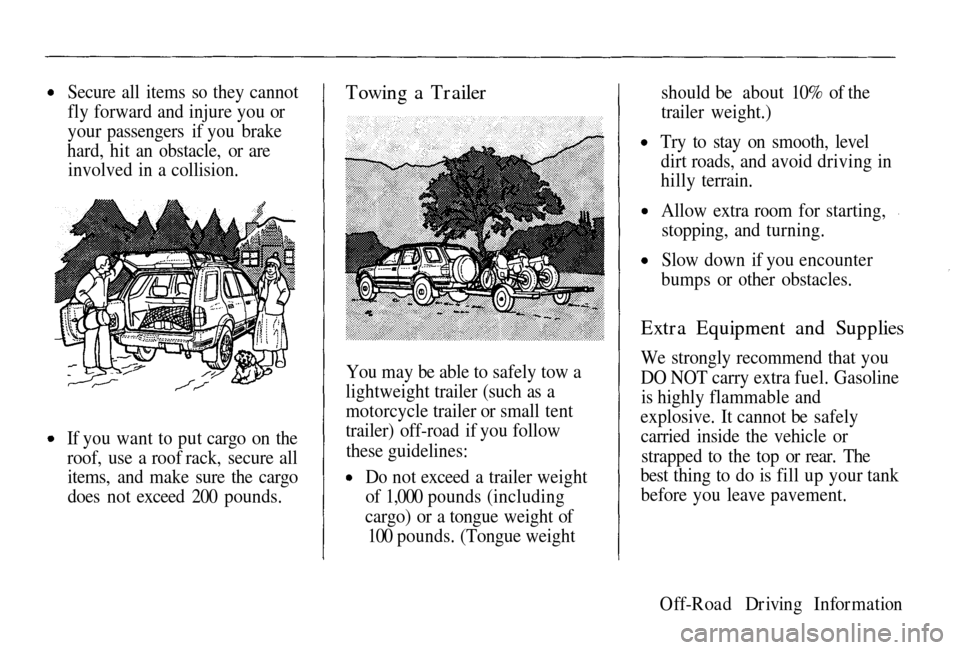
Secure all items so they cannot
fly
forward and injure you or
you
r passengers if you brake
hard,
hit an obstacle, or are
involved
in a collision.
If you want to put cargo on the
roof,
use a roof rack, secure all
items,
and make sure the cargo
does
not exceed 200 pounds. Towing a Trailer
You may be able to safely tow a
lightweight
trailer (such as a
motorcycle trailer or small tent
trailer)
off-road if you follow
these guidelines:
Do not exceed a trailer weight
of 1,000 pounds (including
cargo) or a tongue weight of 100
pounds. (Tongue weight should be about 10% of the
trailer weight.)
Try
to stay on smooth, level
dirt
roads, and avoid driving in
hilly terrain.
Allow extra room for starting,stopping,
and turning.
Slow down if you encounter
bumps
or other obstacles.
Extr
a Equipment and Supplies
We strongly recommend that you
DO NOT carry extra fuel. Gasoline is highly flammable and
explosive.
It cannot be safely
carried
inside the vehicle or
strapped to the top or rear. The
best thing to do is fill up your tank
before
you leave pavement. Off-Road Driving Information