head HONDA PILOT 2003 1.G User Guide
[x] Cancel search | Manufacturer: HONDA, Model Year: 2003, Model line: PILOT, Model: HONDA PILOT 2003 1.GPages: 392, PDF Size: 5.06 MB
Page 30 of 392

Childrenuptoaboutone
year old should be restrained in a
rear-f acing, reclining child seat. Only
a rear-f acing seat provides the
proper support to protect an inf ant’s
head, neck, and back. See page for additional information on
protecting inf ants.
The f ollowing pages give general
guidelines f or selecting and installing
child seats f or inf ants and small
children.
To provide proper protection, a child
seat should meet three
requirements:
Leaving children without
adult supervision is illegal in most
states and Canadian provinces,
and can be very hazardous. For
example, inf ants and small
childrenleftinavehicleonahot
day can die f rom heatstroke. And
children lef t alone with the key in
the ignition can accidentally set
the vehicle in motion, possibly
injuring themselves or others.
The child seat should
meet Federal Motor Vehicle
Saf ety Standard 213 (FMVSS 213)
or Canadian Motor Vehicle Saf ety
Standard 213 (CMVSS 213). Look
for the manufacturer’s statement
of compliance on the box. 30Inf ant s:
Select ing a Child Seat
T he child seat should be of theproper t ype and size t o f it t he child.
Do not leave children alone in your
vehicle.
T he child seat should meet saf et yst andards.
1.
2.
General Guidelines f or Using
Child Seats
Protecting Children
Driver and Passenger Saf ety26
Page 32 of 392
A small child in a f orward-f acing
child seat is also at risk. If the
vehicle seat is too f ar f orward,
or the child’s head is thrown
f orward during a collision, an
inf lating airbag can kill or
seriously injure the child.
If a small child must ride in the
f ront, f ollow the instructions
provided in this section. The passenger’s f ront airbag
inf lates with enough f orce to kill
or seriously injure an inf ant in a
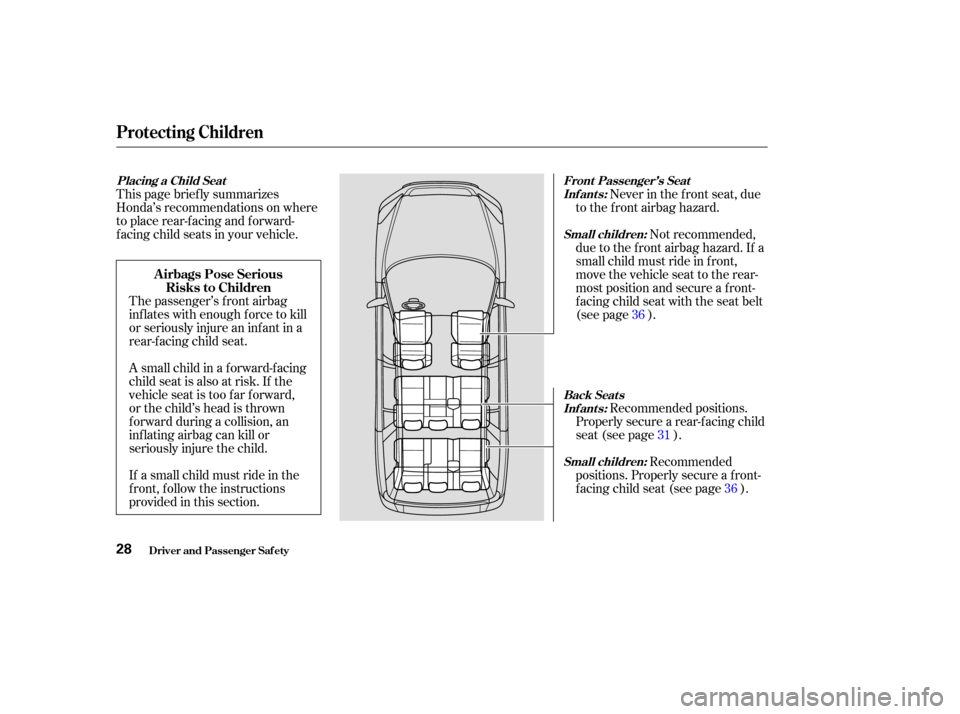
rear-facing child seat.Recommended positions.
Properlysecurearear-facingchild
seat (see page ).
Recommended
positions. Properly secure a f ront-
f acing child seat (see page ). Never in the f ront seat, due
to the f ront airbag hazard.
Not recommended,
due to the f ront airbag hazard. If a
small child must ride in f ront,
move the vehicle seat to the rear-
most position and secure a f ront-
f acing child seat with the seat belt
(see page ).
This page brief ly summarizes
Honda’s recommendations on where
to place rear-facing and forward-
f acing child seats in your vehicle.
36
31
36
Placing a Child Seat
Front Passenger’s Seat
Back Seat sInf ant s:
Small children:
Inf ant s:
Small children:
Airbags Pose SeriousRisks to Children
Protecting Children
Driver and Passenger Saf ety28
Page 34 of 392
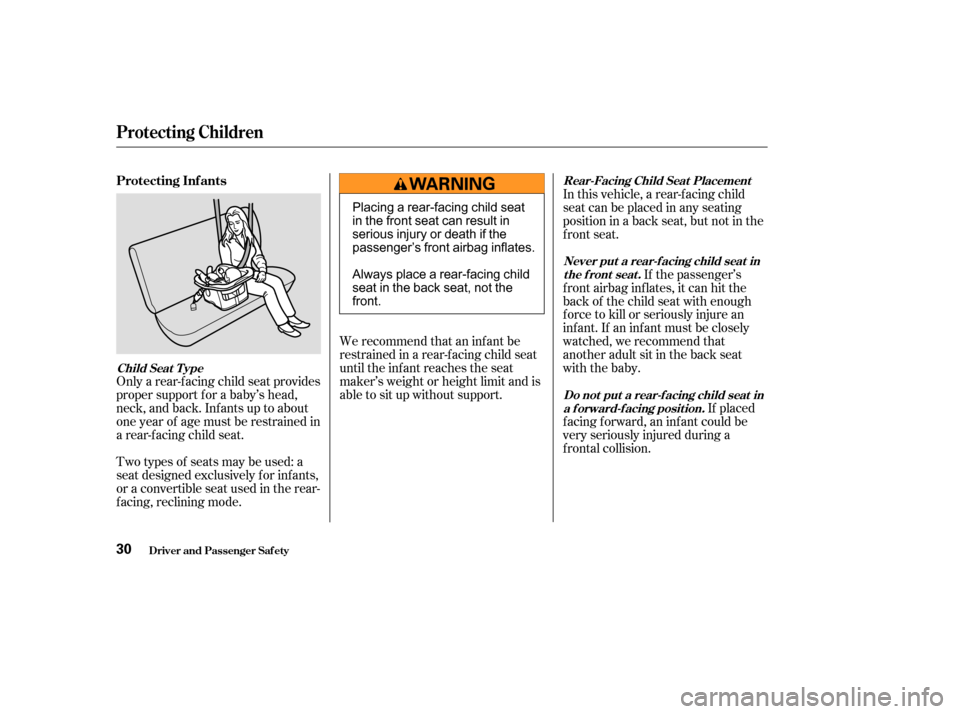
Only a rear-f acing child seat provides
proper support f or a baby’s head,
neck, and back. Inf ants up to about
one year of age must be restrained in
a rear-f acing child seat.We recommend that an inf ant be
restrained in a rear-f acing child seat
until the inf ant reaches the seat
maker’s weight or height limit and is
able to sit up without support.
Two types of seats may be used: a
seat designed exclusively f or inf ants,
or a convertible seat used in the rear-
f acing, reclining mode. In this vehicle, a rear-f acing child
seatcanbeplacedinanyseating
positioninabackseat,butnotinthe
front seat.
If the passenger’s
f ront airbag inf lates, it can hit the
back of the child seat with enough
f orce to kill or seriously injure an
inf ant. If an inf ant must be closely
watched, we recommend that
another adult sit in the back seat
with the baby.
If placed
f acing f orward, an inf ant could be
very seriously injured during a
f rontal collision.
Protecting Inf ants
Child Seat T ype
Rear-Facing Child Seat Placement
Never put a rear-f acing child seat inthe front seat.
Do not put a rear-f acing child seat ina f orward-f acing position.
Protecting Children
Driver and Passenger Saf ety30
Placing a rear-facing child seat
in the front seat can result in
serious injury or death if the
passenger’s front airbag inflates.
Always place a rear-facing child
seat in the back seat, not the
front.
Page 39 of 392
In this vehicle, the best place to
install a f orward-f acing child seat is
in one of the seating positions in a
back seat.
We also recommend that a small
child stay in the child seat as long as
possible, until the child reaches the
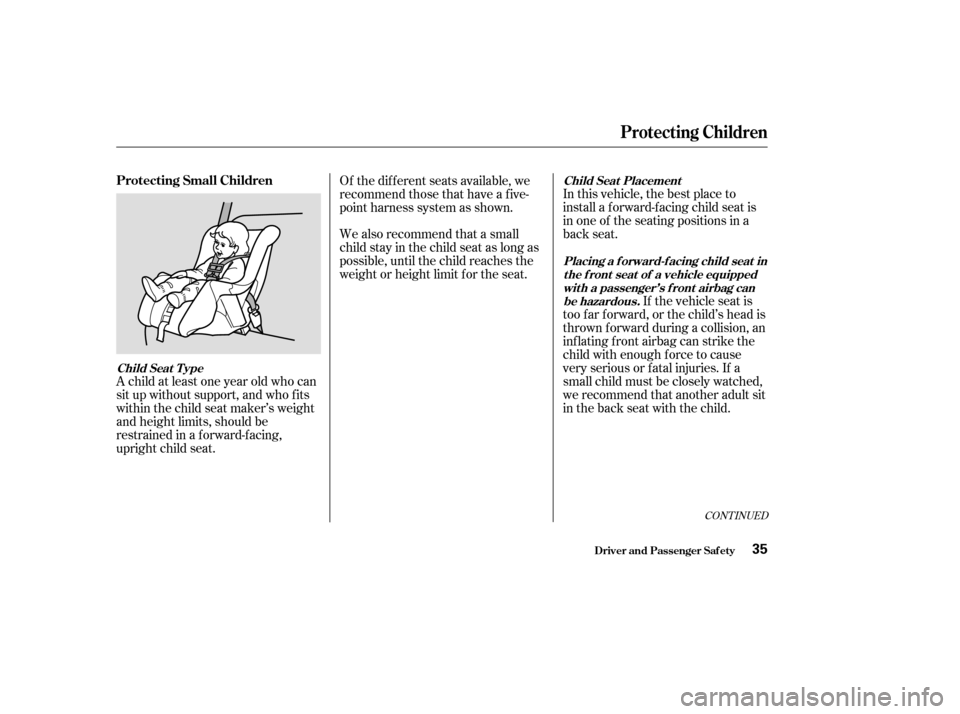
weight or height limit f or the seat. Of the different seats available, we
recommend those that have a f ive-
point harness system as shown.
If the vehicle seat is
too far forward, or the child’s head is
thrown f orward during a collision, an
inflating front airbag can strike the
child with enough f orce to cause
very serious or f atal injuries. If a
small child must be closely watched,
we recommend that another adult sit
in the back seat with the child.
A child at least one year old who can
sit up without support, and who f its
within the child seat maker’s weight
and height limits, should be
restrained in a f orward-f acing,
upright child seat.
CONT INUED
Protecting Small Children
Child Seat T ype Child Seat Placement
Placing a f orward-f acing child seat int he f ront seat of a vehicle equippedwit h a passenger’s f ront airbag canbe hazardous.
Protecting Children
Driver and Passenger Saf ety35
Page 44 of 392
Of course, children vary widely. And
while age may be one indicator of
when a child can saf ely ride in the
f ront, there are other important
f actors you should consider.
Whichever style you select, f ollow
the booster seat maker’s instructions. The back seat is the safest place for
a child of any age or size.
In addition, the passenger’s f ront
airbag poses serious risks to children.
If the seat is too f ar f orward, or the
child’s head is thrown f orward
during a collision, or the child is
unrestrained or out of position, an
inf lating f ront airbag can kill or
seriously injure the child.
The side airbag also poses risks. If
any part of a larger child’s body is in
the path of a deploying airbag, the
child could receive possibly serious
injuries.
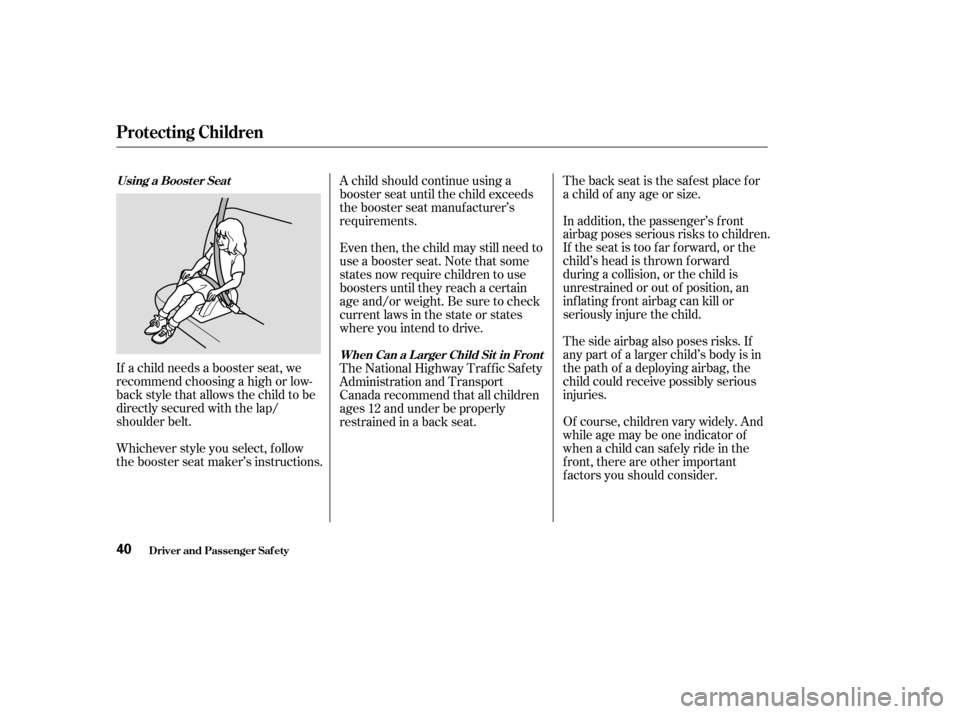
If a child needs a booster seat, we
recommend choosing a high or low-
back style that allows the child to be
directly secured with the lap/
shoulder belt. A child should continue using a
booster seat until the child exceeds
the booster seat manufacturer’s
requirements.
Even then, the child may still need to
use a booster seat. Note that some
states now require children to use
boosters until they reach a certain
ageand/orweight.Besuretocheck
current laws in the state or states
where you intend to drive.
The National Highway Traffic Safety
Administration and Transport
Canada recommend that all children
ages 12 and under be properly
restrained in a back seat.
Using a Boost er Seat
When Can a Larger Child Sit in Front
Protecting Children
Driver and Passenger Saf ety40
Page 47 of 392
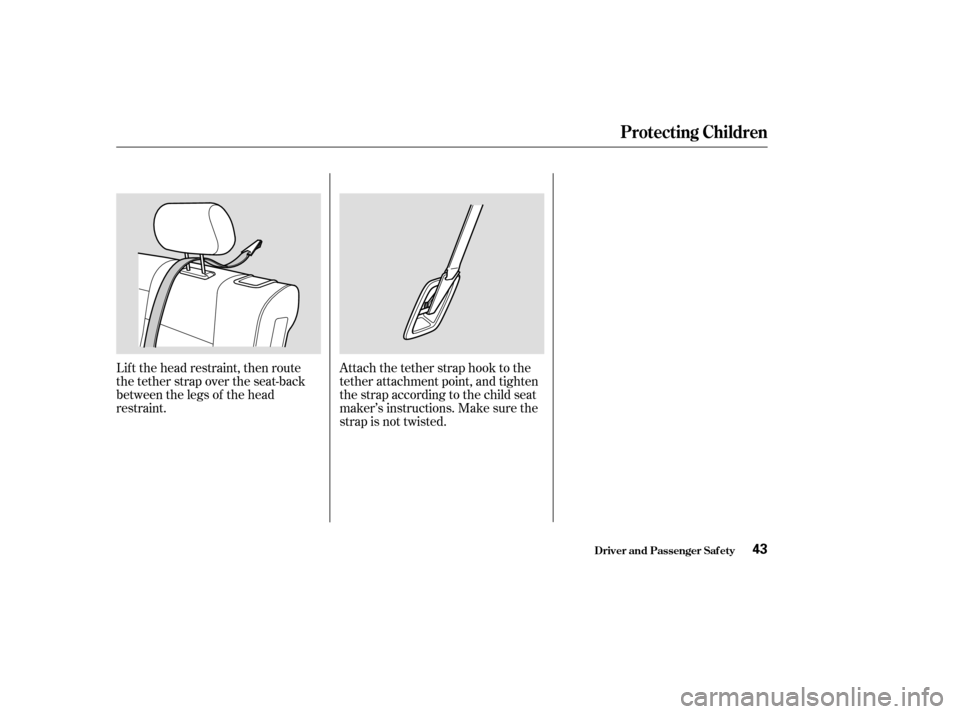
Lift the head restraint, then route
the tether strap over the seat-back
between the legs of the head
restraint.Attach the tether strap hook to the
tether attachment point, and tighten
the strap according to the child seat
maker’s instructions. Make sure the
strap is not twisted.
Protecting Children
Driver and Passenger Saf ety43
Page 55 of 392

After a crash, you may see what
looks like smoke. This is actually
powder f rom the airbag’s surf ace.
Although the powder is not harmf ul,
people with respiratory problems
mayexperiencesometemporary
discomf ort. If this occurs, get out of
the vehicle as soon as it is saf e to do
so.
For additional information on how
your airbags work, see the booklet
titledthat came with your
owner’s manual.
The total time for inflation and
def lation is approximately one-tenth
of a second, so f ast that most
occupants are not aware that the
airbags deployed until they see them
lying in their laps. For additional information on how
your airbags work, ask your dealer
f or a copy of the booklet titled
During a f rontal crash, your seat
belts help restrain your lower body
and torso. Your airbag provides a
cushion to help restrain and protect
your head and chest.
Since both airbags use the same
sensors, both airbags normally
inf late at the same time. However, it
is possible f or only one airbag to
inf late.
This can occur when the severity of
a collision is at the margin, or
threshold, that determines whether
or not the airbags will deploy. In
such cases, the seat belt will provide
suf f icient protection, and the
supplemental protection of f ered by
the airbag would be minimal.
Af ter inf lating, the f ront airbags
immediately def late, so they won’t
interf ere with the driver’s visibility,
or the ability to steer or operate
other controls.
SRS: What You Need to Know
About Airbags
SRS:
What You Need to Know About Airbags
.
Driver and Passenger Saf ety
Additional Inf ormation About Your Airbags
U.S. Owners
Canadian Owners
51
Page 58 of 392

A f ront seat passenger should not
use a cushion or other object as a
backrest. It may prevent the cutof f
system f rom working properly.
When you turn the ignition ON (II),
the indicator should light brief ly and
goout(seepage ).Ifitdoesn’t
light, stays on, or comes on while
driving without a passenger in the
f ront seat, have the system checked.
If a small-statured adult leans
sideways, or larger adult slouches
and leans sideways into the
deployment path of the side airbag,
the system may also shut of f the side
airbag.
This light alerts you that
the passenger’s side airbag
has been automatically shut off.
It does not mean there is a problem
with your side airbags. It means that
thesideairbagcutoff systemhas
activated to prevent the side airbag
f rom deploying. If the side airbag cutof f indicator
light comes on, you should have the
passenger sit upright. Once the
passenger is out of the deployment
path of the side airbag, the system
will turn the airbag back on and the
light will go out.
To reduce the risk of injury f rom an
inf lating side airbag, your vehicle has
an automatic cutoff system for the
passenger’s side airbag.
Although Honda does not encourage
children to ride in the f ront, this
system is designed to shut of f the
side airbag if a child leans sideways
and the child’s head is in the side
airbag deployment path. 62
Additional Inf ormation About Your Airbags
Driver and Passenger Saf ety
How the Side Airbag Cutof f
Indicator L ight Works
54
Page 63 of 392
This section gives inf ormation about
the controls and displays that
contribute to the daily operation of
your Honda. All the essential
controls are within easy reach............................
Control Locations .60
...............................
Indicator Lights .61
.............................................
Gauges .67
Controls Near the Steering .......................................
Wheel .71
...................................
Headlights .72
Automatic Lighting Off .....................................
Feature .73
............
Daytime Running Lights . 73
....
Instrument Panel Brightness . 73
................................
Turn Signals .74
.....................
Windshield Wipers .74
..................
Windshield Washers . 76
Rear Window Wiper and .....................................
Washer .76
..........................
Hazard Warning .76
.............
Rear Window Def ogger . 77
......
Steering Wheel Adjustment . 78
...............................
Keys and Locks .79
..............................................
Keys .79
....................
Immobilizer System . 80
............................
Ignition Switch .81
......................
Power Door Locks .82
...................
Remote Transmitter . 84
..............
Childproof Door Locks . 87
........................................
Tailgate .87 ....................................
Glove Box .88
.................................................
Seats .89
............
Power Seat Adjustments . 89
...........
Driver’s Lumbar Support . 90
..........
Manual Seat Adjustments . 91
Second and Third Row seat ............................
Adjustments .92
..........................
Head Restraints .93
........................
Rear Seat Access .94
............
Folding the Second Seat . 94
...............
Folding the Third Seat . 95
...................
Detachable Anchors . 97
....................................
Seat Heaters .98
..............................
Power Windows .99
...........................................
Mirrors .102
...............................
Parking Brake .104
...........................
Beverage Holder .105
.................
Console Compartment . 107
.................................
Cargo Hooks .107
........................
Sunglasses Holder .108
........................................
Sun Visor .109
................................
Vanity Mirror .109
............
Accessory Power Sockets . 110
........................................
Coin Box .111
......................................
Coat Hook .111
...............................
Interior Lights .112
Instruments and Controls
Inst rument s and Cont rols59
Page 69 of 392
Canadian models onlyCanadian models only
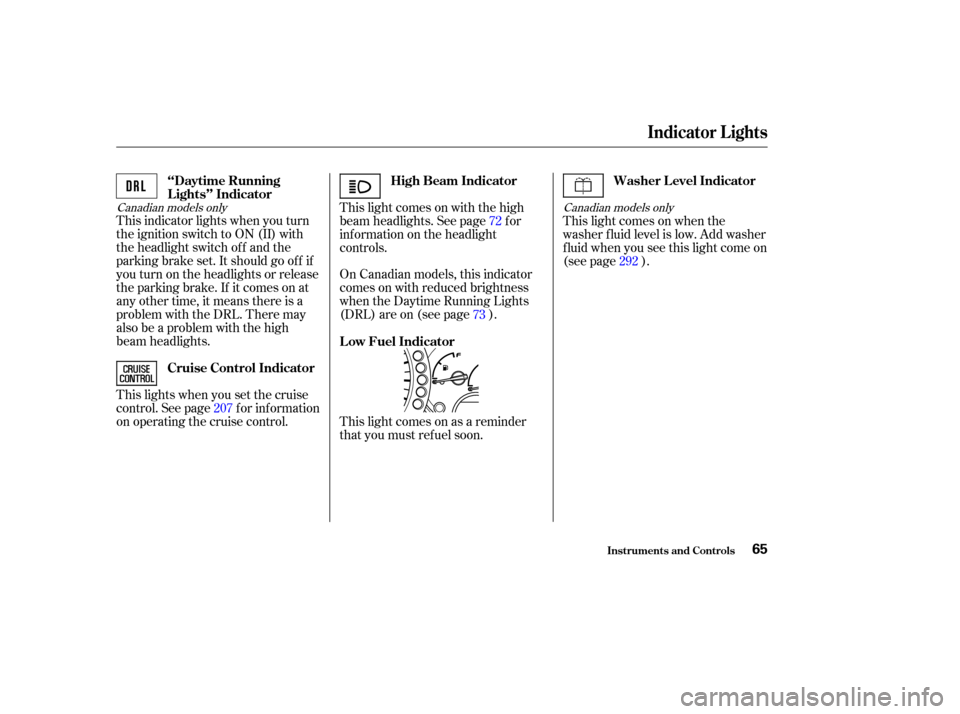
This indicator lights when you turn
the ignition switch to ON (II) with
the headlight switch of f and the
parking brake set. It should go of f if
youturnontheheadlightsorrelease
the parking brake. If it comes on at
any other time, it means there is a
problem with the DRL. There may
also be a problem with the high
beam headlights.This light comes on with the high
beam headlights. See page for
inf ormation on the headlight
controls.
On Canadian models, this indicator
comes on with reduced brightness
when the Daytime Running Lights
(DRL) are on (see page ).
This lights when you set the cruise
control. See page f or inf ormation
on operating the cruise control. This light comes on when the
washer f luid level is low. Add washer
f luid when you see this light come on
(see page ).
This light comes on as a reminder
that you must ref uel soon. 72
73
207 292
‘‘Daytime Running
Lights’’ Indicator
High Beam Indicator
Cruise Control Indicator Washer Level Indicator
Low Fuel Indicator
Indicator L ights
Inst rument s and Cont rols65