hood open HONDA PILOT 2003 1.G User Guide
[x] Cancel search | Manufacturer: HONDA, Model Year: 2003, Model line: PILOT, Model: HONDA PILOT 2003 1.GPages: 392, PDF Size: 5.06 MB
Page 350 of 392
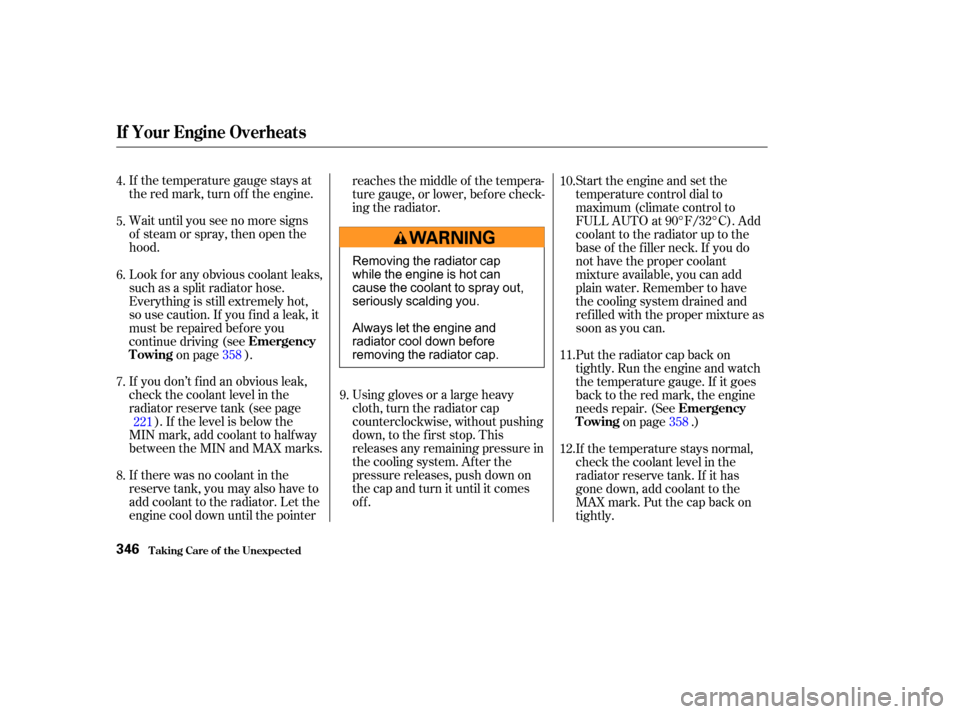
If the temperature gauge stays at
the red mark, turn of f the engine.
Wait until you see no more signs
of steam or spray, then open the
hood.
If you don’t f ind an obvious leak,
check the coolant level in the
radiator reserve tank (see page). If the level is below the
MIN mark, add coolant to halfway
between the MIN and MAX marks.
If there was no coolant in the
reserve tank, you may also have to
add coolant to the radiator. Let the
engine cool down until the pointer reaches the middle of the tempera-
ture gauge, or lower, bef ore check-
ing the radiator.
Using gloves or a large heavy
cloth, turn the radiator cap
counterclockwise, without pushing
down, to the f irst stop. This
releases any remaining pressure in
the cooling system. After the
pressure releases, push down on
the cap and turn it until it comes
off.
Look f or any obvious coolant leaks,
such as a split radiator hose.
Everything is still extremely hot,
so use caution. If you f ind a leak, it
must be repaired bef ore you
continue driving (see
on page ). Start the engine and set the
temperature control dial to
maximum (climate control to
FULL AUTO at 90°F/32°C). Add
coolant to the radiator up to the
base of the f iller neck. If you do
not have the proper coolant
mixture available, you can add
plain water. Remember to have
the cooling system drained and
ref illed with the proper mixture as
soon as you can.
If the temperature stays normal,
check the coolant level in the
radiator reserve tank. If it has
gone down, add coolant to the
MAX mark. Put the cap back on
tightly. Put the radiator cap back on
tightly. Run the engine and watch
the temperature gauge. If it goes
back to the red mark, the engine
needs repair. (See
on page .)
4.
5.
6.
7.
8. 9.10.
11.
12.
358
221 358
T aking Care of t he Unexpect ed
If Your Engine Overheats
Emergency
Towing
Emergency
Towing
346
Removing the radiator cap
while the engine is hot can
cause the coolant to spray out,
seriously scalding you.
Always let the engine and
radiator cool down before
removing the radiator cap.
Page 351 of 392
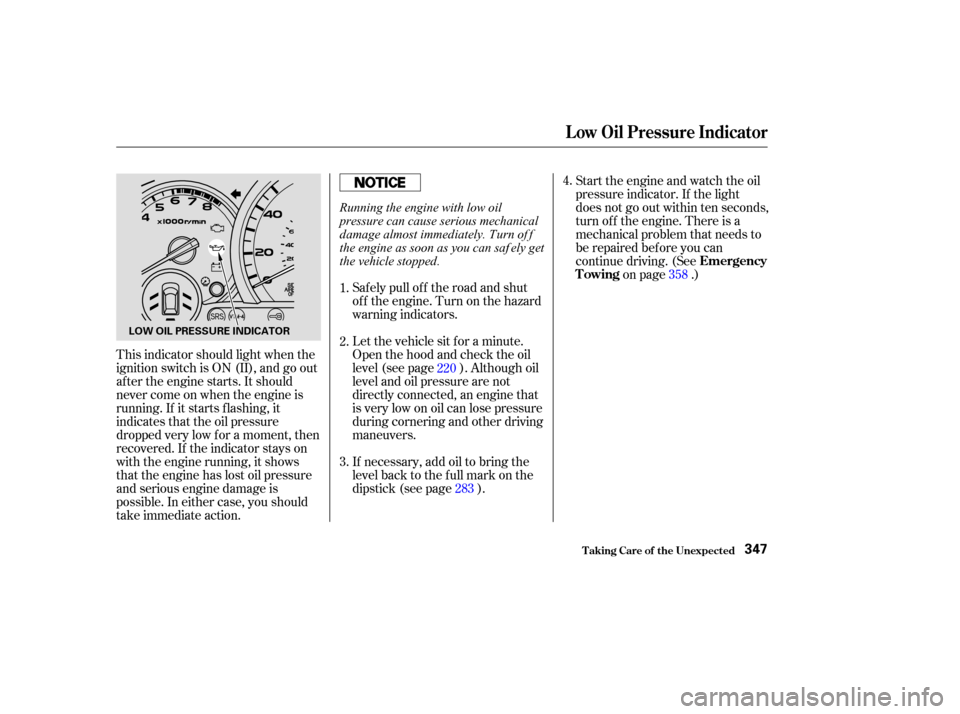
This indicator should light when the
ignition switch is ON (II), and go out
af ter the engine starts. It should
never come on when the engine is
running. If it starts f lashing, it
indicates that the oil pressure
dropped very low f or a moment, then
recovered. If the indicator stays on
with the engine running, it shows
that the engine has lost oil pressure
and serious engine damage is
possible. In either case, you should
take immediate action.Saf ely pull of f the road and shut
of f the engine. Turn on the hazard
warning indicators.
If necessary, add oil to bring the
level back to the full mark on the
dipstick (see page ). Let the vehicle sit f or a minute.
Open the hood and check the oil
level (see page ). Although oil
levelandoilpressurearenot
directly connected, an engine that
is very low on oil can lose pressure
during cornering and other driving
maneuvers.Start the engine and watch the oil
pressure indicator. If the light
does not go out within ten seconds,
turn of f the engine. There is a
mechanical problem that needs to
be repaired bef ore you can
continue driving. (See
on page .)
1.
2.
3. 4.
220 283 358
L ow Oil Pressure Indicator
T aking Care of t he Unexpect ed
Emergency
Towing
347
LOW OIL PRESSURE INDICATOR
Running the engine with low oil
pressure can cause serious mechanical
damage almost immediately. Turn of f
the engine as soon as you can saf ely get
the vehicle stopped.
Page 357 of 392
If something electrical in your
vehicle stops working, the first thing
youshouldcheckforisablownfuse.
Determine f rom the chart on pagesand , or the diagram on the
f use box lid (the diagram f or the
driver’s side interior f use box is on
the kick panel below the f use box),
which f use or f uses control that
component. Check those f uses f irst,
but check all the f uses bef ore
deciding that a blown f use is not the
cause. Replace any blown f uses and
check the component’s operation.
Turn the ignition switch to LOCK
(0). Make sure the headlights and
all other accessories are off.
Remove the cover f rom the f use
box.
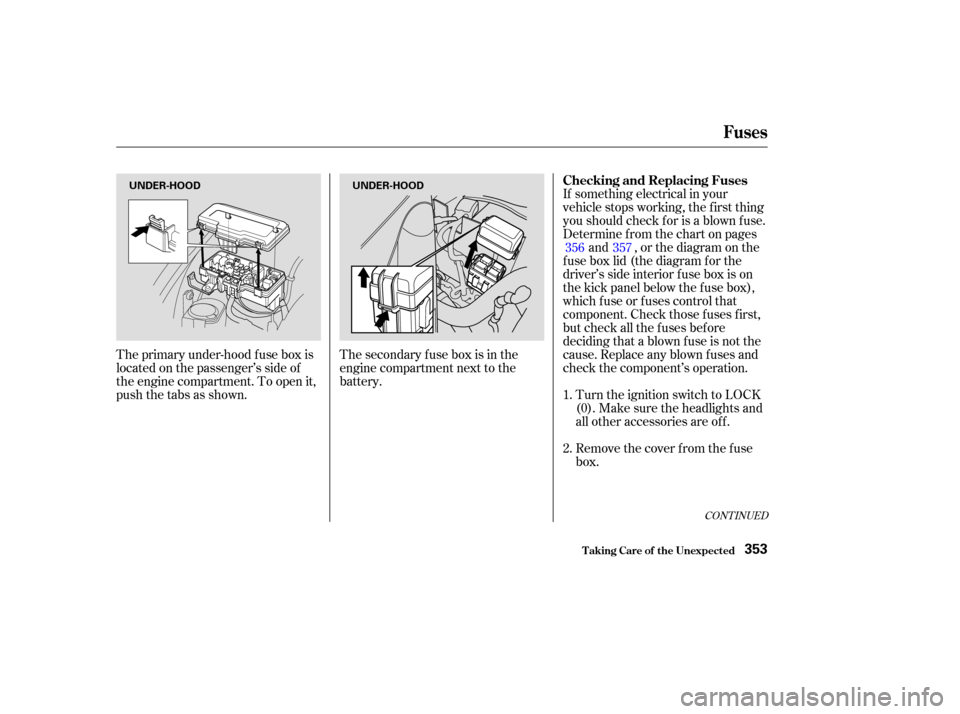
The secondary f use box is in the
engine compartment next to the
battery.
The primary under-hood f use box is
locatedonthepassenger’ssideof
the engine compartment. To open it,
pushthetabsasshown.
1.
2.356 357
CONT INUED
Checking and Replacing Fuses
Fuses
T aking Care of t he Unexpect ed353
UNDER-HOOD
UNDER-HOOD
Page 386 of 392
...............
Gas Mileage, Improving . 222
..........................................
Gasohol .366
.........................................
Gasoline .216
...............
Fuel Reserve Indicator . 65
...........................................
Gauge .68
................
Octane Requirement . 216
........................
Tank, Filling the .217
................
Gas Station Procedures . 217
Gauges ...
Engine Coolant Temperature . 68
...............................................
Fuel .68
...............................
Speedometer .67
.................................
Tachometer .67
GAWR (Gross Axle Weight .......................................
Rating) .248
GCWR (Gross Combined Weight .......................................
Rating) .248
............
Gearshif t Lever Positions . 234
..............................
Glass Cleaning .330
........................................
Glove Box .88
GVWR (Gross Vehicle Weight .......................................
Rating) .248 .............
Halogen Headlight Bulbs . 317
..............
Hazard Warning Flashers . 76
........................................
Headlights .72
........................................
Aiming .317
..............
Automatic Lighting Off . 73
............
Daytime Running Lights . 73
..................
High Beam Indicator . 65
...........
High Beams, Turning on . 72
............
Low Beams, Turning on . 72
.........................
Reminder Chime .72
........
Replacing Halogen Bulbs . 317
...................................
Turning on .72
..............................
Head Restraints .93
...............................
Heated Mirror .104
.....................
Heating and Cooling .118
.............
High Altitude, Starting at . 232
.................
High-Low Beam Switch . 72
HomeLink Universal ...............................
Transmitter .210
....................................
Hood Latch .298
.......................
Hood, Opening the .218
..................................................
Horn .71
.................................
Hydroplaning .246 ...
Identif ication Number, Vehicle . 360
Ignition ..............................................
Keys .79
...........................................
Switch .81
............
Timing Control System . 369
........................
Immobilizer System .80
.........
Important Safety Precautions . 6
.........
Indicators, Instrument Panel . 61
..................
Individual Map Lights . 114
.........................
Inf ant Restraint .26, 30
................................
Inf ant Seats .26, 30
...................
Inf lation, Proper Tire . 308
.................................
Inside Mirror .102
.............................
Inspection, Tire .310
........................
Instrument Panel .2 ,60
........
Instrument Panel Brightness . 73
...........................
Interior Cleaning .328
...............................
Interior Lights .112
........................................
Introduction .i
.................
Jacking up the Vehicle . 338
.......................................
Jack, Tire .335
Index
GHI
J
IV