brake HONDA PILOT 2003 1.G Owner's Guide
[x] Cancel search | Manufacturer: HONDA, Model Year: 2003, Model line: PILOT, Model: HONDA PILOT 2003 1.GPages: 392, PDF Size: 5.06 MB
Page 259 of 392
Since lighting and wiring vary in
trailer type and brand, you should
also have a qualif ied mechanic install
a suitable connector between the
vehicleandthetrailer.
All states and Canadian provinces
require some type of trailer lights.
Check requirements f or the areas
where you plan to tow.
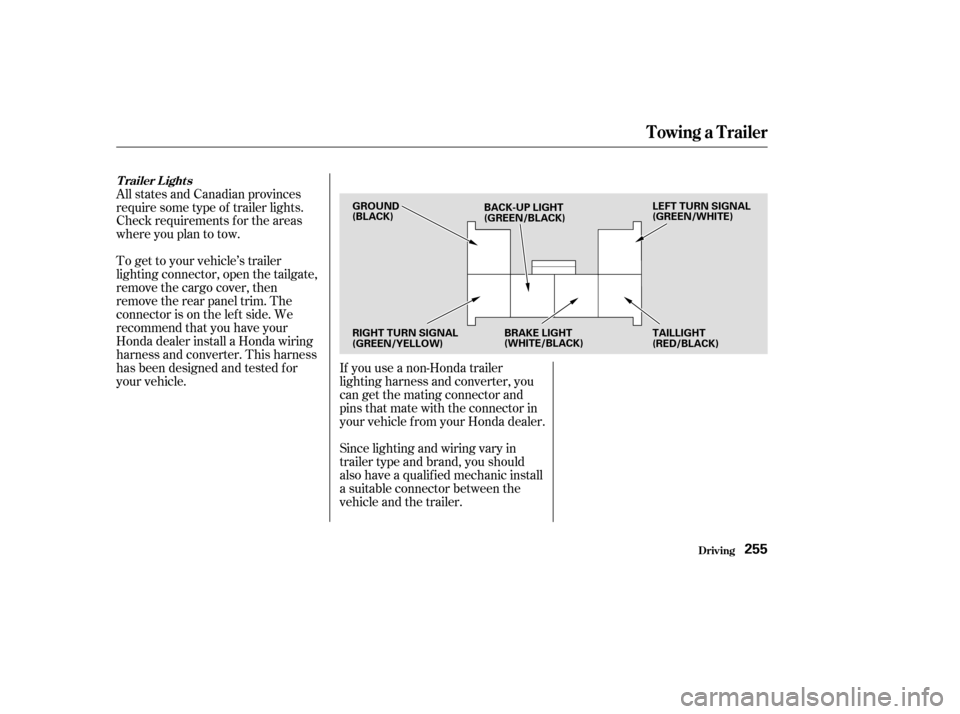
To get to your vehicle’s trailer
lighting connector, open the tailgate,
remove the cargo cover, then
remove the rear panel trim. The
connector is on the lef t side. We
recommend that you have your
Honda dealer install a Honda wiring
harness and converter. This harness
has been designed and tested f or
your vehicle.
If you use a non-Honda trailer
lighting harness and converter, you
cangetthematingconnectorand
pins that mate with the connector in
your vehicle f rom your Honda dealer.
T railer L ights
Towing a Trailer
Driving255
GROUND
(BLACK)
BACK-UP LIGHT
(GREEN/BLACK) LEFT TURN SIGNAL
(GREEN/WHITE)
RIGHT TURN SIGNAL
(GREEN/YELLOW) BRAKE LIGHT
(WHITE/BLACK)
TAILLIGHT
(RED/BLACK)
Page 260 of 392

Many states and provinces require
special exterior mirrors when towing
a trailer. Even if they don’t, you
should install special mirrors if you
cannot clearly see behind you, or if
the trailer creates a blind spot.
We also recommend that you carry a
f ull-size spare wheel and tire f or your
trailer. Ask your trailer sales or
rental agency where and how to
store the spare. See page f or proper tire size,
page f or how to store a f ull-sized
wheel and tire, and page for
inf ormation on changing a f lat tire.
Remember to unhitch the trailer
bef ore changing a f lat.When preparing to tow, and bef ore
driving away, be sure to check the
f ollowing:
The vehicle has been properly
serviced, and the brakes,
suspension, and cooling system
are in good operating condition. If
you tow f requently, f ollow the
Severe Conditions maintenance
schedule. The lights and brakes on your
vehicle and the trailer are working
properly.
Your vehicle tires and spare are in
good condition and properly
inf lated (see page ).
The trailer tires and spare are in
good condition and inf lated as
recommended by the trailer
maker.
When towing a trailer, we
recommend that you carry a f ull-size
spare wheel and tire f or your vehicle.
Using the compact spare that came
with the Pilot may adversely affect
vehicle handling.
Allitemsonandinthetrailerare
properly secured and cannot shif t
while you drive. Thehitch,safetychains,andany
other attachments are secure. All weights and loads are within
limits (see pages and ). The trailer has been properly
serviced and is in good condition.Towing perf ormance can be
af f ected by high altitude, high
temperature, or climbing steep
grades. Theref ore, premium
f uel is recommended when
towing more than 3,500 lbs
(1,590 kg).
313
340 335 308
247 249
Trailer Mirrors Spare TiresPre-T ow Checklist
Towing a Trailer
Driving256
Page 261 of 392

The added weight, length, and
height of a trailer will af f ect your
vehicle’s handling and perf ormance,
so driving with a trailer requires
some special driving skills and
techniques.
Foryoursafetyandthesafetyof
others,taketimetopracticedriving
maneuvers bef ore heading f or the
open road, and f ollow the guidelines
discussed below.
Avoid towing a trailer during your
vehicle’s f irst 500 miles (800
kilometers) (see page ).Drive slower than normal in all
driving situations. Obey all local
speed limits f or vehicles with trailers.
To keep the transmission f rom
f requently upshif ting and
downshif ting, drive in D. When
driving with a f ix-sided (e.g, camper,
utility) trailer, do not exceed 55 mph
(88 km/h). At higher speeds, the
trailer may sway or affect vehicle
handling.
Maketurnsmoreslowlyandwider
than normal. The trailer tracks a
smaller arc than your vehicle, and it
canhitorrunoversomethingthe
vehicle misses. Allow more time and
distance f or braking. When you need
to slow down, slowly lif t your f oot of f
the throttle and gradually apply the
brakes. Do not brake or turn
suddenly as this could cause the
trailer to jackknif e or turn over.
216
CONT INUED
Driving Saf ely With a T railer
Break-In Period T owing Speed
Making T urns and Braking
Towing a Trailer
Driving257
Page 262 of 392

When climbing hills, closely watch
your temperature gauge. If it nears
the red (Hot) mark, turn the air
conditioning of f , reduce speed and, if
necessary, pull to the side of the
road to let the engine cool.
If the transmission shif ts f requently
while going up a hill, shif t down one
gear.
If you must stop when f acing uphill,
use the f oot brake or parking brake.
Do not try to hold the vehicle in
placebypressingontheaccelerator,
as this can cause the automatic
transmission to overheat.
When driving down hills, reduce
your speed and shif t down to D . Do
not ‘‘ride’’ the brakes, and remember
it will take longer to slow down and
stop when towing a trailer.Crosswinds and air turbulence
caused by passing trucks can disrupt
your steering and cause your trailer
to sway. When being passed by a
truck or other large vehicle, keep a
constant speed and steer straight
ahead. Do not try to make quick
steering or braking corrections.
Always drive slowly and have
someone guide you when backing up.
Grip the of the steering
wheel; then turn the wheel to the lef t
to get the trailer to move to the lef t,
andturnthewheelrighttomovethe
trailer to the right.
Follow all normal precautions when
parking, including putting the
transmission in PARK and f irmly
setting the parking brake when you
have f inished parking.
Donotparkonaninclineunlessitis
unavoidable. If you must park on an
incline, turn the vehicle wheels
toward the curb on a downhill and
awayfromthecurbonanuphill.
After parking, place wheel chocks at
each trailer tire, on the downhill side.
If the vehicle wheels slip when
retrieving a boat f rom the water,
shifttofirstgearandturnonVTM-4
Lock (see page ).
Disengage VTM-4 Lock as soon as
the boat is out of the water to
prevent damage to the VTM-4
system.
238
3
bottom
Driving on Hills
Handling Crosswinds and
T urbulence
Backing Up Parking
Ret rieving a Boat
Towing a Trailer
Driving258
Page 263 of 392

When purchasing a tow bar, make
sure you select a reputable
manuf acturer and installer. Follow
the manufacturer’s attachment
instructions caref ully.If you tow more than 8 hours in one
day, you should repeat the above
procedure at least every 8 hours.
(when you stop f or f uel, etc.)
Check the transmission f luid level
(see page ). Maintaining the correct f luid level
is very important.
Start the engine.
Leave the ignition switch in
ACCESSORY (I) so the steering
wheel does not lock. Make sure
the radio and any items plugged
into the accessory power sockets
are turned of f so you do not run
down the battery. Release the parking brake.
Your Pilot can be towed behind a
motorhome at legal highway speeds
up to 65 mph (100 km/h). Do not
exceed 65 mph (100 km/h).
Otherwise, severe transmission
damage will occur. To avoid damage
to the 4WD system, it must be towed
with all f our wheels on the ground
(f lat towing).
Press on the brake pedal. Shif t the
lever through all the positions (P,
R, N, D, D , 2, 1)
ShifttoD,thentoN.Letthe
engine run f or three minutes, then
turn of f the engine.
Do the f ollowing to prepare your
Pilot f or ‘‘f lat towing.’’ Perf orm this
procedure every day immediately
bef ore you begin towing, and f ollow
this procedure exactly; otherwise,
severe automatic transmission
damage will occur. 293
Do not overf ill.
CONT INUED
3
Ext ended T owing
Towing Your Vehicle Behind a Motorhome
Driving259
Page 267 of 392

The f ollowing pages contain practical
tips on basic of f -highway operation.
Driving of f -highway can be hard on a
vehicle. Bef ore you leave the
pavement, be sure all scheduled
maintenance and service has been
done, and that you have inspected
your vehicle. Pay special attention to
the condition of the tires, and use a
gauge to check the tire pressures.Of f -highway, the general rule is to
keep your speed low. Of course,
you’ll need enough speed to keep
moving forward. But at higher
speeds, you have less time to assess
conditions and make good decisions.
There’s also a greater chance of
sliding if you brake or turn too
quickly on wet soil, gravel, or ice. In
any situation, never go f aster than
conditions allow.Generally, the best of f -pavement
braking technique is to gently
depress the brake pedal, then
increase pressure as more braking is
needed. Avoid hard braking. Keep in
mind that you will usually need more
time and distance to brake to a stop
on unpaved surf aces.
After you return to the pavement,
caref ully inspect your vehicle to
make sure there is no damage that
could make driving it unsaf e. Check
the tires for damage and for proper
pressure. If you need to brake hard because of
an emergency, apply steady, even
pressure to the brake pedal. Do not
pump the brakes; let the anti-lock
braking system pump them f or you.
If you pump the brakes, the anti-lock
cannot work as ef f iciently, and your
stopping distance may be increased.
Forbettertractiononallsurfaces,
accelerate slowly and gradually build
up speed. If you try to start too fast
on wet soil, mud, snow, or ice, you
might not have enough traction to
get underway. You may even dig
yourself into a hole. Starting with the
shif t lever in second gear (2) will
help get you to a smooth start on
snow and ice.
CONT INUED
Cont rolling Speed
Check Out Your Vehicle
A ccelerat ing and BrakingDriving T ips
Off-Highway Guidelines
Driving263
Page 268 of 392

Test your brakes from time to time
to make sure they are operating
properly. This will also give you a
f eel f or how much traction you have
on a given surf ace.
Off-highway, the basic turning
technique is to drive at low speed
and gradually adjust the amount of
steering to suit the surf ace.
You should have no problem making
sharp turns at low speed on level
ground. But never make an abrupt
turn at higher speeds, on or of f
pavement. With a higher center of
gravity, your vehicle can more easily
tip or roll over.Bef ore driving up or down a hill, stop
and assess the situation. If you can’t
clearly see all road conditions (good
traction, no bumps, holes or other
obstacles, a safe way out, etc.) walk
the slope bef ore you drive on it. If
you have any doubt about whether
you can saf ely drive on the slope,
. Find another route.
If you are driving up a hill and f ind
that you cannot continue (because of
the steepness, a large obstacle, etc.), . Your vehicle
could roll over. Slowly back down the
hill, f ollowing the same route you
took up the hill. Bumps, holes, rocks, and other
obstacles can be hazardous. Debris
in the road can damage your
suspension or other components.
Even small rocks can cut your tires.
More important, because your
vehicle has a high center of gravity,
driving over a large obstacle, or
allowing a wheel to drop into a deep
hole, can cause your vehicle to tip or
roll over.
Drive slow enough to observe
obstacles ahead and maneuver
around them. If you can’t avoid a
serious obstacle, turn around and
look f or a better route.
don’t do it
do not try to turn around
T urning
Avoiding Obstacles
Driving on Slopes
Off-Highway Guidelines
Driving264
Page 269 of 392
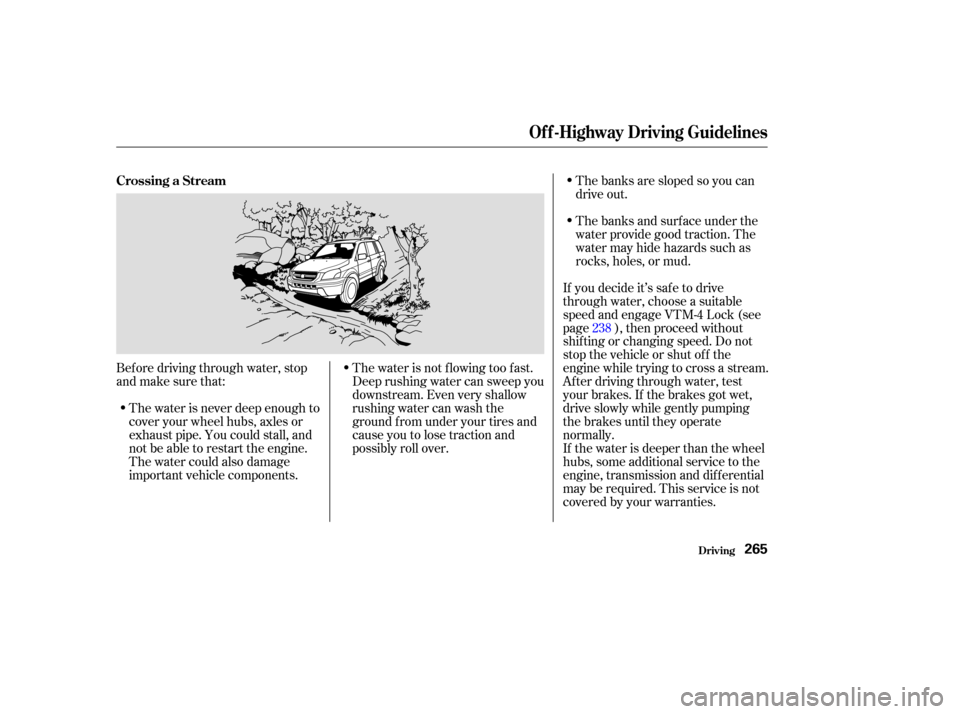
Bef ore driving through water, stop
and make sure that:The water is never deep enough to
cover your wheel hubs, axles or
exhaust pipe. You could stall, and
not be able to restart the engine.
The water could also damage
important vehicle components. The water is not f lowing too f ast.
Deep rushing water can sweep you
downstream. Even very shallow
rushingwatercanwashthe
ground f rom under your tires and
cause you to lose traction and
possibly roll over.The banks are sloped so you can
drive out.
The banks and surf ace under the
water provide good traction. The
water may hide hazards such as
rocks, holes, or mud.
If you decide it’s saf e to drive
through water, choose a suitable
speed and engage VTM-4 Lock (see
page ), then proceed without
shif ting or changing speed. Do not
stop the vehicle or shut of f the
engine while trying to cross a stream.
After driving through water, test
your brakes. If the brakes got wet,
drive slowly while gently pumping
the brakes until they operate
normally.
If the water is deeper than the wheel
hubs, some additional service to the
engine, transmission and dif f erential
mayberequired.Thisserviceisnot
covered by your warranties. 238
Crossing a Stream
Of f -Highway Driving Guidelines
Driving265
Page 273 of 392

This section explains the importance
of keeping your vehicle well
maintained and why you should
f ollow basic maintenance saf ety
precautions.
This section also includes
Maintenance Schedules f or normal
driving and severe driving conditions,
a Maintenance Record, and instruc-
tions f or simple maintenance tasks
you may want to take care of
yourself .
If you have the skills and tools to per-
f orm more complex maintenance
tasks on your Honda, you may want
to purchase the Service Manual. See
page f or inf ormation on how to
obtain a copy, or see your Honda
dealer.......................
Maintenance Saf ety .270
.
Important Safety Precautions . 271
.................
Maintenance Schedule . 272
...
Required Maintenance Record . 279
.......
Owner Maintenance Checks . 281
..............................
Fluid Locations .282
......................................
Engine Oil .283
..................................
Adding Oil .283
....................
Recommended Oil .283
..............................
Synthetic Oil .284
....................................
Additives .284
.....
Changing the Oil and Filter . 285
.............................
Cooling System .287
............
Adding Engine Coolant . 287
.......
Replacing Engine Coolant . 289
....................
Windshield Washers .292
....
Automatic Transmission Fluid . 293
..........................
Dif f erential Fluid .294
....................................
Brake Fluid .295
............................
Brake System .295
..............................
Power Steering .296
.....................
Air Cleaner Element .297
....................................
Hood Latch .298
....................................
Spark Plugs .299
..............................
Replacement .299
............................
Specif ications .301 ...........................................
Battery .302
.................................
Wiper Blades .304
..............
Air Conditioning System . 306
..................
Dust and Pollen Filter . 307
.....................................
Drive Belts .307
....................................
Timing Belt .308
...............................................
Tires .308
......................................
Inf lation .308
..................................
Inspection .310
..............................
Maintenance .311
.............................
Tire Rotation .311
...
Replacing Tires and Wheels . 312
......................
Wheels and Tires .313
..........................
Winter Driving .313
.............................
Snow Tires .314
............................
Tire Chains .314
.............................................
Lights .315
.....................
Headlight Aiming .317
........................
Replacing Bulbs .317
....................
Storing Your Vehicle .324
377
Maintenance
Maint enance269
Page 275 of 392

Bef ore you begin any maintenance,
make sure your vehicle is parked on
level ground and that the parking
brake is set. Also, be sure the engine
is of f . This will help to eliminate
several potential hazards:Be sure
there is adequate ventilation
whenever you operate the engine.
Let the
engine and exhaust system cool
bef ore touching any parts. Read the instructions before you
begin, and make sure you have the
tools and skills required.
To reduce the possibility of f ire or
explosion, be caref ul when working
around gasoline or batteries. Use a
commercially available degreaser or
parts cleaner, not gasoline, to clean
parts. Keep cigarettes, sparks, and
flames away from the battery and all
f uel-related parts.
Do
not run the engine unless in-
structed to do so. You should wear eye protection and
protective clothing when working
near the battery or when using
compressed air.
Maintenance Saf ety
Maint enance
Important Saf ety Precautions
Carbon monoxide poisoning
f rom engine exhaust.
Burns f rom hot parts.
Injury f rom moving parts.
271