seats HONDA PILOT 2005 1.G User Guide
[x] Cancel search | Manufacturer: HONDA, Model Year: 2005, Model line: PILOT, Model: HONDA PILOT 2005 1.GPages: 273, PDF Size: 3.61 MB
Page 29 of 273
CONT INUED
Your f ront airbags are also advanced
airbags. The main purpose of this
feature is to help prevent airbag-
caused injuries to short drivers and
children who ride in f ront.
For both advanced airbags to work
properly:Occupants must sit upright and
wear their seat belts properly.
Do not spill any liquids on or
under the seats, cover the sensors,
or put any cargo or metal objects
under the f ront seats.
Back-seat passengers should not
put their f eet under the f ront seats.
Failure to f ollow these instructions
could damage the sensors or prevent
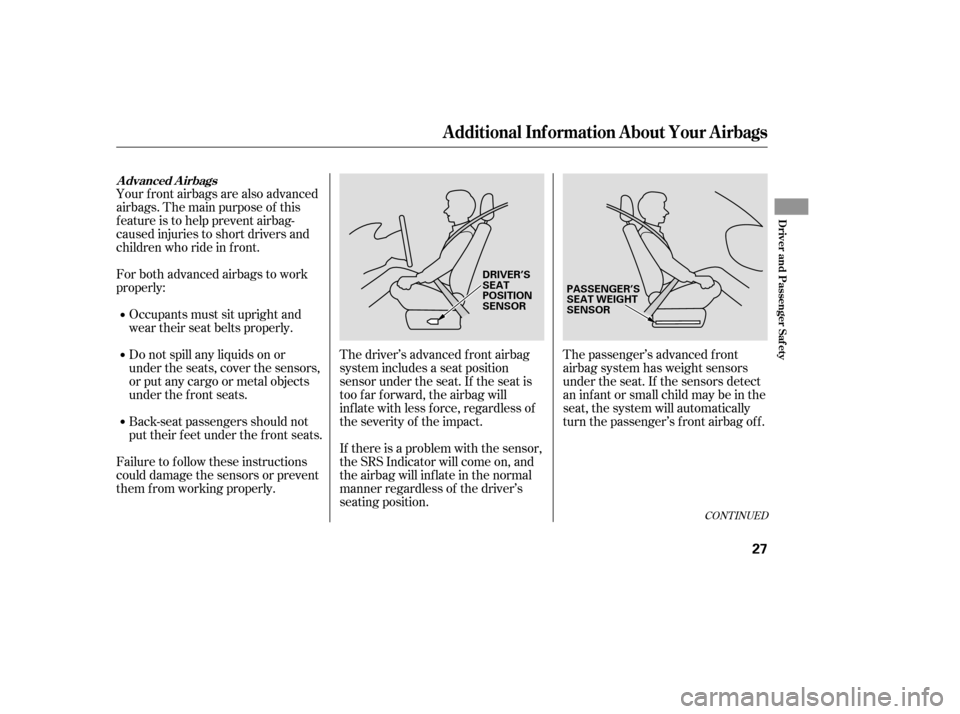
them f rom working properly. The driver’s advanced front airbag
system includes a seat position
sensor under the seat. If the seat is
too f ar f orward, the airbag will
inf late with less f orce, regardless of
the severity of the impact.
If there is a problem with the sensor,
the SRS Indicator will come on, and
the airbag will inf late in the normal
manner regardless of the driver’s
seating position.The passenger’s advanced f ront
airbag system has weight sensors
under the seat. If the sensors detect
an inf ant or small child may be in the
seat, the system will automatically
turn the passenger’s f ront airbag of f .
Additional Inf ormation About Your Airbags
Advanced Airbags
Driver and Passenger Saf ety
27
DRIVER’S
SEAT
POSITION
SENSOR
PASSENGER’S
SEAT WEIGHT
SENSOR
Page 31 of 273

There will be some delay between
the moment the passenger moves
into or out of the airbag deployment
pathandwhentheindicatorcomes
on or goes of f .
A f ront seat passenger should not
use a cushion or other object as a
backrest. It may prevent the cutof f
system f rom working properly.
Only one airbag will deploy during a
side impact. If the impact is on the
passenger’s side, the passenger’s
side airbag will deploy even if there
is no passenger.
To get the best protection f rom the
side airbags, front seat occupants
should wear their seat belts and sit
upright and well back in their seats.
To reduce the risk of injury f rom an
inf lating side airbag, your vehicle has
an automatic cutoff system for the
passenger’s side airbag.
If the Side Airbag Of f Indicator
comes on (see page ), have the
passenger sit upright. Once the
passenger is out of the airbag’s
deployment path, the system will
turn the airbag back on, and the
indicator will go out.
Objects placed on the f ront
passenger seat can also cause the
side airbag to be shut of f . Thesideairbagmayalsoshutoff if a
short adult leans sideways, or a
larger adult slouches and leans
sideways into the airbag’s
deployment path. Although we do not encourage
children to ride in f ront, this system
is designed to shut of f the side
airbag if a child leans sideways and
the child’s head is in the side airbag
deployment path. 31
Additional Inf ormation About Your Airbags
Side A irbag Cut of f Syst em
Driver and Passenger Saf ety
29
Page 41 of 273
CONT INUED
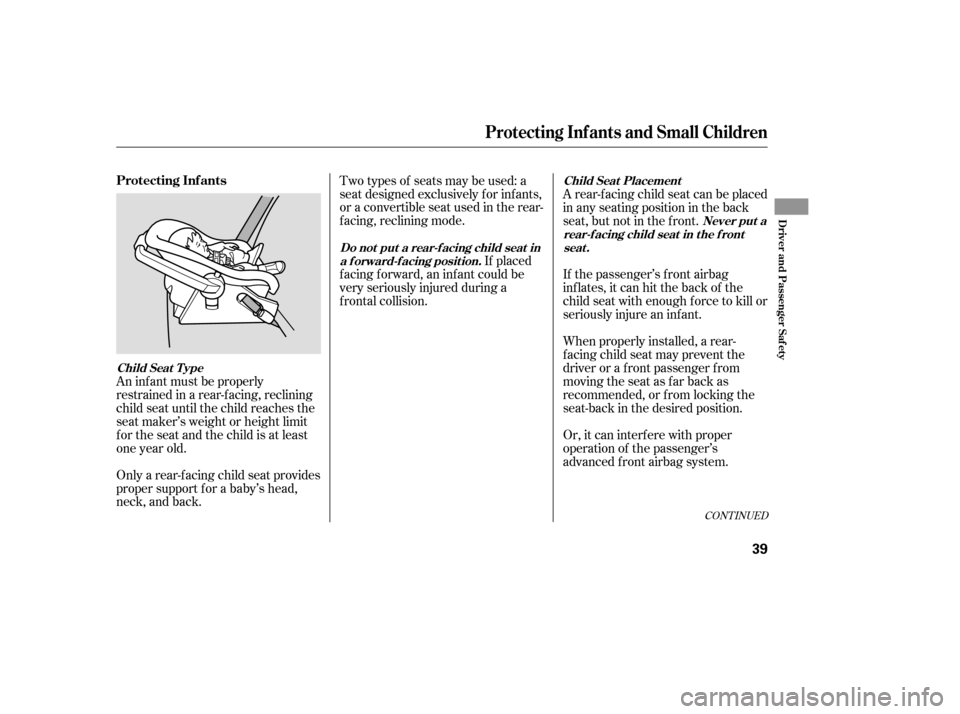
An inf ant must be properly
restrained in a rear-f acing, reclining
child seat until the child reaches the
seat maker’s weight or height limit
for the seat and the child is at least
one year old.
Only a rear-f acing child seat provides
proper support f or a baby’s head,
neck, and back.Two types of seats may be used: a
seat designed exclusively f or inf ants,
or a convertible seat used in the rear-
f acing, reclining mode.
If placed
f acing f orward, an inf ant could be
very seriously injured during a
f rontal collision. A rear-f acing child seat can be placed
in any seating position in the back
seat, but not in the f ront.
If the passenger’s f ront airbag
inflates, it can hit the back of the
child seat with enough f orce to kill or
seriously injure an inf ant.
When properly installed, a rear-
f acing child seat may prevent the
driver or a f ront passenger f rom
moving the seat as far back as
recommended, or f rom locking the
seat-back in the desired position.
Or, it can interf ere with proper
operation of the passenger’s
advanced front airbag system.
Protecting Inf ants and Small Children
Protecting Inf ants
Child Seat T ype Child Seat Placement
Do not put a rear-f acing child seat in a f orward-f acing position. Never put a
rear-f acing child seat in t he f ront seat .
Driver and Passenger Saf ety
39
Page 42 of 273
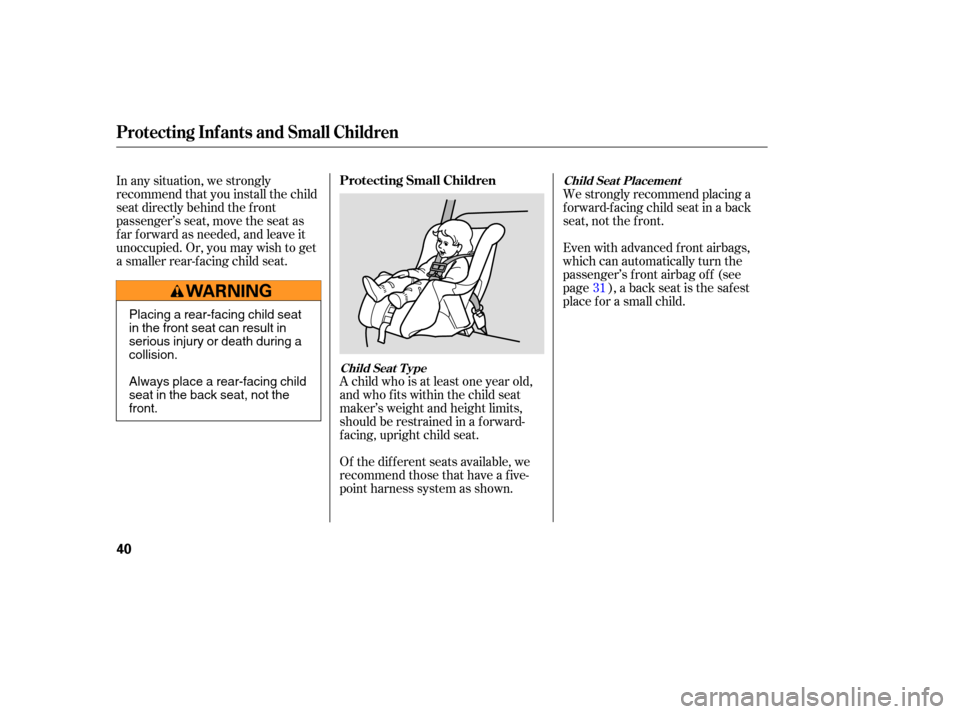
A child who is at least one year old,
and who fits within the child seat
maker’s weight and height limits,
should be restrained in a f orward-
f acing, upright child seat.
Of the different seats available, we
recommend those that have a f ive-
point harness system as shown.We strongly recommend placing a
forward-facing child seat in a back
seat, not the f ront.
In any situation, we strongly
recommend that you install the child
seat directly behind the f ront
passenger’s seat, move the seat as
f ar f orward as needed, and leave it
unoccupied. Or, you may wish to get
a smaller rear-f acing child seat.
Even with advanced front airbags,
which can automatically turn the
passenger’s f ront airbag of f (see
page ), a back seat is the saf est
place f or a small child.31
Protecting Inf ants and Small Children
Protecting Small Children
Child Seat T ype Child Seat Placement
40
Placing a rear-facing child seat
in the front seat can result in
serious injury or death during a
collision.
Always place a rear-facing child
seat in the back seat, not the
front.
Page 43 of 273
Conventional child seats must be
secured to a vehicle with a seat belt,
whereas LATCH-compatible seats
are secured by attaching the seat to
hardware built into the two outer
seating positions in the back seat.
Since LATCH-compatible child seats
are easier to install and reduce the
possibility of improper installation,
we recommend selecting this style.
We also recommend selecting a
LATCH-compatible seat with a rigid,
rather than a f lexible, anchor (see
page ).In seating positions and vehicles not
equipped with LATCH, a LATCH-
compatible child seat can be installed
using a seat belt.
If it is necessary to put a f orward-
f acing child seat in the f ront, move
the vehicle seat as far to the rear as
possible, be sure the child seat is
f irmly secured to the vehicle, and the
child is properly strapped in the seat.
Whatever type of seat you choose, to
provide proper protection, a child
seat should meet three
requirements:
When buying a child seat, you need
to choose either a conventional child
seat, or one designed f or use with
the Lower Anchors and Tethers f or
Children (LATCH) system.
43
CONT INUED
Protecting Inf ants and Small Children, Selecting a Child Seat
Selecting a Child Seat
Driver and Passenger Saf ety
41
Placing a forward-facing child
seat in the front seat can result
in serious injury or death if the
front airbag inflates.
Ifyoumustplaceaforward-
facing child seat in front, move
the vehicle seat as far back as
possible, and properly restrain
the child.
Page 44 of 273

Af ter selecting a proper child seat,
and a good place to install the seat,
there are three main steps in
installing the seat:All child seats must be
secured to the vehicle with the lap
part of a lap/shoulder belt or with
the LATCH (Lower Anchors and
Tethers f or Children) system. A
child whose seat is not properly
secured to the vehicle can be
endangered in a crash.
Af ter installing a child
seat, push and pull the seat
f orward and f rom side to side to
verif y that it is secure.
A child seat secured with a seat belt
should be installed as f irmly as
possible. However, it does not need
to be ‘‘rock solid.’’ Some side-to-side movement can be expected and
should not reduce the child seat’s
ef f ectiveness.
If the child seat is not secure, try
installing it in a dif f erent seating
position, or use a dif f erent style of
child seat that can be f irmly secured.
Make sure the child is properly
strappedinthechildseat
according to the child seat maker’s
instructions. A child who is not
properly secured in a child seat
can be seriously injured in a crash.
The f ollowing pages provide
guidelines on how to properly install
a child seat. A f orward-f acing child
seat is used in all examples, but the
instructions are the same f or rear-
f acing child seats.
Look f or FMVSS
213 or CMVSS 213 on the box.
Rear-facing for infants, forward-
f acing f or small children.
Bef ore purchasing a conventional
child seat, or using a previously
purchased one, we recommend that
you test the seat in the specif ic
vehicle seating position, or positions,
where the seat will be used. 3. 1.
2.3.
1.
2.
Selecting a Child Seat, Installing a Child Seat
Installing a Child Seat
Properly secure t he child seat t o
the vehicle.
Make sure t he child seat is f irmlysecured. Secure the child in the child seat.
T he child seat should meet U.S. or
Canadian Mot or Vehicle Saf et ySt andard 213.
T he child seat should be of theproper t ype and size t o f it t he child.
T he child seat should f it thevehicle seat ing posit ion (orposit ions) where it will be used.
42
Page 45 of 273
Make sure there are no objects
near the anchors that could
prevent a secure connection
between the child seat and the
anchors. Move the seat belt buckle or
tongue away f rom the lower
anchors.
To install a LATCH-compatible child
seat:
Place the child seat on the vehicle
seat, then attach the seat to the
lower anchors according to the
child seat maker’s instructions.
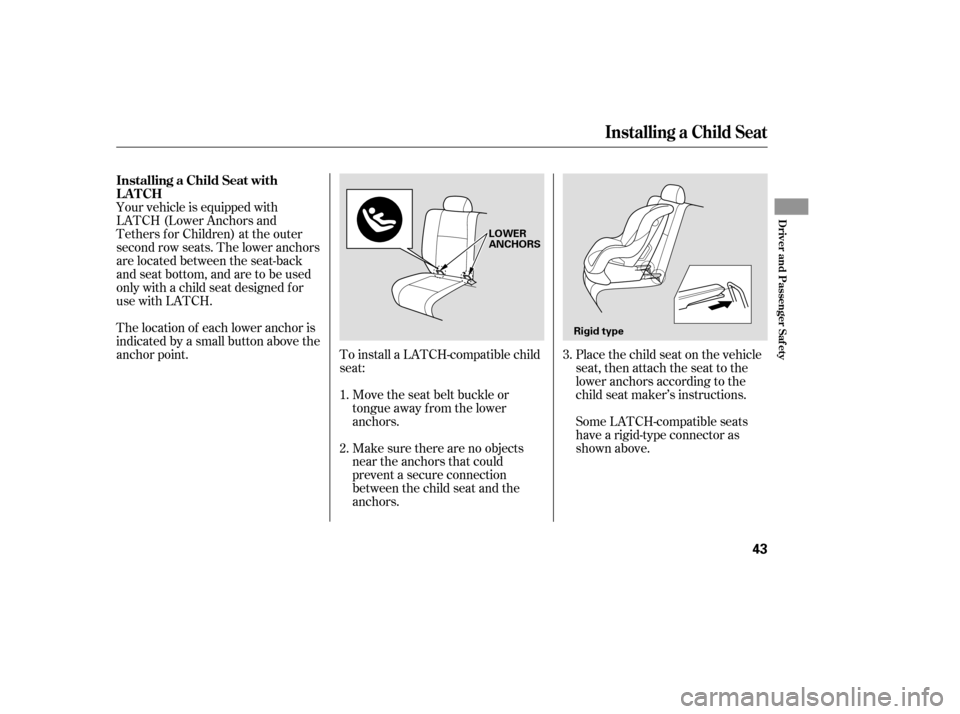
Your vehicle is equipped with
LATCH (Lower Anchors and
Tethers for Children) at the outer
second row seats. The lower anchors
are located between the seat-back
and seat bottom, and are to be used
only with a child seat designed f or
use with LATCH.
The location of each lower anchor is
indicated by a small button above the
anchor point.
Some LATCH-compatible seats
have a rigid-type connector as
shown above.
1.
2. 3.
Installing a Child Seat
Installing a Child Seat with
LATCH
Driver and Passenger Saf ety
43
Rigid type
LOWER
ANCHORS
Page 46 of 273
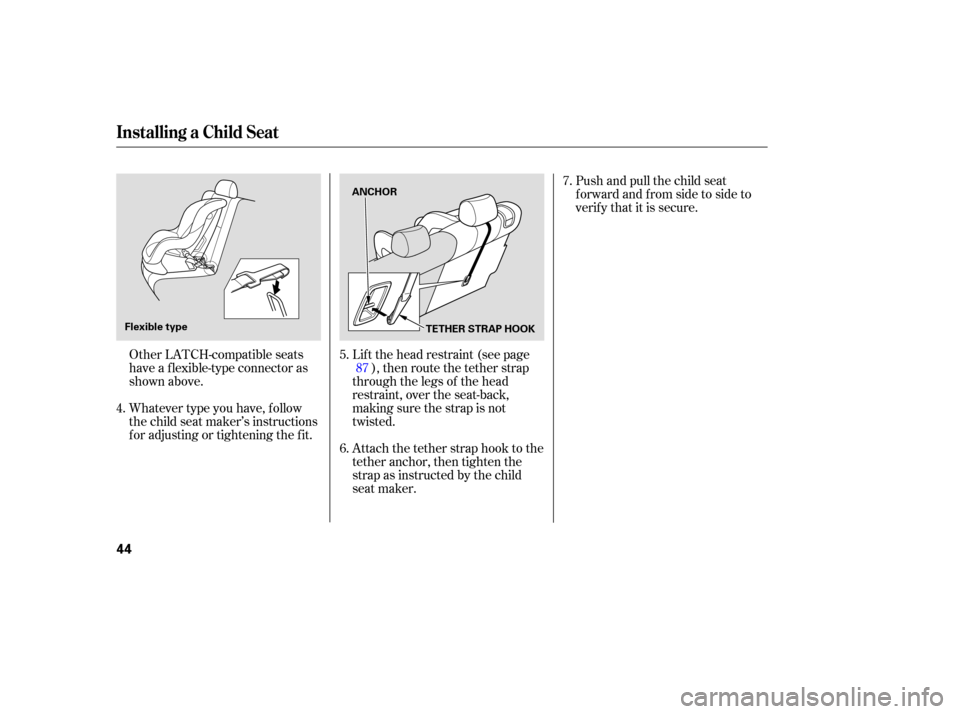
Whatever type you have, f ollow
the child seat maker’s instructions
f or adjusting or tightening the f it.Lif t the head restraint (see page
), then route the tether strap
through the legs of the head
restraint, over the seat-back,
making sure the strap is not
twisted.
Attach the tether strap hook to the
tether anchor, then tighten the
strap as instructed by the child
seat maker. Push and pull the child seat
f orward and f rom side to side to
verif y that it is secure.
Other LATCH-compatible seats
have a f lexible-type connector as
shown above.
4. 5.
6.7.
87
Installing a Child Seat
44
TETHER STRAP HOOK
Flexible type ANCHOR
Page 47 of 273
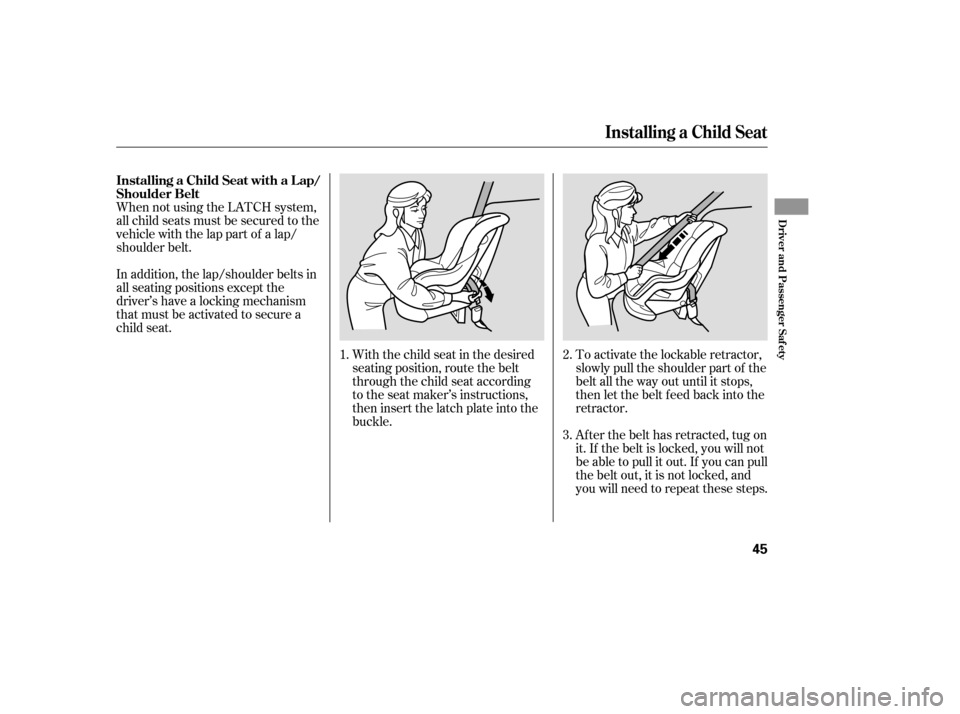
When not using the LATCH system,
all child seats must be secured to the
vehicle with the lap part of a lap/
shoulder belt.With the child seat in the desired
seating position, route the belt
through the child seat according
to the seat maker’s instructions,
then insert the latch plate into the
buckle.To activate the lockable retractor,
slowly pull the shoulder part of the
belt all the way out until it stops,
then let the belt f eed back into the
retractor.
Af ter the belt has retracted, tug on
it. If the belt is locked, you will not
be able to pull it out. If you can pull
thebeltout,itisnotlocked,and
you will need to repeat these steps.
In addition, the lap/shoulder belts in
all seating positions except the
driver’s have a locking mechanism
that must be activated to secure a
child seat.
1.2.
3.
Installing a Child Seat
Installing a Child Seat with a L ap/
Shoulder Belt
Driver and Passenger Saf ety
45
Page 52 of 273
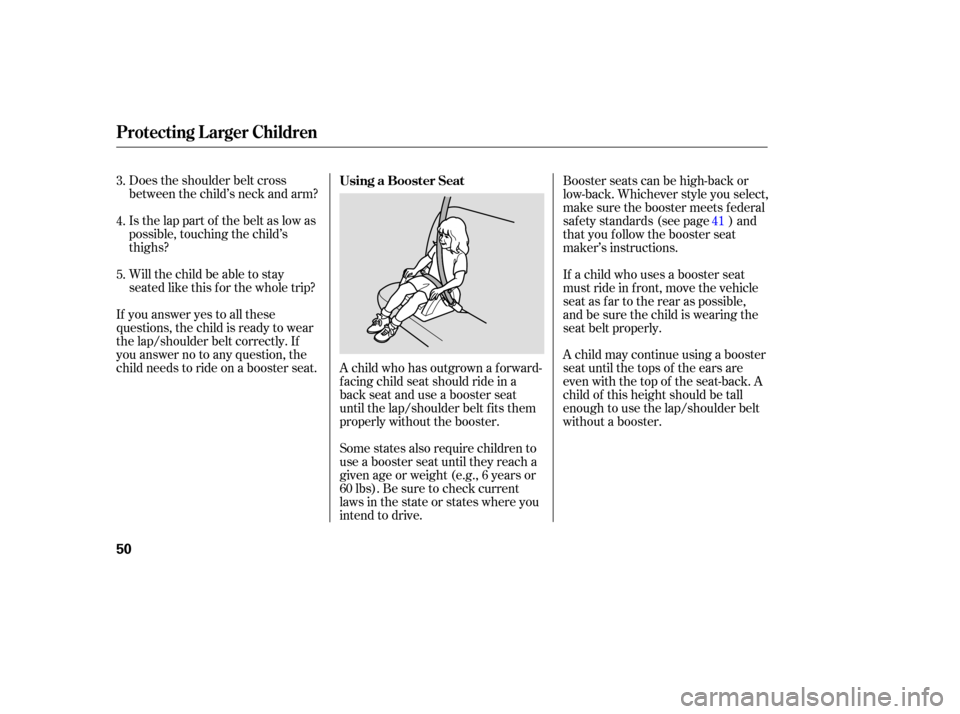
Does the shoulder belt cross
between the child’s neck and arm?
Is the lap part of the belt as low as
possible, touching the child’s
thighs?
Will the child be able to stay
seated like this f or the whole trip?
If you answer yes to all these
questions, the child is ready to wear
the lap/shoulder belt correctly. If
you answer no to any question, the
child needs to ride on a booster seat. A child who has outgrown a f orward- f acing child seat should ride in a
back seat and use a booster seat
until the lap/shoulder belt f its them
properly without the booster.
Some states also require children to
use a booster seat until they reach a
given age or weight (e.g., 6 years or
60 lbs). Be sure to check current
laws in the state or states where you
intend to drive.Booster seats can be high-back or
low-back. Whichever style you select,
make sure the booster meets f ederal
saf ety standards (see page ) and
that you f ollow the booster seat
maker’s instructions.
If a child who uses a booster seat
must ride in f ront, move the vehicle
seat as far to the rear as possible,
and be sure the child is wearing the
seat belt properly.
A child may continue using a booster
seat until the tops of the ears are
even with the top of the seat-back. A
child of this height should be tall
enough to use the lap/shoulder belt
without a booster.
4.
5. 3.
41
Using a Booster Seat
Protecting L arger Children
50