sensor HONDA PILOT 2005 1.G User Guide
[x] Cancel search | Manufacturer: HONDA, Model Year: 2005, Model line: PILOT, Model: HONDA PILOT 2005 1.GPages: 273, PDF Size: 3.61 MB
Page 107 of 273
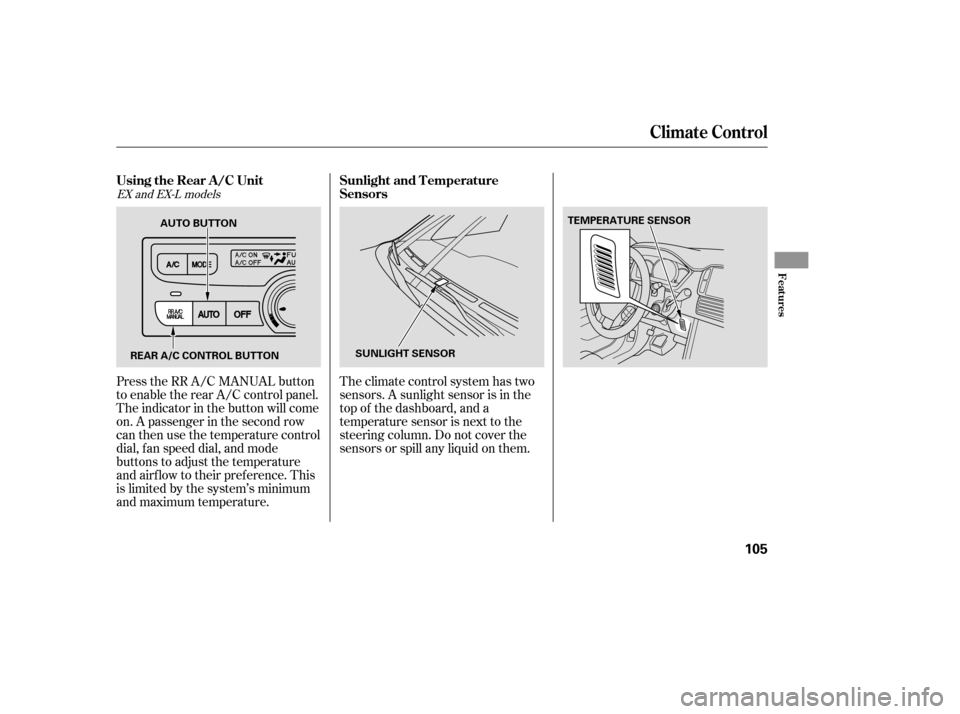
Theclimatecontrolsystemhastwo
sensors. A sunlight sensor is in the
top of the dashboard, and a
temperature sensor is next to the
steering column. Do not cover the
sensors or spill any liquid on them.
Press the RR A/C MANUAL button
to enable the rear A/C control panel.
The indicator in the button will come
on. A passenger in the second row
can then use the temperature control
dial, f an speed dial, and mode
buttons to adjust the temperature
and airflow to their preference. This
is limited by the system’s minimum
and maximum temperature.
EX and EX-L models
Climat e Cont rol
Using the Rear A /C Unit
Sunlight and T emperature
Sensors
Features
105
REAR A/C CONTROL BUTTON SUNLIGHT SENSORTEMPERATURE SENSOR
AUTO BUTTON
Page 167 of 273

Your vehicle is equipped with a tire
pressure monitoring system (TPMS)
that turns on every time you start the
engine and monitors the pressure in
your tires while driving.
Each tire has its own pressure
sensor. If the air pressure of a tire
becomes signif icantly low, the
sensor in that tire immediately sends
a signal that causes the low tire
pressure indicator and the
appropriate tire on the tire pressure
monitor to come on.Each tire, including the spare, should
be checked monthly when cold and
set to the recommended inf lation
pressure as specif ied in the vehicle
placard and this owner’s manual (see
page ).
Although your tire pressure is
monitored, you must manually check
thetirepressuresmonthly.
If you think you can saf ely drive a
short distance to a service station,
proceed slowly, and inf late the tire to
the recommended pressure shown
on the driver’s doorjamb.
When the tire pressure monitoring
system warning indicator is on, one
or more of your tires is signif icantly
under-inf lated. You should stop and
check your tires as soon as possible,
and inflate them to the proper
pressureasindicatedonthevehicle’s
tire inf ormation placard.
Driving on a signif icantly under-
inf lated tire causes the tire to
overheat and can lead to tire failure.
Under-inf lation also reduces f uel
efficiency and tire tread life, and may
af f ect the vehicle’s handling and
stopping ability.
If the tire is f lat, or if the tire
pressure is too low to continue
driving, replace the tire with the
compact spare tire. 247
Tire Pressure Monitoring System (TPMS)
Low Tire Pressure
Indicator
Driving
165
Page 168 of 273

The appropriate tire indicator and
low tire pressure indicator comes on
if a tire becomes signif icantly
underinf lated. Seeon page .The indicator comes on and stays on
if there is a problem with the tire
pressure monitoring system.
If you see this message, the system
is of f and is not monitoring the tire
pressures. Have the system checked
by your dealer as soon as possible. Each wheel is equipped with a tire
pressure sensor mounted inside the
tire behind the valve stem. You must
use TPMS specif ic wheels. It is
recommended that you always have
your tires serviced by your dealer or
qualif ied technician.
If you have a f lat tire, the low tire
pressure and tire monitor indicators
will come on. Replace the indicated
flat tire with the compact spare tire
(see page ). Af ter you replace the f lat tire, the
Low Tire Pressure indicator stays on.
This is normal; the system is not
monitoring the spare tire pressure.
Manually check the spare tire
pressure to be sure it is correct.
Never use a puncture-repairing agent
in a f lat tire. If used, you will have to
replace the tire pressure sensor.
Havetheflattirerepairedbyyour
dealer as soon as possible.
224
165
Tire Pressure Monitoring System (TPMS)
Tire Pressure Monitor
Low Tire
Pressure Indicator Tire Pressure Monitoring
System (T PMS) Indicator
Changing a T ire with T PMS
166
Page 215 of 273
If you use af termarket f loor mats
make sure they f it properly and that
theycanbeusedwiththefloormat
anchors. Do not put additional f loor
mats on top of the anchored mats.If your seat belts get dirty, use a sof t
brush with a mixture of mild soap
and warm water to clean them. Do
not use bleach, dye, or cleaning
solvents. Let the belts air-dry bef ore
you use the vehicle.
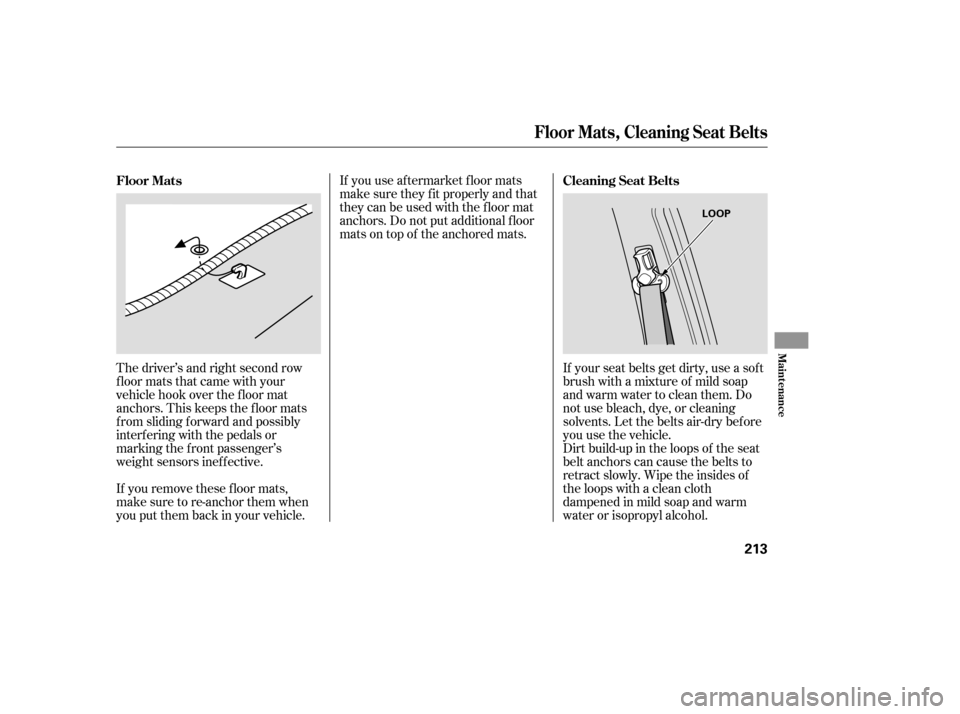
Dirt build-up in the loops of the seat
belt anchors can cause the belts to
retract slowly. Wipe the insides of
the loops with a clean cloth
dampened in mild soap and warm
water or isopropyl alcohol.
The driver’s and right second row
floor mats that came with your
vehicle hook over the f loor mat
anchors. This keeps the f loor mats
f rom sliding f orward and possibly
interf ering with the pedals or
marking the f ront passenger’s
weight sensors inef f ective.
If you remove these f loor mats,
make sure to re-anchor them when
you put them back in your vehicle. Floor Mats
Cleaning Seat Belts
Floor Mats, Cleaning Seat Belts
Maint enance
213
LOOP
Page 254 of 273

The exhaust emissions controls
include f our systems: PGM-FI,
ignition timing control, exhaust gas
recirculation and three way catalytic
converter. These f our systems work
together to control the engine’s
combustion and minimize the
amount of HC, CO, and NOx that
comes out the tailpipe. The exhaust
emissions control systems are
separate f rom the crankcase and
evaporative emissions control
systems.
The PGM-FI system uses sequential
multiport f uel injection.
It has three subsystems: air intake,
engine control, and f uel control. The
powertrain control module (PCM)
uses various sensors to determine
how much air is going into the
engine. It then controls how much
f uel to inject under all operating
conditions.The emissions control systems are
designed and certif ied to work to-
gether in reducing emissions to
levels that comply with the Clean Air
Act. To make sure the emissions
remain low, you should use only new
Honda replacement parts or their
equivalent f or repairs. Using lower
qualitypartsmayincreasethe
emissions f rom your vehicle.
The emissions control systems are
covered by warranties separate from
the rest of your vehicle. Read your
warranty manual f or more informa-
tion.
The three way catalytic converter is
in the exhaust system. Through
chemical reactions, it converts HC,
CO, and NOx in the engine’s exhaust
to carbon dioxide (CO ), nitrogen
(N ), and water vapor. This system constantly adjusts the
ignition timing, reducing the amount
of HC, CO, and NOx produced.
The exhaust gas recirculation (EGR)
system takes some of the exhaust
gas and routes it back into the intake
manif old. Adding exhaust gas to the
air/f uel mixture reduces the amount
of NOx produced when the f uel is
burned.
2
2
Exhaust Emissions Controls Replacement Parts
PGM-FI Syst emT hree Way Cat alyt ic Convert er
Ignit ion T iming Cont rol Syst em
Exhaust Gas Recirculat ion (EGR)Syst em
Emissions Cont rols
252
Page 271 of 273
CONT INUED
How Your Front Airbags.........................................
Work .25
...
How Your Side Airbags Work . 28
........................
SRS Components .23
.............................
SRS Indicator .30 ,58
....
START (Ignition Key Position) . 77
.......................
Starting the Engine .159
In Cold Weather at High ..................................
Altitude .159
................
With a Dead Battery . 230
..............
State Emissions Testing . 254
........
Steam Coming f rom Engine . 230
Steering Wheel ..................................
Adjustment .74
.............
Anti-theft Column Lock . 77
...............................
Buttons .122, 138
...................
Stereo Sound System . 106
....................
Storing Your Vehicle .222
..........................
Sunglasses Holder .96
..........................................
Sun Visor .96
Supplemental Restraint System ......................................
Servicing .32
.........................
SRS Indicator .30 ,58
...................
System Components . 23
..................................
Synthetic Oil .200 ......
Taillights, Changing Bulbs in . 210
.
Taking Care of the Unexpected . 223
....................................
Tape Player .119
Technical Descriptions ......
DOT Tire Quality Grading . 248
.....
Emissions Control Systems . 251
..........
State Emissions Testing . 254
Three Way Catalytic ...............................
Converter .253
.......................
Temperature Gauge .67
........
Temperature, Inside Sensor . 105
....................
Temperature, Outside . 67
...................
Tensioners, Seat Belts . 21
........
Testing of Readiness Codes . 254
..............
Tether Anchorage Points . 47
............................
Thef t Protection .123
..
Three Way Catalytic Converter . 253
..........................
Time, Setting the .124
..................
Tilt the Steering Wheel . 74
....................................
Timing Belt .205
....................................
Tire Chains .220
.........
Tire, How to Change a Flat . 225
Tire Pressure Monitoring ........................
System (TPMS) .165 ...............................................
Tires .216
..............................
Air Pressure .216
.........................
Checking Wear .217
..........................
Compact Spare .224
......
DOT Tire Quality Grading . 248
......................................
Inf lation .216
..................................
Inspection .217
..............................
Maintenance .218
...................................
Replacing .219
......................................
Rotating .218
...........................................
Snow .219
............................
Specif ications .247
...................
Tools, Tire Changing . 225
Towing .....................................
A Trailer .173
................
Emergency Wrecker . 237
....
Equipment and Accessories . 179
.......................
Traction Devices .220
Your Vehicle Behind a ............................
Motorhome .182
.............................
Weight Limit .175
......................
Trailer Driving Tips .180
Index
INDEX
T
VII