instrument panel HONDA PILOT 2006 1.G Owner's Guide
[x] Cancel search | Manufacturer: HONDA, Model Year: 2006, Model line: PILOT, Model: HONDA PILOT 2006 1.GPages: 316, PDF Size: 3.95 MB
Page 188 of 316
Help assure your vehicle’s f uture
reliability and perf ormance by paying
extra attention to how you drive
during the f irst 600 miles (1,000 km).
During this period:Avoid full-throttle starts and rapid
acceleration.
Do not change the oil until the
scheduled maintenance time.
Avoidhardbrakingforthefirst
200 miles (300 km).
Do not tow a trailer.
You should also f ollow these
recommendations with an
overhauled or exchanged engine, or
when the brakes are replaced. In addition, in order to maintain good
perf ormance, f uel economy, and
emissions control, we strongly
recommend, in areas where it is
available, the use of gasoline that
does NOT contain manganese-based
f uel additives such as MMT. Your vehicle is designed to operate
on unleaded gasoline with a pump
octane number of 87 or higher. Use
of a lower octane gasoline can cause
a persistent, heavy metallic rapping
noise that can lead to engine damage.
We recommend using quality
gasolines containing detergent
additives that help prevent fuel
system and engine deposits.
Use of gasoline with these additives
may adversely af f ect perf ormance,
and cause the malfunction indicator
lamp on your instrument panel to
come on. If this happens, contact
your dealer f or service.Some gasoline today is blended with
oxygenates such as ethanol or
MTBE. Your vehicle is designed to
operate on oxygenated gasoline
containing up to 10 percent ethanol
by volume and up to 15 percent
MTBE by volume. Do not use
gasoline containing methanol.
If you notice any undesirable
operating symptoms, try another
service station or switch to another
brand of gasoline.
Premium f uel is recommended when
towing in certain conditions (see
page ).
For f urther important f uel-related
inf ormation, please ref er to your
.
220
Break-in Period, Fuel Recommendation
Break-in Period
Fuel Recommendation
Quick Start Guide
186
Page 200 of 316
Your vehicle has a higher ground
clearance that allows you to travel
over bumps, obstacles, and rough
terrain. It also provides good
visibility so you can anticipate
problems earlier.
Because your vehicle rides higher
of f the ground, it has a high center
of gravity that can cause it to roll
over if you make abrupt turns. Utility
vehicles have a signif icantly higher
roll over rate than other types of
vehicles.
To prevent rollovers or loss of
control:Take corners at slower speeds
than you would with a passenger
vehicle.
Avoid sharp turns and abrupt
maneuvers whenever possible. Make sure the doors and the
tailgate are securely closed and
locked. Check the steering wheel
adjustment (see page ). Check the adjustment of the
inside and outside mirrors (see
page ). Check the seat adjustment (see
page ). Check that any items you may be
carrying are stored properly or
f astened down securely.
Make sure all windows, mirrors,
and outside lights are clean and
unobstructed. Remove f rost, snow,
or ice.
Youshoulddothefollowingchecks
and adjustments bef ore you drive
your vehicle. Do not carry heavy cargo on the
roof . Do not modif y your vehicle in any
way that would raise the center of
gravity.
Fasten your seat belt. Check that
your passengers have f astened
their seat belts (see page ).
When you start the engine, check
the gauges and indicators in the
instrument panel (see page ).
Visually check the tires. If a tire
looks low, use a gauge to check its
pressure (see page ). 3.
2. 1. 4.
5.
6.
7.
8.
9.
15
92
61
78
87
258
See page f or additional driving of f - highway guidelines. 223
Driving Guidelines
Preparing to Drive
198
Page 202 of 316
If the malf unction indicator lamp
comes on along with the ‘‘D’’
indicator, there is a problem in the
automatic transmission control
system. Avoid rapid acceleration, and
have the transmission checked by
your dealer as soon as possible.
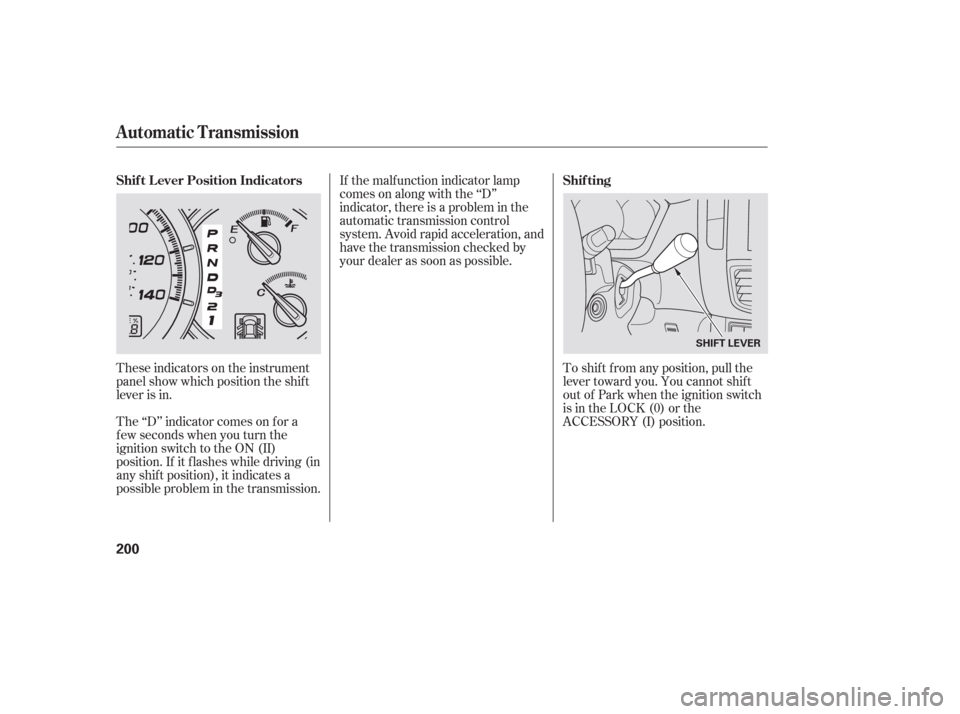
These indicators on the instrument
panel show which position the shif t
lever is in.
The ‘‘D’’ indicator comes on f or a
f ew seconds when you turn the
ignition switch to the ON (II)
position. If it f lashes while driving (in
any shif t position), it indicates a
possible problem in the transmission. To shif t f rom any position, pull the
lever toward you. You cannot shif t
out of Park when the ignition switch
is in the LOCK (0) or the
ACCESSORY (I) position.
Automatic Transmission
Shif t L ever Position Indicators
Shif ting
200
SHIFT LEVER
Page 310 of 316
........................................
Headlights .75
........................................
Aiming .248
..............
Automatic Lighting Off . 76
............
Daytime Running Lights . 76
..................
High Beam Indicator . 67
...........
High Beams, Turning on . 75
............
Low Beams, Turning on . 75
.........................
Reminder Chime .76
........
Replacing Halogen Bulbs . 248
...................................
Turning on .75
...................................
Headphones .172
..............................
Head Restraints .91
.................................
Heated Mirror .93
.....................................
Heater, Seat .86
.....................
Heating and Cooling .106
.............
High Altitude, Starting at . 199
.................
High-Low Beam Switch . 75
..............
High-mount Brake Light . 253
HomeLink Universal ................................
Transceiver .180
.......................
Hood, Opening the .188
...
Identif ication Number, Vehicle . 286Ignition
..............................................
Keys .79
...........................................
Switch .81
............
Timing Control System . 294
........................
Immobilizer System .79
...
Important Handling Inf ormation . iii
.........
Important Safety Precautions . 8
.........
Indicators, Instrument Panel . 61
...............................
Inf ant Restraint .43
......................................
Inf ant Seats .43
...................
Inf lation, Proper Tire . 257
...................................
Inside Mirror .92
.............................
Inspection, Tire .258
Installing a Child Seat .........................................
LATCH .47
..........
Tether Anchorage Points . 51
........................
Instrument Panel .5 ,61
........
Instrument Panel Brightness . 76
........................................
Introduction .i
.................
Jacking up the Vehicle . 268
.......................................
Jack, Tire .267
................................
Jump Starting .272 ..................................................
Keys .79
.......................
Label, Certif ication .286
.................
Lane Change, Signaling . 75
........................
Lap/Shoulder Belts .22
...........
LATCH Anchorage System . 47
.......................................
Lights .75, 102
....................
Bulb Replacement .248
.......................................
Indicator .61
.........................................
Parking .75
..................................
Turn Signal .75
....................................
Load Limits .194
......
LOCK (Ignition Key Position) . 81
Locks .......
Anti-thef t Steering Column . 81
............................
Fuel Fill Door .187
....................................
Glove Box .99
....................
Lockout Prevention . 82
.................................
Power Door .82
........................
Low Coolant Level .189
.........................
Low Fuel Indicator .67
...
Low Oil Pressure Indicator . 62,276
Index
I JK
L
IV