steering wheel HONDA PILOT 2007 1.G User Guide
[x] Cancel search | Manufacturer: HONDA, Model Year: 2007, Model line: PILOT, Model: HONDA PILOT 2007 1.GPages: 319, PDF Size: 4.53 MB
Page 178 of 319
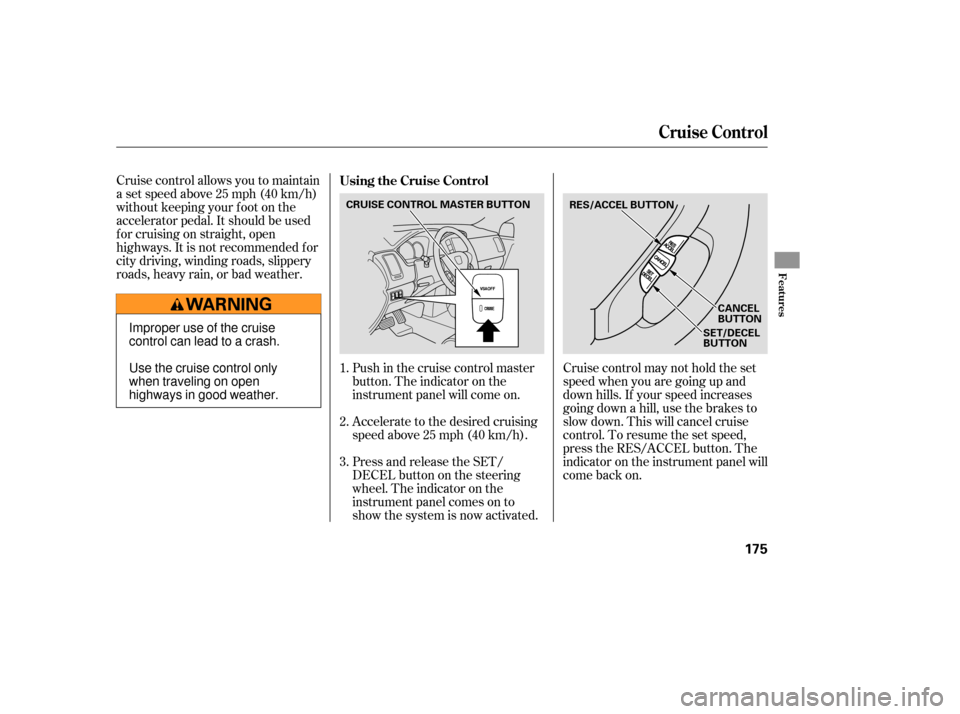
Cruise control allows you to maintain
asetspeedabove25mph(40km/h)
without keeping your f oot on the
accelerator pedal. It should be used
f or cruising on straight, open
highways. It is not recommended f or
city driving, winding roads, slippery
roads, heavy rain, or bad weather.Accelerate to the desired cruising
speedabove25mph(40km/h).
Press and release the SET/
DECELbuttononthesteering
wheel. The indicator on the
instrument panel comes on to
show the system is now activated. Push in the cruise control master
button. The indicator on the
instrument panel will come on.Cruise control may not hold the set
speed when you are going up and
down hills. If your speed increases
going down a hill, use the brakes to
slow down. This will cancel cruise
control. To resume the set speed,
press the RES/ACCEL button. The
indicator on the instrument panel will
come back on.
1.
2.
3. Using the Cruise Control
Cruise Control
Features
175
CRUISE CONTROL MASTER BUTTON
CANCEL
BUTTON
SET/DECEL
BUTTON
RES/ACCEL BUTTON
Improper use of the cruise
control can lead to a crash.
Use the cruise control only
when traveling on open
highways in good weather.
Page 179 of 319

You can increase the set cruising
speed in any of these ways:Push on the accelerator pedal.
Accelerate to the desired cruising
speed, then press the SET/
DECEL button.
You can decrease the set cruising
speed in any of these ways: Press and hold the SET/DECEL
button. Release the button when
you reach the desired speed. To slow down in very small
amounts, tap the SET/DECEL
button. Each time you do this,
your vehicle will slow down about
1 mph (1.6 km/h).
Tap the brake pedal lightly with
your f oot. The CRUISE
CONTROL indicator on the
instrument panel will go out.
When the vehicle slows to the
desired speed, press the SET/
DECEL button.
Even with the cruise control turned
on, you can still use the accelerator
pedal to speed up f or passing. Af ter
completing the pass, take your foot
of f the accelerator pedal. The vehicle
will return to the set cruising speed.
Resting your f oot on the brake pedal
causes cruise control to cancel. You can cancel cruise control in any
of these ways:
Tap the brake pedal.
Push the CANCEL button on the
steering wheel.
Pushthecruisecontrolmaster
button.
To increase the speed in very
small amounts, tap the RES/
ACCEL button. Each time you do
this, your vehicle will speed up
about 1 mph (1.6 km/h). When you push the CANCEL button
or tap on the brake pedal, the system
will remember the previously set
cruising speed. To return to that
speed, accelerate to above 25 mph
(40 km/h) and then press and
release the RES/ACCEL button. The
CRUISE CONTROL indicator comes
on. The vehicle will accelerate to the
same cruising speed as bef ore.
Pressingthecruisecontrolmaster
button turns the system off and
erases the previous cruising speed.
Press and hold the RES/ACCEL
button. When you reach the
desired cruising speed, release the
button.
Changing the Set Speed Canceling Cruise Control
Resuming the Set Speed
Cruise Control
176
Page 195 of 319

Removing parts f rom your vehicle,
or replacing components with
non-Honda components could
seriously af f ect your vehicle’s
handling, stability, and reliability.Raising your vehicle with a
non-Honda suspension kit can
af f ect the handling and stability.
Herearesomeexamples:
Lowering your vehicle with a
non-Honda suspension kit that
signif icantly reduces ground
clearance can allow the
undercarriage to hit speed bumps
or other raised objects, which
could cause the airbags to deploy. If you plan to modif y your vehicle,
consult your dealer.Modif ying your steering wheel or
any other part of your vehicle’s
safety features can make the
systems inef f ective. Larger or smaller wheels and tires
can interf ere with the operation of
your vehicle’s anti-lock brakes and
other systems. Non-Honda wheels, because they
are a universal design, can cause
excessive stress on suspension
components and will not be
compatible with the tire pressure
monitoring system (TPMS).
Modif ying Your Vehicle
A ccessories and Modif ications
192
Page 201 of 319

Your vehicle has a higher ground
clearance that allows you to travel
over bumps, obstacles, and rough
terrain. It also provides good
visibility so you can anticipate
problems earlier.
Because your vehicle rides higher
off the ground, it has a high center
of gravity that can cause it to roll
over if you make abrupt turns. Utility
vehicl es have a signifi cantly higher
roll over rate than other types of
ve hicles.
To prevent rollovers or loss of
control:
Take corners at slower speeds
than you would with a passenger
vehicle.
Avoid sharp turns and abrupt
maneuvers whenever possible. Do
not carry heavy cargo on the
roof. Do not modify your vehicle in any
way that would raise the center of
gravity.
Check the adjustment of the
inside and outside mirrors (see
page ).
Check
the seat adjustment (see
page ).
Check
that any items you may be
carrying are stored properly or
fastened down securely.
Youshoulddothefollowingchecks
and
adjustmen ts before you drive
your vehicle.
Make sure all windows, mirrors,
and outside lights are clean and
unobstructed. Remove frost, snow,
or ice.
Vi sually check the tires. If a tire
looks low, use a gauge to check its
pressure (see page ).
Your
vehicle is equipped with a four-
wheel drive (4WD) system. When
the system senses a loss of front-
wheel traction, it automatically
transfers some power to the rear
wh eels. This gives you better
traction and mobility.
You still need to exercise the same
care when accelerating, steering, and
brakingthatyouwouldinatwo-
wheel drive vehicle. 3. 2. 1.
4.
5.
87
92 258
Four-wheel drive models
See page f or additional driving of f -highway guidelines. 222
Driving Guidelines
Preparing to Drive
198
Page 202 of 319

If the engine does not start within
15 seconds, or starts but stalls
right away, repeat step 4 with the
accelerator pedal pressed halfway
down. If the engine starts, release
pressu re on the accelerator pedal
so the engine does not race.
If the engine fails to start, press
the accelerator pedal all the way
down, and hold it there while
starting to clear flooding. If the
engine still does not start, return
to step 5.
Check
the steering wheel
ad justment (see page ).
Make sure the doors and the
tailgate are secu rely closed and
locked.
Fasten your seat belt. Check that
your passengers have fastened
their seat belts (see page ).
Wh en you start the engine, check
the gauges and indicato rs in the
instrument panel (see page ). Without
touching the accelerator
pedal, turn the ignition key to the
START (III) position. Do not hold
the key in the START (III)
position for more than 15 seconds
at a time. If the engine does not
start right away, pause for at least
10 seconds before trying again.
Make
sure the shift lever is in
Park. Press on the brake pedal.
In
cold weather, turn off all
electrical accessories to reduce
the drain on the battery.
Apply
the parking brake. 5.
6.
1.
2.
3.
4.
78
61
15
6.
7.
8.
9.
79
Driving
Guidelines, Starting the Engine
Starting theEngine
Driving
199
The engine is harder to start in cold
weather. Also, the thinner air found at
altitudes above 8,000 feet (2,400
meters) adds to this problem.
The immobilizer system protects your
veh icle from theft. If an improperly-
coded key (or other device) is used, the
engine’s f uel system is disabled. For
more inf ormation, see page .
Page 211 of 319

Check the brakes after driving
through deep water. Apply the
brakes moderately to see if they f eel
normal. If not, apply them gently and
f requently until they do. Be extra
cautious in your driving.
Resting your f oot on the pedal keeps
the brakes applied lightly, builds up
heat, and reduces their ef f ectiveness.
It also keeps your brake lights on all
the time, conf using drivers behind
you.
Constant application of the brakes
when going down a long hill builds
up heat and reduces their ef f ective-
ness. Use the engine to assist the
brakes by taking your f oot of f the
accelerator and downshif ting to a
lower gear. Your vehicle is equipped with disc
brakes at all f our wheels. A power
assist helps reduce the ef f ort needed
on the brake pedal. The anti-lock
brake system (ABS) helps you retain
steering control when braking very
hard. The hydraulic system that operates
the brakes has two separate circuits.
Each circuit works diagonally across
the vehicle (the lef t-f ront brake is
connected with the right-rear brake,
etc.). If one circuit should develop a
problem, you will still have braking
at two wheels. Braking System Design
Braking System
208
Page 213 of 319

such as trying to take a
corn er too fast or making a sudden
lane change. Always drive at a safe
speed for the road and weather
conditions.
Always steer moderate ly
wh en you are braking hard. Severe
or sharp steering wheel movement
can still cause your vehicle to veer
into oncoming traffic or off the road.
If
this indicator comes on, the anti-
lock function of the braking system
has shut down. The brakes still work
like a conven tional system, but
without anti-lock. You should have
your dealer inspect your vehic le as
soon as possible.
If the ABS indicator and the brake
system indicator come on together,
and the parking brake is fully
released, the front-to-rear braking
distribution system may also be shut
down.
Test your brakes as instructed on
page . If the brakes f eel normal,
drive slowly and have your vehicle
repaired by your dealer as soon as
possible. Avoid sudden hard braking
which could cause the rear wheels to
lock up and possibly lead to a loss of
control. It only helps with steering
control during braking. on loose or
uneven surf aces, such as gravel or
snow, than a vehicle without anti-
lock.
278
Anti-lock Brakes (ABS)
A BS will not prevent a skid that
results f rom changing direction
abruptly,
A BS cannot prevent a loss of
stability.
ABS Indicator
Important Saf ety Reminders
A BS does not reduce the time or
distance it takes to stop the
vehicle. A vehicle with A BS may require a
longer distance to stop
210
Page 224 of 319

When driving down hills, reduce
your speed and shift down to D . Do
not ‘‘ride’’ the brakes.
If you must stop when facing uphill,
use the foot brake or parking brake.
Do not try to hold the vehicle in
placebypressingontheaccelerator,
as this can cause the automatic
transmission to overheat.
Crosswinds and air turbulen ce
caused by passing trucks can disrupt
your steering and cause trailer to
sway. When being passed by a large
vehicle, keep a constant speed, and
steer straight ahead. Do not try to
make quick steering or braking
corrections. Al
ways drive slowly and have
someone guide you when backing up.
Grip the of the steering
wheel; then turn the wheel to the left
to get the trailer to move to the left,
andturnthewheel righttomovethe
trailer to the right.
Follow all norm al precau tions when
parking, including putting the
transmission in Park and firmly
setting the parking brake. Also, place
wheel chocks at each of the trailer’s
tires.
If the vehicle’s tires slip when
retr ieving a boat from the water,
shift to first gear, and turn on VTM-4
lock (see page ). Disengage
VTM-4 lock as soon as the boat is
out of the water to prevent damage
to the VTM-4 system. Your
vehicle is not designed to be
towed behind a motor home. If your
vehicle needs to be towed in an
emergency, see page .
204 279
3
bottom
Remember, it
takes longer to slow down and
stop when towing a trailer. Towing Your Vehicle
Handling Crosswinds and Buf f et ingBacking Up
ParkingRet rieving a Boat
T railer Driving T ips, T owing Your Vehicle Behind a Motorhome
Driving
221
Page 230 of 319

If you have the skills and tools to
perform more complex maintenance
tasks on your vehicle, you may want
to purchase the service manual. See
page f or inf ormation on how to
obtain a copy, or see your dealer. This section also includes
instructions on how to read the
maintenance messages in the
inf ormation display, a maintenance
record, and instructions f or simple
maintenance tasks you may want to
take care of yourself . This section explains why it is
important to keep your vehicle well
maintained and how to f ollow basic
maintenance saf ety precautions. ......................
Maintenance Saf ety .228
....................
Maintenance Minder .229
....................
Maintenance Record .236
..............................
Fluid Locations .238
........................
Adding Engine Oil .239
.........
Changing the Oil and Filter .240
..............................
Engine Coolant .242
....................
Windshield Washers .243
....
Automatic Transmission Fluid .244
..............................
Dif f erential Oil .245
....................................
Timing Belt .245
....................................
Brake Fluid .246
....................
Power Steering Fluid .247
.............................................
Lights .248
.....................................
Floor Mats .254
.......................
Cleaning Seat Belts .254
.................................
Wiper Blades .255
...........................................
Wheels .257
...............................................
Tires .257
...................
Checking the Battery .262
.............................
Vehicle Storage .263
305
Maintenance
Maint enance
227
Page 250 of 319
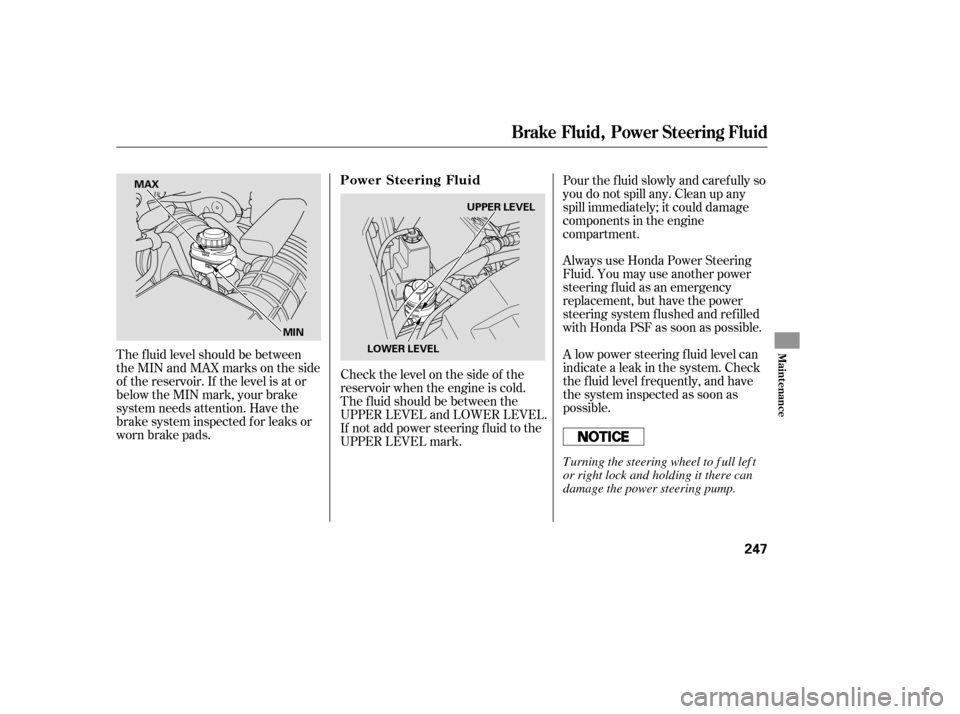
Check the level on the side of the
reservoir when the engine is cold.
The f luid should be between the
UPPER LEVEL and LOWER LEVEL.
If not add power steering f luid to the
UPPER LEVEL mark.A
low power steering
f
luid level can
indicate a leak in the system. Check
the f luid level f requently, and have
the system inspected as soon as
possible.
Brake Fluid, Power Steering Fluid
Maint enance
247
UPPER LEVEL
LOWER LEVEL
Turning the steering wheel to f ull lef t
or right lock and holding it there can
damage the power steering pump.
Always use Honda Power Steering
F
luid. You may use a
not
her power
steering f luid as an emergency
replacement, but have the power
steering system f lushed and ref illed
with Honda PSF as soon as possible. Pour the f luid slowly and caref ully so
you do not spill any. Clean up any
spill immediately; it could damage
components in the engine
compartment.
The f luid level should be between
theMINandMAXmarksontheside
of the reservoir. If the level is at or
below the MIN mark, your brake
system needs attention. Have the
brake system inspected f or leaks or
worn brake pads.
MIN
MAX
Power Steering Fluid