brake HONDA PILOT 2007 1.G Owner's Manual
[x] Cancel search | Manufacturer: HONDA, Model Year: 2007, Model line: PILOT, Model: HONDA PILOT 2007 1.GPages: 319, PDF Size: 4.53 MB
Page 206 of 319
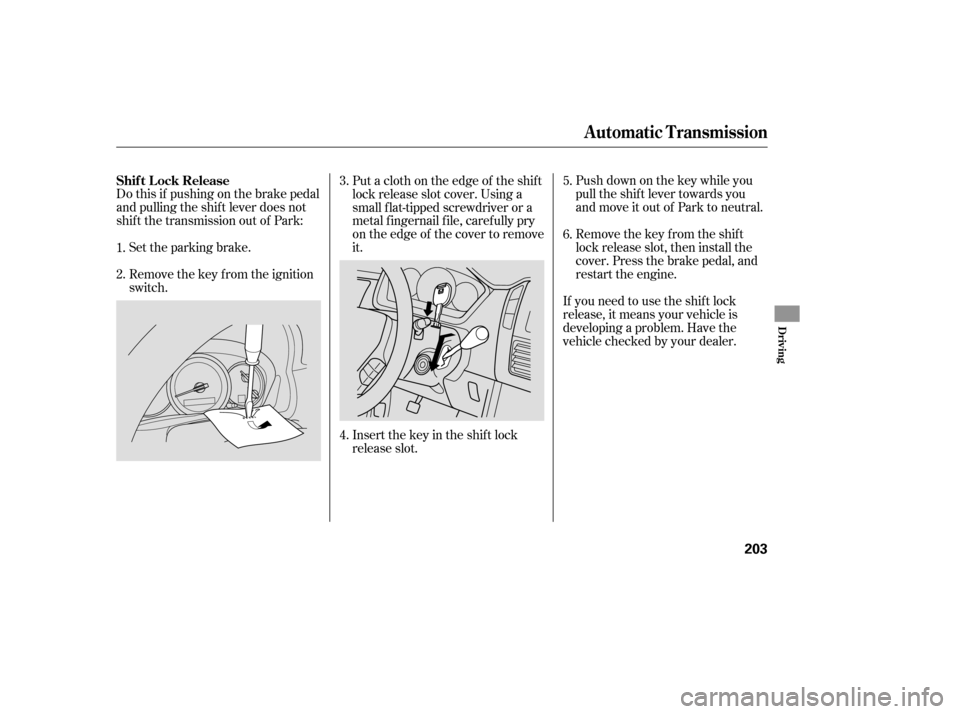
Do this if pushing on the brake pedal
and pulling the shif t lever does not
shif t the transmission out of Park:Set the parking brake. Push down on the key while you
pull the shif t lever towards you
and move it out of Park to neutral.
Remove the key from the shift
lock release slot, then install the
cover. Press the brake pedal, and
restart the engine.
Put a cloth on the edge of the shif t
lock release slot cover. Using a
small f lat-tipped screwdriver or a
metal f ingernail f ile, caref ully pry
on the edge of the cover to remove
it.
Insert the key in the shift lock
release slot.
Remove the key from the ignition
switch.
If you need to use the shif t lock
release, it means your vehicle is
developing a problem. Have the
vehicle checked by your dealer.
3.
4. 5.
6.
1.
2. Shif t L ock Release
Automatic Transmission
Driving
203
Page 210 of 319

Set the parking brake bef ore you put
the transmission in Park. This keeps
the vehicle from moving and putting
pressure on the parking mechanism
in the transmission.If the vehicle is f acing downhill,
turn the front wheels toward the
curb and set the parking brake. If the vehicle is f acing uphill, turn
the front wheels away from the
curb and set the parking brake.
Always use the parking brake when
you park your vehicle. Make sure
the parking brake is set f irmly or
your vehicle may roll if it is on an
incline. Make sure the moonroof (if
equipped) and the windows are
closed.
Turn of f the lights.
Place any packages, valuables, etc.
in the cargo area or take them
with you.
Lock the doors.
Check the indicator on the driver’s
door to verify that the security
system is set.
Never park over dry leaves, tall
grass, or other f lammable
materials. The hot three way
catalytic converter could cause
these materials to catch on fire.
On vehicles with security system
Parking Tips
Driving
207
Page 211 of 319

Check the brakes after driving
through deep water. Apply the
brakes moderately to see if they f eel
normal. If not, apply them gently and
f requently until they do. Be extra
cautious in your driving.
Resting your f oot on the pedal keeps
the brakes applied lightly, builds up
heat, and reduces their ef f ectiveness.
It also keeps your brake lights on all
the time, conf using drivers behind
you.
Constant application of the brakes
when going down a long hill builds
up heat and reduces their ef f ective-
ness. Use the engine to assist the
brakes by taking your f oot of f the
accelerator and downshif ting to a
lower gear. Your vehicle is equipped with disc
brakes at all f our wheels. A power
assist helps reduce the ef f ort needed
on the brake pedal. The anti-lock
brake system (ABS) helps you retain
steering control when braking very
hard. The hydraulic system that operates
the brakes has two separate circuits.
Each circuit works diagonally across
the vehicle (the lef t-f ront brake is
connected with the right-rear brake,
etc.). If one circuit should develop a
problem, you will still have braking
at two wheels. Braking System Design
Braking System
208
Page 212 of 319

If the brake pads need replacing, you
will hear a distinctive, metallic
screeching sound when you apply
the brake pedal. If you do not have
the brake pads replaced, they will
screech all the time. It is normal f or
the brakes to occasionally squeal or
squeak when you apply them.The anti-lock brake system (ABS)
helps prevent the brakes f rom
locking up, and helps you retain
steering control by pumping the
brakes rapidly, much f aster than a
person can do it.
The ABS also balances the f ront-to-
rear braking distribution according
to vehicle loading.
Let the ABS work f or you by always
keeping f irm, steady pressure on the
brake pedal. This is sometimes
ref erred to as ‘‘stomp and steer.’’You will f eel a pulsation in the brake
pedal when the ABS activates, and
you may hear some noise. This is
normal: it is the ABS rapidly
pumpingthebrakes.Ondry
pavement, you will need to press on
thebrakepedalveryhardbeforethe
ABS activates. However, you may
feel the ABS activate immediately if
you are trying to stop on snow or ice.
You should never pump the brake pedal.
Anti-lock Brakes (ABS)
Brake Wear Indicators
Braking System, Anti-lock Brakes (ABS)
Driving
209
Page 213 of 319

such as trying to take a
corn er too fast or making a sudden
lane change. Always drive at a safe
speed for the road and weather
conditions.
Always steer moderate ly
wh en you are braking hard. Severe
or sharp steering wheel movement
can still cause your vehicle to veer
into oncoming traffic or off the road.
If
this indicator comes on, the anti-
lock function of the braking system
has shut down. The brakes still work
like a conven tional system, but
without anti-lock. You should have
your dealer inspect your vehic le as
soon as possible.
If the ABS indicator and the brake
system indicator come on together,
and the parking brake is fully
released, the front-to-rear braking
distribution system may also be shut
down.
Test your brakes as instructed on
page . If the brakes f eel normal,
drive slowly and have your vehicle
repaired by your dealer as soon as
possible. Avoid sudden hard braking
which could cause the rear wheels to
lock up and possibly lead to a loss of
control. It only helps with steering
control during braking. on loose or
uneven surf aces, such as gravel or
snow, than a vehicle without anti-
lock.
278
Anti-lock Brakes (ABS)
A BS will not prevent a skid that
results f rom changing direction
abruptly,
A BS cannot prevent a loss of
stability.
ABS Indicator
Important Saf ety Reminders
A BS does not reduce the time or
distance it takes to stop the
vehicle. A vehicle with A BS may require a
longer distance to stop
210
Page 214 of 319

The vehicle stability assist (VSA)
system helps to stabilize the vehicle
during cornering if the vehicle turns
more or less than desired. It also
assists you in maintaining traction
while accelerating on loose or
slippery road surfaces. It does this
by regulating the engine’s output,
and by selectively applying the
brakes.
When VSA activates, you may notice
that the engine does not respond to
the accelerator in the same way it
does at other times.
The VSA system cannot enhance the
vehicle’s driving stability in all
situ ations and does not control your
vehicle’s entire braking system. It is
still your responsibility to drive and
corner at reasonable speeds and to
leave a sufficient margin of safety. When
VSA activates, you will see the
VSA activation indicator blink. If
the VSA system indicator comes
on while driving, pull to the side of
theroadwhenitissafe,andturnoff
the engine. Reset the system by
restarting the engine. If the VSA
system indicator stays, or comes
back on while driving, have the VSA
system inspected by your deale r.
If the indicator does not come on
when the ignition switch is turned to
the ON (II) position, there may be a
problem with the VSA system. Have
your dealer inspect your vehicle as
soon as possible (see page ).
Without VSA, your vehicle will have
normal braking and cornering ability,
but it will not have VSA traction and
stability enhancement. 64
VSA A ctivation Indicator
VSA System Indicator
Vehicle Stability Assist (VSA) System
Driving
211
Page 221 of 319

Honda requires that any trailer with
a total trailer weight of 1,000 lbs (455
kg) or more has its own brakes.
There are two common types of
trailer brakes: surge and electric.
Surge brakes are common for boat
trailers, since the brakes will get wet.
If you choose electric brakes, be
sure they are electronica lly actuated.
Do not attempt to tap into your
vehicle’s hydraulic system. No
matter how successful it may seem,
any attempt to attach trailer brakes
to your vehicles hydraulic system
will lower braking effectiven ess and
create a potential hazard. Always
use safety chains when you
tow a trailer. Make sure the chains
are secured to the trailer and hitch,
and that they cross under the tongue
and can catch the trailer if it
becomes unhitched. Leave enough
sl ack to allow the trailer to turn
co rners easily, but do not let the
ch ains drag on the ground.
This device is recommended if your
trailer tends to sway. Your trailer
maker can tell you what kind of sway
control you need and how to install it.
Many states and provinces require
special exterior mirrors when towing
a trailer. Even if they don’t, you
should install special mirrors if you
cannot clearly see behind you, or if
the trailer creates a blind spot. When
towing a trailer, we
recommend that you carry a full-size
spare wheel and tire for your vehicle
and trailer. See page for proper
tire size, page for how to store a
full size wheel and tire, and page f or inf ormation on changing a
flat tire.
Remember to unhitch the trailer
bef ore changing a f lat. Ask your
trailer sales or rental agency where
and how to store the trailer’s spare
tire.
Seeyourtrailerdealerorrental
agency f or more inf ormation on
installing electric brakes. 267
258
270
Towing a Trailer
Trailer Brakes Saf ety Chains
Sway Cont rolTrailer Mirrors Spare Tires
218
Page 222 of 319
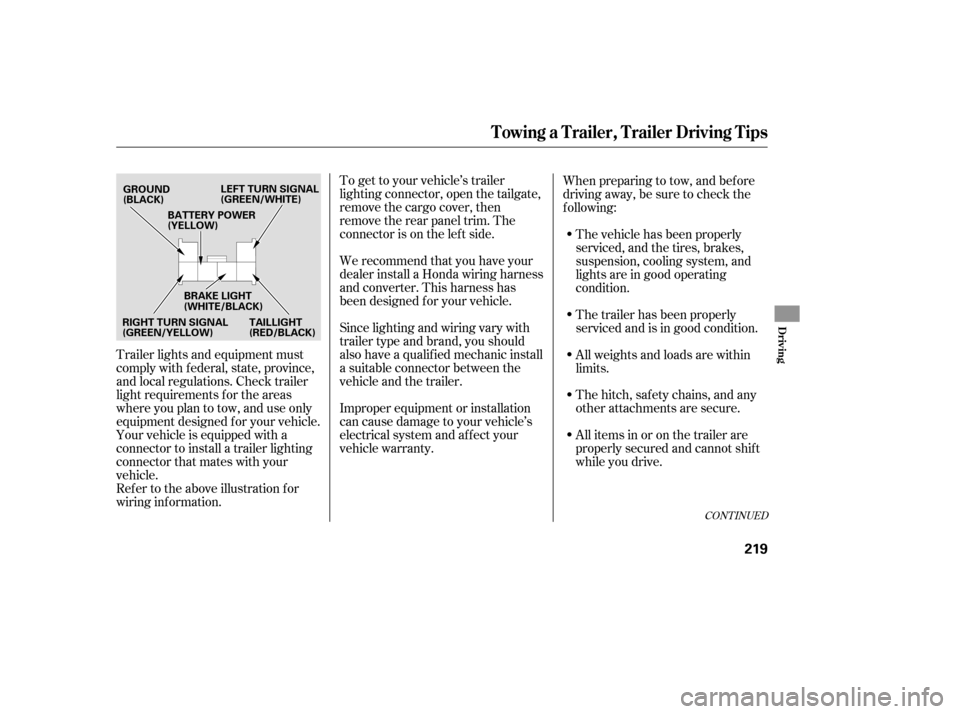
To get to your vehicle’s trailer
lighting connector, open the tailgate,
remove the cargo cover, then
remove the rear panel trim. The
connector is on the lef t side.
Trailer lights and equipment must
comply with f ederal, state, province,
and local regulations. Check trailer
light requirements f or the areas
where you plan to tow, and use only
equipment designed f or your vehicle.
Your vehicle is equipped with a
connector to install a trailer lighting
connector that mates with your
vehicle.
Ref er to the above illustration f or
wiring information. We recommend that you have your
dealer install a Honda wiring harness
and converter. This harness has
been designed f or your vehicle.
Since lighting and wiring vary with
trailer type and brand, you should
also have a qualif ied mechanic install
a suitable connector between the
vehicleandthetrailer.
Improper equipment or installation
can cause damage to your vehicle’s
electrical system and af f ect your
vehicle warranty.When preparing to tow, and bef ore
driving away, be sure to check the
f ollowing:
The vehicle has been properly
serviced, and the tires, brakes,
suspension, cooling system, and
lights are in good operating
condition.
The trailer has been properly
serviced and is in good condition.
All weights and loads are within
limits.
Thehitch,safetychains,andany
other attachments are secure.
All items in or on the trailer are
properly secured and cannot shif t
while you drive.
CONT INUED
Towing a Trailer, Trailer Driving Tips
Driving
219
GROUND
(BLACK) LEFT TURN SIGNAL
(GREEN/WHITE)
RIGHT TURN SIGNAL
(GREEN/YELLOW) BRAKE LIGHT
(WHITE/BLACK)
TAILLIGHT
(RED/BLACK)
BATTERY POWER
(YELLOW)
Page 223 of 319

Your vehicle tires and spare are
properly inflated, and the trailer
tires and spare are inflated as
recommended by the trailer
maker.
To wing performance can be
affected by high altitude, high
te mperature, or when climbing
steep grades. Therefore, premium
fuel (premium unleaded gasoline
wi th pump octane number of 91 or
higher) is recommended when
towing more than 3,500 lbs (1,590
kg).
The added weight, length, and
height of a trailer will affect your
vehicl e’s handling and performance,
so driving with a trailer requires
some special driving skills and
techniques. Foryoursafetyandthesafetyof
others,taketimetopracticedriving
maneuvers
before heading for the
open road, and follow the guidelines
below.
Avoid towing a trailer during your
vehicle’s f irst 600 miles (1,000 km)
(see page ).
Drive slower than normal in all
driving situations, and obey posted
speed limits f or vehicles with trailers.
When towing a f ixed-sided trailer
(e.g., camper), do not exceed 55 mph
(88 km/h). At higher speeds, the
trailer may sway or affect vehicle
handling.
To prevent the transmission f rom
shif ting f requently, drive in the D
position. Maketurnsmoreslowlyandwider
than normal. The trailer tracks a
smaller arc than your vehicle, and it
canhitorrunoversomethingthe
vehicle misses. Allow more time and
distance f or braking. Do not brake or
turn suddenly as this could cause the
trailer to jackknif e or turn over.
When climbing hills, closely watch
your temperature gauge. If it nears
the red (Hot) mark, turn the air
conditioning of f , reduce speed and, if
necessary, pull to the side of the
road to let the engine cool.
If the automatic transmission shif ts
f requently while going up a hill, shif t
to D .
186
3
Trailer Driving Tips
Driving Saf ely With a T railer
Break-In Period
T owing Speeds and Gears Making T urns and Braking
Driving on Hills
220
Page 224 of 319

When driving down hills, reduce
your speed and shift down to D . Do
not ‘‘ride’’ the brakes.
If you must stop when facing uphill,
use the foot brake or parking brake.
Do not try to hold the vehicle in
placebypressingontheaccelerator,
as this can cause the automatic
transmission to overheat.
Crosswinds and air turbulen ce
caused by passing trucks can disrupt
your steering and cause trailer to
sway. When being passed by a large
vehicle, keep a constant speed, and
steer straight ahead. Do not try to
make quick steering or braking
corrections. Al
ways drive slowly and have
someone guide you when backing up.
Grip the of the steering
wheel; then turn the wheel to the left
to get the trailer to move to the left,
andturnthewheel righttomovethe
trailer to the right.
Follow all norm al precau tions when
parking, including putting the
transmission in Park and firmly
setting the parking brake. Also, place
wheel chocks at each of the trailer’s
tires.
If the vehicle’s tires slip when
retr ieving a boat from the water,
shift to first gear, and turn on VTM-4
lock (see page ). Disengage
VTM-4 lock as soon as the boat is
out of the water to prevent damage
to the VTM-4 system. Your
vehicle is not designed to be
towed behind a motor home. If your
vehicle needs to be towed in an
emergency, see page .
204 279
3
bottom
Remember, it
takes longer to slow down and
stop when towing a trailer. Towing Your Vehicle
Handling Crosswinds and Buf f et ingBacking Up
ParkingRet rieving a Boat
T railer Driving T ips, T owing Your Vehicle Behind a Motorhome
Driving
221