spare tire HONDA PILOT 2007 1.G Owners Manual
[x] Cancel search | Manufacturer: HONDA, Model Year: 2007, Model line: PILOT, Model: HONDA PILOT 2007 1.GPages: 319, PDF Size: 4.53 MB
Page 68 of 319

This indicator normally comes on for
a few seconds when you turn the
ignition switch to the ON (II)
position.
The
appropriate tire indicator will
come on along with the low tire
pressure indicator if a tire is
extrem ely underinflated or has
suddenly lost pressure. See
for what to
do if this indicator comes on. If
this indicator comes on and stays
on at any other time, or if it does not
come on when you turn the ignition
switch to the ON (II) position, there
is a problem with the TPMS. With
this indicator on, the low tire
pressure indicator and the tire
pressu re monitor will not come on
when a tire loses pressure. Take the
vehicle to your dealer to have the
system checked.
This
indicator normally comes on for
a few seconds when you turn the
ignition switch to the ON (II)
position.
If it comes on while driving, it
indicates that one or more of your
vehicl e’s tires are extremely low on
pressure.
If this happens, pull to the side of the
ro ad when it is safe, check which tire
has lost the pressure on the tire
pressure monitor, and determine the
cause. If it is because of a f lat tire,
replace the flat tire with the compact
spare (see page ), and have the
f lat tire repaired as soon as possible.
If two or more tires are underinf lated,
call a prof essional towing service
(see page ). Ref er to page f or more inf ormation. 266
279
205 Tire Pressure Monitoring
System (T PMS) Indicator
Low Tire Pressure
Indicator T ire Pressure Monitor
Low
Tire Pressure Indicator
Instrument Panel Indicators
Inst rument s and Cont rols
65
Page 208 of 319

Your vehicle is equipped with a tire
pressure monitoring system (TPMS)
that turns on every time you start the
engine and monitors the pressure in
your tires while driving.
Each tire has its own pressure
sensor. If the air pressure of a tire
becomes significantly low, the
sensor in that tire immediately sends
a signal that causes the low tire
pressure indicator and the
appropriate tire on the tire pressu re
monitor to come on. Each
tire, including the spare, should
be checked monthly when cold and
set to the recommended inflation
pressure as specif ied in the vehicle
placard and this owner’s manual (see
page ).
Although your tire pressure is
monitored, you must manually check
thetirepressuresmonthly.
If you think you can saf ely drive a
short distance to a service station,
proceed slowly, and inf late the tire to
the recommended pressure shown
on the driver’s doorjamb.
When the tire pressure monitoring
system warning indicator is on, one
or more of your tires is signif icantly
under-inf lated. You should stop and
check your tires as soon as possible,
and inflate them to the proper
pressureasindicatedonthevehicle’s
tire inf ormation placard.
If the tire is f lat, or if the tire
pressure is too low to continue
driving, replace the tire with the
compact spare tire.
Driving on a signif icantly under-
inf lated tire causes the tire to
overheat and can lead to tire failure.
Under-inf lation also reduces f uel
efficiency and tire tread life, and may
af f ect the vehicle’s handling and
stopping ability. 289
Tire Pressure Monitoring System (TPMS)
Low Tire Pressure
Indicator
Driving
205
Page 209 of 319

The appropriate tire indicator and
low tire pressu re indicator comes on
if a tire becomes significantly
underinflated. See
on page .
This indicator comes on and stays on
if there is a problem with the tire
pressure monitoring system.
If you see this message, the system
is off and is not monitoring the tire
pressures. Have the system checked
by your dealer as soon as possible.
If you have a flat tire, the low tire
pressu re and tire monitor indicators
will come on. Replace the indicated
flat tire with the compact spare tire
(see page ). Each wheel is equipped with a tire
pressure sensor mounted inside the
tire behind the valve stem. You must
use TPMS specif ic wheels. It is
recommended that you always have
your tires serviced by your dealer or
qualif ied technician.
Af ter you replace the f lat tire, the
low tire pressure indicator stays on.
This is normal; the system is not
monitoring the spare tire pressure.
Manually check the spare tire
pressure to be sure it is correct.
Never use a puncture-repairing agent
in a f lat tire. If used, you will have to
replace the tire pressure sensor.
Havetheflattirerepairedbyyour
dealer as soon as possible.
266 205
As required by the FCC:
This device complies with Part 15 of theFCC rules. Operation is subject to thef ollowing two conditions: (1) This devicemay not cause harmf ul interf erence, and(2) this device must accept anyinterf erence received, includinginterf erence that may cause undesiredoperation.
Changes or modif ications not expresslyapproved by the party responsible f orcompliance could void the user’sauthority to operate the equipment.
This device complies with IndustryCanada Standard RSS-210.Operation is subject to the f ollowing twoconditions: (1) this device may not causeinterf erence, and (2) this device mustaccept any interf erence that may causeundesired operation of the device.
Tire Pressure Monitoring System (TPMS)
Tire Pressure Monitor
Low Tire
Pressure Indicator
Changing a T ire with T PMS Tire Pressure Monitoring
System (T PMS) Indicator
206
Page 215 of 319
VSA is turned on every time you
start the engine, even if you turn ed it
off the last time you drove the
vehicle.
Driving with varying tire or wheel
sizes may cause the VSA to
malfunction. When replacing tires,
make sure they are of the same size
and type as your original tires (see
page ).
Deactivate the VSA system if you
need to drive with the compact spare
tire installed (see page ).
If you install winter tires, make sure
they are the same size as those that
were originally supplied with your
vehicle. Exercise the same caution
during winter driving as you would if
your vehicle was not equipped with
VSA.
In certain unusual conditions when
your vehicle gets stuck in shallow
mud or f resh snow, it may be easier
to free it with the VSA temporarily
switched of f . When the VSA system
is of f , the traction control system is
alsooff.Youshouldonlyattemptto
f ree your vehicle with the VSA of f if
you are not able to f ree it when the
VSA is on.
Immediately af ter f reeing your
vehicle, be sure to switch the VSA on
again. We do not recommend driving
your vehicle with the VSA and
traction control systems switched off.
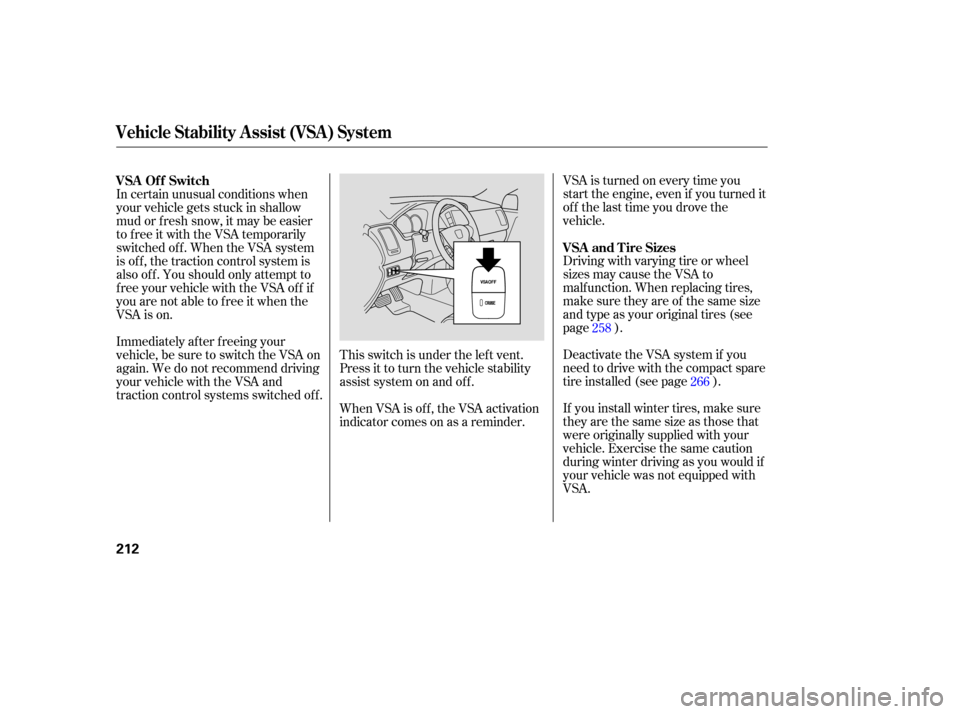
When VSA is off, the VSA activation
indicator comes on as a reminder. This switch is under the lef t vent.
Press it to turn the vehicle stability
assist system on and of f . 258
266
VSA and Tire Sizes
VSA Of f Switch
Vehicle Stability Assist (VSA) System
212
Page 221 of 319

Honda requires that any trailer with
a total trailer weight of 1,000 lbs (455
kg) or more has its own brakes.
There are two common types of
trailer brakes: surge and electric.
Surge brakes are common for boat
trailers, since the brakes will get wet.
If you choose electric brakes, be
sure they are electronica lly actuated.
Do not attempt to tap into your
vehicle’s hydraulic system. No
matter how successful it may seem,
any attempt to attach trailer brakes
to your vehicles hydraulic system
will lower braking effectiven ess and
create a potential hazard. Always
use safety chains when you
tow a trailer. Make sure the chains
are secured to the trailer and hitch,
and that they cross under the tongue
and can catch the trailer if it
becomes unhitched. Leave enough
sl ack to allow the trailer to turn
co rners easily, but do not let the
ch ains drag on the ground.
This device is recommended if your
trailer tends to sway. Your trailer
maker can tell you what kind of sway
control you need and how to install it.
Many states and provinces require
special exterior mirrors when towing
a trailer. Even if they don’t, you
should install special mirrors if you
cannot clearly see behind you, or if
the trailer creates a blind spot. When
towing a trailer, we
recommend that you carry a full-size
spare wheel and tire for your vehicle
and trailer. See page for proper
tire size, page for how to store a
full size wheel and tire, and page f or inf ormation on changing a
flat tire.
Remember to unhitch the trailer
bef ore changing a f lat. Ask your
trailer sales or rental agency where
and how to store the trailer’s spare
tire.
Seeyourtrailerdealerorrental
agency f or more inf ormation on
installing electric brakes. 267
258
270
Towing a Trailer
Trailer Brakes Saf ety Chains
Sway Cont rolTrailer Mirrors Spare Tires
218
Page 223 of 319

Your vehicle tires and spare are
properly inflated, and the trailer
tires and spare are inflated as
recommended by the trailer
maker.
To wing performance can be
affected by high altitude, high
te mperature, or when climbing
steep grades. Therefore, premium
fuel (premium unleaded gasoline
wi th pump octane number of 91 or
higher) is recommended when
towing more than 3,500 lbs (1,590
kg).
The added weight, length, and
height of a trailer will affect your
vehicl e’s handling and performance,
so driving with a trailer requires
some special driving skills and
techniques. Foryoursafetyandthesafetyof
others,taketimetopracticedriving
maneuvers
before heading for the
open road, and follow the guidelines
below.
Avoid towing a trailer during your
vehicle’s f irst 600 miles (1,000 km)
(see page ).
Drive slower than normal in all
driving situations, and obey posted
speed limits f or vehicles with trailers.
When towing a f ixed-sided trailer
(e.g., camper), do not exceed 55 mph
(88 km/h). At higher speeds, the
trailer may sway or affect vehicle
handling.
To prevent the transmission f rom
shif ting f requently, drive in the D
position. Maketurnsmoreslowlyandwider
than normal. The trailer tracks a
smaller arc than your vehicle, and it
canhitorrunoversomethingthe
vehicle misses. Allow more time and
distance f or braking. Do not brake or
turn suddenly as this could cause the
trailer to jackknif e or turn over.
When climbing hills, closely watch
your temperature gauge. If it nears
the red (Hot) mark, turn the air
conditioning of f , reduce speed and, if
necessary, pull to the side of the
road to let the engine cool.
If the automatic transmission shif ts
f requently while going up a hill, shif t
to D .
186
3
Trailer Driving Tips
Driving Saf ely With a T railer
Break-In Period
T owing Speeds and Gears Making T urns and Braking
Driving on Hills
220
Page 261 of 319

The following chart shows the
recommended cold tire pressures for
most normal driving conditions.
Thecompactsparetirepressureis:
For convenience, the recommended
tire sizes and cold tire pressures are
on a lab el on the driver’s doorjamb.
For additional information about
your tires, see page .
If you check air pressures when the
tires are hot [driven f or several miles
(kilometers)], you will see readings 4
to6psi(30to40kPa,0.3to0.4
kgf /cm ) higher than the cold
readings. This is normal. Do not let
air out to match the recommended
cold air pressure. The tire will be
underinf lated.
Youshouldgetyourowntire
pressure gauge and use it whenever
you check your tire pressures. This
will make it easier f or you to tell if a
pressure loss is due to a tire problem
and not due to a variation between
gauges.
While tubeless tires have some
ability to self -seal if they are
punctured, you should look closely
for punctures if a tire starts losing
pressure.
We recommend that you visually
check your tires every day. If you
think a tire might be low, check it
immediately with a tire gauge.
Use a gauge to measure the air
pressure in each tire at least once a
month. Even tires that are in good
condition may lose 1 to 2 psi (10 to
20 kPa, 0.1 to 0.2 kgf /cm ) per
month. Remember to check the
sparetireatthesametime.
Check the air pressures when the
tires are cold. This means the
vehicle has been parked f or at least 3
hours, or driven less than 1 mile (1.6
km). Add or release air, if needed, to
match the recommended cold tire
pressures.
289
Tire Size Cold Tire Pressure
for Normal Driving
Tires
Recommended T ire Pressures
258
60 psi (420 kPa , 4.2 kgf/cm)
32 psi (220 kPa ,2.2 kgf/cm
)
P235/70R16 104S
Page 268 of 319

This section covers the more
common problems that motorists
experience with their vehicles. It
gives you inf ormation about how to
safely evaluate the problem and what
to do to correct it. If the problem has
stranded you on the side of the road,
you may be able to get going again.
If not, you will also f ind instructions
on getting your vehicle towed.......................
Compact Spare Tire .266
....................
Changing a Flat Tire .267
.............
If the Engine Won’t Start .271
................................
Jump Starting .272
..............
If the Engine Overheats .274
.........
Low Oil Pressure Indicator .276
..........
Charging System Indicator .276
.......
Malf unction Indicator Lamp .277
...............
Brake System Indicator .278
......................
Emergency Towing .279
..............................................
Fuses .279
..............................
Fuse Locations .283
Taking Care of the Unexpected
T aking Care of t he Unexpect ed
265
Page 269 of 319
Use the compact spare tire as a
temporary replacement only. Get
your regular tire repaired or replaced,
and put it back on your vehicle as
soon as you can.
Check the inf lation pressure of the
compact spare tire every time you
check the other tires. It should be
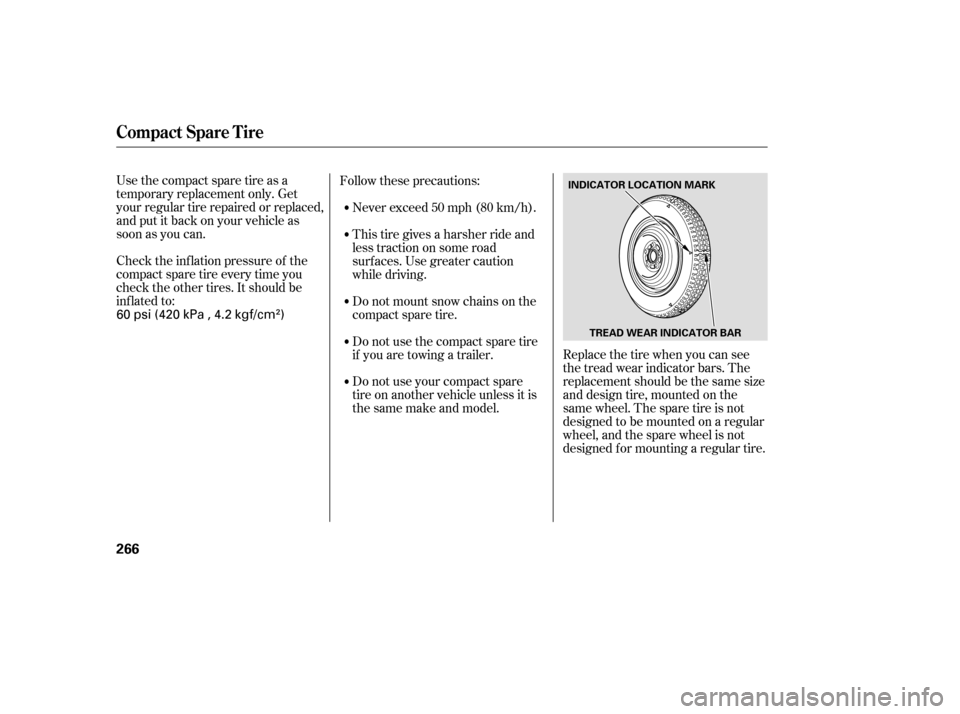
inf lated to:Replace the tire when you can see
the tread wear indicator bars. The
replacement should be the same size
and design tire, mounted on the
same wheel. The spare tire is not
designed to be mounted on a regular
wheel, and the spare wheel is not
designed f or mounting a regular tire.
Follow these precautions:
Never exceed 50 mph (80 km/h).
This tire gives a harsher ride and
less traction on some road
surf aces. Use greater caution
while driving.
Do not mount snow chains on the
compact spare tire.
Do not use your compact spare
tire on another vehicle unless it is
thesamemakeandmodel. Do not use the compact spare tire
if you are towing a trailer.
Compact Spare Tire
266
INDICATOR LOCATION MARK
TREAD WEAR INDICATOR BAR
60 psi (420 kPa , 4.2 kgf/cm)
Page 270 of 319
CONT INUED
If you have a f lat tire while driving,
stop in a saf e place to change it.
Drive slowly along the shoulder until
you get to an exit or an area to stop
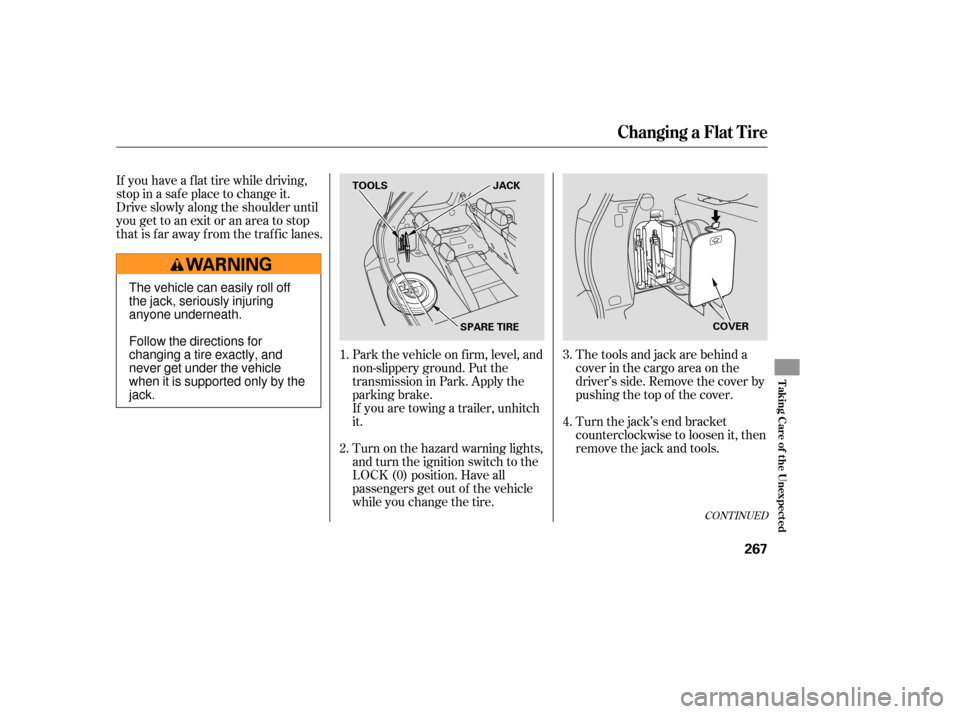
that is far away from the traffic lanes.Park the vehicle on f irm, level, and
non-slippery ground. Put the
transmission in Park. Apply the
parking brake.
If you are towing a trailer, unhitch
it.
Turn on the hazard warning lights,
and turn the ignition switch to the
LOCK (0) position. Have all
passengers get out of the vehicle
while you change the tire.Turn the jack’s end bracket
counterclockwise to loosen it, then
remove the jack and tools. Thetoolsandjackarebehinda
cover in the cargo area on the
driver’s side. Remove the cover by
pushing the top of the cover.
2. 1. 3.
4.
Changing a Flat Tire
T aking Care of t he Unexpect ed
267
SPARE TIRE
TOOLS
COVER
JACK
The vehicle can easily roll off
the jack, seriously injuring
anyone underneath.
Follow the directions for
changing a tire exactly, and
never get under the vehicle
when it is supported only by the
jack.