weight HONDA PILOT 2013 2.G User Guide
[x] Cancel search | Manufacturer: HONDA, Model Year: 2013, Model line: PILOT, Model: HONDA PILOT 2013 2.GPages: 488, PDF Size: 10.18 MB
Page 65 of 488
uuChild SafetyuSafety of Larger Children
64
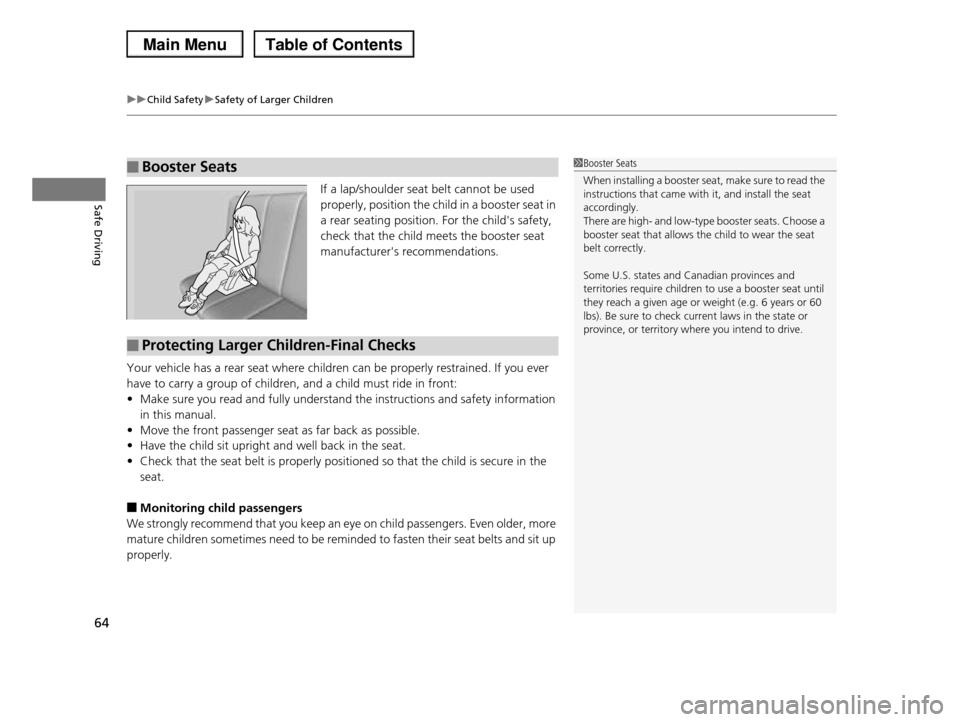
Safe DrivingIf a lap/shoulder seat belt cannot be used
properly, position the child in a booster seat in
a rear seating position. For the child's safety,
check that the child meets the booster seat
manufacturer's recommendations.
Your vehicle has a rear seat where children can be properly restrained. If you ever
have to carry a group of children, and a child must ride in front:
•Make sure you read and fully understand the instructions and safety information
in this manual.
•Move the front passenger seat as far back as possible.
•Have the child sit upright and well back in the seat.
•Check that the seat belt is properly positioned so that the child is secure in the
seat.
■Monitoring child passengers
We strongly recommend that you keep an eye on child passengers. Even older, more
mature children sometimes need to be reminded to fasten their seat belts and sit up
properly.
■Booster Seats1Booster Seats
When installing a booster seat, make sure to read the instructions that came with it, and install the seat
accordingly.
There are high- and low-type booster seats. Choose a booster seat that allows the child to wear the seat
belt correctly.
Some U.S. states and Canadian provinces and
territories require children to use a booster seat until
they reach a given age or weight (e.g. 6 years or 60 lbs). Be sure to check current laws in the state or
province, or territory where you intend to drive.
■Protecting Larger Children-Final Checks
Page 111 of 488
110
Controls
Opening and Closing the Tailgate
Precautions for Opening/Closing the Tailgate
Always make sure individuals and objects are clear of the tailgate before opening or
closing it.
■Opening the tailgate
•Open the tailgate all the way.
uIf it is not fully opened, the tailgate may come down accidentally by its own
weight.
•Be careful when it is windy. The wind may cause the tailgate to close.
■Closing the tailgate
Keep the tailgate closed while driving to:
uAvoid possible damage.
uPrevent exhaust gas from leaking into the vehicle.
2Carbon Monoxide Gas P. 65
1Precautions for Opening/Closing the Tailgate
Be careful not to hit your head on the tailgate or to
put your hands between the tailgate and the cargo area when closing the tailgate.
When operating the power tailgate, make sure there is enough space around your vehicle. People near the
tailgate may be seriously hurt if the tailgate hits or
closes on their heads. Be especially cautious if children are around.
When you are storing or picking up luggage from the cargo area while the engine is idling, do not stand in
front of the exhaust pipe. You may get burned.
Do not allow any passenger in the cargo space. They
may get hurt during hard braking, a sudden
acceleration, or a crash.
3WARNING
Closing a power tailgate while anyone is in
the path of the tailgate can cause serious
injury.
Make sure everyone is clear before closing
the tailgate.
Models with power tailgate
Page 117 of 488
116
uuOpening and Closing the TailgateuOpening/Closing the Glass Hatch
Controls
Opening/Closing the Glass Hatch
The glass hatch can be operated by pressing the glass hatch release button* on the
remote transmitter, pressing the glass hatch release button* on the driver's door, or
pressing the button on the tailgate.
■Opening the glass hatch
•Open the glass hatch all the way.
uIf it is not fully opened, the glass hatch may come down accidentally by its own
weight.
•Be careful when it is windy. The wind may cause the glass hatch to close.
■Closing the glass hatch
•To close the glass hatch, lower it and press on the handle until it latches.
•Keep the glass hatch closed while driving to:
uAvoid possible damage.
uPrevent exhaust gas from leaking into the vehicle.
2Carbon Monoxide Gas P. 65
1Opening/Closing the Glass Hatch
The rear wiper does not operate with the glass hatch open.
* Not available on all models
Page 328 of 488
327
uuBefore DrivinguMaximum Load Limit
Continued
Driving
Maximum Load Limit
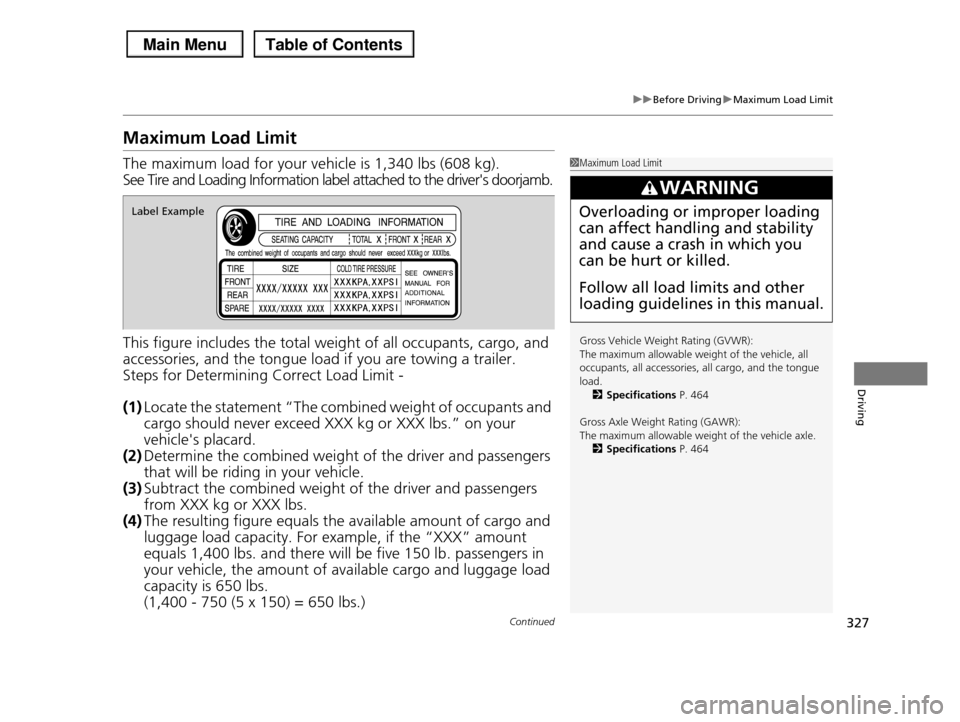
The maximum load for your vehicle is 1,340 lbs (608 kg).
See Tire and Loading Information label attached to the driver's doorjamb.
This figure includes the total weight of all occupants, cargo, and
accessories, and the tongue load if you are towing a trailer.
Steps for Determining Correct Load Limit -
(1)Locate the statement “The combined weight of occupants and
cargo should never exceed XXX kg or XXX lbs.” on your
vehicle's placard.
(2)Determine the combined weight of the driver and passengers
that will be riding in your vehicle.
(3)Subtract the combined weight of the driver and passengers
from XXX kg or XXX lbs.
(4)The resulting figure equals the available amount of cargo and
luggage load capacity. For example, if the “XXX” amount
equals 1,400 lbs. and there will be five 150 lb. passengers in
your vehicle, the amount of available cargo and luggage load
capacity is 650 lbs.
(1,400 - 750 (5 x 150) = 650 lbs.)
1Maximum Load Limit
Gross Vehicle Weight Rating (GVWR): The maximum allowable weight of the vehicle, all
occupants, all accessories, all cargo, and the tongue
load.2Specifications P. 464
Gross Axle Weight Rating (GAWR):
The maximum allowable weight of the vehicle axle.2Specifications P. 464
3WARNING
Overloading or improper loading
can affect handling and stability
and cause a crash in which you
can be hurt or killed.
Follow all load limits and other
loading guidelines in this manual.
Label Example
Page 329 of 488
328
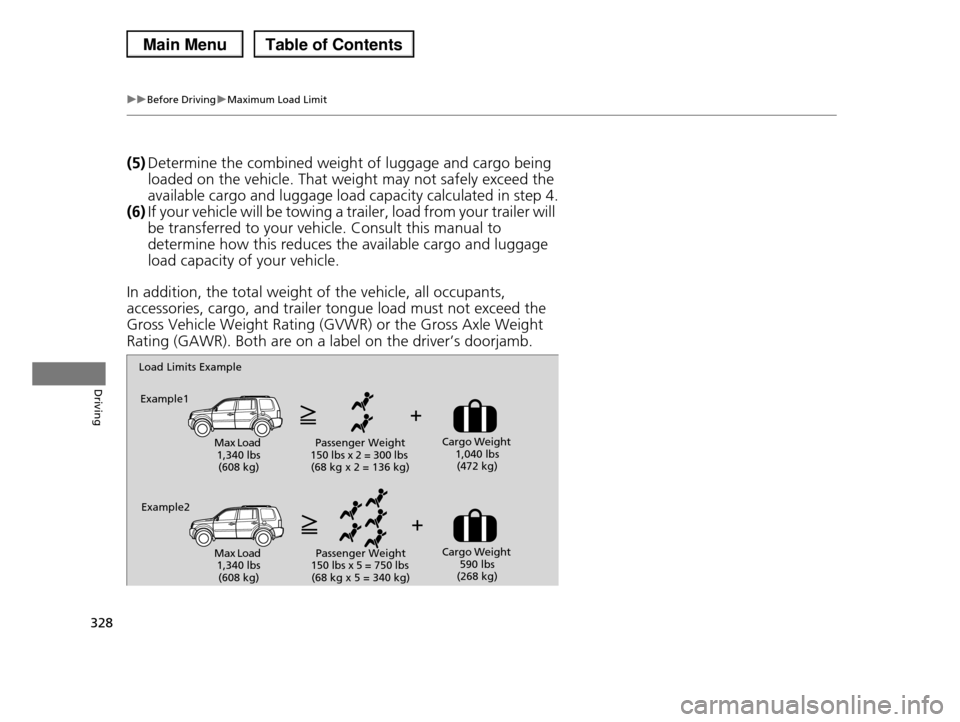
uuBefore DrivinguMaximum Load Limit
Driving
(5)Determine the combined weight of luggage and cargo being
loaded on the vehicle. That weight may not safely exceed the
available cargo and luggage load capacity calculated in step 4.
(6)If your vehicle will be towing a trailer, load from your trailer will
be transferred to your vehicle. Consult this manual to
determine how this reduces the available cargo and luggage
load capacity of your vehicle.
In addition, the total weight of the vehicle, all occupants,
accessories, cargo, and trailer tongue load must not exceed the
Gross Vehicle Weight Rating (GVWR) or the Gross Axle Weight
Rating (GAWR). Both are on a label on the driver’s doorjamb.
Load Limits Example
Example1
Max Load 1,340 lbs (608 kg)
Passenger Weight 150 lbs x 2 = 300 lbs (68 kg x 2 = 136 kg)
Cargo Weight 1,040 lbs (472 kg)
Example2
Max Load 1,340 lbs (608 kg)
Passenger Weight 150 lbs x 5 = 750 lbs (68 kg x 5 = 340 kg)
Cargo Weight 590 lbs (268 kg)
Page 330 of 488
329Continued
Driving
Towing a Trailer
Towing Preparation
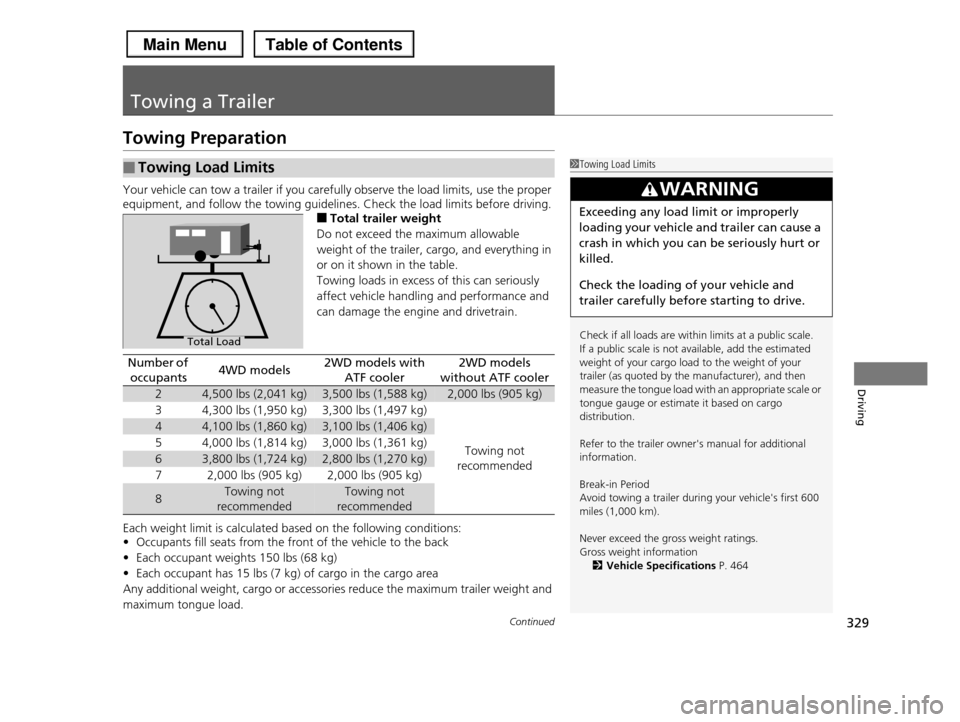
Your vehicle can tow a trailer if you carefully observe the load limits, use the proper
equipment, and follow the towing guidelines. Check the load limits before driving.
■Total trailer weight
Do not exceed the maximum allowable
weight of the trailer, cargo, and everything in
or on it shown in the table.
Towing loads in excess of this can seriously
affect vehicle handling and performance and
can damage the engine and drivetrain.
Each weight limit is calculated based on the following conditions:
•Occupants fill seats from the front of the vehicle to the back
•Each occupant weights 150 lbs (68 kg)
•Each occupant has 15 lbs (7 kg) of cargo in the cargo area
Any additional weight, cargo or accessories reduce the maximum trailer weight and
maximum tongue load.
■Towing Load Limits1Towing Load Limits
Check if all loads are within limits at a public scale.
If a public scale is not available, add the estimated
weight of your cargo load to the weight of your trailer (as quoted by the manufacturer), and then
measure the tongue load with an appropriate scale or
tongue gauge or estimate it based on cargo distribution.
Refer to the trailer owner's manual for additional information.
Break-in Period Avoid towing a trailer during your vehicle's first 600
miles (1,000 km).
Never exceed the gross weight ratings.
Gross weight information
2Vehicle Specifications P. 464
3WARNING
Exceeding any load limit or improperly
loading your vehicle and trailer can cause a
crash in which you can be seriously hurt or
killed.
Check the loading of your vehicle and
trailer carefully before starting to drive.
Total Load
Number of
occupants4WD models2WD models with
ATF cooler
2WD models
without ATF cooler
24,500 lbs (2,041 kg)3,500 lbs (1,588 kg)2,000 lbs (905 kg)
34,300 lbs (1,950 kg)3,300 lbs (1,497 kg)
Towing not
recommended
44,100 lbs (1,860 kg)3,100 lbs (1,406 kg)
54,000 lbs (1,814 kg)3,000 lbs (1,361 kg)
63,800 lbs (1,724 kg)2,800 lbs (1,270 kg)
72,000 lbs (905 kg)2,000 lbs (905 kg)
8Towing not
recommended
Towing not
recommended
Page 331 of 488
330
uuTowing a TraileruTowing Preparation
Driving
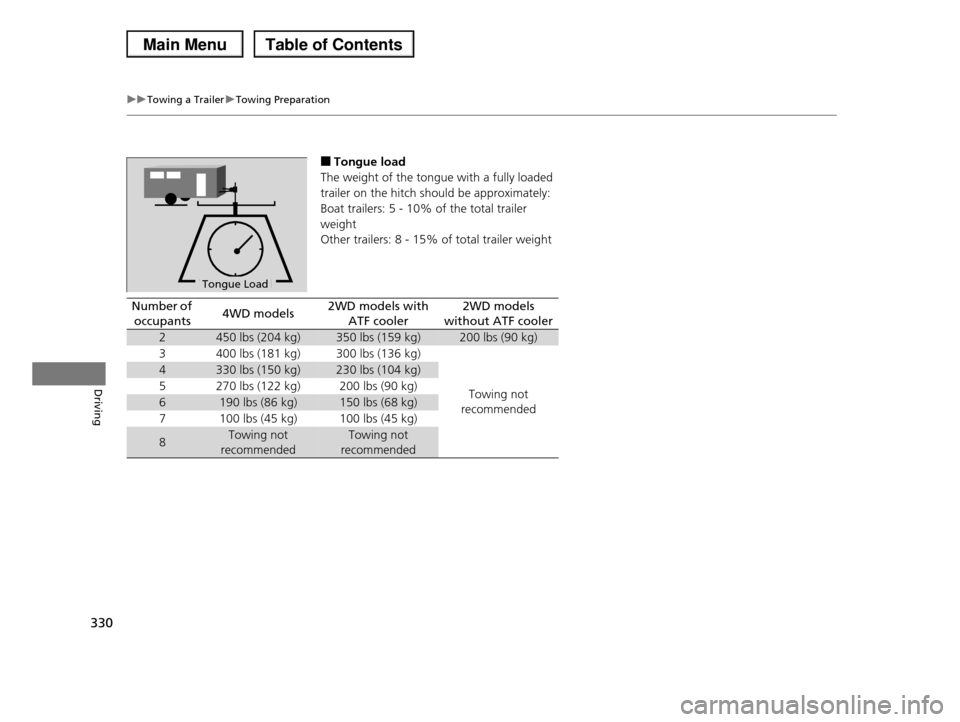
■Tongue load
The weight of the tongue with a fully loaded
trailer on the hitch should be approximately:
Boat trailers: 5 - 10% of the total trailer
weight
Other trailers: 8 - 15% of total trailer weight
To ngue LoadTongue Load
Number of
occupants4WD models2WD models with
ATF cooler
2WD models
without ATF cooler
2450 lbs (204 kg)350 lbs (159 kg)200 lbs (90 kg)
3400 lbs (181 kg)300 lbs (136 kg)
Towing not
recommended
4330 lbs (150 kg)230 lbs (104 kg)
5270 lbs (122 kg)200 lbs (90 kg)
6190 lbs (86 kg)150 lbs (68 kg)
7100 lbs (45 kg)100 lbs (45 kg)
8Towing not
recommended
Towing not
recommended
Page 333 of 488
uuTowing a TraileruTowing Preparation
332
Driving
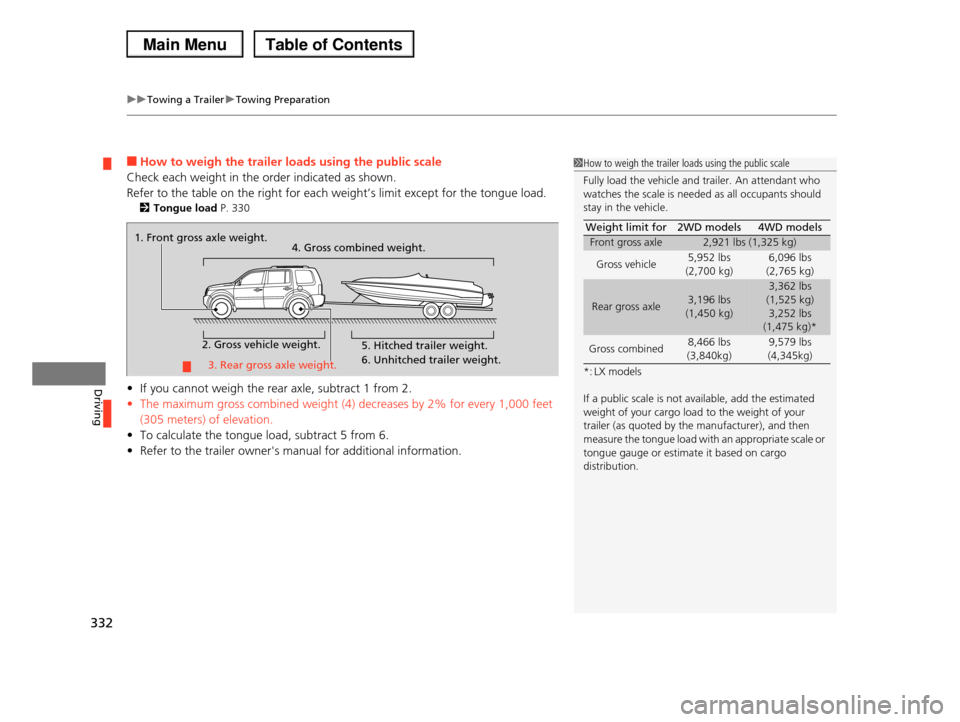
■How to weigh the trailer loads using the public scale
Check each weight in the order indicated as shown.
Refer to the table on the right for each weight’s limit except for the tongue load.
2Tongue load P. 330
•If you cannot weigh the rear axle, subtract 1 from 2.
•The maximum gross combined weight (4) decreases by 2% for every 1,000 feet
(305 meters) of elevation.
•To calculate the tongue load, subtract 5 from 6.
•Refer to the trailer owner's manual for additional information.
1How to weigh the trailer loads using the public scale
Fully load the vehicle and trailer. An attendant who watches the scale is needed as all occupants should
stay in the vehicle.
*: LX models
If a public scale is not available, add the estimated
weight of your cargo load to the weight of your
trailer (as quoted by the manufacturer), and then measure the tongue load with an appropriate scale or
tongue gauge or estimate it based on cargo
distribution.
Weight limit for 2WD models 4WD models
Front gross axle2,921 lbs (1,325 kg)
Gross vehicle5,952 lbs
(2,700 kg)
6,096 lbs
(2,765 kg)
Rear gross axle3,196 lbs
(1,450 kg)
3,362 lbs
(1,525 kg)
3,252 lbs (1,475 kg)*
Gross combined8,466 lbs
(3,840kg)
9,579 lbs
(4,345kg)
1. Front gross axle weight.
2. Gross vehicle weight.
4. Gross combined weight.
3. Rear gross axle weight.
5. Hitched trailer weight.
6. Unhitched trailer weight.
Page 335 of 488
uuTowing a TraileruTowing Preparation
334
Driving
■Trailer brakes
Recommended for any trailer with a total weight of 1,000 lbs (450 kg) or more:
There are two common types of trailer brakes: surge and electric. Surge brakes are
common for boat trailers, since the brakes will get wet.
If you choose electric brakes, be sure they are electronically actuated. Do not
attempt to attach trailer brakes to your vehicle's hydraulic system, as it will lower
braking effectiveness and create a potential hazard.
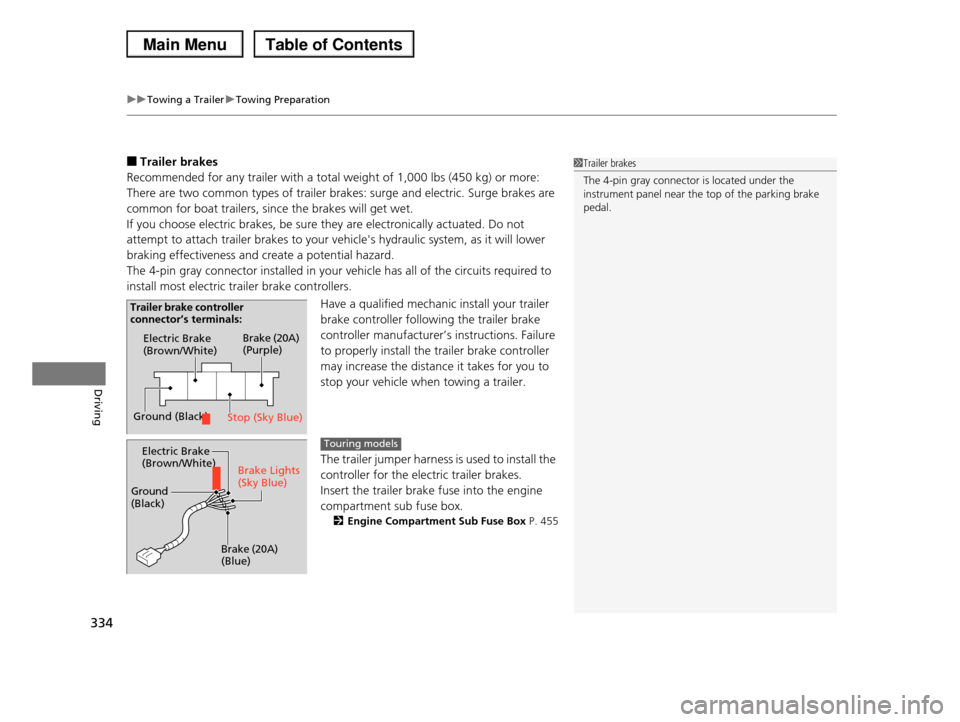
The 4-pin gray connector installed in your vehicle has all of the circuits required to
install most electric trailer brake controllers.
Have a qualified mechanic install your trailer
brake controller following the trailer brake
controller manufacturer’s instructions. Failure
to properly install the trailer brake controller
may increase the distance it takes for you to
stop your vehicle when towing a trailer.
The trailer jumper harness is used to install the
controller for the electric trailer brakes.
Insert the trailer brake fuse into the engine
compartment sub fuse box.
2Engine Compartment Sub Fuse Box P. 455
1Trailer brakes
The 4-pin gray connector is located under the instrument panel near the top of the parking brake
pedal.
Electric Brake (Brown/White)
Ground (Black)
Brake (20A) (Purple)
Stop (Sky Blue)
Trailer brake controller connector’s terminals:
Electric Brake (Brown/White)
Ground (Black)
Brake (20A) (Blue)
Brake Lights (Sky Blue)
Touring models
Page 337 of 488
336
uuTowing a TraileruTowing Preparation
Driving
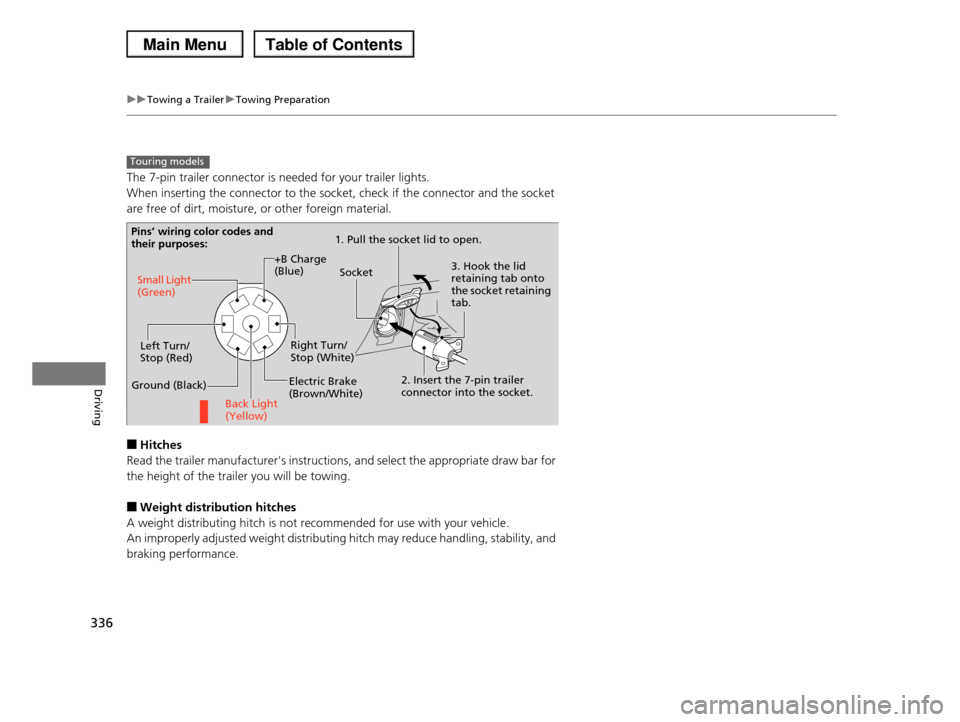
The 7-pin trailer connector is needed for your trailer lights.
When inserting the connector to the socket, check if the connector and the socket
are free of dirt, moisture, or other foreign material.
■Hitches
Read the trailer manufacturer's instructions, and select the appropriate draw bar for
the height of the trailer you will be towing.
■Weight distribution hitches
A weight distributing hitch is not recommended for use with your vehicle.
An improperly adjusted weight distributing hitch may reduce handling, stability, and
braking performance.
Touring models
Pins’ wiring color codes and their purposes:1. Pull the socket lid to open.
3. Hook the lid retaining tab onto the socket retaining tab.
2. Insert the 7-pin trailer connector into the socket.
Socket
Back Light (Yellow)
Left Turn/Stop (Red)
Electric Brake (Brown/White)
Right Turn/Stop (White)
Ground (Black)
Small Light (Green)
+B Charge (Blue)