fuel HONDA PRELUDE 1990 User Guide
[x] Cancel search | Manufacturer: HONDA, Model Year: 1990, Model line: PRELUDE, Model: HONDA PRELUDE 1990Pages: 143, PDF Size: 2.07 MB
Page 77 of 143

Check the following items at each fuel stop:
1. Engine oil level.
2. Radiator coolant level.
Check the following items periodically: 1. Brakes: for braking efficiency, brake pedal travel and hydraulic fluid level.
2. Lights: for operation of headlights, taillights, side marker lights, stoplights, turn signals and back-up lights.
3. Tires: for correct pressures (including spare); inspect for cuts and uneven or excessive wear. Rotate every 7,500 miles (12,000 km)
in the pattern shown on page 107.
4. Steering: for excessive play or vibration while driving. 5. Exhaust system: for leaks or loose mounts.
6. Wipers: for operation of windshield wipers and washer, and condition of wiper blades.
7. Seat belts: for condition of fabric and buckles, and operation of the restraint mechanism.
8. Battery condition.
(cont'd)ProCarManuals.comMain Menu t s
Page 78 of 143
Maintenance Schedule and Records (cont'd)
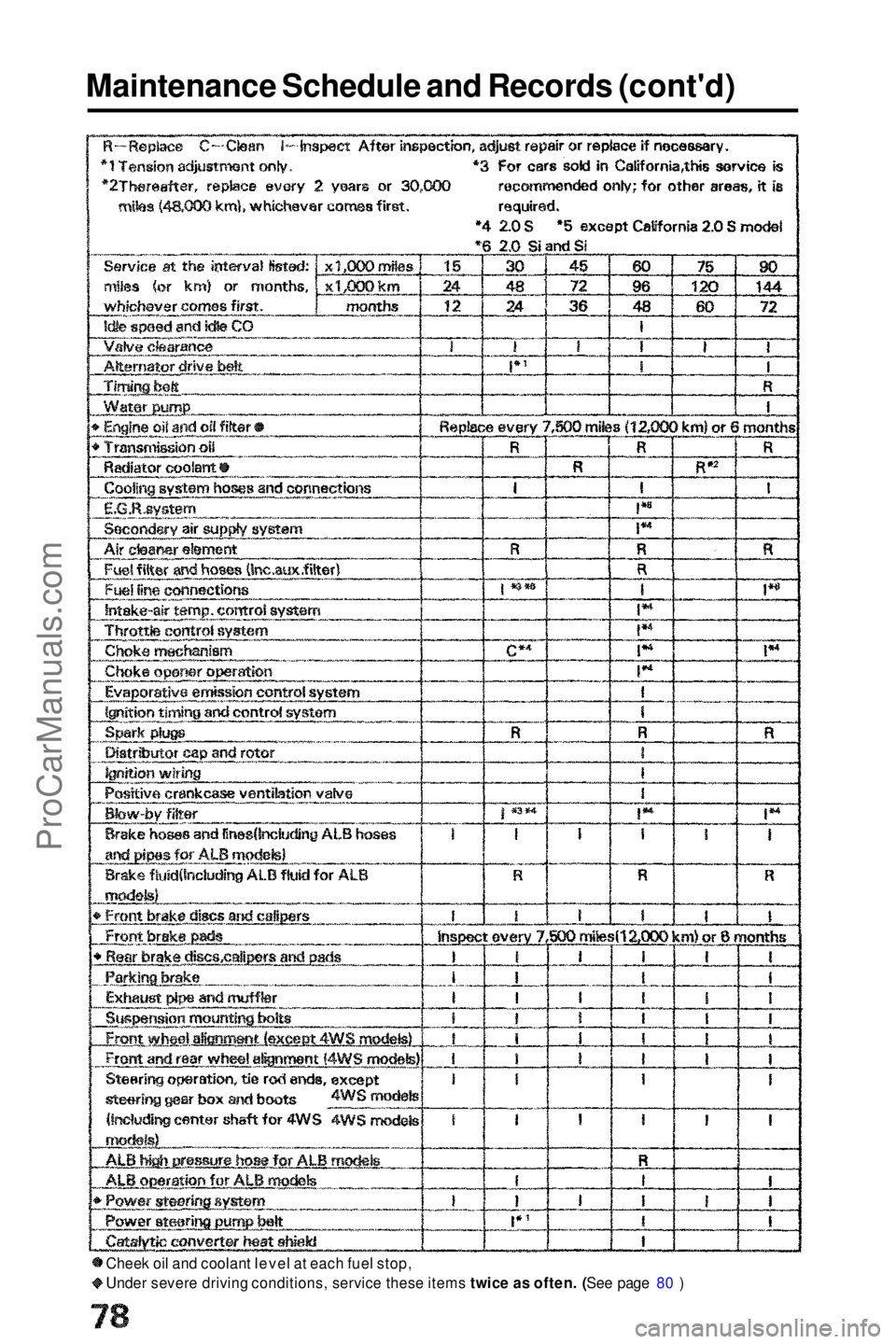
Cheek oil and coolant level at each fuel stop,
Under severe driving conditions, service these items twice as often. (See page 80 )ProCarManuals.comMain Menu t s
Page 83 of 143
Engine Oil and Filter
Checking
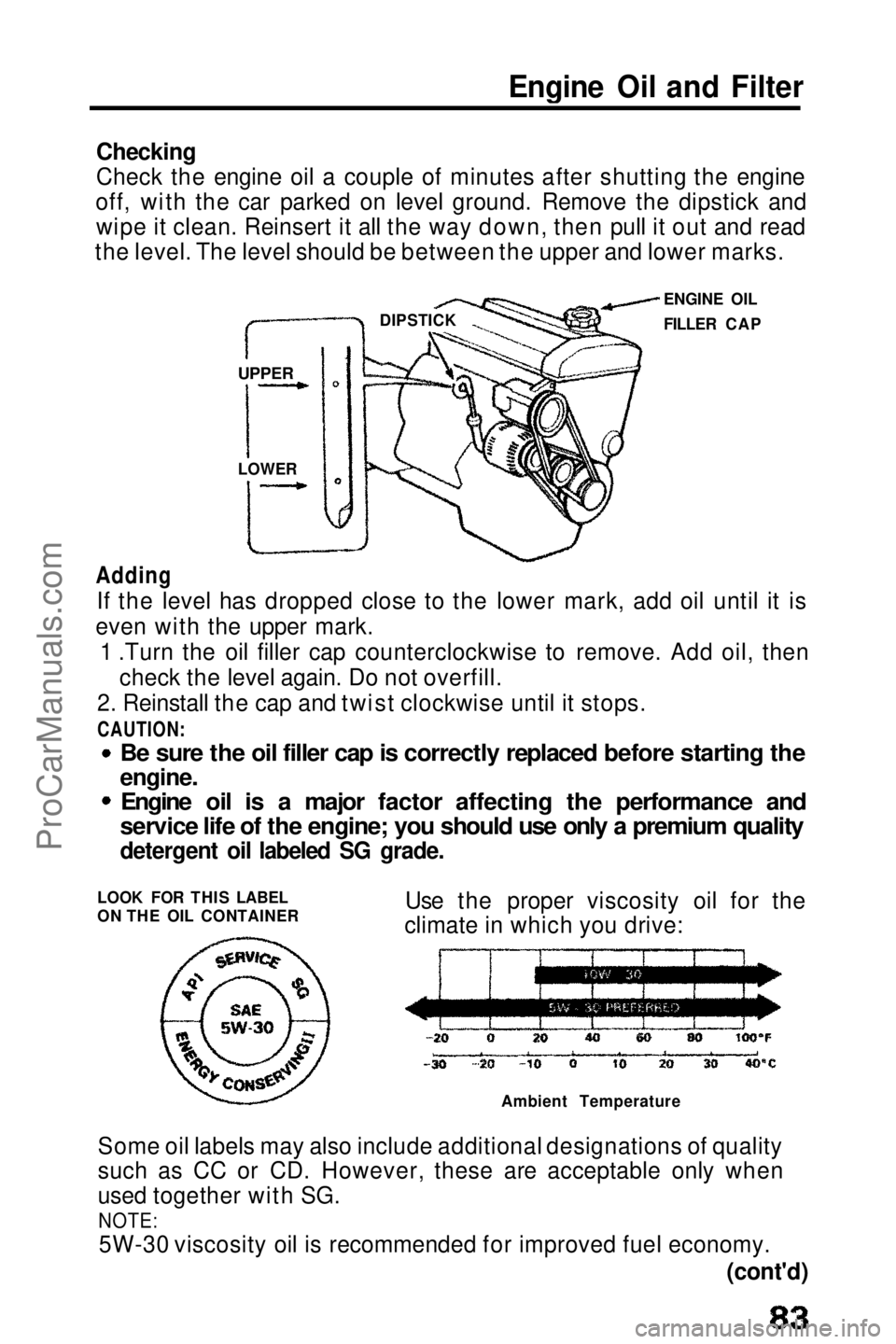
Check the engine oil a couple of minutes after shutting the engine
off, with the car parked on level ground. Remove the dipstick and wipe it clean. Reinsert it all the way down, then pull it out and read
the level. The level should be between the upper and lower marks.
ENGINE OIL
FILLER CAP
Adding
If the level has dropped close to the lower mark, add oil until it is
even with the upper mark. 1 .Turn the oil filler cap counterclockwise to remove. Add oil, then check the level again. Do not overfill.
2. Reinstall the cap and twist clockwise until it stops.
CAUTION:
Be sure the oil filler cap is correctly replaced before starting the
engine.
Engine oil is a major factor affecting the performance and
service life of the engine; you should use only a premium quality
detergent oil labeled SG grade.
LOOK FOR THIS LABEL
ON THE OIL CONTAINER
Use the proper viscosity oil for the
climate in which you drive:
Some oil labels may also include additional designations of quality
such as CC or CD. However, these are acceptable only when
used together with SG.
NOTE:
5W-30 viscosity
oil is recommended for improved fuel economy.
(cont'd)
Ambient Temperature
UPPER
LOWER
DIPSTICKProCarManuals.comMain Menu t s
Page 84 of 143
Engine Oil and Filter (cont'd)
Fuel Efficient Oil
For the best fuel economy from your car, it is recommended that
you use a fuel efficient SG oil. This oil is usually identified by the words such as: "Energy Conserving II," "Gas Saving," and "Fuel
Saving," etc.
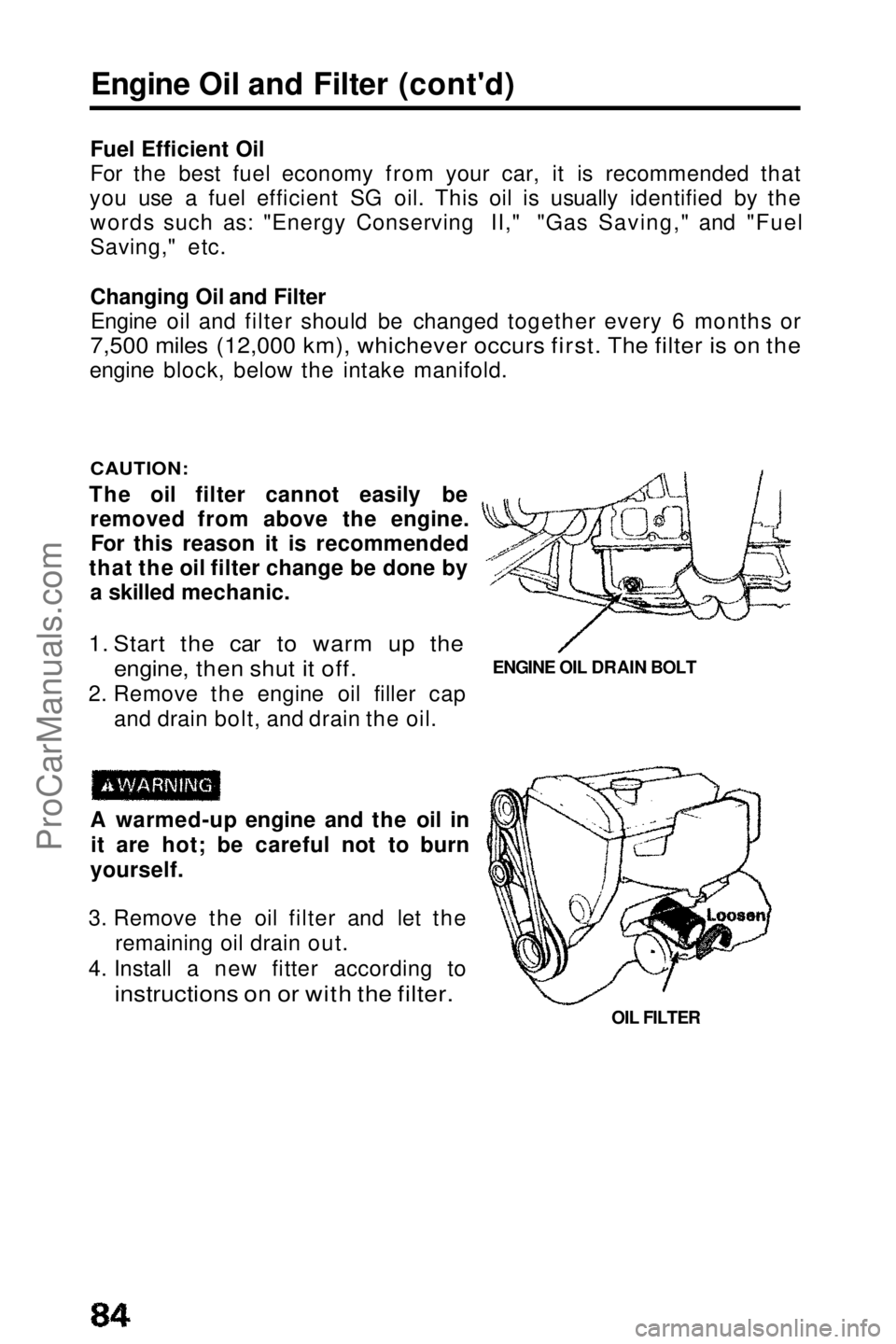
Changing Oil and FilterEngine oil and filter should be changed together every 6 months or
7,500 miles (12,000 km), whichever occurs first. The filter is on the
engine block, below the intake manifold.
CAUTION:
The oil filter cannot easily be removed from above the engine.For this reason it is recommended
that the oil filter change be done by a skilled mechanic.
1. Start the car to warm up the
engine, then shut it off.
2. Remove the engine oil filler cap and drain bolt, and drain the oil. ENGINE OIL DRAIN BOLT
A warmed-up engine and the oil in it are hot; be careful not to burn
yourself.
3. Remove the oil filter and let the remaining oil drain out.
4. Install a new fitter according to
instructions on or with the filter.
OIL FILTERProCarManuals.comMain Menu t s
Page 96 of 143
Fuel Filters/Clutch Fluid
Fuel Filters
(2.0 S)
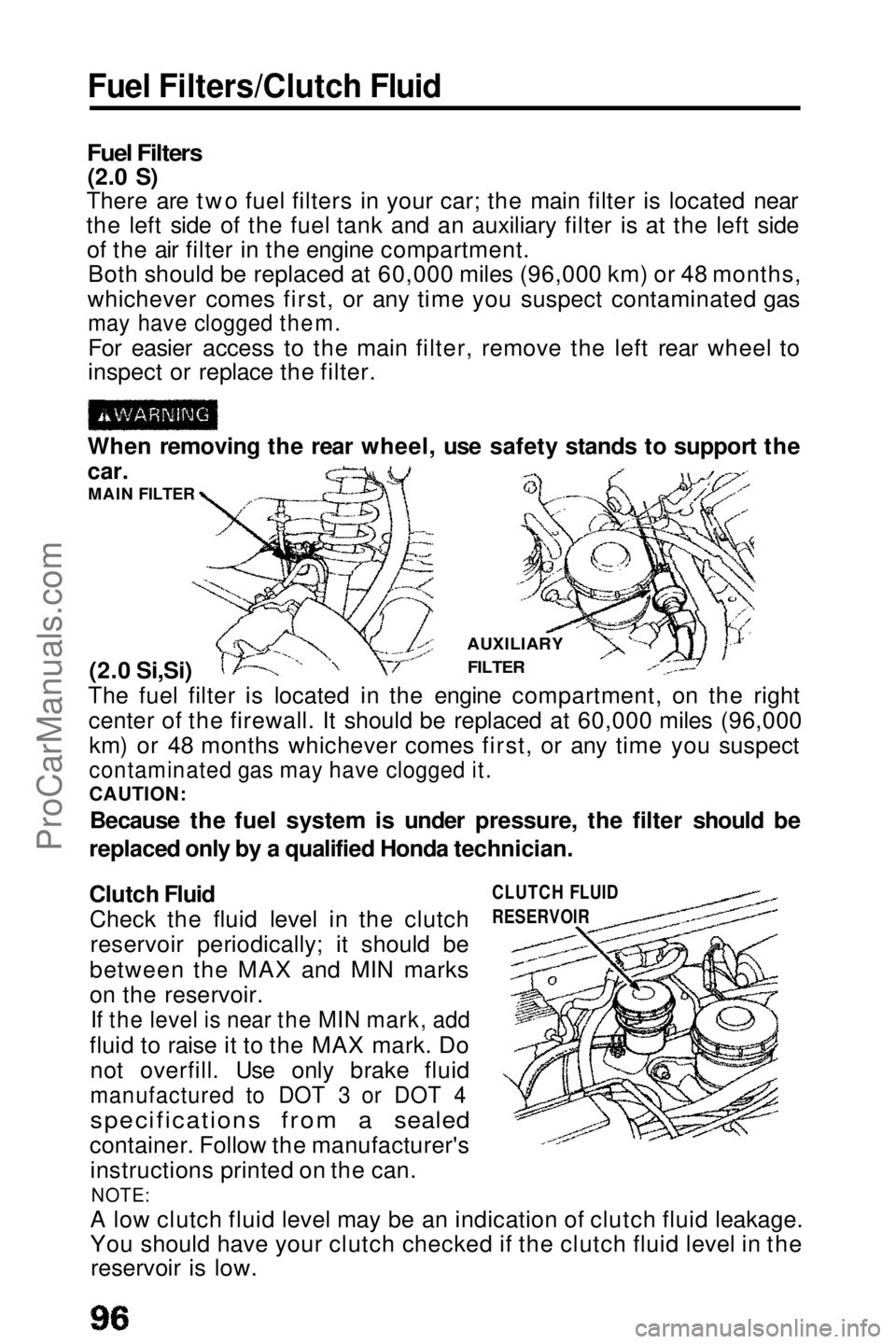
There are two fuel filters in your car; the main filter is located near
the left side of the fuel tank and an auxiliary filter is at the left side
of the air filter in the engine compartment. Both should be replaced at 60,000 miles (96,000 km) or 48 months,
whichever comes first, or any time you suspect contaminated gas
may have clogged them.
For easier access to the main filter, remove the left rear wheel to
inspect or replace the filter.
The fuel filter is located in the engine compartment, on the right
center of the firewall. It should be replaced at 60,000 miles (96,000km) or 48 months whichever comes first, or any time you suspect
contaminated gas may have clogged it.
CAUTION:
Because the fuel system is under pressure, the filter should be
replaced only by a qualified Honda technician.
CLUTCH FLUID
RESERVOIR
Clutch Fluid
Check the fluid level in the clutchreservoir periodically; it should be
between the MAX and MIN marks
on the reservoir.
If the level is near the MIN mark, add
fluid to raise it to the MAX mark. Do not overfill. Use only brake fluid
manufactured to DOT 3 or DOT 4
specifications from a sealed
container. Follow the manufacturer's instructions printed on the can.
NOTE:
A low clutch fluid level may be an indication of clutch fluid leakage.
You should have your clutch checked if the clutch fluid level in the reservoir is low.
When removing the rear wheel, use safety stands to support the
car.
AUXILIARYFILTER
(2.0 Si,Si)
MAIN FILTERProCarManuals.comMain Menu t s
Page 130 of 143

Emission Controls
Sources of Emissions
The combustion process produces carbon monoxide, oxides of nitrogen and hydrocarbons. The evaporation of fuel in the fuel tank
also produces hydrocarbons. Control of oxides of nitrogen and
hydrocarbons is very important since, under certain conditions,
when subjected to sunlight, they react to form photochemical smog. Carbon monoxide does not react to form smog, but it is toxic.
Honda Motor Co., Ltd. has developed a number of systems which
are highly effective in reducing carbon monoxide, oxides of nitrogen
and hydrocarbons.
The Clean Air Act
The Clean Air Act requires all vehicle manufacturers to explain in writing, the operation and maintenance of their emission control
systems.
Maintenance instructions are included on pages 76—81 ; the
operation of each system is explained on the following.
Replacement Parts
The emission control systems on your new Honda were designed, built and certified to conform with the Federal regulations
implementing the Clean Air Act. Honda recommends only the use of
new, genuine Honda parts or their equivalent. The use of other
replacement parts which are not of equivalent quality may impair
the effectiveness of your car's emission control systems.
Crankcase Emission Control System
To prevent crankcase emissions, your car is equipped with a Positive Crankcase Ventilation (PCV) System which routes blowby
gases from the crankcase, through the PCV valve and intake manifold, into the combustion chamber.ProCarManuals.comMain Menu t s
Page 131 of 143

Evaporative Emission Control System
The Evaporative Emission Control System is designed to prevent
fuel vapors from escaping into the atmosphere.
(2.0 Si,Si)
Fuel vapors from the fuel tank are directed into the charcoal
canister where they are adsorbed and stored while the engine is
stopped or idling. When the coolant temperature rises to a certain
value, the vapors are drawn into the engine through the throttle body and the intake manifold during normal engine operation.
(2.0 S)Fuel vapors from the fuel tank and carburetor are directed into the
charcoal canister where they are adsorbed and stored while the
engine is stopped.
When the engine is running and engine coolant temperature is above
the set temperature of the thermo sensor, the purge control diaphragm valve is open so that fuel vapors in the charcoal canister may be drawn into the engine through the carburetor and the intake
manifold.
Engine Exhaust Controls
The engine exhaust emission control systems are designed to
control combustion during idle, acceleration, cruise, and deceleration.
These systems are entirely separate from the crankcase and evaporative emission control systems described previously. HONDA PGM-FI System (2.0 Si,Si)
The PGM-FI system consists of three independent sub-systems; Air intake, Electronic Control and Fuel Control, thus allowing moreaccurate control of air/fuel ratios under all operating conditions.
The Electronic Control Unit (ECU) detects the amount of air
drawn into the cylinders and determines the amount of fuel to be injected to provide the optimum air/fuel ratio for all engine needs.
(cont'd)ProCarManuals.comMain Menu t s
Page 132 of 143

Emission Controls (cont'd)
Intake Air Temperature Control System (2.0 S)The air control valve mounted inside the air cleaner snorkel
automatically opens and closes according to the intake air
temperature. The carburetor then receives air of constant
temperature which results in lower exhaust emissions.
Carburetor Controls (2.0 S)—Throttle controller — This system controls the throttle during
gear shifting, reducing the amount of HC caused by unburned
fuel mixture.
— Choke opener — When starting a cold engine, this device
opens the choke slightly. This reduces the amount of HC and
CO.
— Altitude Compensation devices — The Air Jet Controller (AJC)
has an atmospheric pressure sensing bellows. The AJC is
designed to control the amount of additional air fed to the
carburetor jets to maintain good driveability at any altitude. Ignition Timing Control System
This system automatically controls the ignition timing to reduce
the amount of HC and NOx.
Exhaust Gas Recirculation (EGR) [Except California 2.0 S models]
The EGR system is designed to control the formation of oxides of nitrogen (NOx) caused when fuel mixture burns at high
temperature. It works by recirculating exhaust gas through the EGR valve and intake manifold into the combustion chambers
where it reduces peak temperature by diluting the air/fuel mixture.
Catalytic Converter
The catalyst is used to convert hydrocarbons (HC), carbon monoxide (CO) and oxides of nitrogen (NOx) in the exhaust gas,
to carbon dioxide (CO 2
), dinitrogen (N 2
) and water vapor.
ProCarManuals.comMain Menu t s
Page 133 of 143

Air Supply System (2.0 S)
A secondary air supply system helps improve emission
performance by promoting more complete combustion during
deceleration.
Air injection with Feedback System (2.0 S)
This system maintains the proper air/fuel ratio for the most
efficient use of the three way catalytic converter by controlling
the amount of air injection in response to the oxygen concentration in the exhaust manifold.ProCarManuals.comMain Menu t s
Page 134 of 143
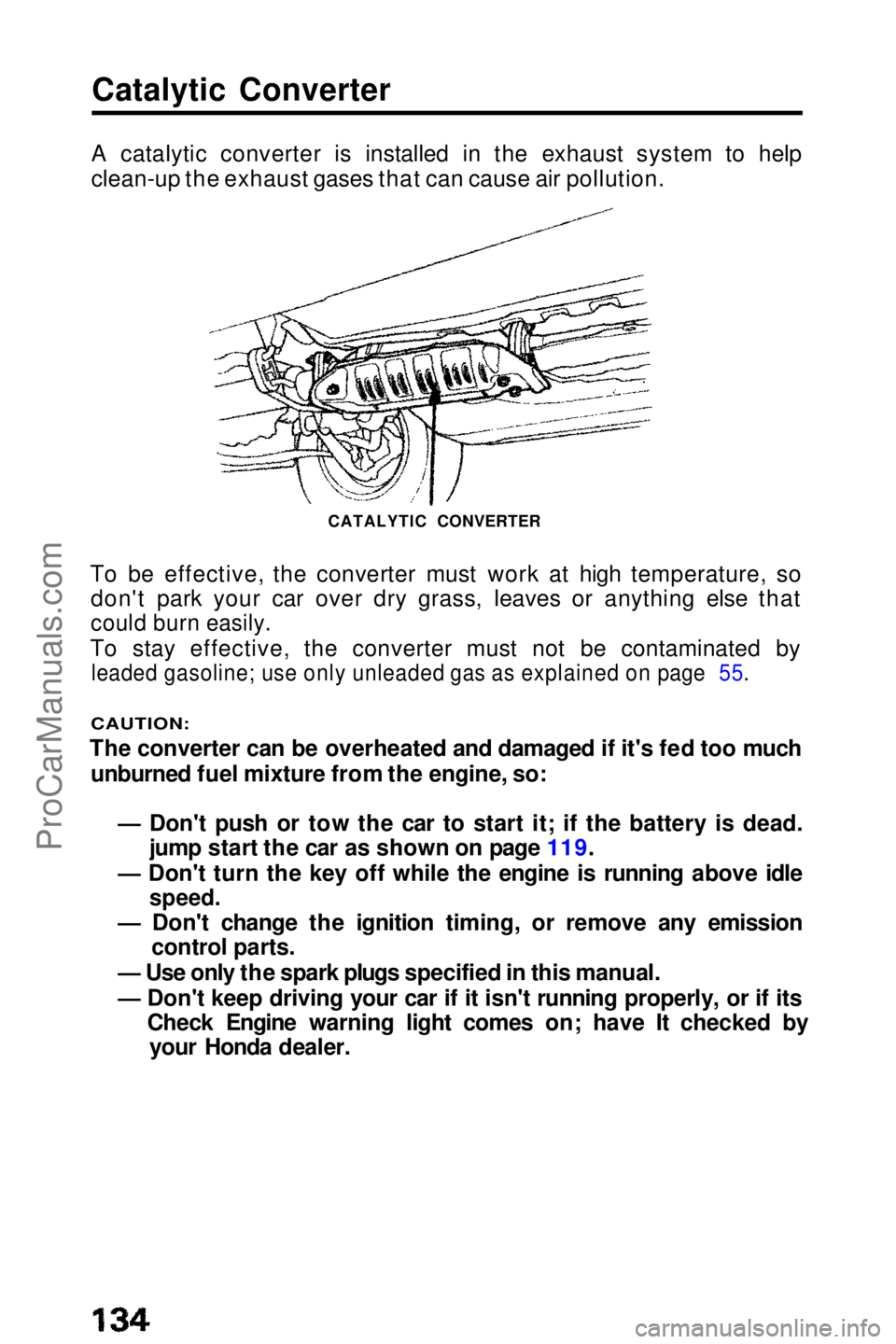
Catalytic Converter
A catalytic converter is installed in the exhaust system to help
clean-up the exhaust gases that can cause air pollution.
To be effective, the converter must work at high temperature, so don't park your car over dry grass, leaves or anything else that
could burn easily.
To stay effective, the converter must not be contaminated by
leaded gasoline; use only unleaded gas as explained on page 55.
CAUTION:
The converter can be overheated and damaged if it's fed too much unburned fuel mixture from the engine, so:
— Don't push or tow the car to start it; if the battery is dead. jump start the car as shown on page 119.
— Don't turn the key off while the engine is running above idle
speed.
— Don't change the ignition timing, or remove any emission control parts.
— Use only the spark plugs specified in this manual.
— Don't keep driving your car if it isn't running properly, or if its Check Engine warning light comes on; have It checked byyour Honda dealer. CATALYTIC CONVERTERProCarManuals.comMain Menu t s