brake light HONDA PRELUDE 1990 Owners Manual
[x] Cancel search | Manufacturer: HONDA, Model Year: 1990, Model line: PRELUDE, Model: HONDA PRELUDE 1990Pages: 143, PDF Size: 2.07 MB
Page 18 of 143
ALB (Anti Lock Brakes) help to maintain the road holding and
tractability of your car during severe braking, and under slippery road conditions. The ALB system prevents the wheels from locking(thus reducing the chance of skidding) to ensure controllable
deceleration. When sudden braking might otherwise lock one or more wheels, the ALB system temporarily reduces the braking
pressure to the wheel or wheels about to lock to ensure continued
braking efficiency.
When the ALB is regulating the braking pressure, the brake pedal pulsates slightly to make the driver aware that the system is
compensating for critical braking conditions. The pulsating brake pedal can be an indication of hazardous road condition, and to
remind you to take extra care.
Don't mix different diameter tires; it will confuse the ALB
computer which monitors the road speed of each wheel. For
example, if one or more tires are larger than the others, the computer will think they are rolling more slowly (as if they are
about to lock up) and reduce brake pressure to those wheels.On loose or uneven surfaces (gravel, ruts etc.) where all four
wheels loss traction intermittently, the ALB system may require
a longer stopping distance than an equivalent car with a conventional braking system.
The ALB system cannot make up for extreme road conditions or driver misjudgement, It is still the driver's responsibility to drive
at a suitable speed and provide a margin of safety for the road,
weather and traffic conditions at hand.
CAUTION:
Be careful not to damage the wiring or the speed sensors at the
back of each wheel when removing mud or snow from the wheel
housings.
NOTE:
You may hear a sound like a small motor running, coming from the engine while driving or after the ALB is applied. This indicates theALB pump is in service and the system is working properly.
Ant
i
Lock Brake (Si with ALB)
ProCarManuals.comMain Menu t s
Page 23 of 143
Charging System Warning Light
The charging system warning light comes on when there is a problem with the electrical charging system or when the ignition
switch is turned on with the engine not running. If the light comes
on while driving, stop the car and check to see if the alternator belt is loose or broken.
To check the belt tension, stop the engine and push with about 98N (22 Ib) of force on the middle of the belt as shown. The belt should
deflect about:
10
—
12 mm (0.4
—
0.5 in) If the engine has been running,
some engine components may
be hot enough to burn you. Keep hands away from the
radiator fan. The fan may start
automatically without warning
and run for up to 15 minutes,
even after the engine is turned
off.
NOTE:
If necessary, have the charging system checked by an authorized
Honda dealer.
Check Engine Warning Light
This light comes on for a couple of seconds each time the ignition is
turned on. It will also come on, and remain on, if there is a
malfunction in the emission control system. If the light comes on
while driving, avoid driving at high speed, and have the system checked by a Honda dealer as soon as possible.
Parking Brake/Brake Failure Warning Light
Check the brake warning light every time you start the car.
With the parking brake set, the warning light should go on when the
ignition switch is turned to II or III, With the parking brake released,
the light should go on when the ignition switch is turned to III. If the light goes on at any other time, it means the brake fluid level in the
master cylinder reservoir is too low ; add fluid and have your dealer
check for leaks and brake pad wear immediately. See page 99. BRAKE
(cont'd)ProCarManuals.comMain Menu t s
Page 24 of 143
Warning and indicator Lights (cont'd)
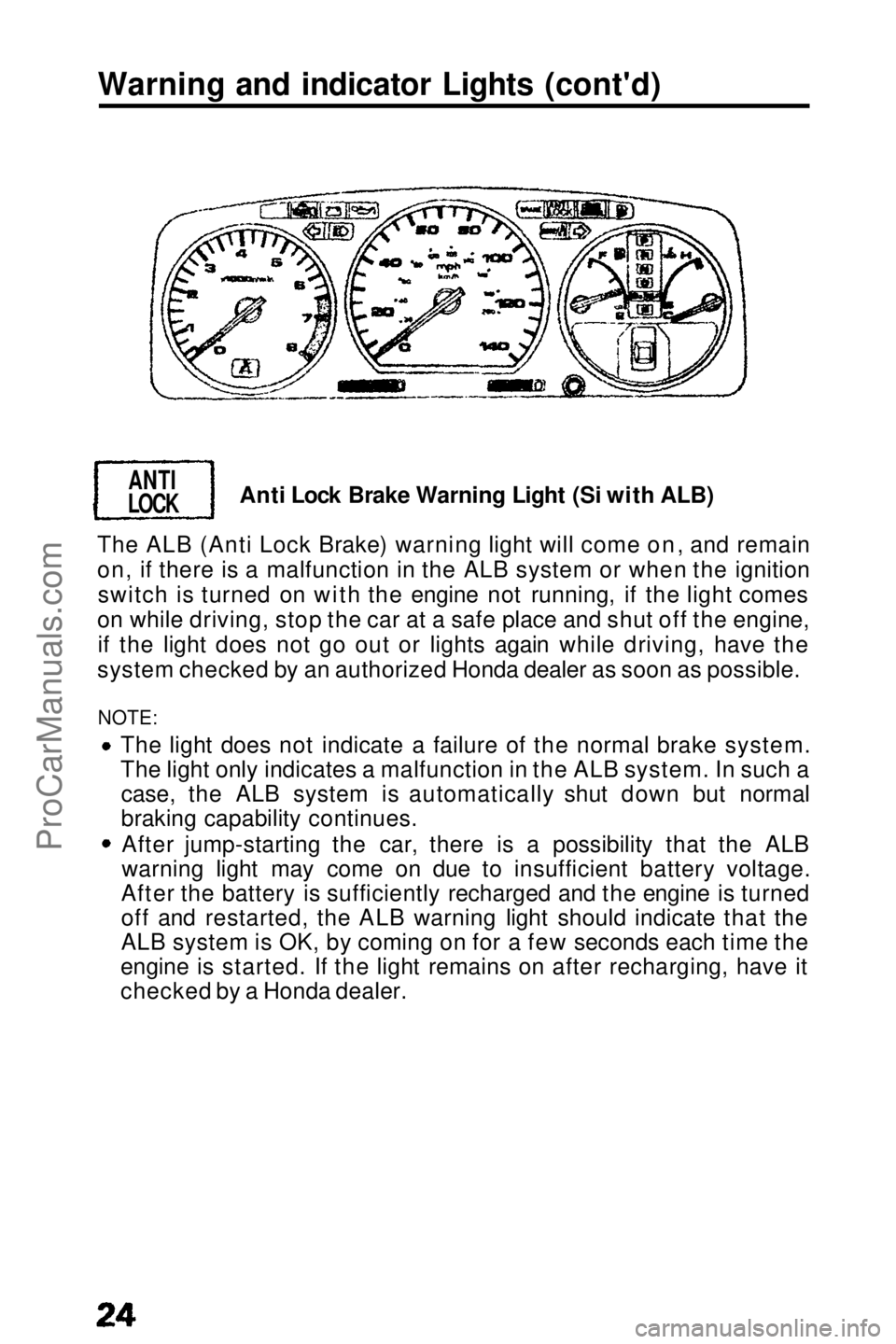
Anti Lock Brake Warning Light (Si with ALB)
The ALB (Anti Lock Brake) warning light will come on, and remain
on, if there is a malfunction in the ALB system or when the ignition switch is turned on with the engine not running, if the light comes
on while driving, stop the car at a safe place and shut off the engine, if the light does not go out or lights again while driving, have the
system checked by an authorized Honda dealer as soon as possible.
NOTE:
The light does not indicate a failure of the normal brake system.
The light only indicates a malfunction in the ALB system. In such acase, the ALB system is automatically shut down but normal
braking capability continues.
After jump-starting the car, there is a possibility that the ALB
warning light may come on due to insufficient battery voltage.
After the battery is sufficiently recharged and the engine is turned
off and restarted, the ALB warning light should indicate that the
ALB system is OK, by coming on for a few seconds each time the
engine is started. If the light remains on after recharging, have it
checked by a Honda dealer.
ANTI
LOCKProCarManuals.comMain Menu s t
Page 25 of 143
Safety Indicator Lights
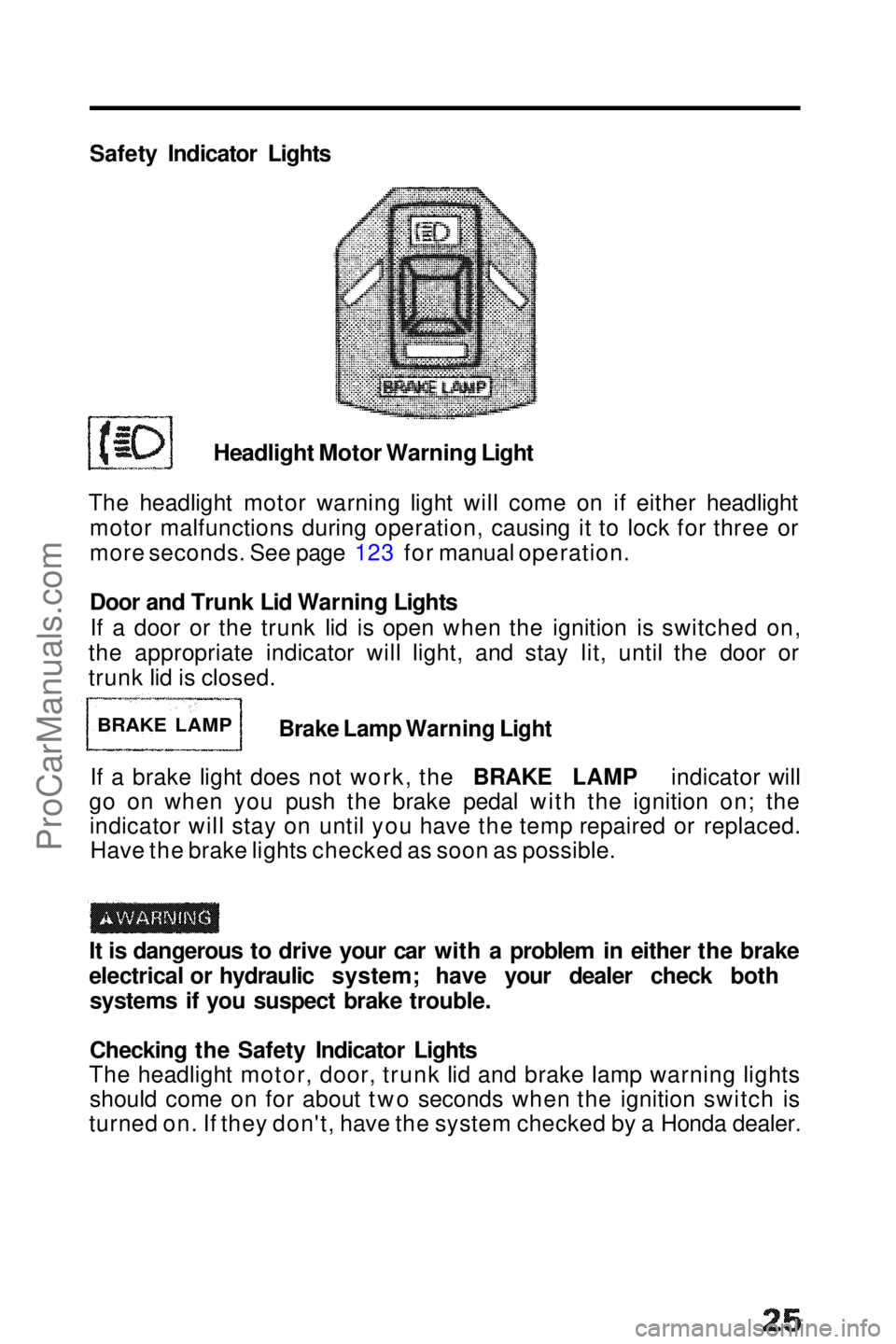
Headlight Motor Warning Light
The headlight motor warning light will come on if either headlight motor malfunctions during operation, causing it to lock for three or
more seconds. See page 123 for manual operation.
Door and Trunk Lid Warning Lights
If a door or the trunk lid is open when the ignition is switched on,
the appropriate indicator will light, and stay lit, until the door or
trunk lid is closed.
Brake Lamp Warning Light
If a brake light does not work, the BRAKE LAMP indicator will
go on when you push the brake pedal with the ignition on; the indicator will stay on until you have the temp repaired or replaced.Have the brake lights checked as soon as possible.
It is dangerous to drive your car with a problem in either the brake
electrical or hydraulic system; have your dealer check both systems if you suspect brake trouble.
Checking the Safety Indicator Lights
The headlight motor, door, trunk lid and brake lamp warning lights should come on for about two seconds when the ignition switch is
turned on. If they don't, have the system checked by a Honda dealer.
BRAKE LAMPProCarManuals.comMain Menu s t
Page 35 of 143
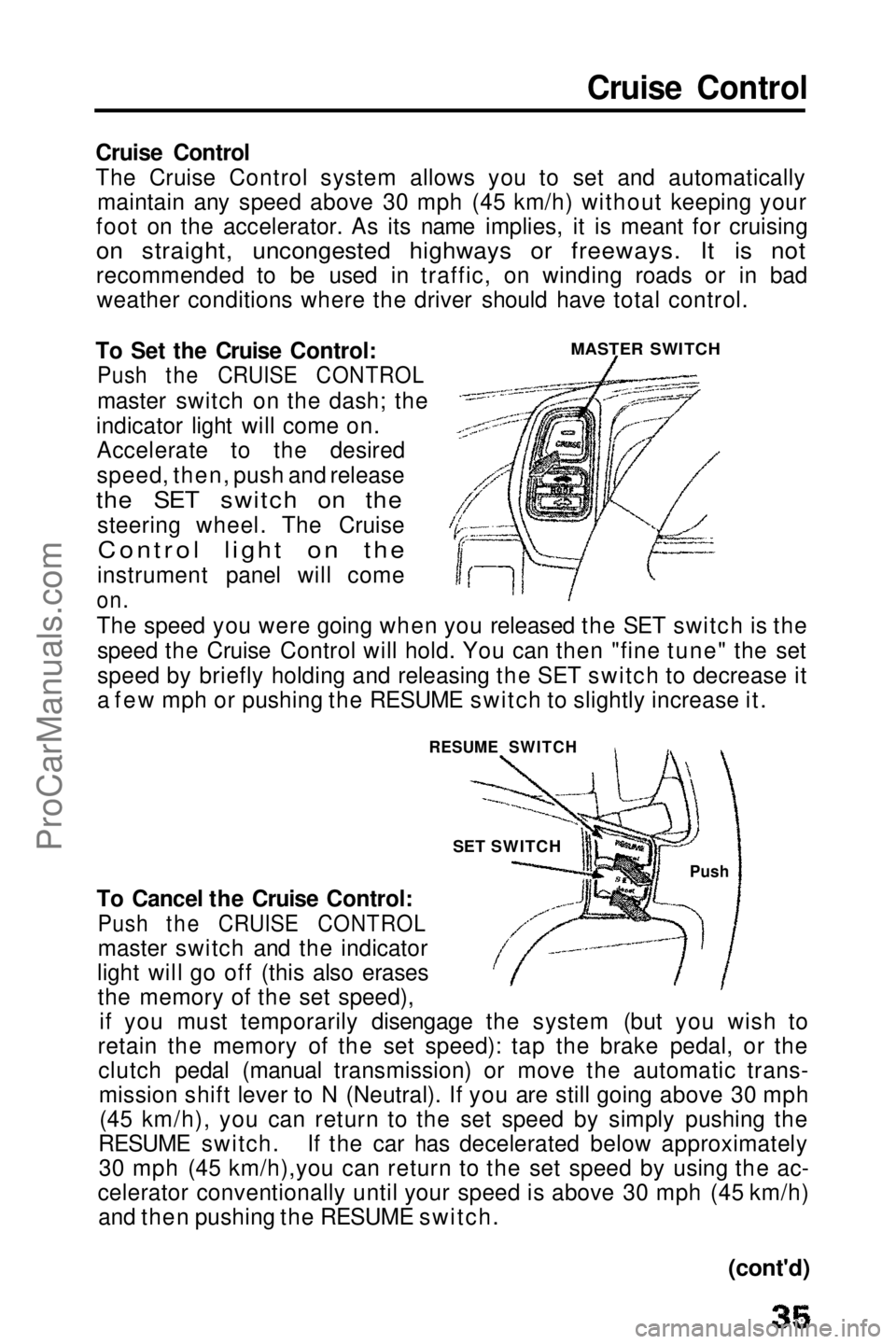
Cruise Control
Cruise Control
The Cruise Control system allows you to set and automatically maintain any speed above 30 mph (45 km/h) without keeping your
foot on the accelerator. As its name implies, it is meant for cruising
on straight, uncongested highways or freeways. It is not
recommended to be used in traffic, on winding roads or in bad weather conditions where the driver should have total control.
To Set the Cruise Control:
Push the CRUISE CONTROL
master switch on the dash; the
indicator light will come on. Accelerate to the desired
speed, then, push and release
the SET switch on the
steering wheel. The Cruise
Control light on the
instrument panel will come
on.
The speed you were going when you released the SET switch is the speed the Cruise Control will hold. You can then "fine tune" the set
speed by briefly holding and releasing the SET switch to decrease it
a few mph or pushing the RESUME switch to slightly increase it.
To Cancel the Cruise Control:
Push the CRUISE CONTROL
master switch and the indicator
light will go off (this also erases the memory of the set speed), if you must temporarily disengage the system (but you wish to
retain the memory of the set speed): tap the brake pedal, or the clutch pedal (manual transmission) or move the automatic trans-mission shift lever to N (Neutral). If you are still going above 30 mph(45 km/h), you can return to the set speed by simply pushing the
RESUME switch. If the car has decelerated below approximately 30 mph (45 km/h),you can return to the set speed by using the ac-
celerator conventionally until your speed is above 30 mph (45 km/h) and then pushing the RESUME switch.
MASTER SWITCH
RESUME SWITCH Push
SET SWITCH
(cont'd)ProCarManuals.comMain Menu t s
Page 36 of 143

Cruise Control (cont'd)
To Change the Set Speed: To a faster speed — For gradual acceleration with your foot off the
accelerator, push
and hold the RESUME switch until you reach the
desired speed; release the switch and the system's memory will be re-programmed to the new speed.
For faster acceleration, push the accelerator until you reach the
desired speed, then push and release the SET switch to re-program
the system.
To a slower speed — push and hold the SET switch and the car willcoast; when you reach the desired slower speed, release the switchand the system will be re-programmed.
For temporary acceleration above the set speed, such as for passing,
use the accelerator pedal conventionally. When you want to return
to the set speed, take your foot off the accelerator and coast without applying the brakes.
The Cruise Control automates the function of the accelerator pedal to maintain your car at a constant speed. This can be a
convenience on long trips, but it can also be a danger if there are many other cars on the road or if the road is unfamiliar. Pay strict
attention to the responsibility of driving whenever using the Cruise Control.
CAUTION:
Because the Cruise Control directly activates the accelerator pedal, don't rest your foot under the pedal when the Cruise
Control is on; it may pull the pedal down onto your foot.
NOTE:
With Cruise Control on, your speed will still vary slightly,particularly when going up or down hills.
Do not drive with your foot on the brake or clutch pedal (manual
transmission), as this will cause the Cruise Control to disengage.ProCarManuals.comMain Menu t s
Page 39 of 143
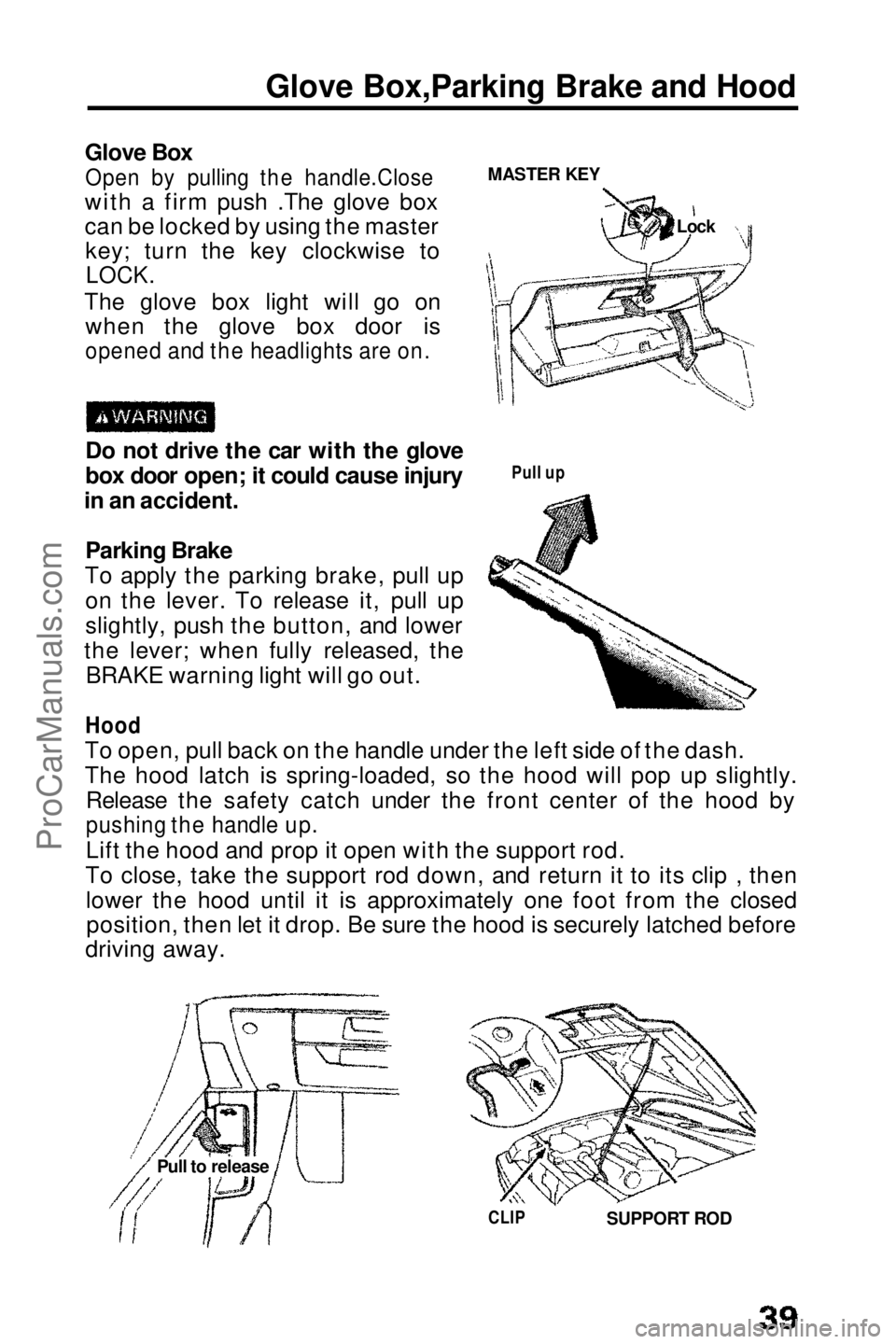
Glove Box,Parking Brake and Hood
Glove Box
Open by pulling the handle.Close
with a firm push .The glove box
can be locked by using the master key; turn the key clockwise to
LOCK.
The glove box light will go on when the glove box door is
opened and the headlights are on.
Do not drive the car with the glove
box door open; it could cause injury
in an accident.
Parking Brake
To apply the parking brake, pull up on the lever. To release it, pull up
slightly, push the button, and lower
the lever; when fully released, the BRAKE warning light will go out.
Hood
To open, pull back on the handle under the left side of the dash.
The hood latch is spring-loaded, so the hood will pop up slightly. Release the safety catch under the front center of the hood by
pushing the handle up.
Lift the hood and prop it open with the support rod.
To close, take the support rod down, and return it to its clip , then lower the hood until it is approximately one foot from the closedposition, then let it drop. Be sure the hood is securely latched before
driving away. MASTER KEY
Pull up
CLIP
SUPPORT ROD
Pull to release LockProCarManuals.comMain Menu t s
Page 53 of 143
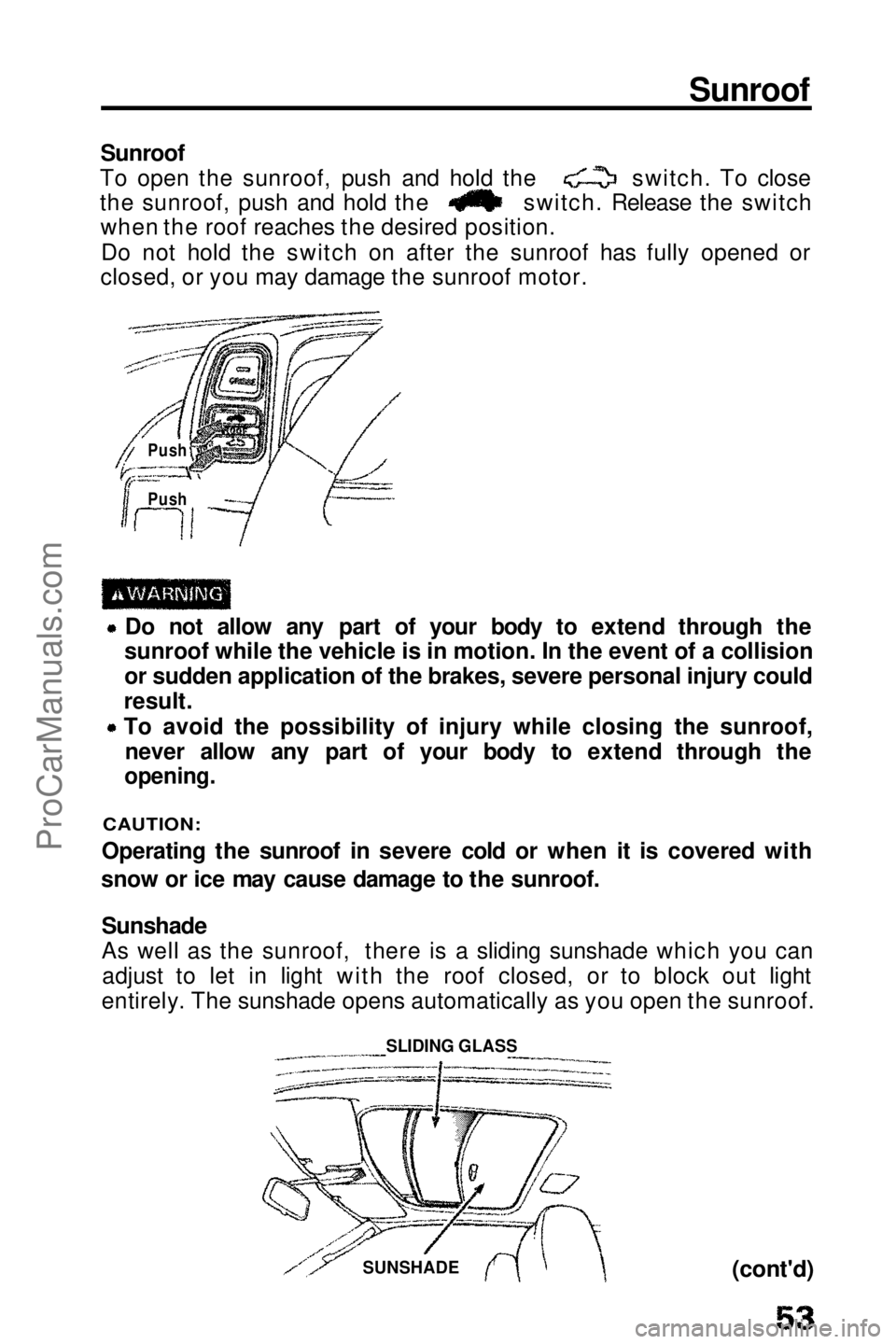
Sunroof
Sunroof
To open the sunroof, push and hold the switch. To close
the sunroof, push and hold the switch. Release the switch
when the roof reaches the desired position.
Do not hold the switch on after the sunroof has fully opened or
closed, or you may damage the sunroof motor. Do not allow any part of your body to extend through the
sunroof while the vehicle is in motion. In the event of a collision
or
sudden application of the brakes, severe personal injury could
result.
To avoid the possibility of injury while closing the sunroof,
never allow
any part of your body to extend through the
opening.
CAUTION:
Operating the sunroof in severe cold or when it is covered with
snow or ice may cause damage to the sunroof.
Sunshade
As well as the sunroof, there is a sliding sunshade which you canadjust to let in light with the roof closed, or to block out light
entirely. The sunshade opens automatically as you open the sunroof.
(cont'd)
Push
Push
SUNSHADE
SLIDING GLASSProCarManuals.comMain Menu t s
Page 61 of 143

Starting the Engine
Before Starting
Manual Transmission:
1 . Apply the parking brake.
2 . Push the clutch pedal all the way in (see NOTE below).
3 . Shift the transmission to neutral.
NOTE:
On cars equipped with manual transmissions, the engine will
not crank unless the clutch pedal is fully depressed.
Automatic Transmission: 1. Make sure the shift lever is in Park (P).
2. Apply the parking brake and the foot brake.
Starting a Cold Engine(2.0 S)
NOTE:
When starting in cold weather, keep all unnecessary electrical
circuits off (lights, defogger, etc.) for the best battery output.
1. Above 32°F(0°C) Push the accelerator to the floor 1 time and slowly release it.
Below 32°F(0°C)
Push the accelerator to the floor 2 or 3 times and slowly
release it.
Below 0°F(-18°C)
Push the accelerator to the floor 3 or 4 times and slowly
release it.
DO NOT pump while cranking.
2. With your foot OFF the accelerator, crank the engine until it starts and runs. (It may require more than 5 seconds of cranking.)
NOTE:
If the engine won't start, push the accelerator pedal down 1 more
time and slowly release it, then start the engine.Repeat once more if necessary,
If the engine still won't start, push the accelerator down about halfway; hold it there and crank the engine until it starts. Once the
engine starts, release the accelerator gradually as the enginewarms up.If the engine doesn't start within 15 seconds of cranking, turn the
key off
and wait 10 seconds before trying again.
3. If the outside temperature is below freezing, or if your car has not been driven for several days, warm up the engine for a few
minutes before driving.
(cont'd)ProCarManuals.comMain Menu t s
Page 63 of 143

Safety Items
Before driving away, check that: The doors are closed properly. The mirrors are properly adjusted, and the windows clean.
The driver and passengers are wearing properly adjusted seat
belts.
The head restraints are properly adjusted.
The warning and indicator lights are operating properly.
The brake pedal feels normal.
All luggage and cargo is secured.
Nothing is interfering with the driver's feet or blocking vision to
the rear.
While driving remember to: Always drive defensively; expect the unexpected. Reduce your speed during night hours and bad weather.
Follow at a safe distance; don't tailgate.
Get off the highway when you are tired; stop and take a rest.
When stopping for repairs: Park the car well off the road.
Turn on the hazard warning flasher. Use flares or other warning devices to warn other motorists.
After parking your car: Apply the parking brake and shift to first gear if equipped withmanual transmission, or PARK on automatic transmission
equipped cars.
Make sure the windows are closed and all doors are locked.
If parked on a hill:
Turn the front wheels away from the curb if facing uphill.
Turn the front wheels toward the curb if facing downhill. Never leave children unattended in a parked car.
Take your
keys.ProCarManuals.comMain Menu t s