check oil HONDA PRELUDE 1990 Owners Manual
[x] Cancel search | Manufacturer: HONDA, Model Year: 1990, Model line: PRELUDE, Model: HONDA PRELUDE 1990Pages: 143, PDF Size: 2.07 MB
Page 22 of 143
Warning and Indicator Lights (cont'd)
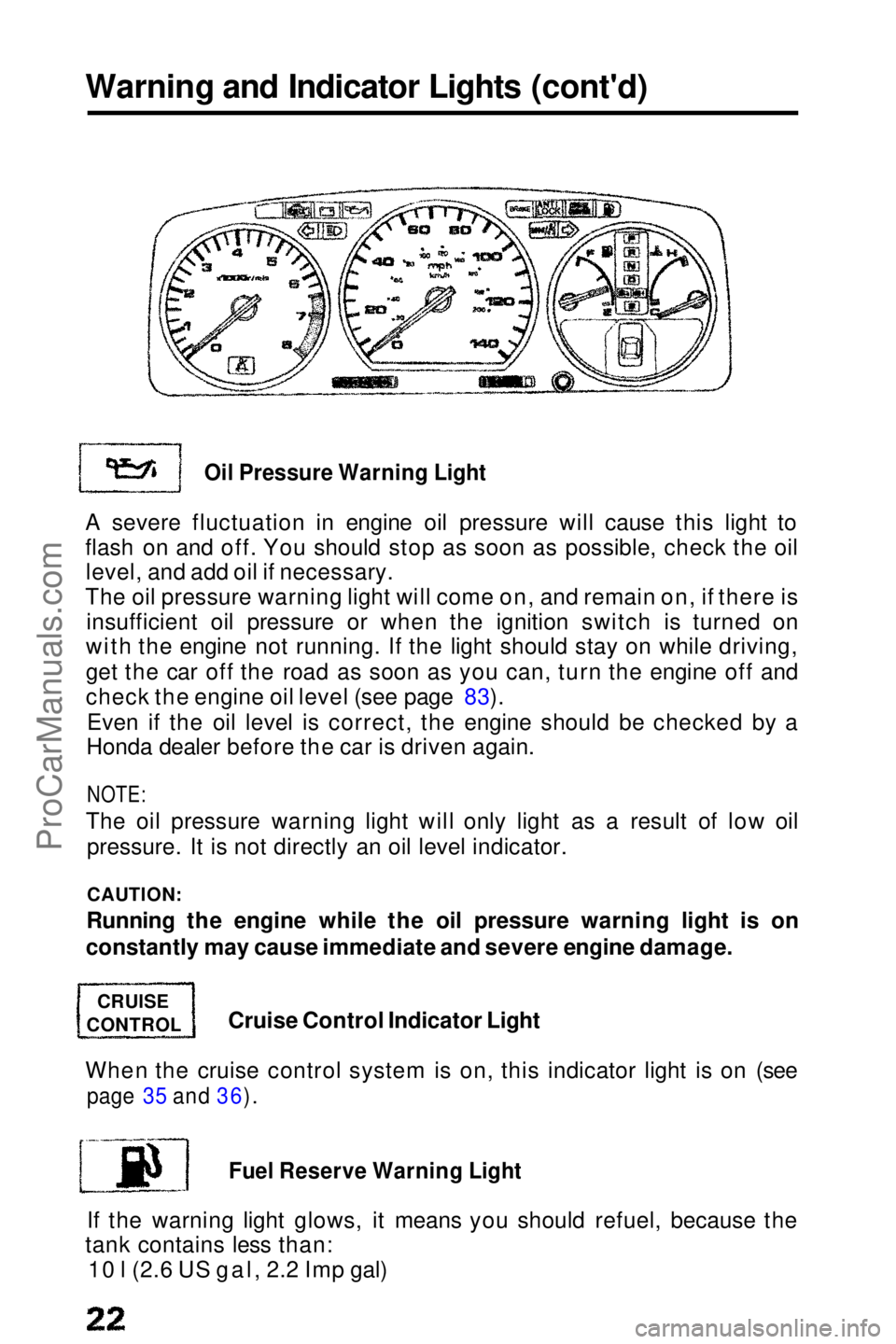
Oil Pressure Warning Light
A severe fluctuation in engine oil pressure will cause this light to
flash on and off. You should stop as soon as possible, check the oil level, and add oil if necessary.
The oil pressure warning light will come on, and remain on, if there is insufficient oil pressure or when the ignition switch is turned on
with the engine not running. If the light should stay on while driving,
get the car off the road as soon as you can, turn the engine off and
check the engine oil level (see page 83).
Even if the oil level is correct, the engine should be checked by a
Honda dealer before the car is driven again.
NOTE:
The oil pressure warning light will only light as a result of low oil pressure. It is not directly an oil level indicator.
CAUTION:
Running the engine while the oil pressure warning light is on
constantly may cause immediate and severe engine damage.
Cruise Control Indicator Light
When the cruise control system is on, this indicator light is on (see
page 35 and 36).
Fuel Reserve Warning Light
If the warning light glows, it means you should refuel, because the
tank contains less than:
10 l (2.6 US gal, 2.2 Imp gal) CRUISE
CONTROLProCarManuals.comMain Menu t s
Page 77 of 143

Check the following items at each fuel stop:
1. Engine oil level.
2. Radiator coolant level.
Check the following items periodically: 1. Brakes: for braking efficiency, brake pedal travel and hydraulic fluid level.
2. Lights: for operation of headlights, taillights, side marker lights, stoplights, turn signals and back-up lights.
3. Tires: for correct pressures (including spare); inspect for cuts and uneven or excessive wear. Rotate every 7,500 miles (12,000 km)
in the pattern shown on page 107.
4. Steering: for excessive play or vibration while driving. 5. Exhaust system: for leaks or loose mounts.
6. Wipers: for operation of windshield wipers and washer, and condition of wiper blades.
7. Seat belts: for condition of fabric and buckles, and operation of the restraint mechanism.
8. Battery condition.
(cont'd)ProCarManuals.comMain Menu t s
Page 83 of 143
Engine Oil and Filter
Checking
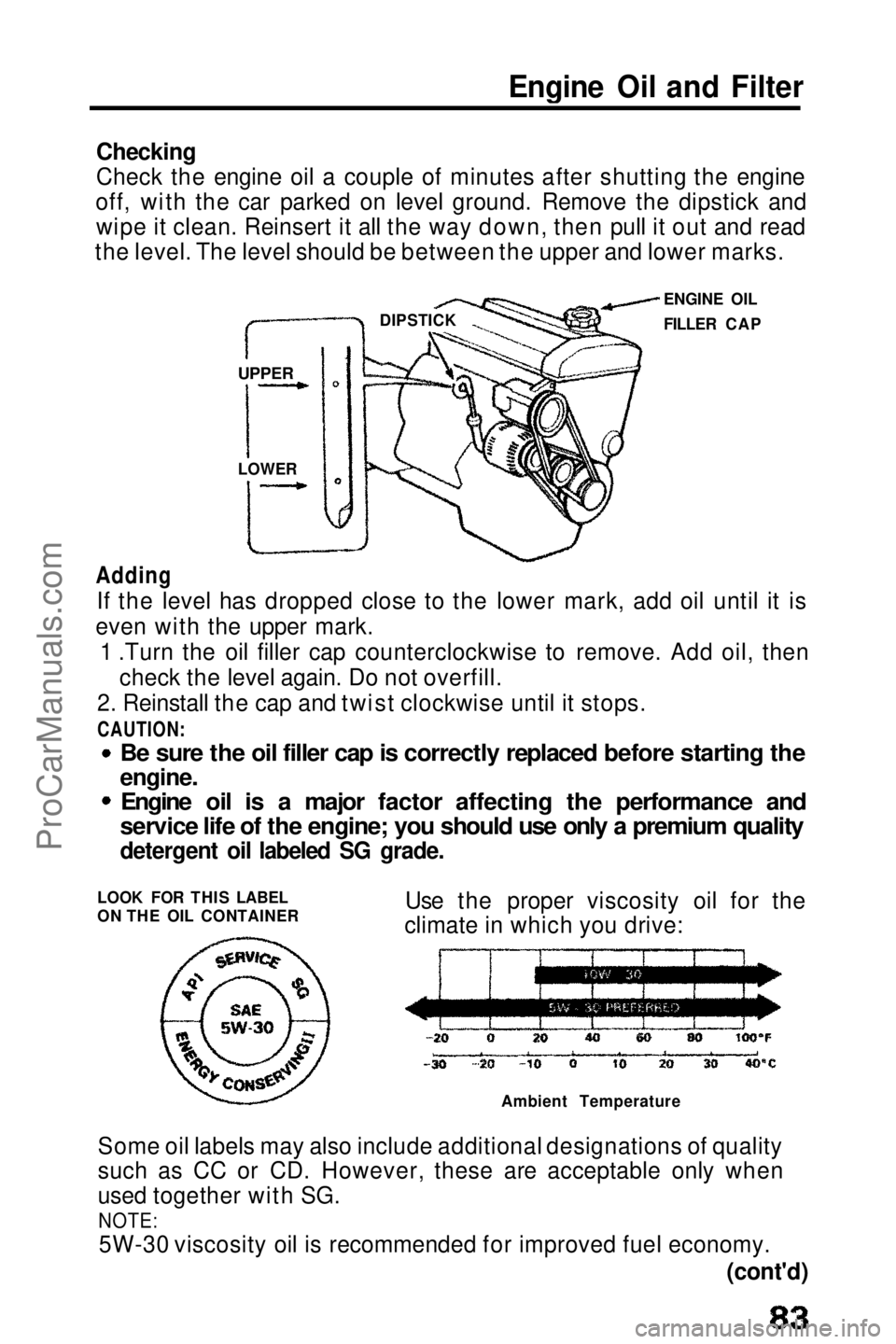
Check the engine oil a couple of minutes after shutting the engine
off, with the car parked on level ground. Remove the dipstick and wipe it clean. Reinsert it all the way down, then pull it out and read
the level. The level should be between the upper and lower marks.
ENGINE OIL
FILLER CAP
Adding
If the level has dropped close to the lower mark, add oil until it is
even with the upper mark. 1 .Turn the oil filler cap counterclockwise to remove. Add oil, then check the level again. Do not overfill.
2. Reinstall the cap and twist clockwise until it stops.
CAUTION:
Be sure the oil filler cap is correctly replaced before starting the
engine.
Engine oil is a major factor affecting the performance and
service life of the engine; you should use only a premium quality
detergent oil labeled SG grade.
LOOK FOR THIS LABEL
ON THE OIL CONTAINER
Use the proper viscosity oil for the
climate in which you drive:
Some oil labels may also include additional designations of quality
such as CC or CD. However, these are acceptable only when
used together with SG.
NOTE:
5W-30 viscosity
oil is recommended for improved fuel economy.
(cont'd)
Ambient Temperature
UPPER
LOWER
DIPSTICKProCarManuals.comMain Menu t s
Page 85 of 143

5. Reinstall the drain bolt with a new washer and tighten it securely.
Refill the engine with the recommended oil, to the upper mark on
the dipstick.
ENGINE OIL CHANGE CAPACITY (including filter):
3.8 l (4,0 US qt, 3.3 Imp qt)
6. Start the engine and make sure oil is not leaking from the drain
bolt or filter.
7. Shut off the engine and recheck the oil level.
NOTE:
Please dispose of used motor oil in a manner that is compatible with
the environment. We suggest you take it in a sealed container to
your local service station for reclamation. Do not throw it in the
trash or pour it on the ground.
CAUTION:
Used motor oil may cause skin cancer if repeatedly left in contact
with the skin for prolonged periods. Although this is unlikely unless you handle used oil on a daily basis, it is still advisable to
thoroughly wash your hands with soap and water as soon as possible after handing used oil.ProCarManuals.comMain Menu t s
Page 86 of 143
Transmission Oil/Fluid Check
Transmission oil/fluid must be checked with the engine off and the
car on level ground.
If the engine has been running, some engine components may
be hot enough to burn you. Keep hands away from the radiator fan. The fan may start
automatically without warning and run for up to 15 minutes,
even after the engine is turned off.
CAUTION:
If the oil/fluid level is low, check for possible leaks before adding
oil. Do not overfill.
Since the transmission and differential are in the same housing, you
are actually checking both oil/fluid levels in one procedure. Change
transmission oil/fluid according to the Maintenance Schedule on
page 78 .
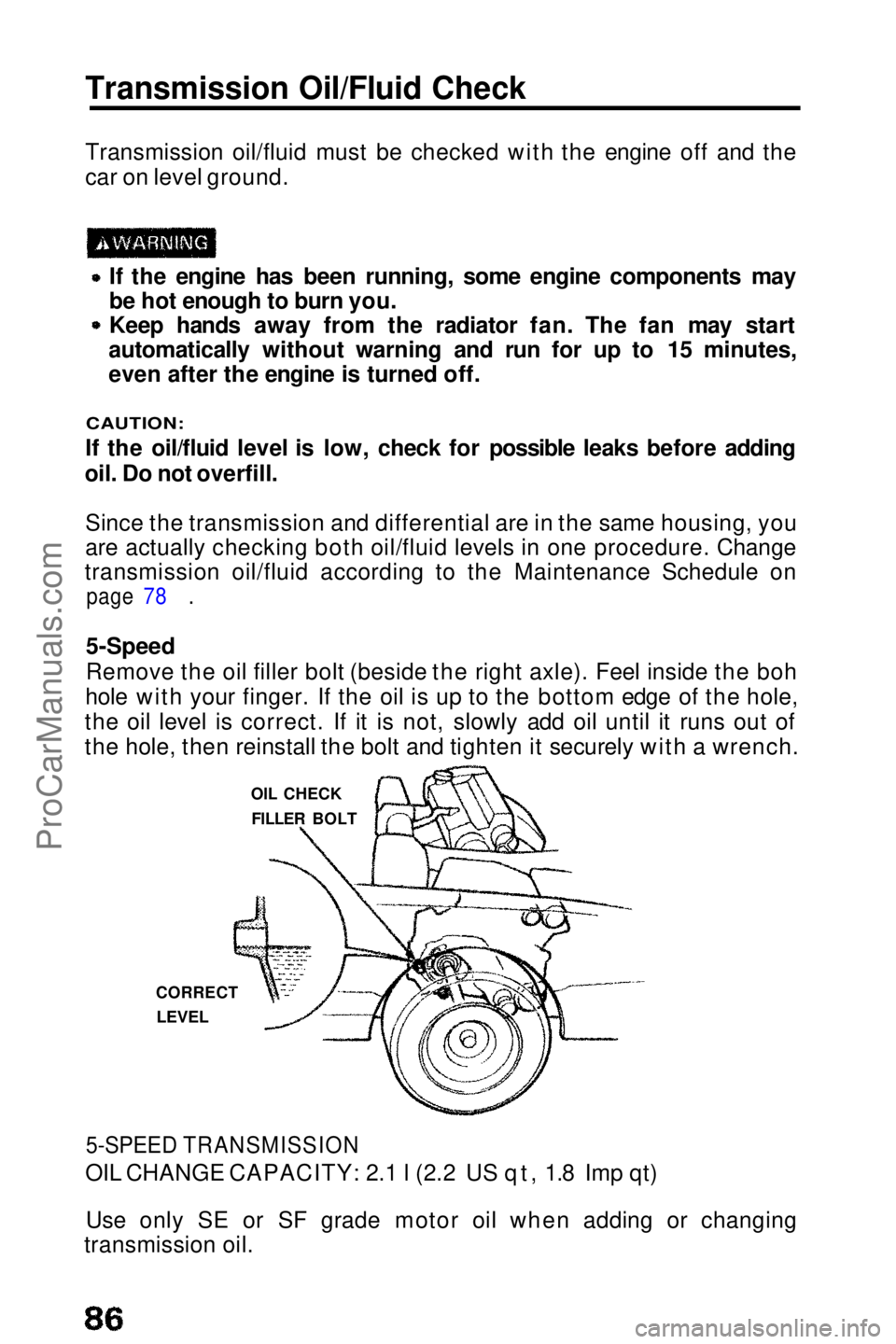
5-Speed
Remove the oil filler bolt (beside the right axle). Feel inside the boh
hole with your finger. If the oil is up to the bottom edge of the hole,
the oil level is correct. If it is not, slowly add oil until it runs out of
the hole, then reinstall the bolt and tighten it securely with a wrench.
CORRECT
LEVEL
5-SPEED TRANSMISSION
OIL CHANGE CAPACITY: 2.1 l (2.2 US qt, 1.8 Imp qt)
Use only SE or SF grade motor oil when adding or changing
transmission oil. OIL CHECK
FILLER BOLTProCarManuals.comMain Menu t s
Page 87 of 143
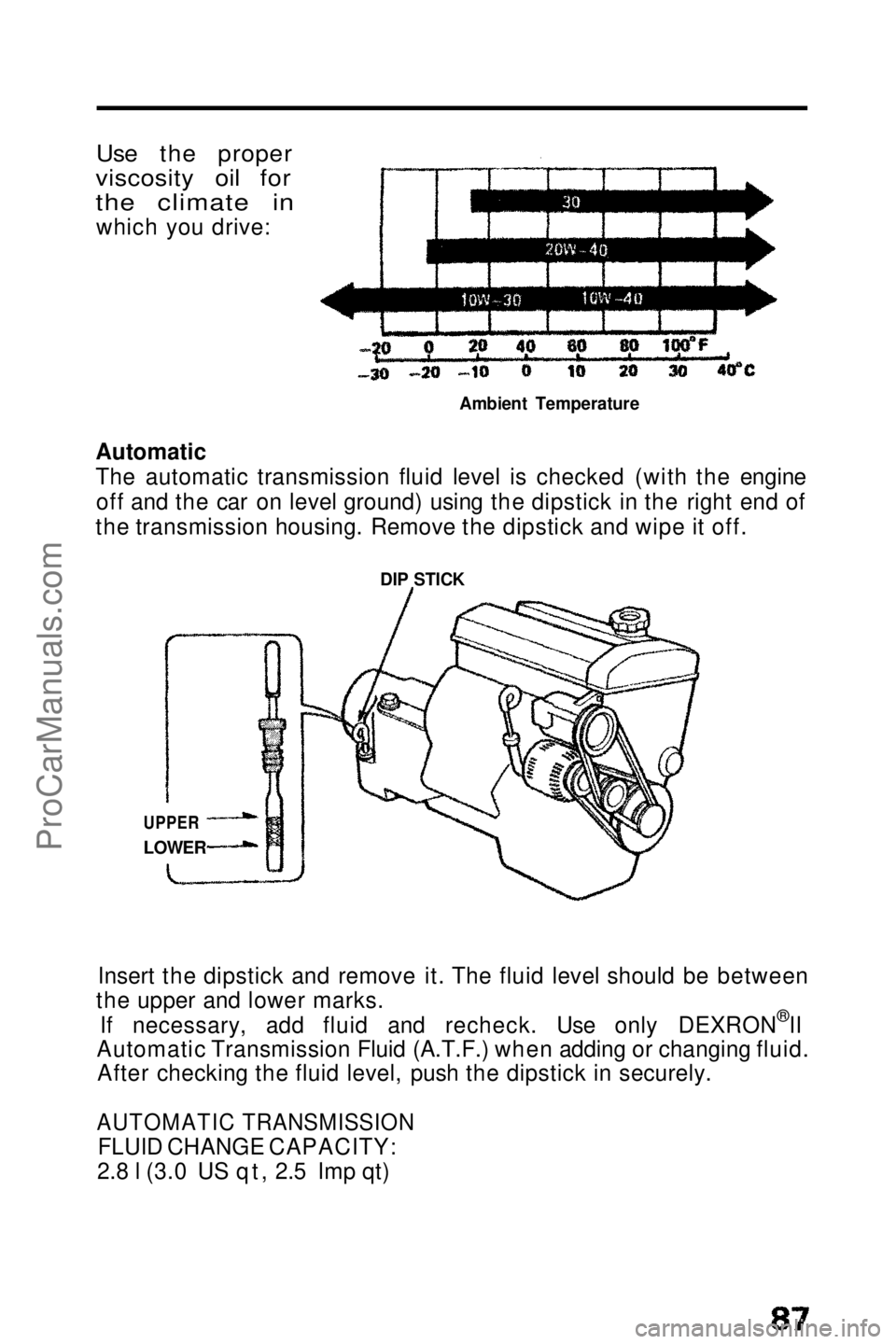
Use the proper
viscosity oil for
the climate in
which you drive:
Ambient Temperature
Automatic
The automatic transmission fluid level is checked (with the engine off and the car on level ground) using the dipstick in the right end of
the transmission housing. Remove the dipstick and wipe it off.
Insert the dipstick and remove it. The fluid level should be between
the upper and lower marks.
If necessary, add fluid and recheck. Use only DEXRON ®
II
Automatic Transmission Fluid (A.T.F.) when adding or changing fluid. After checking the fluid level, push the dipstick in securely.
AUTOMATIC TRANSMISSION
FLUID CHANGE CAPACITY:
2.8 l (3.0 US qt, 2.5 Imp qt) DIP STICK
UPPER
LOWERProCarManuals.comMain Menu t s
Page 100 of 143
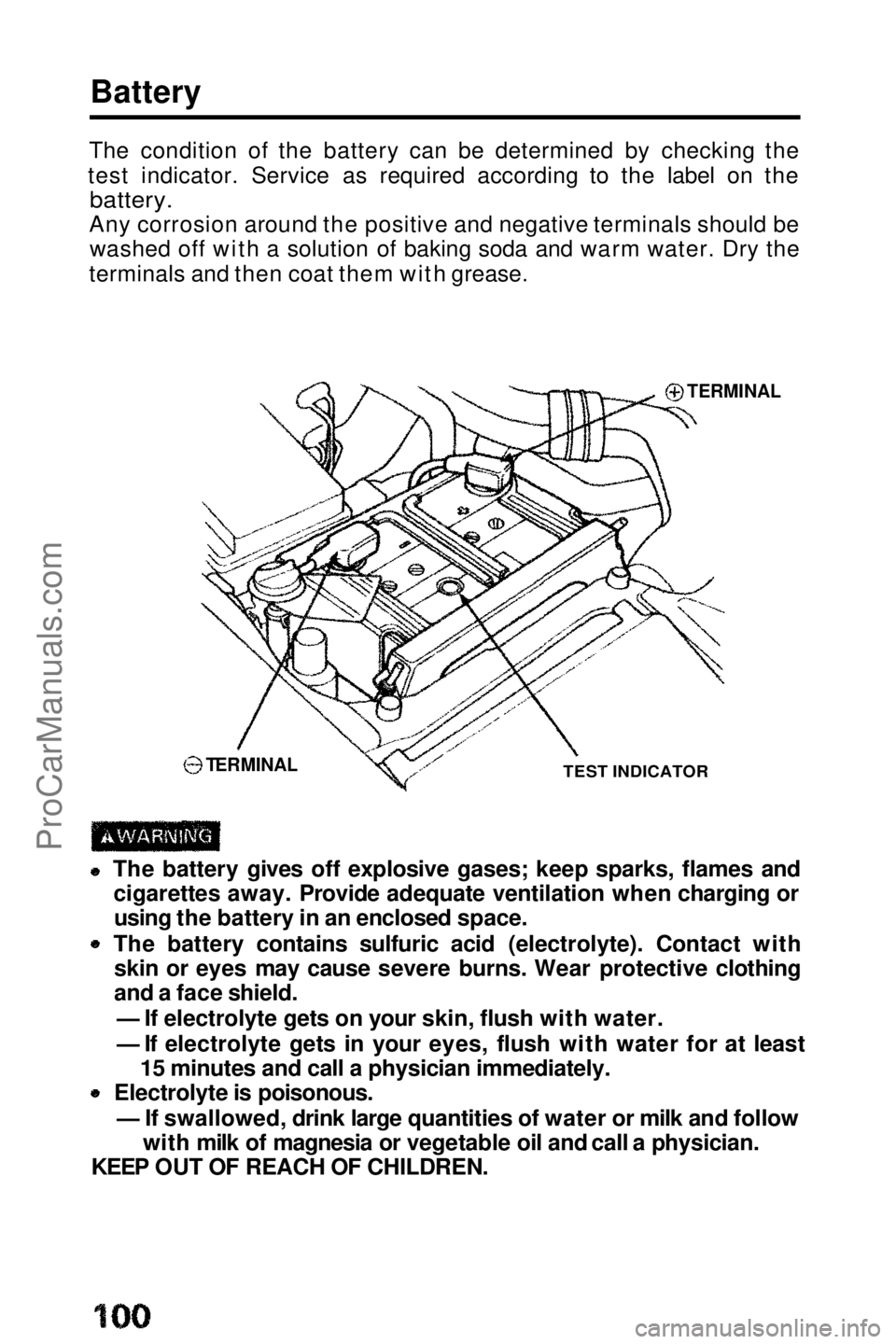
The condition of the battery can be determined by checking the
test indicator. Service as required according to the label on the
battery.
Any corrosion around the positive and negative terminals should be washed off with a solution of baking soda and warm water. Dry the
terminals and then coat them with grease.
The battery gives off explosive gases; keep sparks, flames andcigarettes away. Provide adequate ventilation when charging orusing the battery in an enclosed space.
The battery contains sulfuric acid (electrolyte). Contact with skin or eyes may cause severe burns. Wear protective clothing
and a face shield.
— If electrolyte gets on your skin, flush with water.
— If electrolyte gets in your eyes, flush with water for at least
15 minutes and call a physician immediately.
Electrolyte is poisonous.
— If swallowed, drink large quantities of water or milk and follow with milk of magnesia or vegetable oil and call a physician.
KEEP OUT OF REACH OF CHILDREN.
Battery
TEST INDICATOR
TERMINAL
TERMINAL
ProCarManuals.comMain Menu t s
Page 138 of 143
Index (cont'd)
Emission Controls.........................130
Engine
Coolant.......................................88
Coolant Temperature
Gauge....................................20
Identification Number .............127
Oil and Filter...............................83
Oil Pressure
Warning
Light .......................................22
Specification ...........................125
Exhaust Controls....................131
Engine Exhaust Ga
s Warning
....................................................64
Evaporative Emission Control
System ....................................131
Exhaust Gas Recirculation...........132
Exterior Care.................................110
Filters
Air...........................................94
Engine Oil ...................................84
Fuel.............................................96
Fluid .....................................See "Oil"
Foreign Countries, Operation in ...............................56
Four Wheel Steering.......................59 Front Seat
Adjustment..................................5
Fuel
Filter Door and Cap...................56
Fuel Reserve
Warning
Light .......................................22
Gauge.........................................20
Gasohol......................................55
Gasoline ......................................55
Requirement..............................55
Filter...........................................96
Fuse
Checking and Replacing .........101
Specification...........................126 Gasoline............................See"Fuel"
Gas Station Information
...........................................back cover
Gauges............................................20
Glove Box ........................................39
Hazard Warning
Indicator Light ...........................21
Hazard Warning System................33
Headlights
Flasher.......................................31
Headlight Motor
Switch ...........32
High Beam Indicator..................21
High Beam/Low
Beam
Switch...................................31
If the
Retractable Headlights
do not operate ...................123
Reminder Chime
.......................30
Retractable Headlight Motor Warning Light .......................25
Switch.......................................30
Headlight High
Beam Indicator
Light ...........................................21
Head Restraints.................................8
Heating.............................................45
High Bea
m
Switch .......................................31
Indicator Light ...........................21
Hood Latch.....................................39
Identification Numbers.................127
Ignition
Keys.............................................3
Switch........................................58
Indicator Lights ...............................20
Inflation Pressures, Tire..............105
Instrument Panel....................19
Instrument Panel
Brightness
Control.......................................33
Interior light .....................................33
Interior Trim Care .........................110 Jack .............................................116
Jump Starting ...............................119ProCarManuals.comMain Menu t s
Page 143 of 143
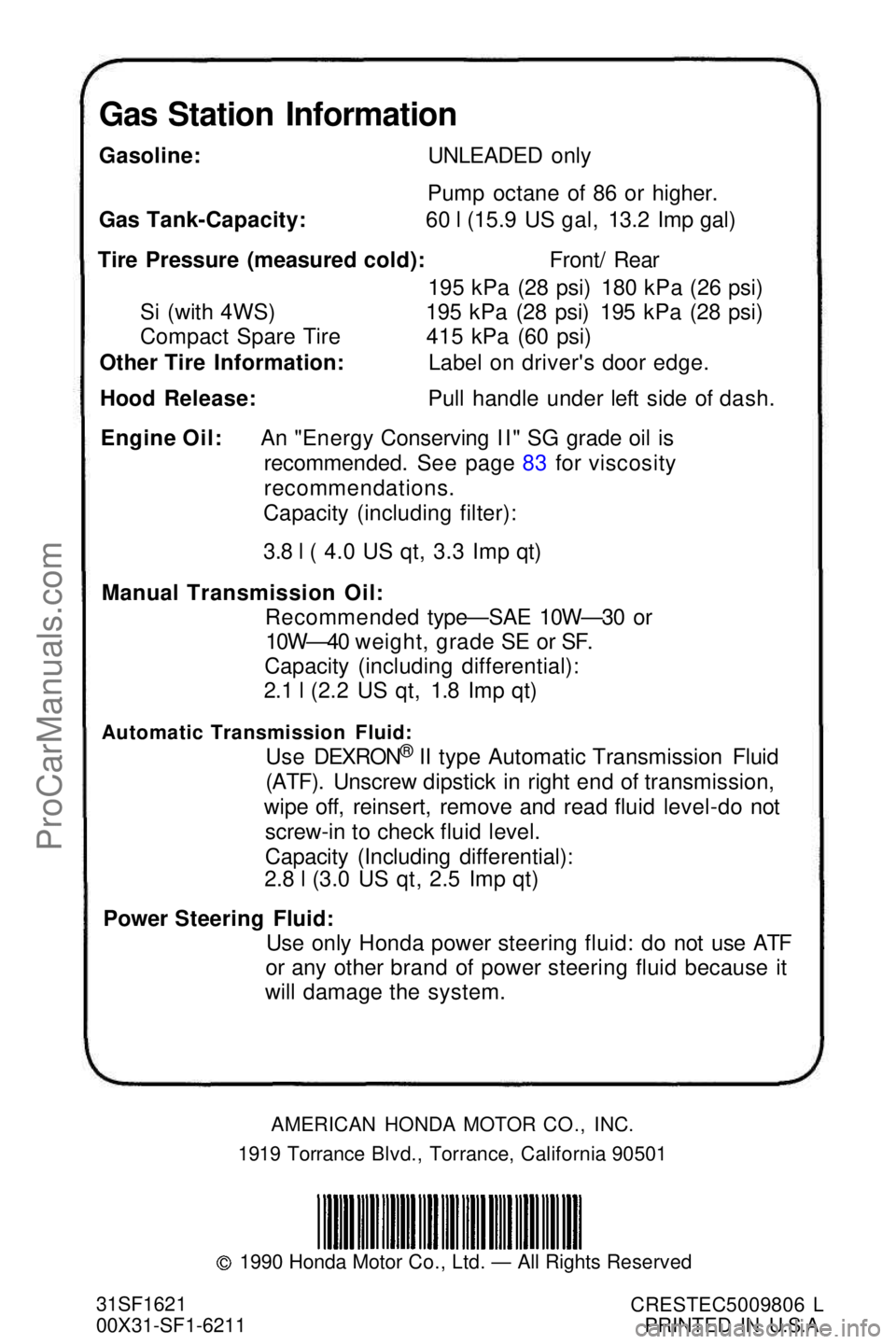
Gas Station Information
Gasoline: UNLEADED onlyPump octane of 86 or higher.
Gas Tank-Capacity: 60 l (15.9 US gal, 13.2 Imp gal)
Tire Pressure (measured cold): Front/ Rear 195 kPa (28 psi) 180 kPa (26 psi)
Si (with 4WS) 195 kPa (28 psi) 195 kPa (28 psi)
Compact Spare Tire 415 kPa (60 psi)
Other Tire Information: Label on driver's door edge.
Hood Release: Pull handle under left side of dash.
Engine Oil: An "Energy Conserving II" SG grade oil is recommended. See page 83 for viscosity
recommendations.
Capacity (including filter):
3.8 l ( 4.0 US qt, 3.3 Imp qt)
Manual Transmission Oil: Recommended type—SAE 10W—30 or10W—40 weight, grade SE or SF.
Capacity (including differential):
2.1 l (2.2 US qt, 1.8 Imp qt)
Automatic Transmission Fluid:
Use DEXRON® II type Automatic Transmission Fluid
(ATF). Unscrew dipstick in right end of transmission,
wipe off, reinsert, remove and read fluid level-do not screw-in to check fluid level.
Capacity (Including differential):
2.8 l (3.0 US qt, 2.5 Imp qt)
Power Steering Fluid: Use only Honda power steering fluid: do not use ATF
or any other brand of power steering fluid because it
will damage the system.
AMERICAN HONDA MOTOR CO., INC.
1919 Torrance Blvd., Torrance, California 90501
1990 Honda Motor Co., Ltd. — All Rights Reserved
31SF1621
00X31-SF1-6211CRESTEC5009806 L PRINTED IN U.S.A.
ProCarManuals.comMain Menu t s