heating HONDA PRELUDE 1990 Owners Manual
[x] Cancel search | Manufacturer: HONDA, Model Year: 1990, Model line: PRELUDE, Model: HONDA PRELUDE 1990Pages: 143, PDF Size: 2.07 MB
Page 19 of 143
Instrument Panel
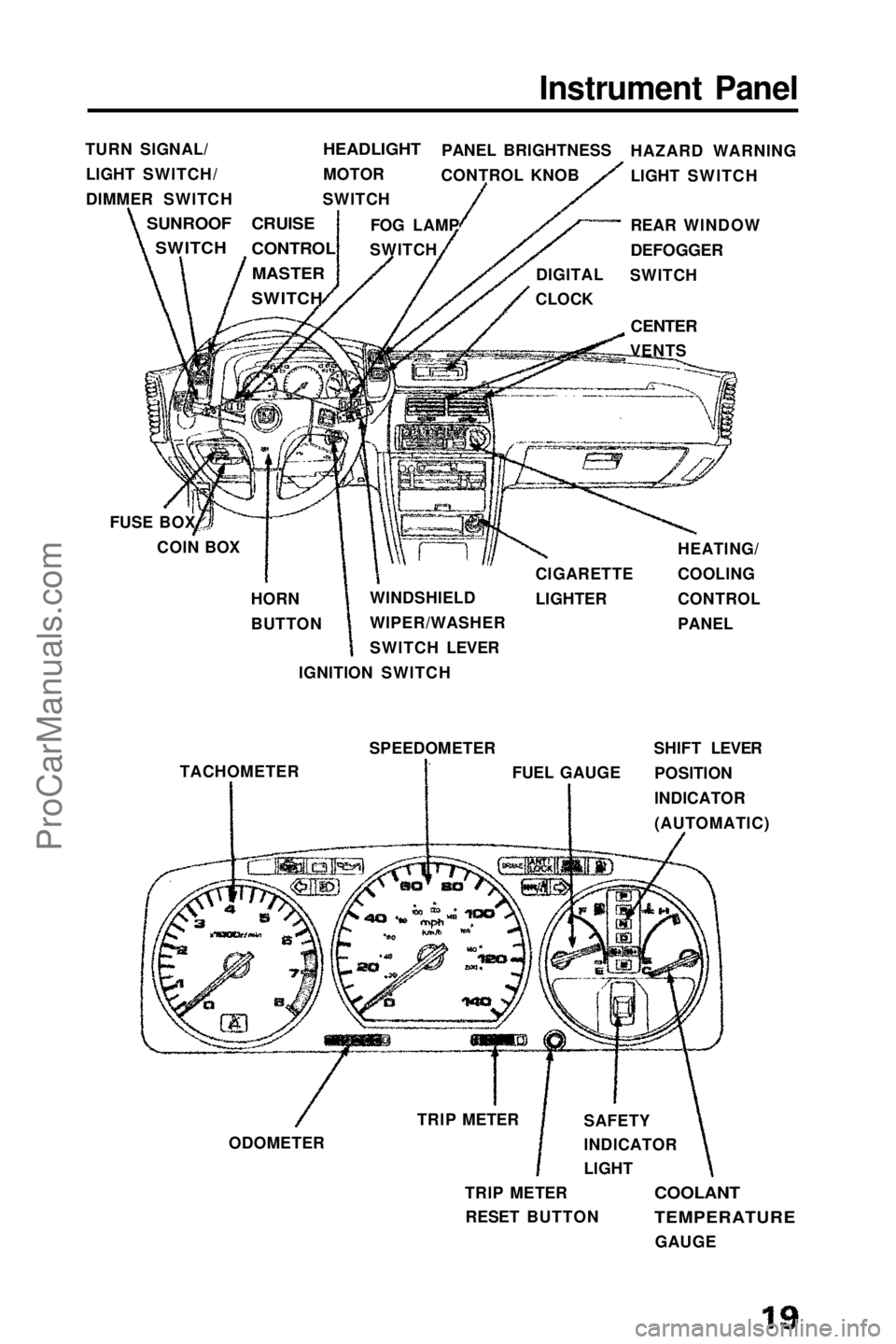
TURN SIGNAL/ LIGHT SWITCH/
DIMMER SWITCH
SUNROOFSWITCH
HEADLIGHT
MOTOR
SWITCH PANEL BRIGHTNESS
CONTROL KNOB HAZARD WARNING
LIGHT SWITCH
FOG LAMP
SWITCH REAR WINDOW
DEFOGGER
SWITCH
DIGITAL
CLOCK
CENTER
VENTS
CRUISE
CONTROL
MASTER
SWITCH
FUSE BOX COIN BOX
HORN
BUTTON WINDSHIELD
WIPER/WASHER
SWITCH LEVER
IGNITION SWITCH CIGARETTE
LIGHTER
HEATING/
COOLING
CONTROL
PANEL
TACHOMETER SPEEDOMETER
FUEL GAUGESHIFT LEVER
POSITION
INDICATOR
(AUTOMATIC)
ODOMETER TRIP METER
TRIP METERRESET BUTTON SAFETY
INDICATOR
LIGHT
COOLANT
TEMPERATURE
GAUGEProCarManuals.comMain Menu t s
Page 38 of 143
Cigarette Lighter and Ashtrays
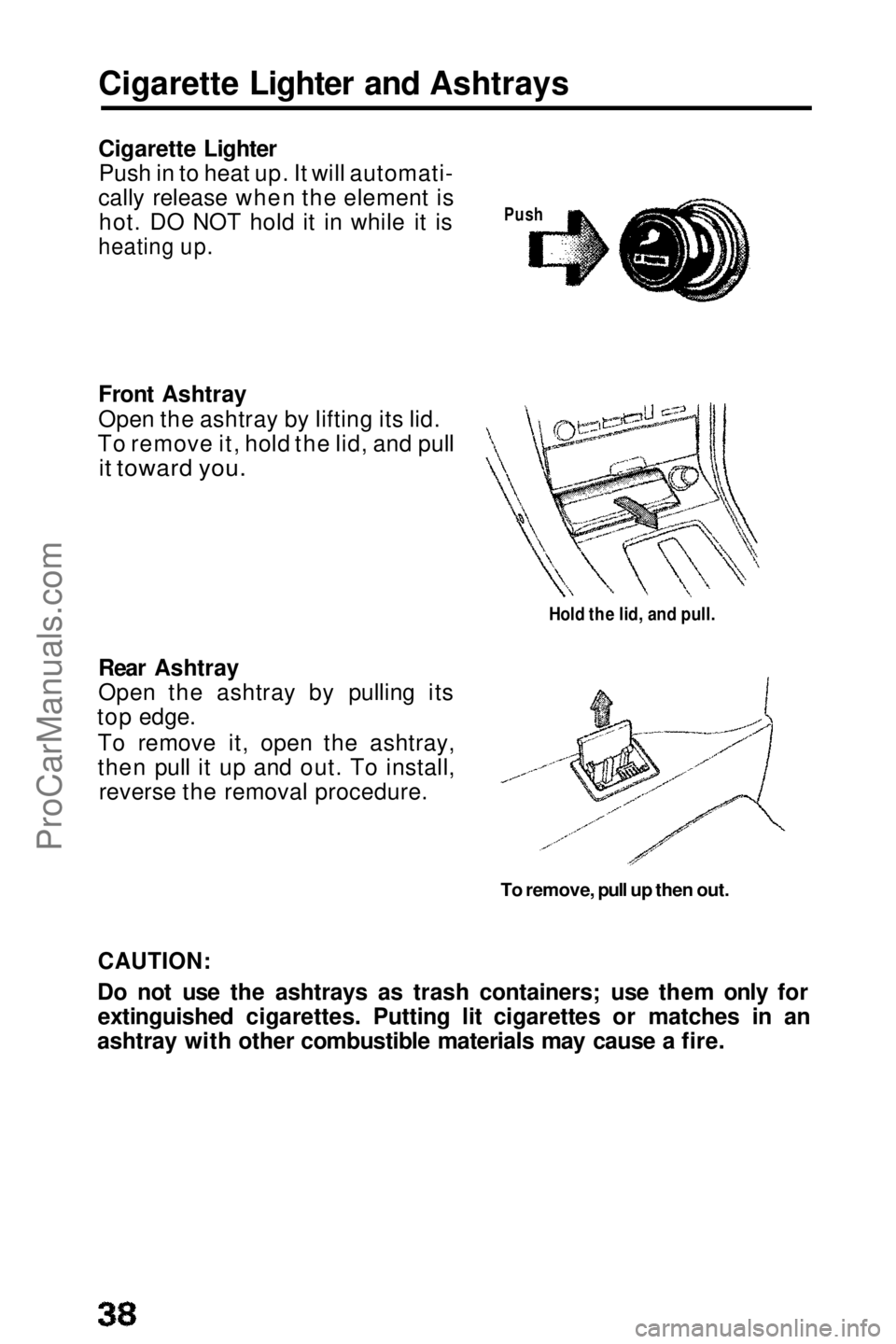
Cigarette Lighter
Push in to heat up. It will automati-
cally release when the element is hot. DO NOT hold it in while it is
heating up.
Front Ashtray
Open the ashtray by lifting its lid.
To remove it, hold the lid, and pull
it toward you.
Rear Ashtray
Open the ashtray by pulling its
top edge.
To remove it, open the ashtray,
then pull it up and out. To install, reverse the removal procedure.
CAUTION:
Do not
use the ashtrays as trash containers; use them only for
extinguished cigarettes. Putting lit cigarettes or matches in an
ashtray with other combustible materials may cause a fire.
Push
Hold the lid, and pull.
To remove, pull up then out.ProCarManuals.comMain Menu t s
Page 41 of 143
Heating and Cooling
The vents, heater and air conditioner are combined in one system; adjusting four basic controls to different settings can provide a fullrange of interior temperatures for safe and comfortable driving,
(Air conditioner is optional on the 2.0 S and 2.0 Si models.)
Ventilation
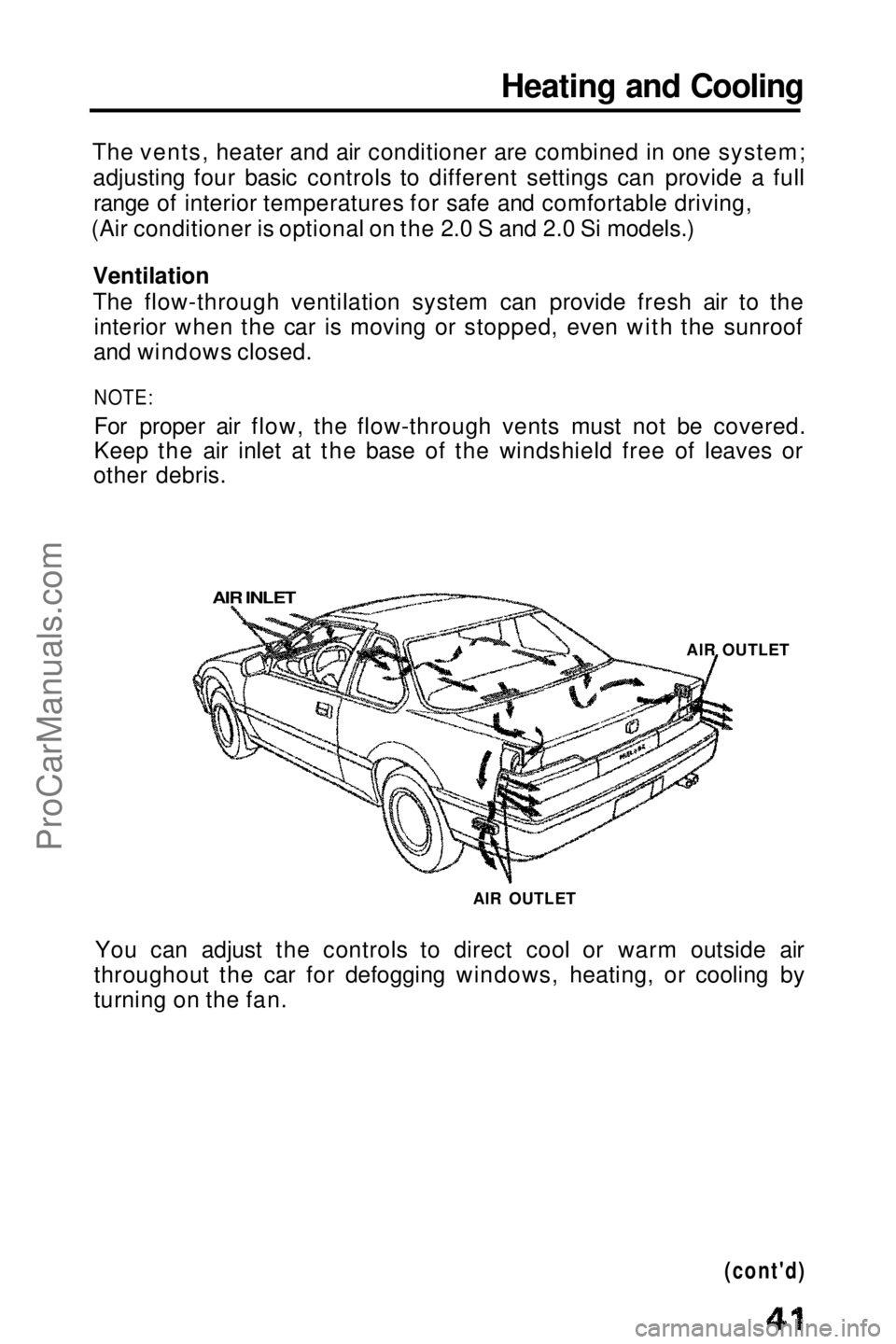
The flow-through ventilation system can provide fresh air to theinterior when the car is moving or stopped, even with the sunroof
and windows closed.
NOTE:
For proper air flow, the flow-through vents must not be covered.
Keep the air inlet at the base of the windshield free of leaves or
other debris.
You can adjust the controls to direct cool or warm outside air
throughout the car for defogging windows, heating, or cooling by
turning on the fan.
(cont'd)
AIR INLET
AIR OUTLET
AIR OUTLETProCarManuals.comMain Menu t s
Page 42 of 143
Heating and Cooling (cont'd)
Dash Vents
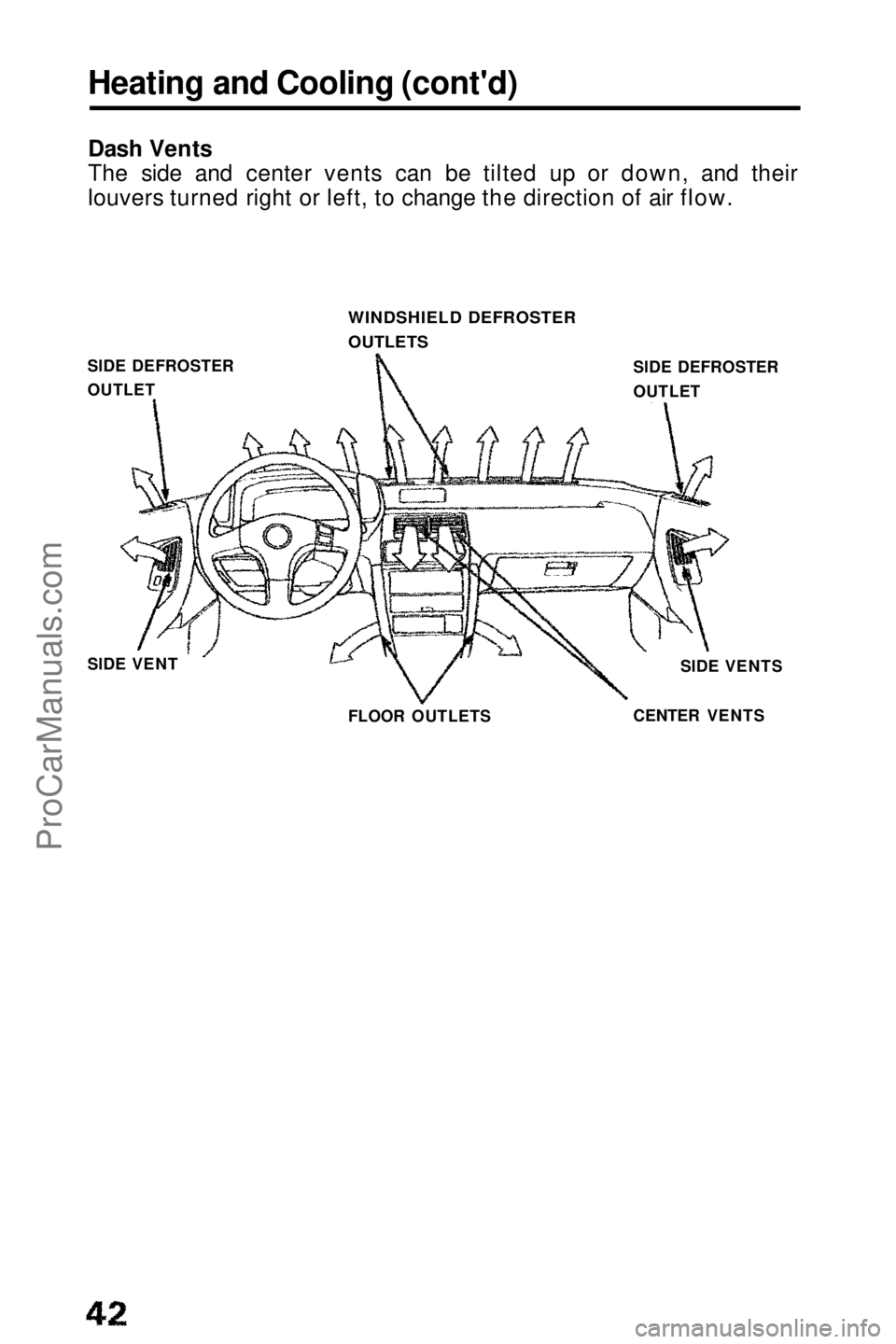
The side and center vents can be tilted up or down, and their
louvers turned right or left, to change the direction of air flow.
SIDE DEFROSTER
OUTLET
SIDE VENT
WINDSHIELD DEFROSTER
OUTLETS
SIDE DEFROSTER
OUTLET
FLOOR OUTLETS SIDE VENTS
CENTER VENTSProCarManuals.comMain Menu t s
Page 44 of 143
Heating and Cooling (cont'd)
NOTE:
The windows may become fogged if the system is in the
position for an extended period of time with the air
conditioner off. As soon as the interior is warmed, switch to the
position.
How to Use the Controls
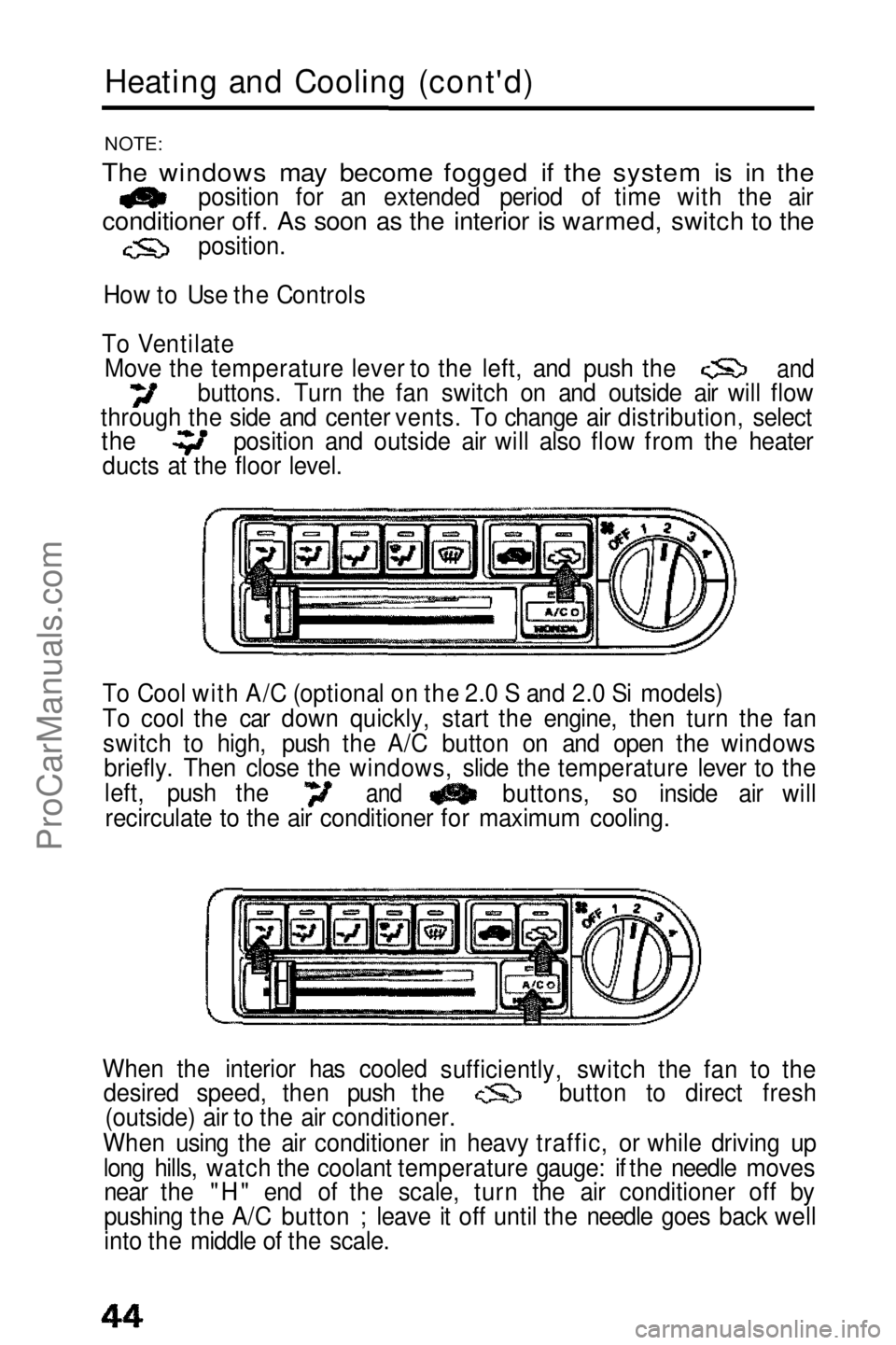
To Ventilate Move the temperature lever to the left, and push the buttons. Turn the fan switch on and outside air will flow
through the side and center vents. To change air distribution, select
To Cool with A/C (optional on the 2.0 S and 2.0 Si models)
To cool the car down quickly, start the engine, then turn the fanswitch to high, push the A/C button on and open the windows briefly. Then close the windows, slide the temperature lever to the
When the interior has cooled desired speed, then push the (outside) air to the air conditioner.
When using the air conditioner in heavy traffic, or while driving up long hills, watch the coolant temperature gauge: if the needle movesnear the "H" end of the scale, turn the air conditioner off by
pushing the A/C button ; leave it off until the needle goes back well
into the middle of the scale.
and
the
ducts at the floor level. position and outside air will also flow from the heater
sufficiently, switch the fan to thebutton to direct fresh
and
left, push the
recirculate to the buttons, so inside air will
air conditioner for maximum cooling.ProCarManuals.comMain Menu t s
Page 45 of 143
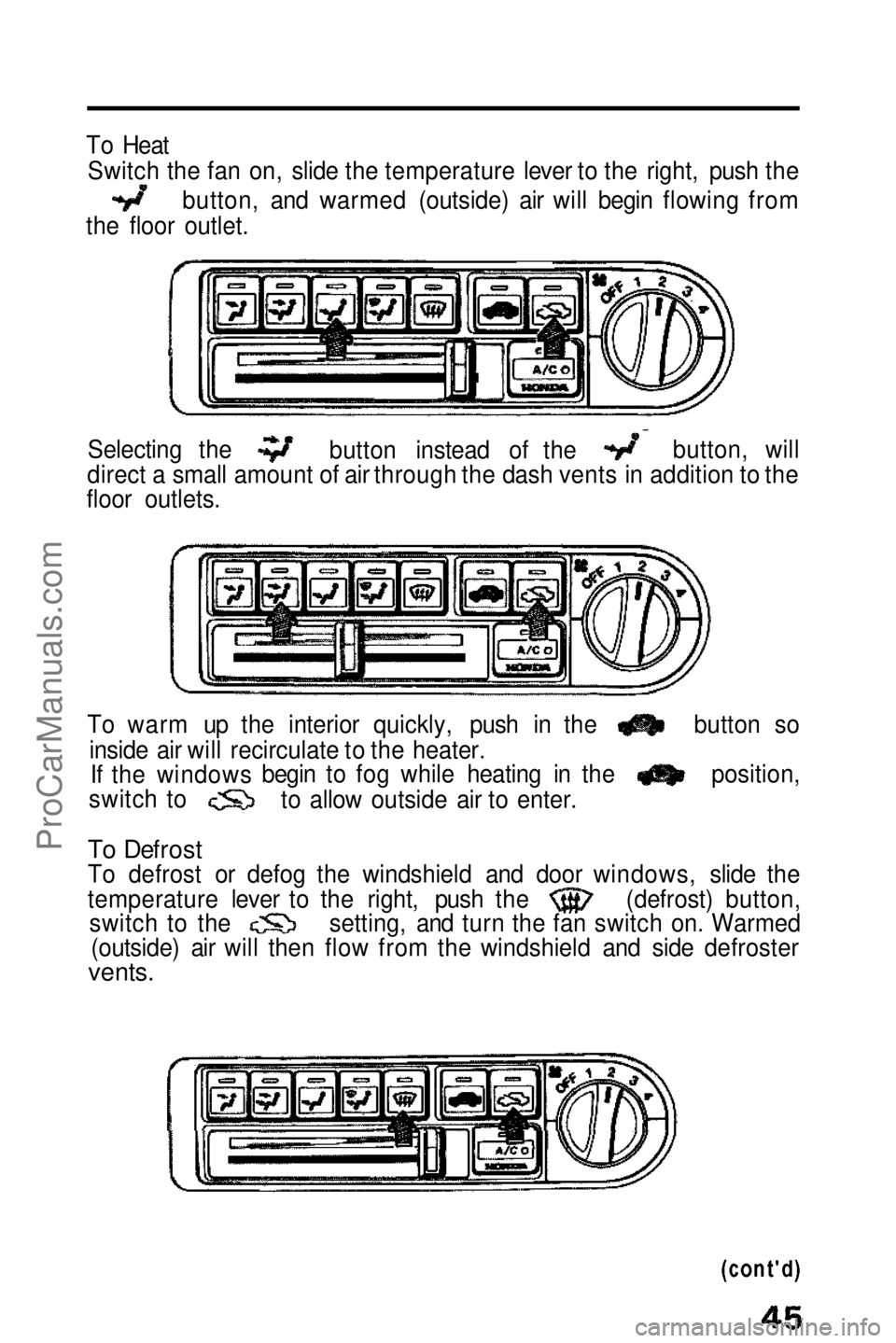
To Heat
Switch the fan on, slide the temperature lever to the right, push the
button, and warmed (outside) air will begin flowing from
the floor outlet.
Selecting the
direct a small amount of air through the dash vents in addition to the
floor outlets. button, will
button instead of the
To warm up the interior quickly, push in the inside air will recirculate to the heater. button so
position,
begin to fog while heating in the
to allow outside air to enter.
If the windows
switch to
To Defrost
To defrost or defog the windshield and
temperature lever to the right, push the door windows, slide the
(defrost) button,
switch on. Warmed
(outside) air will then flow from the windshield and side defroster
vents.
switch to the
setting, and turn the fanProCarManuals.comMain Menu t s
Page 46 of 143
Heating and Cooling (cont'd)
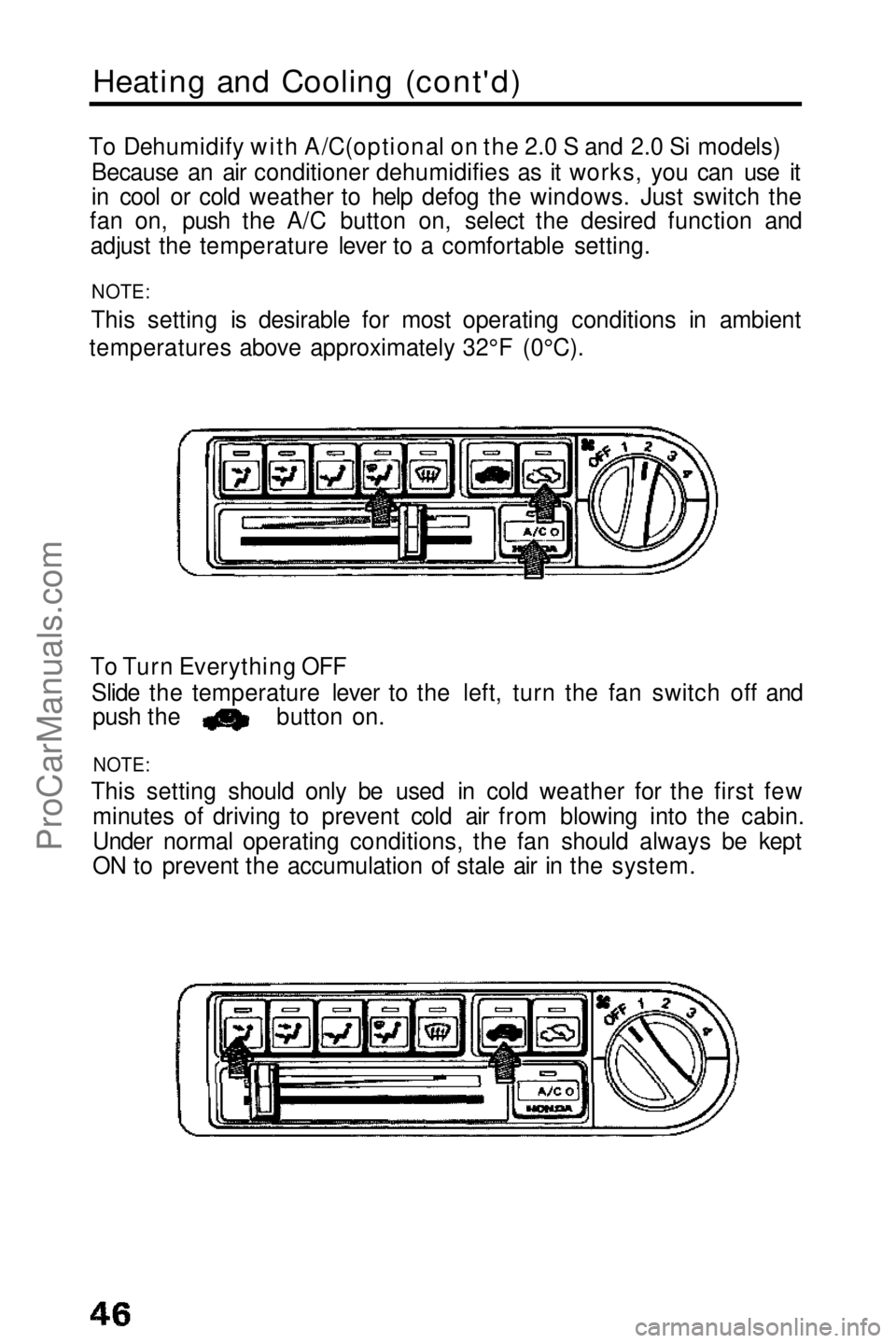
To Dehumidify with A/C(optional on the 2.0 S and 2.0 Si models) Because an air conditioner dehumidifies as it works, you can use it
in cool or cold weather to help defog the windows. Just switch the
fan on, push the A/C button on, select the desired function and
adjust the temperature lever to a comfortable setting.
NOTE:
This setting is desirable for most operating conditions in ambient
temperatures above approximately 32°F (0°C).
To Turn Everything OFFSlide the temperature lever to the left, turn the fan switch off and push the
NOTE:
This setting should only be used in cold weather for the first few minutes of driving to prevent cold air from blowing into the cabin.
Under normal operating conditions, the fan should always be kept
ON to prevent the accumulation of stale air in the system. button on.ProCarManuals.comMain Menu t s
Page 64 of 143
Engine Exhaust Gas Warning
A properly maintained car is your best protection against exhaust
gas entering the passenger compartment. The exhaust system should be thoroughly inspected by acompetent mechanic whenever:
The car is raised for an oil change.
You notice a change in the sound of the exhaust.
The exhaust system or the rear or underside of the car is
damaged.
Avoid breathing exhaust gases. They contain carbon monoxide, which is a colorless, odorless gas that can cause loss of
consciousness and eventual death. If you suspect that exhaust gas is entering the passenger compartment, have the cause
determined and corrected as soon as possible. If you must drive
under these conditions, drive only with all windows fully open. Do not drive with the trunk lid open. An open trunk may draw
exhaust gases into the passenger compartment. If you must
drive with the trunk lid open, drive only with all the windows
wide open.
Do not run the engine in confined areas, such as garages, any
longer than necessary to move the car in or out. If you must sit in a parked car with the engine running for more
than a short time, adjust the heating/ventilation system as
follows:
1. Push the
and buttons on.
2. Set the temperature lever for best comfort.
3.Turn the fan to the highest speed.
NOTE:
To insure proper operation of the car's ventilation system, keep the
front air inlet clear of snow, mud, leaves or other obstructions.ProCarManuals.comMain Menu t s
Page 65 of 143
Shifting the 5 Speed
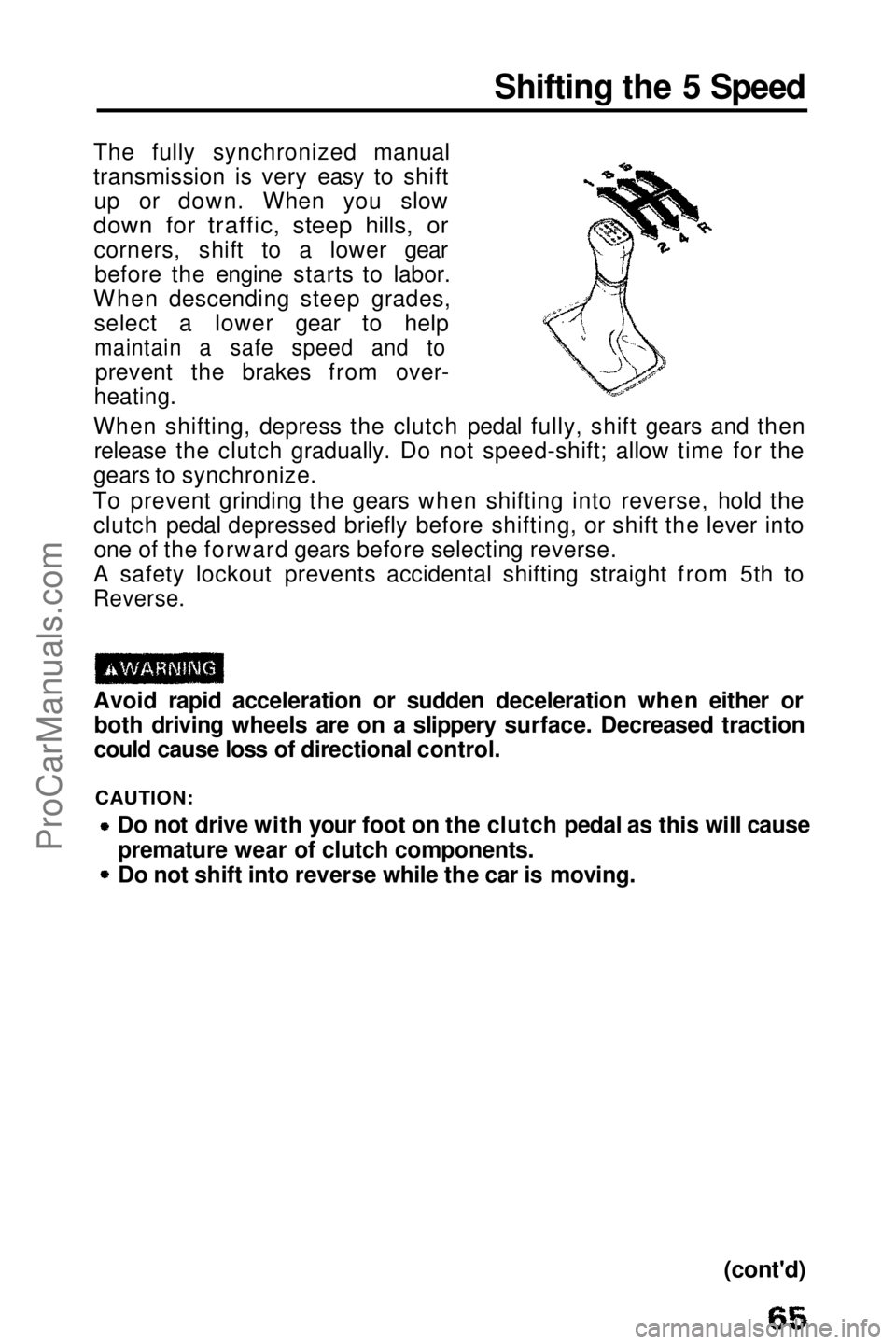
The fully synchronized manual
transmission is very easy to shift up or down. When you slow
down for traffic, steep hills, or
corners, shift to a lower gearbefore the engine starts to labor.
When descending steep grades, select a lower gear to help
maintain a safe speed and to
prevent the brakes from over-
heating.
When shifting, depress the clutch pedal fully, shift gears and then release the clutch gradually. Do not speed-shift; allow time for the
gears to synchronize.
To prevent grinding the gears when shifting into reverse, hold the clutch pedal depressed briefly before shifting, or shift the lever intoone of the forward gears before selecting reverse.
A safety lockout prevents accidental shifting straight from 5th to
Reverse.
Avoid rapid acceleration or sudden deceleration when either or both driving wheels are on a slippery surface. Decreased traction
could cause loss of directional control.
CAUTION:
Do not drive with your foot on the clutch pedal as this will causepremature wear of clutch components.
Do not shift into reverse while the car is moving.
(cont'd)ProCarManuals.comMain Menu t s
Page 75 of 143

CAUTION:
Before starting out, check the operation of the lights and all car/
trailer connections. After driving a short distance, stop and
recheck the lights and connections.
Reversing is difficult and requires practice. While backing-up,
the trailer may pivot off-course. To correct for this, grip the bottom of the steering wheel and move your hand to the left to
move the trailer to the left, or to the right to move the trailer to
the right. Turn the steering wheel a little at a time, and keep the
speed very low. Have someon e guide you when backing.
To help
prevent overheating of the brakes, shift into a lower
gear to make use of engine braking before descending steep or
long grades. Do not make sudden downshifts. Pay strict attention to the coolant temperature gauge when
going up hills. Because of the added load of the trailer, your car's
engine may overheat on hot days. Turning off the air conditioner
will reduce the load on the cooling system.
On cars equipped with automatic transmission. —Do not hold the car stationary on an incline by using the accelerator pedal; this can cause the transmission fluid tooverheat. Instead, use the handbrake or footbrake.
—When towing trailers, avoid high transmission fluid temperatures (caused by the transmission frequently shiftingbetween 3rd and 4th gears) by driving in S3.
NOTE:
Be sure to check state and local laws concerning maximum speed or
other driving restrictions for cars towing trailers. If you are driving
across several states, check each state's requirements before
leaving home, because restrictions may vary.
Parking with a Trailer
Whenever parking your car on an incline with a trailer attached, first
place and seat chocks at each wheel of the car and trailer. This is in
addition to the normal parking preparations of firmly applying the parking brake and placing the transmission in first or reverse
(manual transmission) or P (automatic transmission).
CAUTION:
Parking on an incline is not recommended and should be done only
if it cannot be avoided. Follow all precautions mentioned above
and turn the wheels to point towards a curb if facing downhill,
away from a curb if facing uphill. When leaving an inclined parking place, move the car slightly to unseat the chocks. Then while
keeping the foot brakes firmly applied, have an assistant remove
the chocks.ProCarManuals.comMain Menu t s