service HONDA PRELUDE 1990 Owners Manual
[x] Cancel search | Manufacturer: HONDA, Model Year: 1990, Model line: PRELUDE, Model: HONDA PRELUDE 1990Pages: 143, PDF Size: 2.07 MB
Page 1 of 143
 to navigate through\
this reference.
For a printed owners manual, click on authorized manuals or go")
1990 Prelude Online Reference Owner's Manual
Use these links (and links throughout this manual) to navigate through\
this reference.
For a printed owner's manual, click on authorized manuals or go to www.h\
elminc.com.
Features & Safety ........................................................................\
........................................................ 2
What you should know before driving your car.
Starting & Driving........................................................................\
.....................................................
55
What gas to use, how to change gears, etc.
Maintenance
........................................................................\
............................................................... 76
The Required Maintenance Schedule and some items you can service.
Emergency Service
........................................................................\
................................................ 116
Changing a flat, jump starting, towing.
Specifications
........................................................................\
......................................................... 125
Dimensions, weights and capacities.
Consumer Information
........................................................................\
.......................................... 127
Reporting Safety Detects, warranty service, vehicle identification numbe\
rs, etc.
Index ........................................................................\
....................... .................................................
137
Gas Station Information
Contents
Owner's Identification Form
ProCarManuals.com
Page 2 of 143
Introduction
This manual contains important information about the safe
operation and maintenance of your car.
We urge you to read it carefully, become familiar with the controls it
describes, and follow its recommendations, to help make your
driving trouble-free and enjoyable.
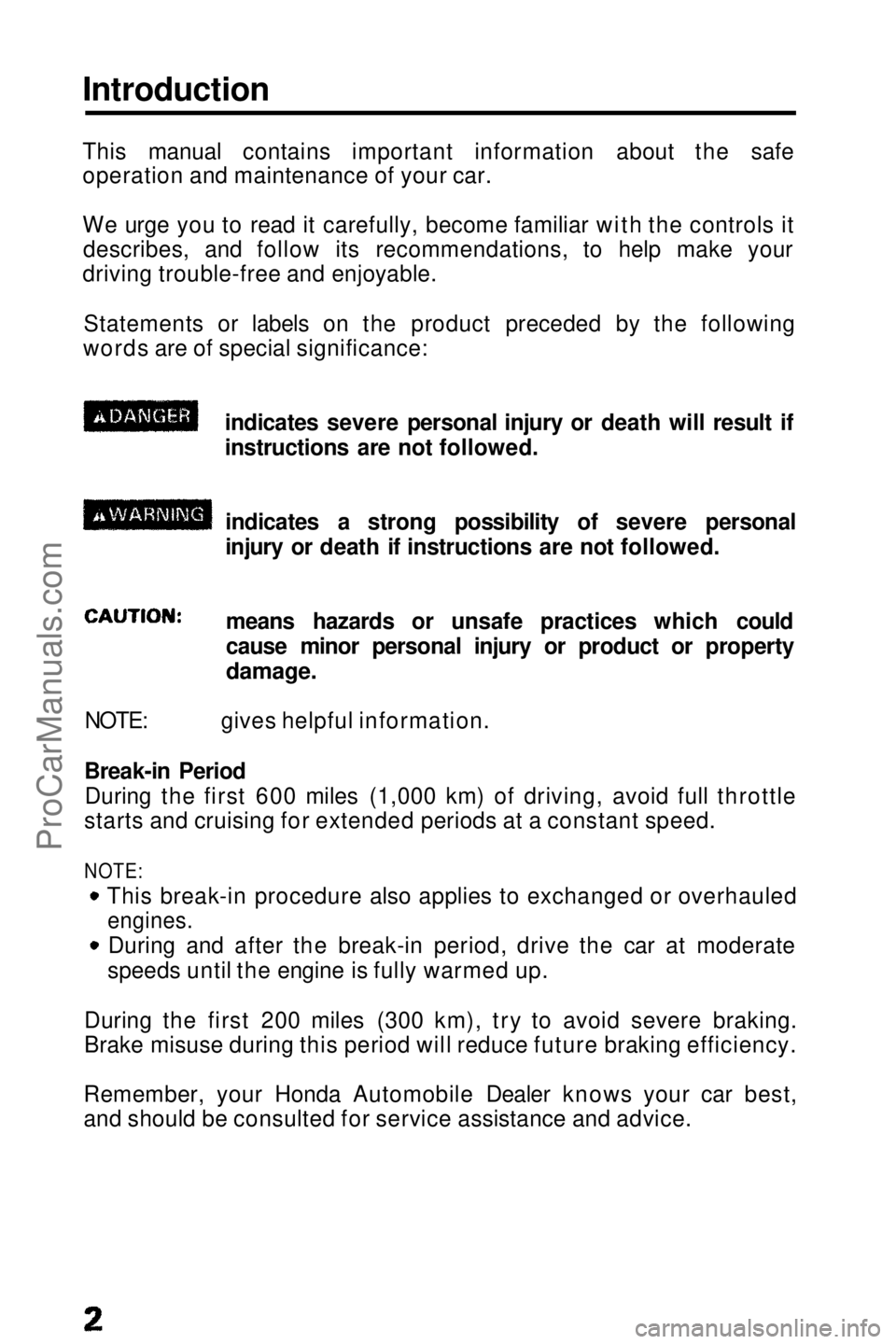
Statements or labels on the product preceded by the following
words are of special significance:
indicates severe personal injury or death will result if
instructions are not followed.indicates a strong possibility of severe personal
injury or death if instructions are not followed.means hazards or unsafe practices which could
cause minor personal injury or product or property
damage.
NOTE: gives helpful information.
Break-in Period During the first 600 miles (1,000 km) of driving, avoid full throttle
starts and cruising for extended periods at a constant speed.
NOTE:
This break-in procedure also applies to exchanged or overhauled
engines.
During and after the break-in period, drive the car at moderate
speeds until the engine is fully warmed up.
During the first 200 miles (300 km), try to avoid severe braking.
Brake misuse during this period will reduce future braking efficiency.
Remember, your Honda Automobile Dealer knows your car best,
and should be consulted for service assistance and advice.ProCarManuals.comMain Menu t s
Page 18 of 143
ALB (Anti Lock Brakes) help to maintain the road holding and
tractability of your car during severe braking, and under slippery road conditions. The ALB system prevents the wheels from locking(thus reducing the chance of skidding) to ensure controllable
deceleration. When sudden braking might otherwise lock one or more wheels, the ALB system temporarily reduces the braking
pressure to the wheel or wheels about to lock to ensure continued
braking efficiency.
When the ALB is regulating the braking pressure, the brake pedal pulsates slightly to make the driver aware that the system is
compensating for critical braking conditions. The pulsating brake pedal can be an indication of hazardous road condition, and to
remind you to take extra care.
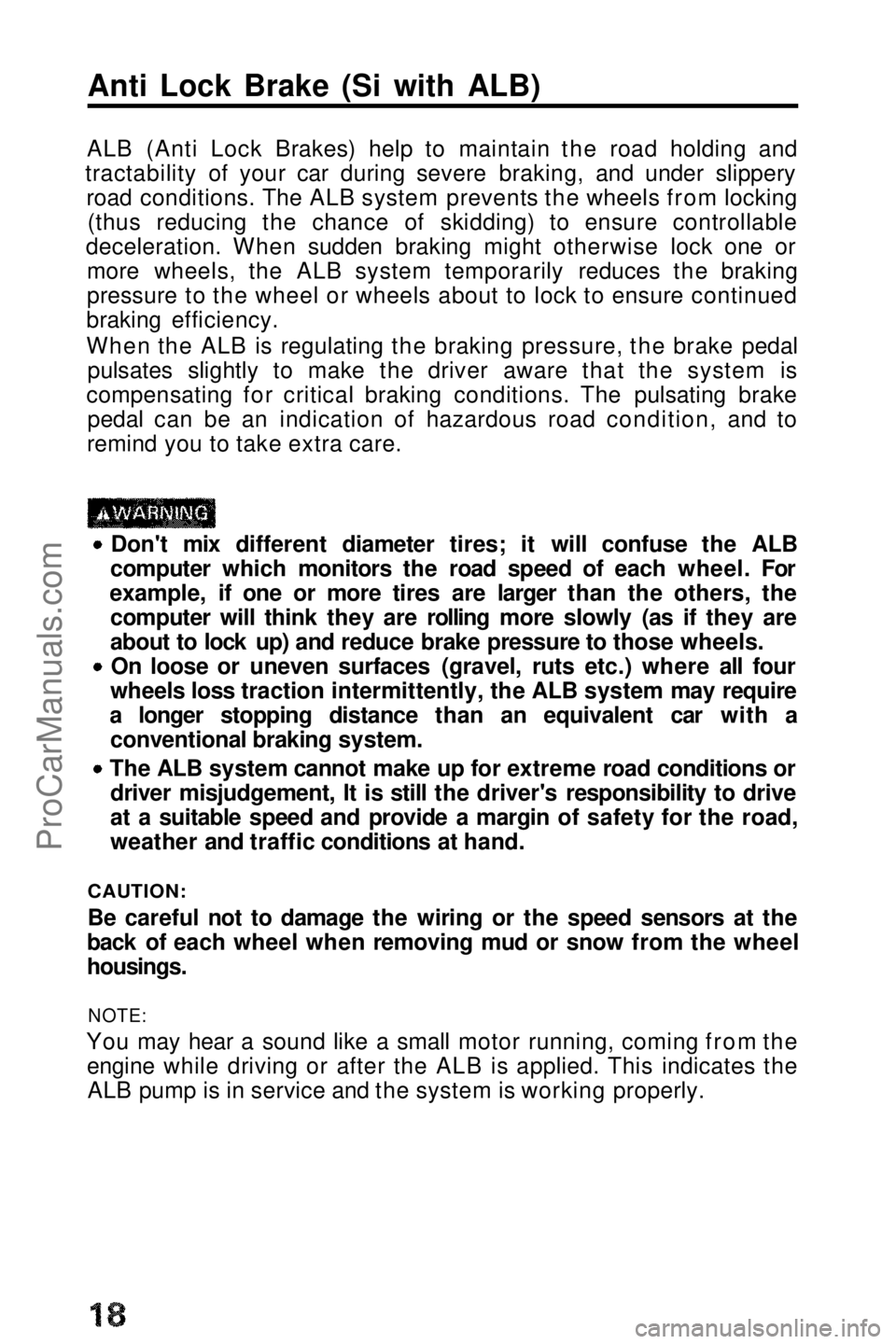
Don't mix different diameter tires; it will confuse the ALB
computer which monitors the road speed of each wheel. For
example, if one or more tires are larger than the others, the computer will think they are rolling more slowly (as if they are
about to lock up) and reduce brake pressure to those wheels.On loose or uneven surfaces (gravel, ruts etc.) where all four
wheels loss traction intermittently, the ALB system may require
a longer stopping distance than an equivalent car with a conventional braking system.
The ALB system cannot make up for extreme road conditions or driver misjudgement, It is still the driver's responsibility to drive
at a suitable speed and provide a margin of safety for the road,
weather and traffic conditions at hand.
CAUTION:
Be careful not to damage the wiring or the speed sensors at the
back of each wheel when removing mud or snow from the wheel
housings.
NOTE:
You may hear a sound like a small motor running, coming from the engine while driving or after the ALB is applied. This indicates theALB pump is in service and the system is working properly.
Ant
i
Lock Brake (Si with ALB)
ProCarManuals.comMain Menu t s
Page 76 of 143

Your Honda automobile must be properly maintained to ensure that
it is in peak operating condition and the emission levels are within
the standards set by the Federal Clean Air Act, The following instructions and maintenance procedures are based
on the assumption that your car will be used exclusively for the purpose for which it was designed:
1. To carry passengers and cargo within the load limits shown on the label on the edge of the driver's door.
2. To be driven on reasonable road surfaces within legal limits.
3. To generally be driven daily over a distance of several miles.
4. Use gasoline from pumps labeled unleaded, with a pump octane number of 68 or higher. The pump octane number is an average of
the Research (R) octane and Motor (M) octane numbers.
NOTE:
Failures which occur due to a lack of maintenance will not be
covered under warranty.
The Required Maintenance Schedule * specifies all maintenance required to keep your car in peak operating condition. Work should
be done by an authorized Honda dealer but may be done by any qualified service facility or individual who is competent in this type
of work.
Maintenance, replacement, or repair of emission control devicesand systems may be done by any automotive repair establishment
or individual using parts that are "certified" to EPA standards.
After the maintenance has been done, be sure to complete the Maintenance Records on pages 79 — 81 . All required maintenance is
considered normal owner operating cost and you will be charged for it by your dealer.
* For vehicles sold in California, maintenance operations indicated
by * 3 on page 78 are recommended by the manufacturer.
Other maintenance operations are required by California
regulations and condition the emission warranty.
Maintenance Schedule and RecordsProCarManuals.comMain Menu t s
Page 78 of 143
Maintenance Schedule and Records (cont'd)
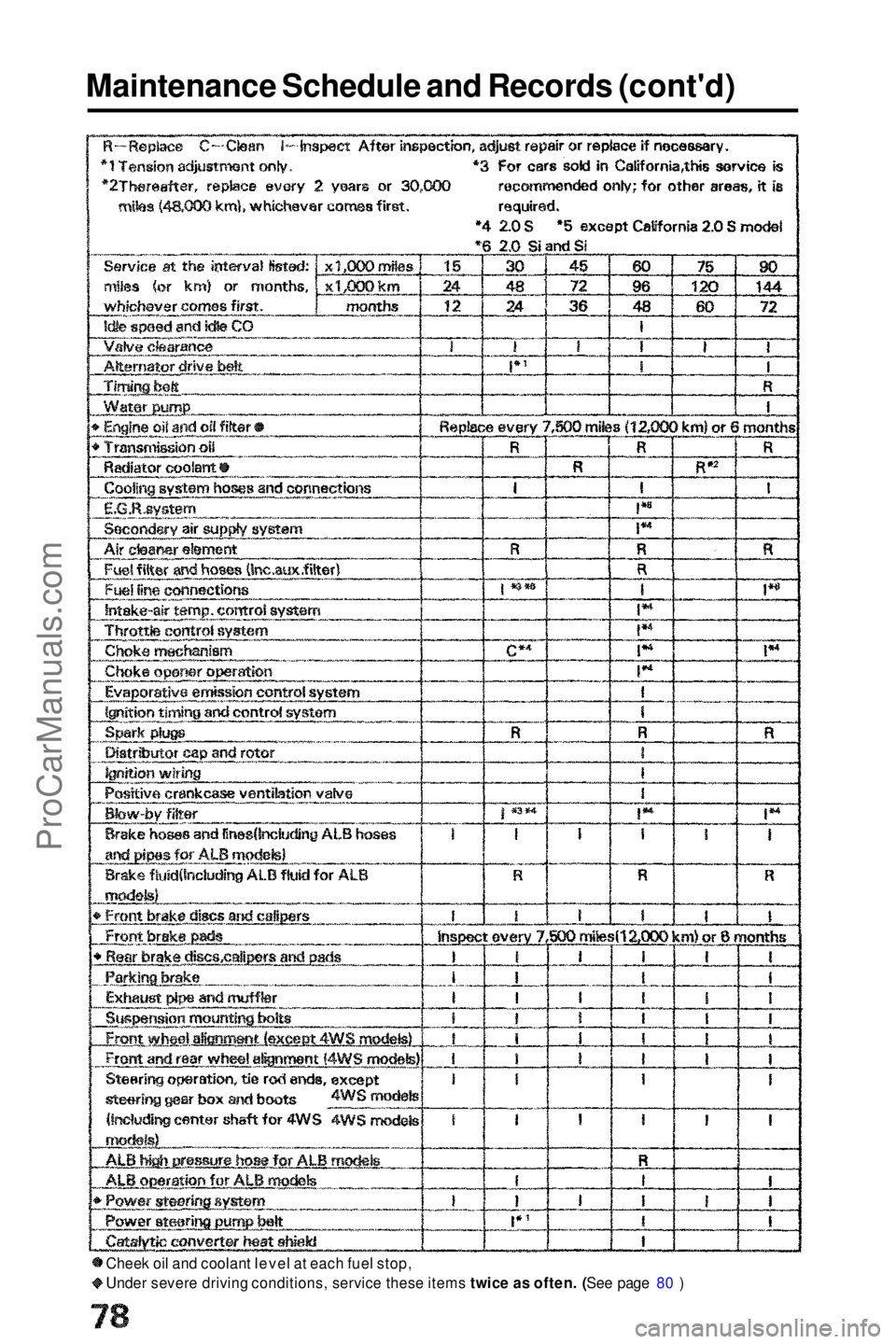
Cheek oil and coolant level at each fuel stop,
Under severe driving conditions, service these items twice as often. (See page 80 )ProCarManuals.comMain Menu t s
Page 80 of 143
Maintenance Schedule and Records (cont'd)
Severe Driving Conditions
CAUTION:
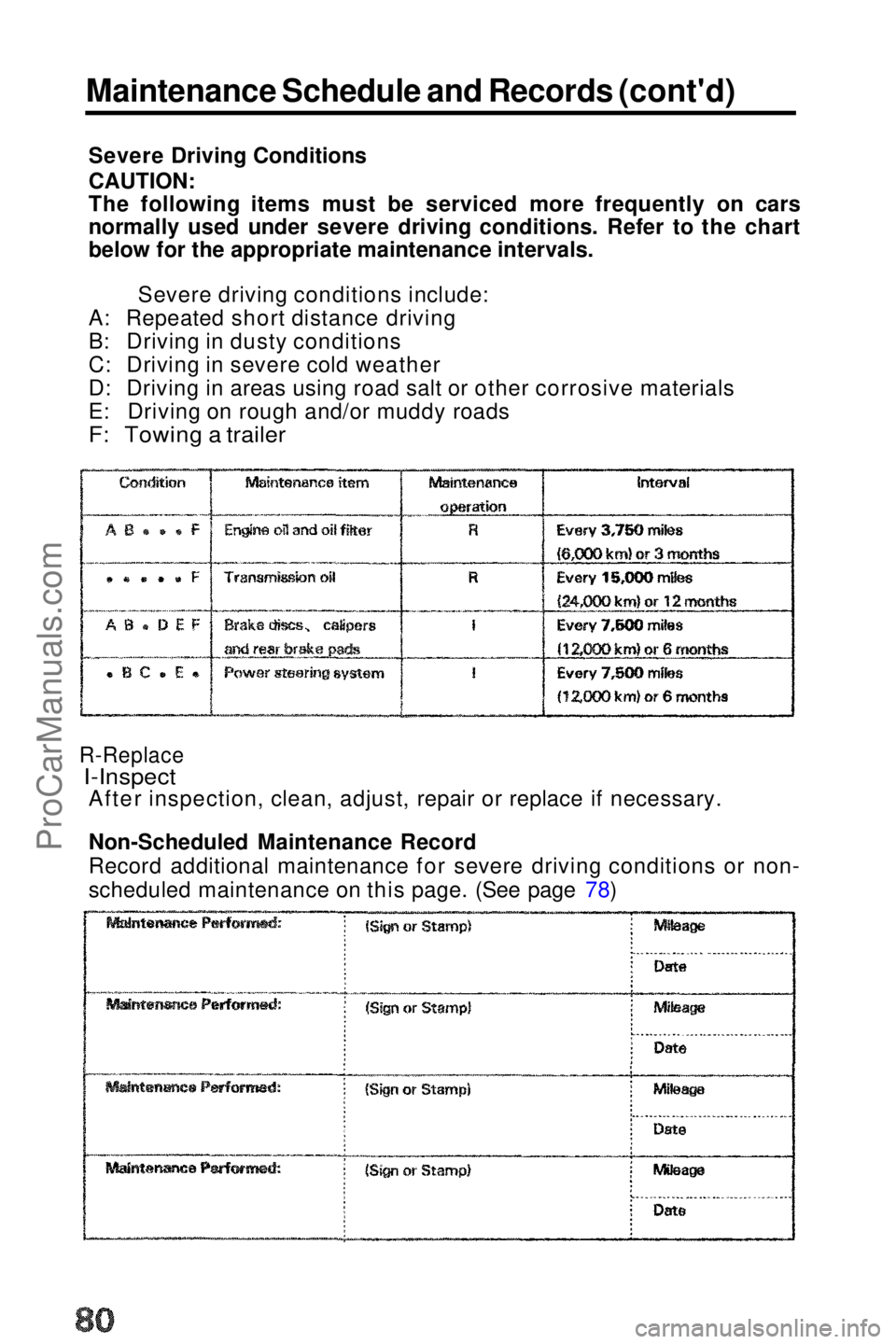
The following items must be serviced more frequently on cars
normally used under severe driving conditions. Refer to the chart
below for the appropriate maintenance intervals. Severe driving conditions include:
A: Repeated short distance driving
B: Driving in dusty conditions
C: Driving in severe cold weather
D: Driving in areas using road salt or other corrosive materials
E: Driving on rough and/or muddy roads
F: Towing a trailer
R-Replace
I-Inspect
After inspection, clean, adjust, repair or replace if necessary.
Non-Scheduled Maintenance Record
Record additional maintenance for severe driving conditions or non-
scheduled maintenance on this page. (See page 78)ProCarManuals.comMain Menu t s
Page 83 of 143
Engine Oil and Filter
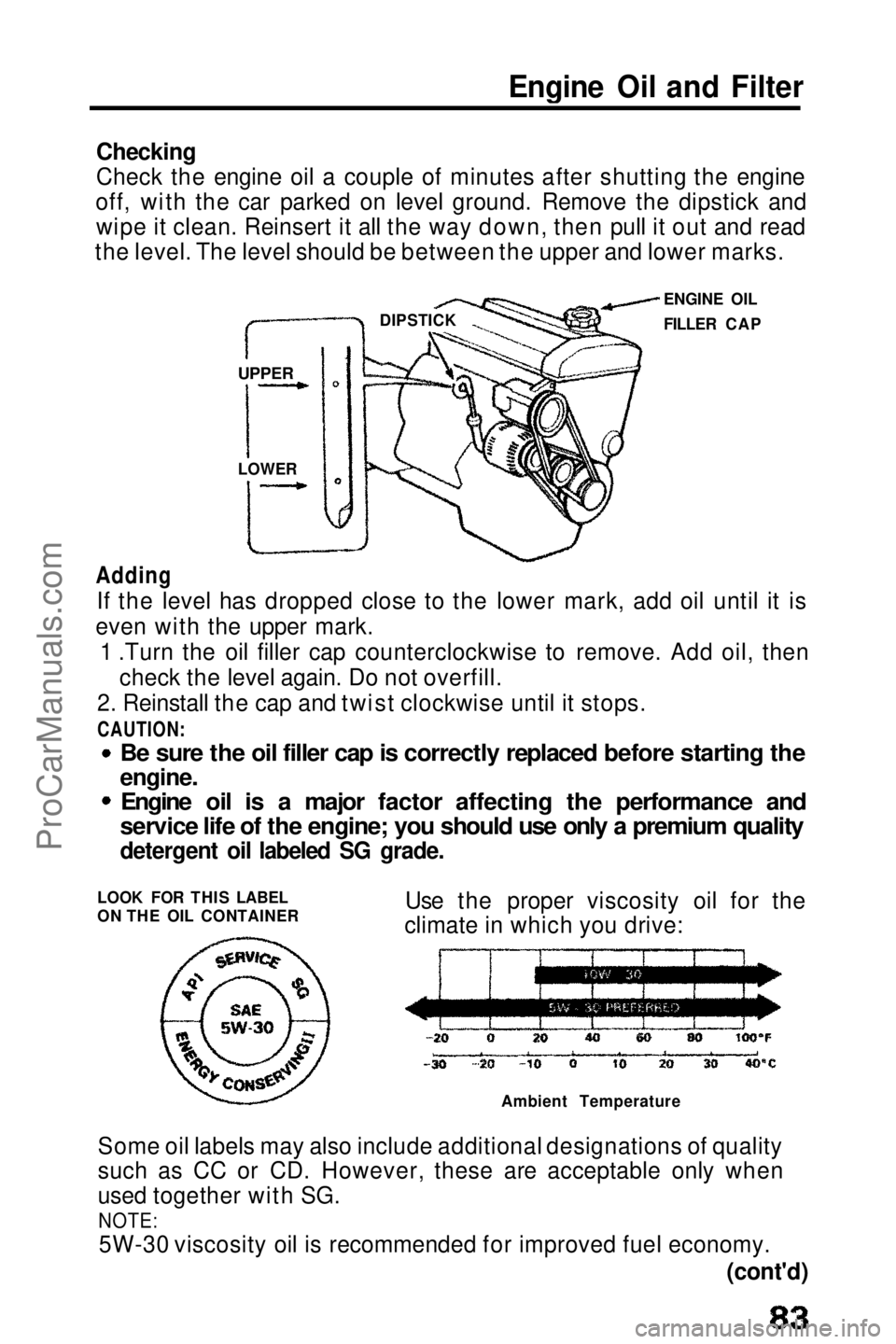
Checking
Check the engine oil a couple of minutes after shutting the engine
off, with the car parked on level ground. Remove the dipstick and wipe it clean. Reinsert it all the way down, then pull it out and read
the level. The level should be between the upper and lower marks.
ENGINE OIL
FILLER CAP
Adding
If the level has dropped close to the lower mark, add oil until it is
even with the upper mark. 1 .Turn the oil filler cap counterclockwise to remove. Add oil, then check the level again. Do not overfill.
2. Reinstall the cap and twist clockwise until it stops.
CAUTION:
Be sure the oil filler cap is correctly replaced before starting the
engine.
Engine oil is a major factor affecting the performance and
service life of the engine; you should use only a premium quality
detergent oil labeled SG grade.
LOOK FOR THIS LABEL
ON THE OIL CONTAINER
Use the proper viscosity oil for the
climate in which you drive:
Some oil labels may also include additional designations of quality
such as CC or CD. However, these are acceptable only when
used together with SG.
NOTE:
5W-30 viscosity
oil is recommended for improved fuel economy.
(cont'd)
Ambient Temperature
UPPER
LOWER
DIPSTICKProCarManuals.comMain Menu t s
Page 85 of 143

5. Reinstall the drain bolt with a new washer and tighten it securely.
Refill the engine with the recommended oil, to the upper mark on
the dipstick.
ENGINE OIL CHANGE CAPACITY (including filter):
3.8 l (4,0 US qt, 3.3 Imp qt)
6. Start the engine and make sure oil is not leaking from the drain
bolt or filter.
7. Shut off the engine and recheck the oil level.
NOTE:
Please dispose of used motor oil in a manner that is compatible with
the environment. We suggest you take it in a sealed container to
your local service station for reclamation. Do not throw it in the
trash or pour it on the ground.
CAUTION:
Used motor oil may cause skin cancer if repeatedly left in contact
with the skin for prolonged periods. Although this is unlikely unless you handle used oil on a daily basis, it is still advisable to
thoroughly wash your hands with soap and water as soon as possible after handing used oil.ProCarManuals.comMain Menu t s
Page 98 of 143
Brakes
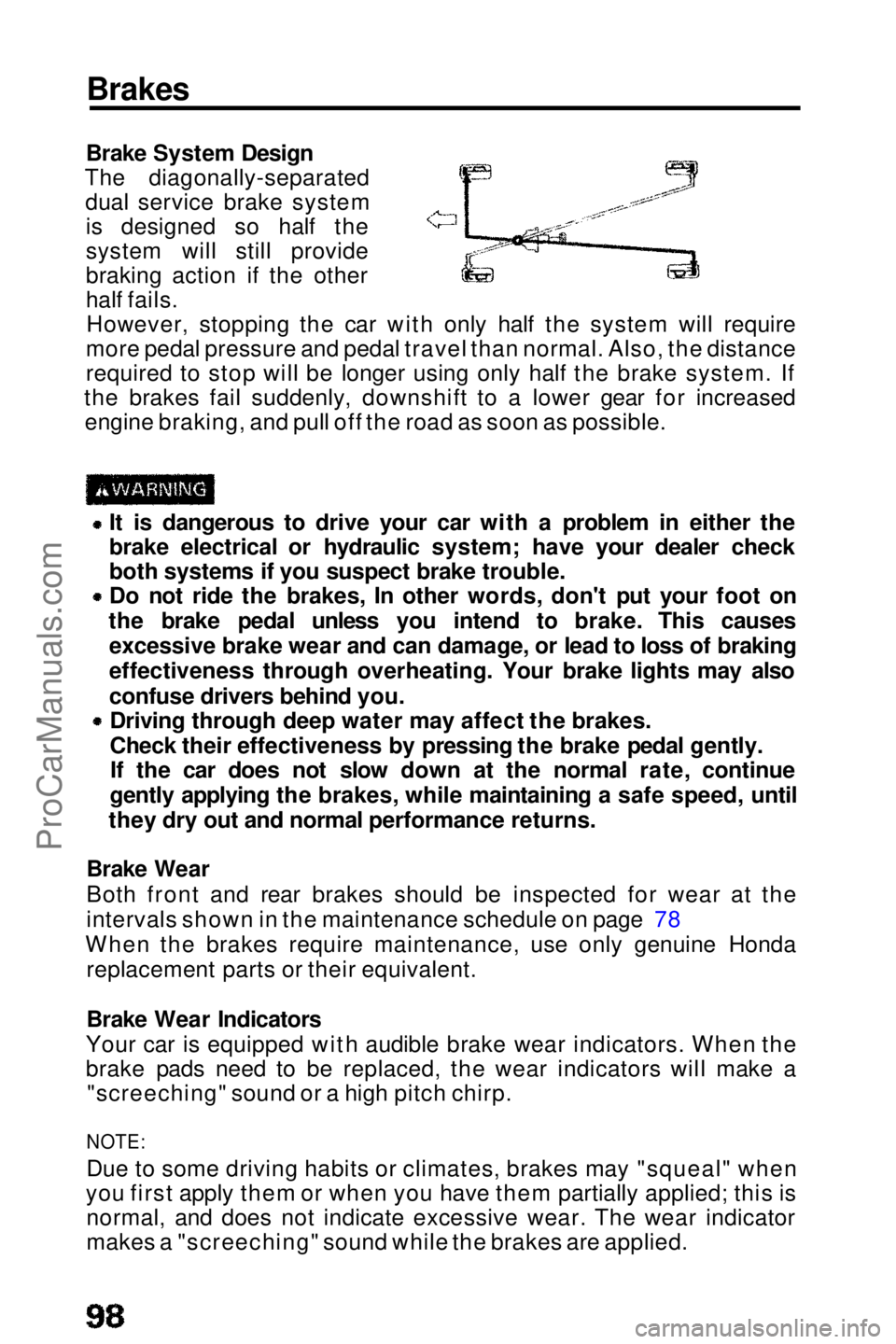
Brake System Design
The diagonally-separated dual service brake systemis designed so half the
system will still provide
braking action if the other
half fails.However, stopping the car with only half the system will require
more pedal pressure and pedal travel than normal. Also, the distance
required to stop will be longer using only half the brake system. If
the brakes fail suddenly, downshift to a lower gear for increased engine braking, and pull off the road as soon as possible.
It is dangerous to drive your car with a problem in either the
brake electrical or hydraulic system; have your dealer check
both systems if you suspect brake trouble. Do not ride the brakes, In other words, don't put your foot on
the brake pedal unless you intend to brake. This causes excessive brake wear and can damage, or lead to loss of braking
effectiveness through overheating. Your brake lights may also
confuse drivers behind you.Driving through deep water may affect the brakes.
Check their effectiveness by pressing the brake pedal gently.If the car does not slow down at the normal rate, continue
gently applying the brakes, while maintaining a safe speed, until
they dry out and normal performance returns.
Brake Wear
Both front and rear brakes should be inspected for wear at the
intervals shown in the maintenance schedule on page 78
When the brakes require maintenance, use only genuine Honda replacement parts or their equivalent.
Brake Wear Indicators
Your car is equipped with audible brake wear indicators. When the
brake pads need to be replaced, the wear indicators will make a "screeching" sound or a high pitch chirp.
NOTE:
Due to some driving habits or climates, brakes may "squeal" when
you first apply them or when you have them partially applied; this is normal, and does not indicate excessive wear. The wear indicator
makes a "screeching" sound while the brakes are applied.ProCarManuals.comMain Menu t s
Page 100 of 143
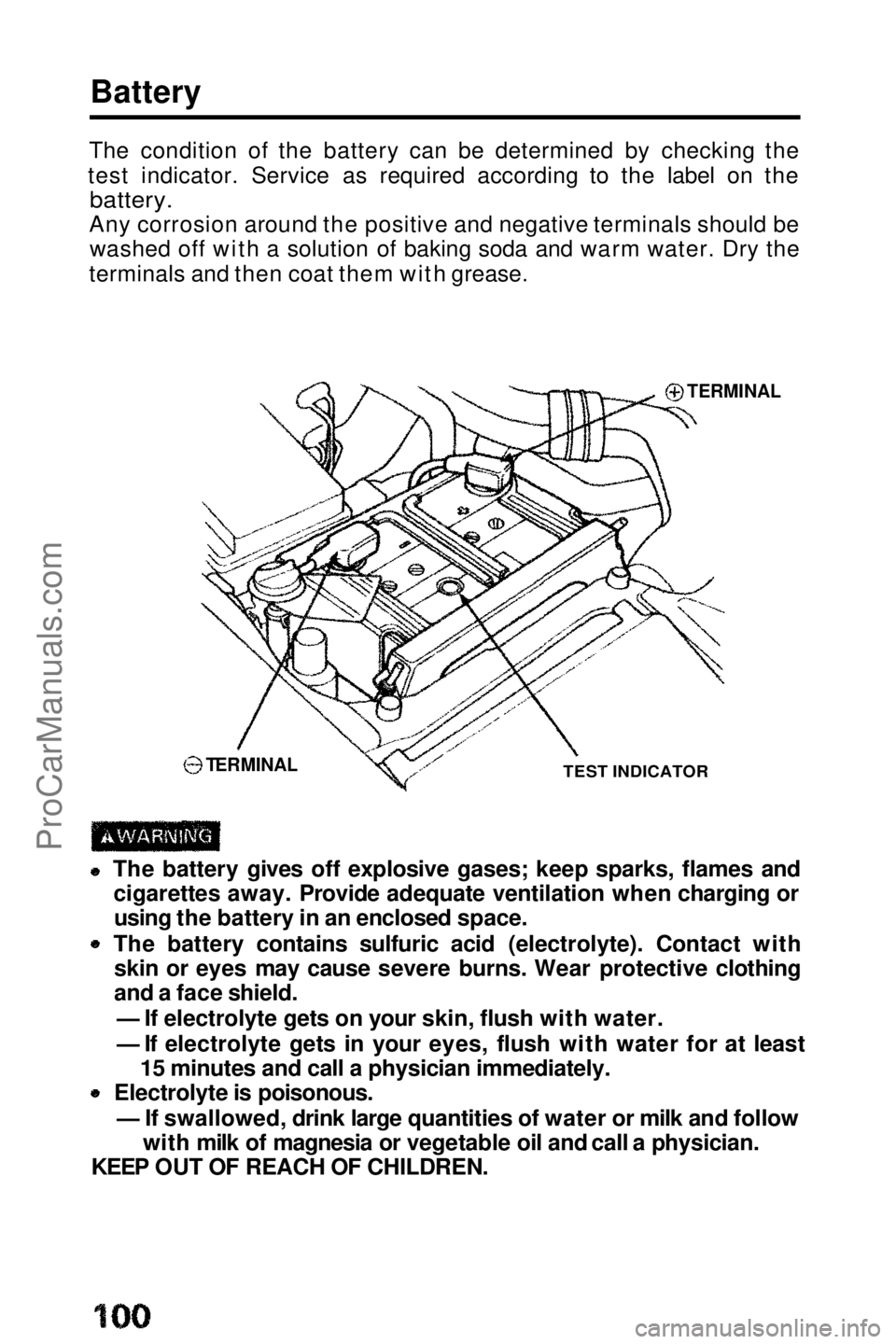
The condition of the battery can be determined by checking the
test indicator. Service as required according to the label on the
battery.
Any corrosion around the positive and negative terminals should be washed off with a solution of baking soda and warm water. Dry the
terminals and then coat them with grease.
The battery gives off explosive gases; keep sparks, flames andcigarettes away. Provide adequate ventilation when charging orusing the battery in an enclosed space.
The battery contains sulfuric acid (electrolyte). Contact with skin or eyes may cause severe burns. Wear protective clothing
and a face shield.
— If electrolyte gets on your skin, flush with water.
— If electrolyte gets in your eyes, flush with water for at least
15 minutes and call a physician immediately.
Electrolyte is poisonous.
— If swallowed, drink large quantities of water or milk and follow with milk of magnesia or vegetable oil and call a physician.
KEEP OUT OF REACH OF CHILDREN.
Battery
TEST INDICATOR
TERMINAL
TERMINAL
ProCarManuals.comMain Menu t s