tire pressure HONDA PRELUDE 1990 Owners Manual
[x] Cancel search | Manufacturer: HONDA, Model Year: 1990, Model line: PRELUDE, Model: HONDA PRELUDE 1990Pages: 143, PDF Size: 2.07 MB
Page 18 of 143
ALB (Anti Lock Brakes) help to maintain the road holding and
tractability of your car during severe braking, and under slippery road conditions. The ALB system prevents the wheels from locking(thus reducing the chance of skidding) to ensure controllable
deceleration. When sudden braking might otherwise lock one or more wheels, the ALB system temporarily reduces the braking
pressure to the wheel or wheels about to lock to ensure continued
braking efficiency.
When the ALB is regulating the braking pressure, the brake pedal pulsates slightly to make the driver aware that the system is
compensating for critical braking conditions. The pulsating brake pedal can be an indication of hazardous road condition, and to
remind you to take extra care.
Don't mix different diameter tires; it will confuse the ALB
computer which monitors the road speed of each wheel. For
example, if one or more tires are larger than the others, the computer will think they are rolling more slowly (as if they are
about to lock up) and reduce brake pressure to those wheels.On loose or uneven surfaces (gravel, ruts etc.) where all four
wheels loss traction intermittently, the ALB system may require
a longer stopping distance than an equivalent car with a conventional braking system.
The ALB system cannot make up for extreme road conditions or driver misjudgement, It is still the driver's responsibility to drive
at a suitable speed and provide a margin of safety for the road,
weather and traffic conditions at hand.
CAUTION:
Be careful not to damage the wiring or the speed sensors at the
back of each wheel when removing mud or snow from the wheel
housings.
NOTE:
You may hear a sound like a small motor running, coming from the engine while driving or after the ALB is applied. This indicates theALB pump is in service and the system is working properly.
Ant
i
Lock Brake (Si with ALB)
ProCarManuals.comMain Menu t s
Page 57 of 143
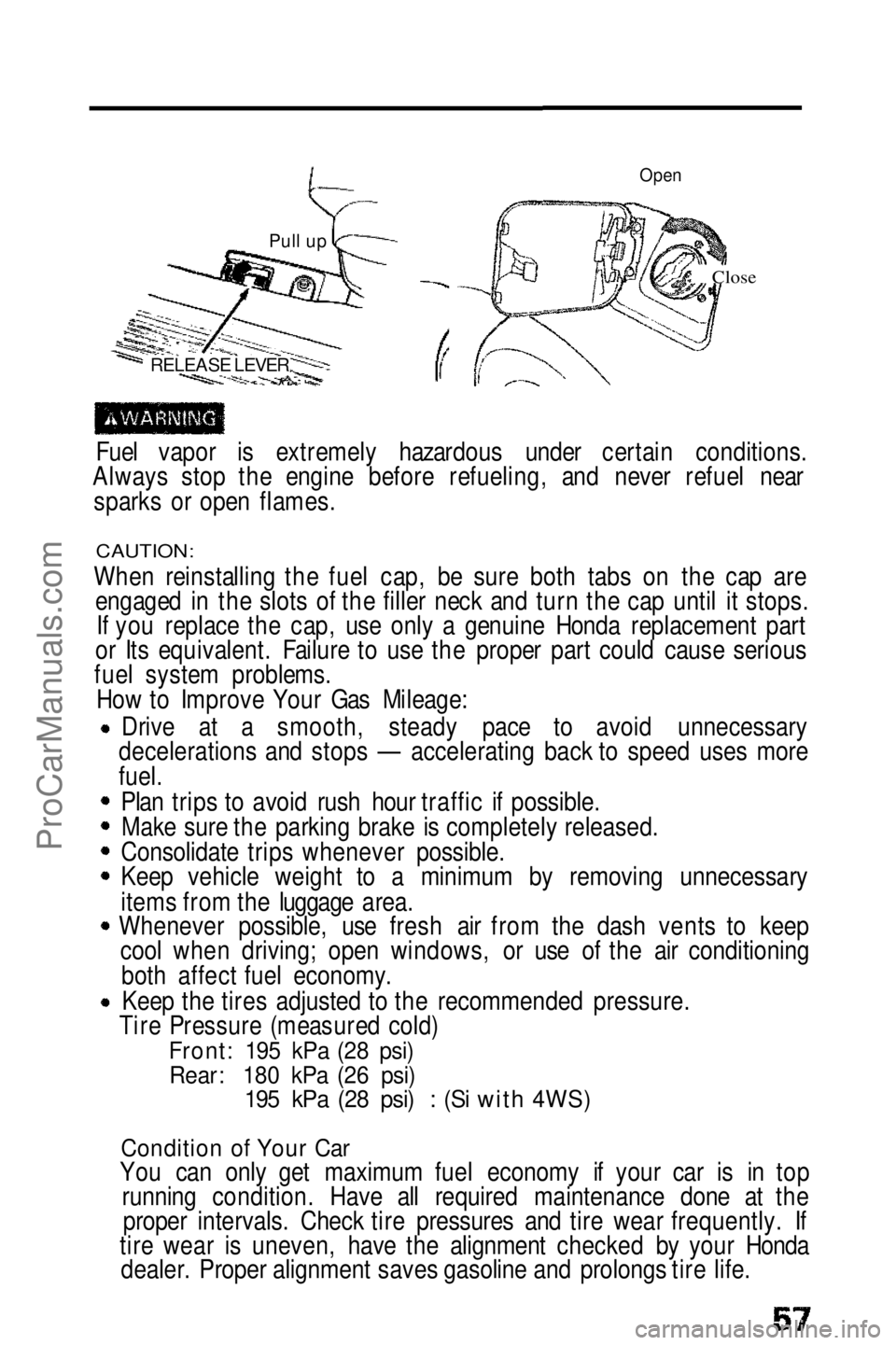
Open
Close
Fuel vapor is extremely hazardous under certain conditions.
Always stop the engine before refueling, and never refuel near
sparks or open flames.
CAUTION:
When reinstalling the fuel cap, be sure both tabs on the cap are engaged in the slots of the filler neck and turn the cap until it stops.
If you replace the cap, use only a genuine Honda replacement part
or Its equivalent. Failure to use the proper part could cause serious
fuel system problems.
How to Improve Your Gas Mileage:
Drive at a smooth, steady pace to avoid unnecessary
decelerations and stops — accelerating back to speed uses more
fuel.
Plan trips to avoid rush hour traffic if possible.Make sure the parking brake is completely released.
Consolidate trips whenever possible.
Keep vehicle weight to a minimum by removing unnecessary
items from the luggage area.
Whenever possible, use fresh air from the dash vents to keep
cool when driving; open windows, or use of the air conditioningboth affect fuel economy.
Keep the tires adjusted to the recommended pressure.
Tire Pressure (measured cold)
Front: 195 kPa (28 psi)
Rear: 180 kPa (26 psi)
195 kPa (28 psi) : (Si with 4WS)
Condition of Your Car
You can only get maximum fuel economy if your car is in top running condition. Have all required maintenance done at theproper intervals. Check tire pressures and tire wear frequently. If
tire wear is uneven, have the alignment checked by your Honda dealer. Proper alignment saves gasoline and prolongs tire life.
RELEASE LEVER
Pull upProCarManuals.comMain Menu t s
Page 72 of 143

Towing a Trailer (cont'd)
Hitches
Use only a hitch recommended by your Honda dealer. The hitch
should be bolted securely to the car and installed by a qualified
technician. Do not use a hitch designed for temporary installation
and never use one that attaches only to the bumper.
Trailer Brakes and safety chains
The Honda Automobile Division recommends that trailers equippedwith brakes, should conform to any applicable federal and stateregulations, When using a trailer equipped with electric brakes, a
trailer brake controller that connects to the car's electrical system is recommended. Installing a brake controller that connects to the car's
brake hydraulic system could result in brake fluid contamination or
leaks, A safety chain must always be used between the car and the
trailer. Leave sufficient slack in the chain so that it does not bind in
sharp turns. The chain should cross under the trailer tongue to prevent the tongue from dropping to the ground.
Tires
Make sure your car's are properly inflated. Adjust tire pressure
to the recommended tire pressure indicated on the label attached to
the edge of the driver's door.The trailer tires should be of the proper size, load rating and inflated to the pressure recommended
by the trailer manufacturer.
Trailer Lights
Trailer light must comply with federal, state and local regulations. See your local recreation vehicle dealer or rental agency for the
correct type of lighting and wiring for your trailer, Check for correct
operation of the turn signals and stop lights each time you hitch up.
CAUTION:
Connections to your car's electrical system should be made by
your Honda dealer or a qualified electrician.Improper installation
may damage your vehicle's electrical system and cause a
malfunction of the lights.
ProCarManuals.comMain Menu t s
Page 77 of 143

Check the following items at each fuel stop:
1. Engine oil level.
2. Radiator coolant level.
Check the following items periodically: 1. Brakes: for braking efficiency, brake pedal travel and hydraulic fluid level.
2. Lights: for operation of headlights, taillights, side marker lights, stoplights, turn signals and back-up lights.
3. Tires: for correct pressures (including spare); inspect for cuts and uneven or excessive wear. Rotate every 7,500 miles (12,000 km)
in the pattern shown on page 107.
4. Steering: for excessive play or vibration while driving. 5. Exhaust system: for leaks or loose mounts.
6. Wipers: for operation of windshield wipers and washer, and condition of wiper blades.
7. Seat belts: for condition of fabric and buckles, and operation of the restraint mechanism.
8. Battery condition.
(cont'd)ProCarManuals.comMain Menu t s
Page 105 of 143
The factory-installed tires on your car were selected to provide the
best performance for normal driving.
Inflation Pressures
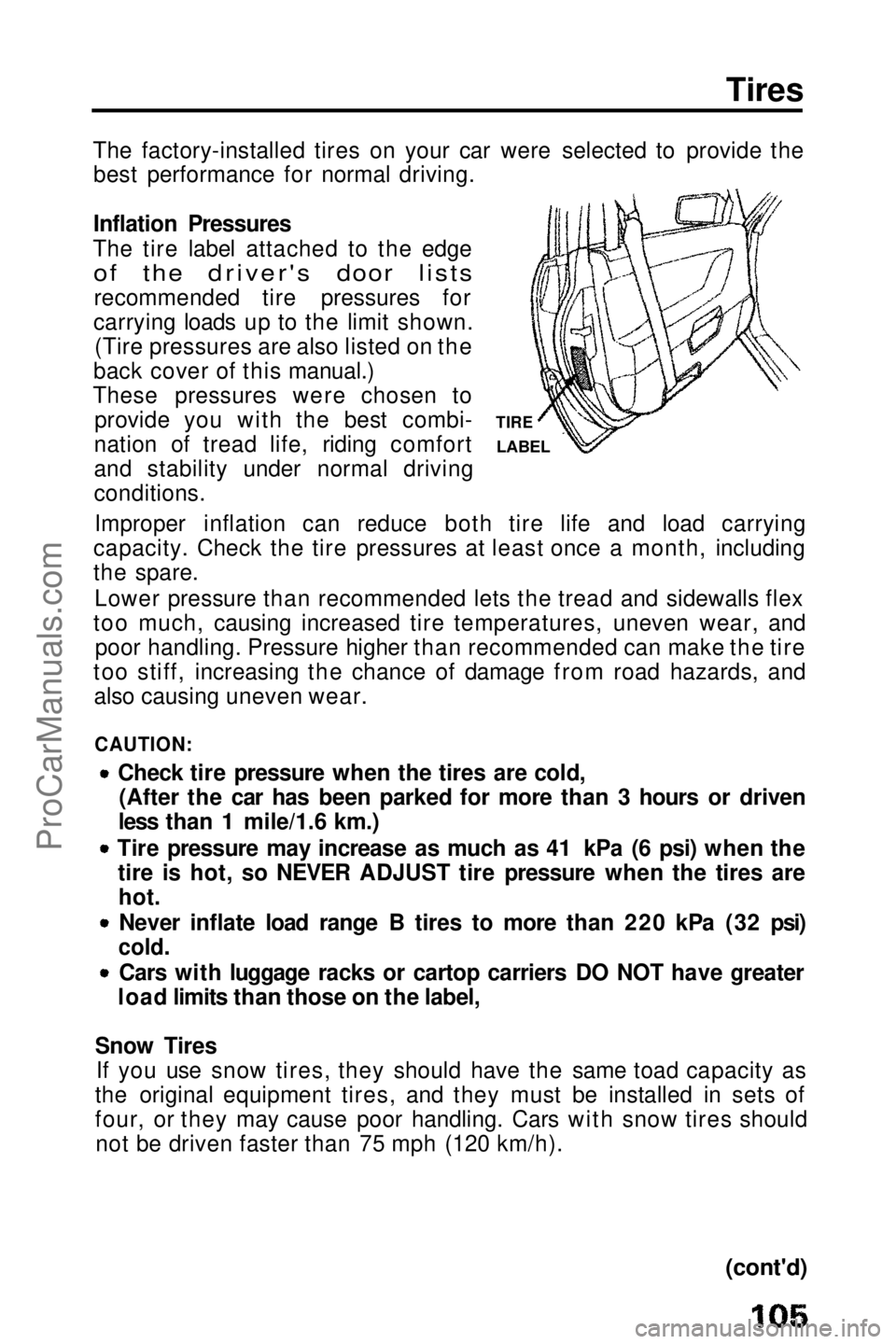
The tire label attached to the edge
of the driver's door lists
recommended tire pressures for
carrying loads up to the limit shown. (Tire pressures are also listed on the
back cover of this manual.)
These pressures were chosen to provide you with the best combi-
nation of tread life, riding comfort
and stability under normal driving
conditions.
Improper inflation can reduce both tire life and load carrying
capacity. Check the tire pressures at least once a month, including
the spare.
Lower pressure than recommended lets the tread and sidewalls flex
too much, causing increased tire temperatures, uneven wear, and poor handling. Pressure higher than recommended can make the tire
too stiff, increasing the chance of damage from road hazards, and also causing uneven wear.
CAUTION: Check tire pressure when the tires are cold,(After the car has been parked for more than 3 hours or driven
less than 1 mile/1.6 km.) Tire pressure may increase as much as 41 kPa (6 psi) when the
tire is hot, so NEVER ADJUST tire pressure when the tires arehot.
Never inflate load range B tires to more than 220 kPa (32 psi)
cold.
Cars with luggage racks or cartop carriers DO NOT have greater
load limits than those on the label,
Snow Tires If you use snow tires, they should have the same toad capacity as
the original equipment tires, and they must be installed in sets of
four, or they may cause poor handling. Cars with snow tires should not be driven faster than 75 mph (120 km/h).
(cont'd)Tires
TIRE
LABELProCarManuals.comMain Menu t s
Page 112 of 143
Appearance Care (cont'd)
Rust Prevention
Rusting is likely to occur in parts of the car where water is trapped
or where there is continual dampness. Water will collect inside doors and body panels if drain holes
become clogged.
Water which seeps under or soaks floor mats will subject floor sections to prolonged wetness or dampness. Road dirt or sand, which collects and fills recesses on the
underside of the car, retains moisture long after the rest of the
car has dried.
The removal of paint and undercoating by stones, gravel, and minor accidents immediately exposes metal to air and moisture.Rusting is increased by high humidity and by the presence of
corrosive substances in the air or on the roads.
Salt used for road de-icing will coat the bottom of the ear and
hasten rusting.Localities with high humidity have greater potential for rust
problems, especially where salt is also present on the road or in
moist sea air.
Industrial pollution will accelerate the deterioration of paint
finishes and promote rusting.
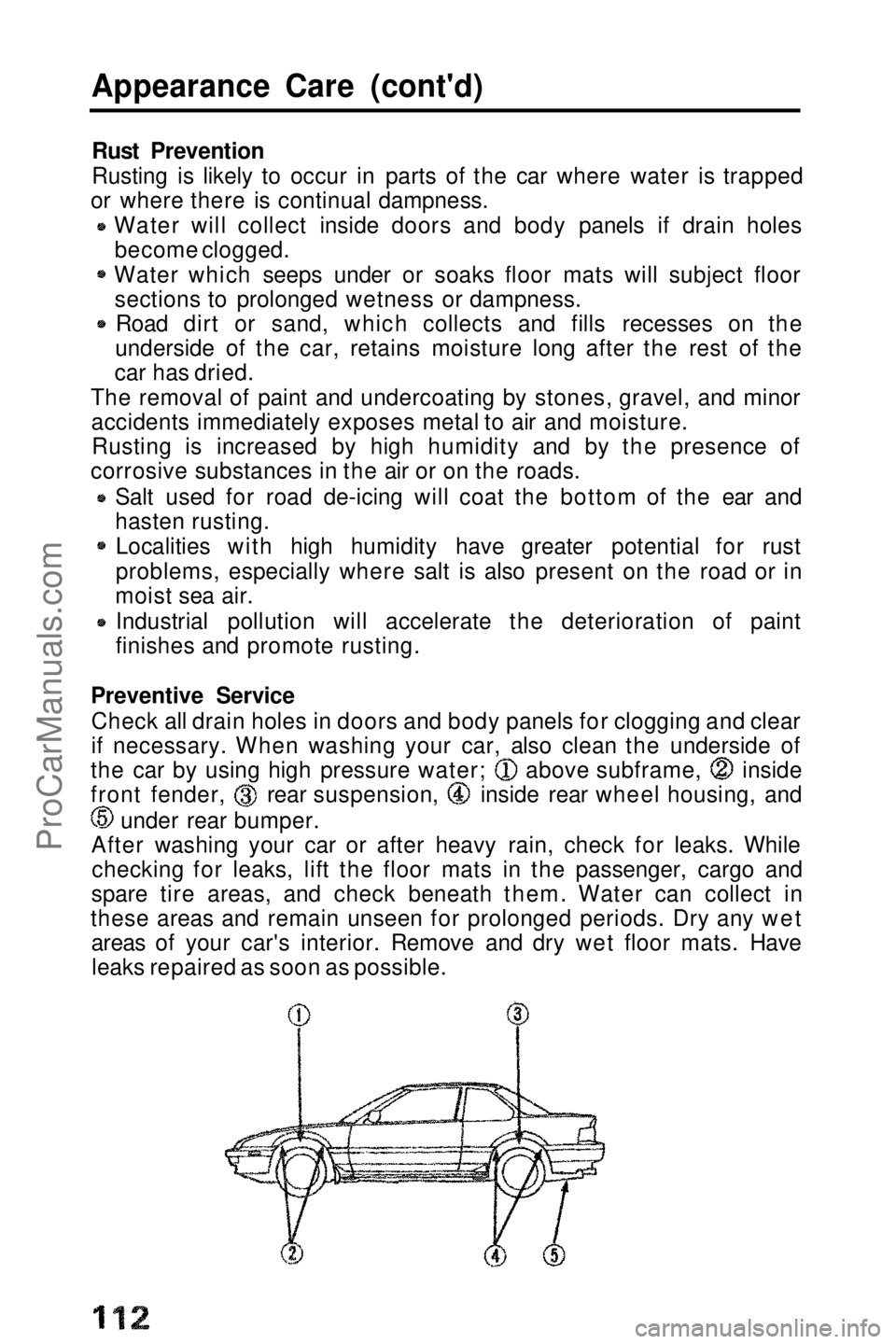
Preventive Service Check all drain holes in doors and body panels for clogging and clear
if necessary. When washing your car, also clean the underside of the car by using high pressure water; above subframe, inside
front fender, rear suspension, inside rear wheel housing, and
under rear bumper.
After washing your car or after heavy rain, check for leaks. While checking for leaks, lift the floor mats in the passenger, cargo and
spare tire areas, and check beneath them. Water can collect in
these areas and remain unseen for prolonged periods. Dry any wet areas of your car's interior. Remove and dry wet floor mats. Haveleaks repaired as soon as possible.ProCarManuals.comMain Menu t s
Page 114 of 143
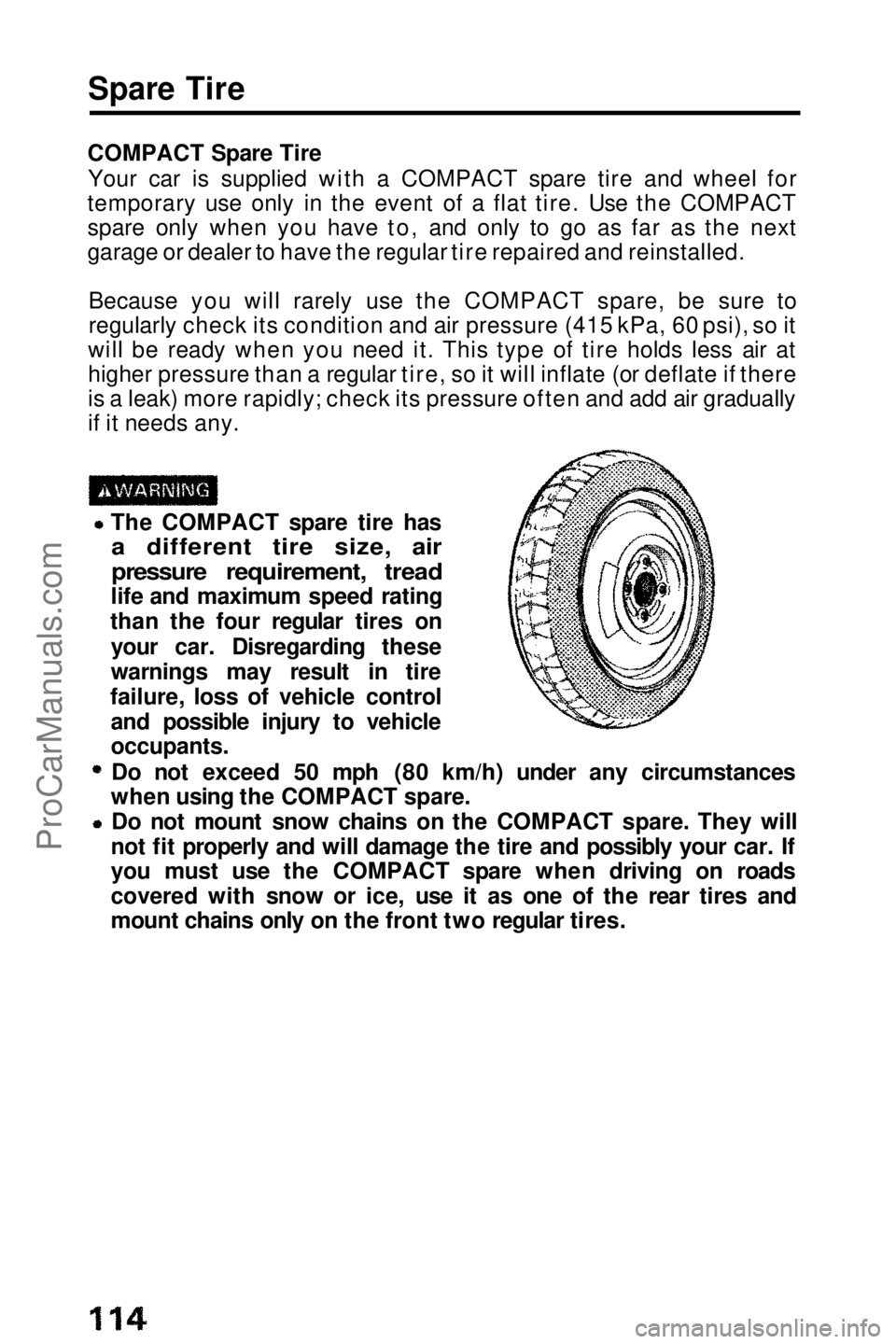
Spare Tire
COMPACT Spare Tire Your car is supplied with a COMPACT spare tire and wheel for
temporary use only in the event of a flat tire. Use the COMPACT
spare only when you have to, and only to go as far as the next
garage or dealer to have the regular tire repaired and reinstalled.
Because you will rarely use the COMPACT spare, be sure to
regularly check its condition and air pressure (415 kPa, 60 psi), so it
will be ready when you need it. This type of tire holds less air at
higher pressure than a regular tire, so it will inflate (or deflate if there
is a leak) more rapidly; check its pressure often and add air gradually
if it needs any. The COMPACT spare tire has
a different tire size, air
pressure requirement, tread
life and maximum speed rating
than the four regular tires on
your car. Disregarding these
warnings may result in tire
failure, loss of vehicle control and possible injury to vehicle
occupants.
Do not exceed 50 mph (80 km/h) under any circumstances
when using the COMPACT spare. Do not mount snow chains on the COMPACT spare. They will
not fit properly and will damage the tire and possibly your car. If
you must use the COMPACT spare when driving on roads
covered with snow or ice, use it as one of the rear tires and
mount chains only on the front two regular tires.ProCarManuals.comMain Menu t s
Page 115 of 143
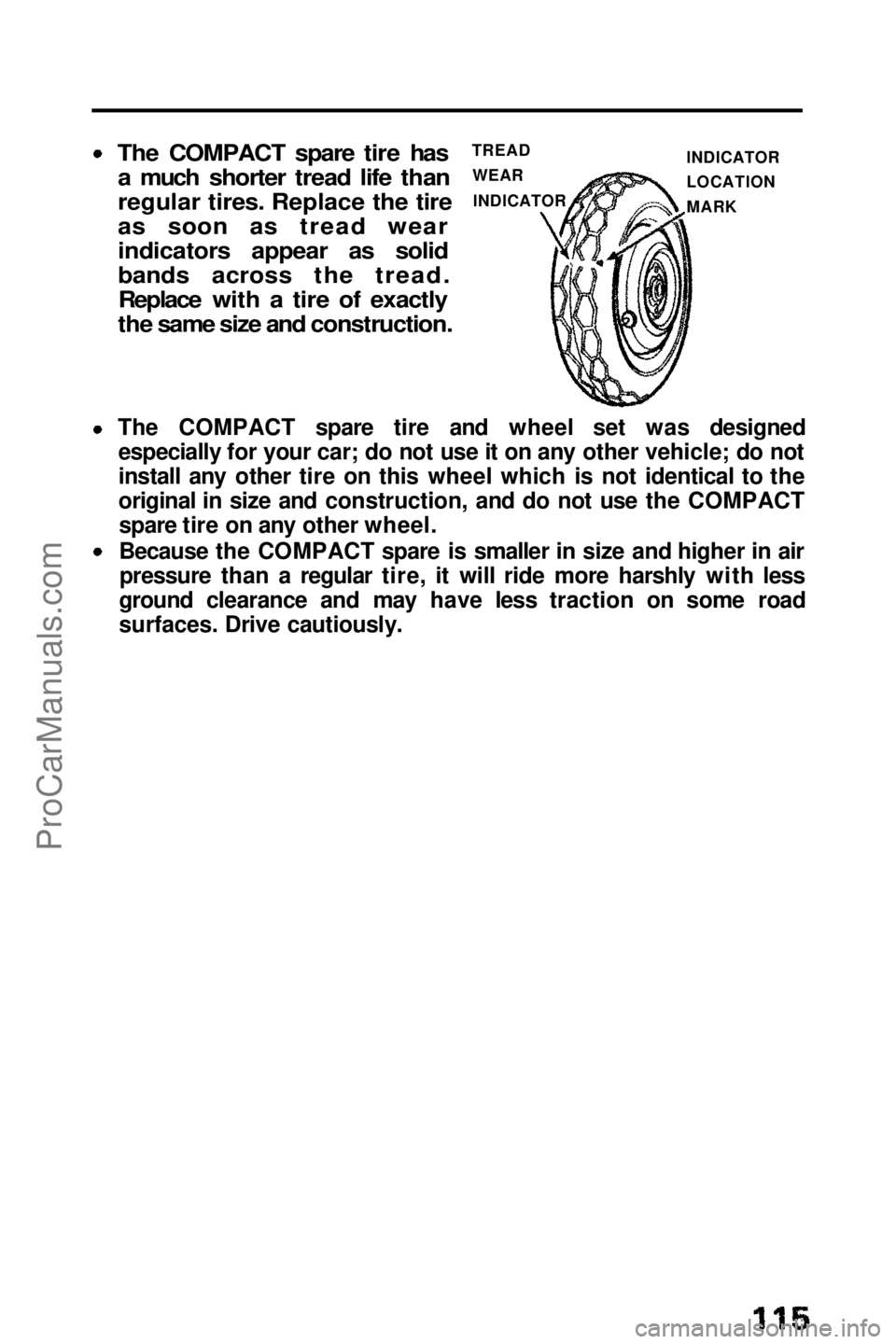
The COMPACT spare tire has
a much shorter tread life than
regular tires. Replace the tire
as soon as tread wear
indicators appear as solid
bands across the tread.Replace with a tire of exactly
the same size and construction.
The COMPACT spare tire and wheel set was designed especially for your car; do not use it on any other vehicle; do not
install any other tire on this wheel which is not identical to the
original in size and construction, and do not use the COMPACTspare tire on any other wheel.
Because the COMPACT spare is smaller in size and higher in airpressure than a regular tire, it will ride more harshly with less
ground clearance and may have less traction on some road
surfaces. Drive cautiously. INDICATOR
LOCATION
MARK
TREAD
WEAR
INDICATORProCarManuals.comMain Menu t s
Page 137 of 143
Index
(cont'd)
Air Conditioner
Operation.....................................
43
Service.......................................108
Air Filte
r ...........................................95
Air Pressure, Tires........................105
Aluminum Alloy Wheels...............111
Antifreeze ..................See
"Radiator coolant"
Anti Lock Brakes(ALB) ..................18 ALB Warning Light .....................
24
ALB Fluid
.....................................
99
Anti-theft Steering
Column Lock
System.........................................58
Appearance Care .........................
110
Ashtrays..........................................38
Audio System
.................................
47
Automatic Transmission
Driving Technique ......................68
Fluid.............................................87
Operation....................................67
Shift Lever
Position
Indicator .................................
21 Battery
Charging System Warning
Light.......................................23
Jump Starting ...........................119 Maintenance .............................100
Specification ........................... 126
Beeper System Fasten Seat Belt Beeper ............13
Key Reminder .............................58
Light Reminder Chime ................30
Belts,Seat...............See "Seat Belts"
Brake Lamp Warning Light.............25
Brakes Brake Failure Warning Light .......................................23
Brake Fluid...................................99
Brake System Design .................98
Brake Wear .................................98
Brake Wear Indicators................98
Parking Brake ..............................39
Parking Brake Warning Light .......................................23
Break-in Period ..................................2
Bulb
Replacement.............................103
Specification .............................126
Buzzer ............See "Beeper System"
Capacities......................................125
Care and Cleaning.........................110
Catalytic Converter .....................134
Certification Label ........................127
Chains,Tires ................................. 106
Child Restraint System ..................14
Cigarette Lighter .............................38
Clock................................................37
COMPACT Spare Tire .................114Coolant Temperature Gauge .........20
Cooling(with A/C) ...........................44 Cooling System ...............................88
Crankcase Emission ControlSystem ..........................................
130
Cruise Control
Opeartion...................................
35Indicator .....................................22
Defogger.........................................28
Defroster .........................................45
Dimmer Switch, Headlights...........31
Doors
Locks............................................3
Warning Light ............................25
Emergency
Changing Flat Tire ...................116
Hazard Warning System ..........33If the Retractable Headlights do not operate ...................123
If the Sunroof Won't
Close .....................................54
If Your Car Gets Stuck ...........122
Jump Starting .........................119Towing.....................................121Warning and
Indicator
Lights....................................21
ProCarManuals.comMain Menu t s
Page 138 of 143
Index (cont'd)
Emission Controls.........................130
Engine
Coolant.......................................88
Coolant Temperature
Gauge....................................20
Identification Number .............127
Oil and Filter...............................83
Oil Pressure
Warning
Light .......................................22
Specification ...........................125
Exhaust Controls....................131
Engine Exhaust Ga
s Warning
....................................................64
Evaporative Emission Control
System ....................................131
Exhaust Gas Recirculation...........132
Exterior Care.................................110
Filters
Air...........................................94
Engine Oil ...................................84
Fuel.............................................96
Fluid .....................................See "Oil"
Foreign Countries, Operation in ...............................56
Four Wheel Steering.......................59 Front Seat
Adjustment..................................5
Fuel
Filter Door and Cap...................56
Fuel Reserve
Warning
Light .......................................22
Gauge.........................................20
Gasohol......................................55
Gasoline ......................................55
Requirement..............................55
Filter...........................................96
Fuse
Checking and Replacing .........101
Specification...........................126 Gasoline............................See"Fuel"
Gas Station Information
...........................................back cover
Gauges............................................20
Glove Box ........................................39
Hazard Warning
Indicator Light ...........................21
Hazard Warning System................33
Headlights
Flasher.......................................31
Headlight Motor
Switch ...........32
High Beam Indicator..................21
High Beam/Low
Beam
Switch...................................31
If the
Retractable Headlights
do not operate ...................123
Reminder Chime
.......................30
Retractable Headlight Motor Warning Light .......................25
Switch.......................................30
Headlight High
Beam Indicator
Light ...........................................21
Head Restraints.................................8
Heating.............................................45
High Bea
m
Switch .......................................31
Indicator Light ...........................21
Hood Latch.....................................39
Identification Numbers.................127
Ignition
Keys.............................................3
Switch........................................58
Indicator Lights ...............................20
Inflation Pressures, Tire..............105
Instrument Panel....................19
Instrument Panel
Brightness
Control.......................................33
Interior light .....................................33
Interior Trim Care .........................110 Jack .............................................116
Jump Starting ...............................119ProCarManuals.comMain Menu t s