towing HONDA PRELUDE 1990 Owners Manual
[x] Cancel search | Manufacturer: HONDA, Model Year: 1990, Model line: PRELUDE, Model: HONDA PRELUDE 1990Pages: 143, PDF Size: 2.07 MB
Page 1 of 143
 to navigate through\
this reference.
For a printed owners manual, click on authorized manuals or go")
1990 Prelude Online Reference Owner's Manual
Use these links (and links throughout this manual) to navigate through\
this reference.
For a printed owner's manual, click on authorized manuals or go to www.h\
elminc.com.
Features & Safety ........................................................................\
........................................................ 2
What you should know before driving your car.
Starting & Driving........................................................................\
.....................................................
55
What gas to use, how to change gears, etc.
Maintenance
........................................................................\
............................................................... 76
The Required Maintenance Schedule and some items you can service.
Emergency Service
........................................................................\
................................................ 116
Changing a flat, jump starting, towing.
Specifications
........................................................................\
......................................................... 125
Dimensions, weights and capacities.
Consumer Information
........................................................................\
.......................................... 127
Reporting Safety Detects, warranty service, vehicle identification numbe\
rs, etc.
Index ........................................................................\
....................... .................................................
137
Gas Station Information
Contents
Owner's Identification Form
ProCarManuals.com
Page 71 of 143
Towing a Trailer
Your car is designed primarily to carry passengers and a normal
amount of luggage. Although your car is capable of towing a trailer,
there will be an effect on handling, performance, braking, general
vehicle and tire durability and fuel economy. The weight of the trailer plus its cargo must not exceed a total
of 1,000 Ibs. (450 kg).
The gross vehicle weight must not exceed the Gross Vehicle
Weight Rating (GVWR) indicated on the Certification label (see page 127). The gross vehicle weight is the total weight of the
car, driver, passengers, luggage, hitch and trailer tongue load.
The total weight supported by each axle must not exceed the Gross Axle Weight Rating (GAWR). The front and rear GAWR's
are shown on the Certification label (page 127). The
distribution of luggage and passengers in the car, as well as the
tongue load and hitch weight should also be considered in terms of the GAWR, which is the maximum amount of weight that
should be supported over the front and the rear axles. You
should have your car and trailer weighed at a commercial
weighing station to check both the GVWR and GAWR's to
confirm that the total weight and weight distribution are within safe driving limits.
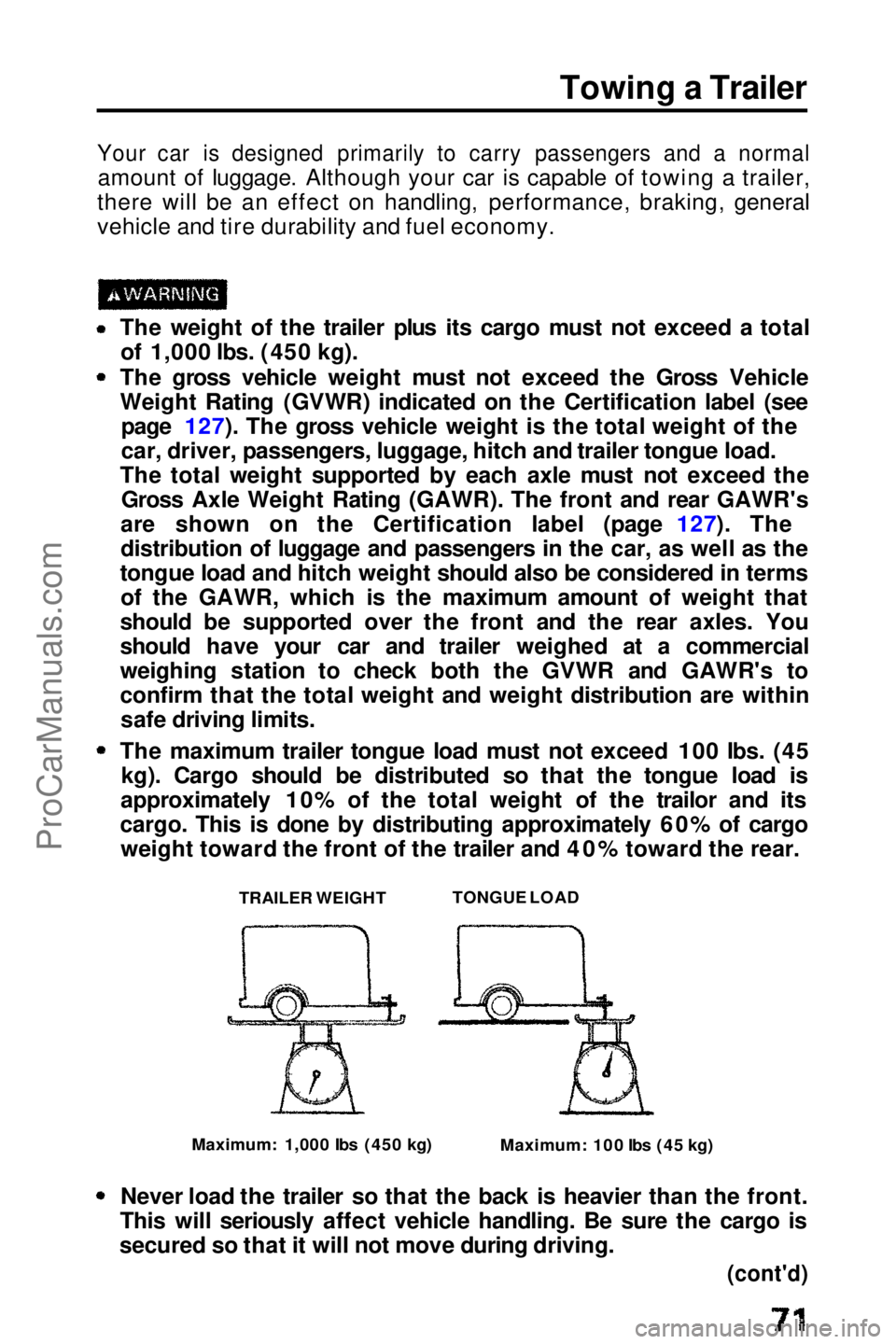
The maximum trailer tongue load must not exceed 100 Ibs. (45 kg). Cargo should be distributed so that the tongue load is
approximately 10% of the total weight of the trailor and its
cargo. This is done by distributing approximately 60% of cargo weight toward the front of the trailer and 40% toward the rear. Never load the trailer so that the back is heavier than the front.
This will seriously affect vehicle handling. Be sure the cargo is
secured so that it will not move during driving. TONGUE LOAD
TRAILER WEIGHT
Maximum: 100 Ibs (45 kg)
Maximum: 1,000 Ibs (450 kg)
(cont'd)ProCarManuals.comMain Menu t s
Page 72 of 143

Towing a Trailer (cont'd)
Hitches
Use only a hitch recommended by your Honda dealer. The hitch
should be bolted securely to the car and installed by a qualified
technician. Do not use a hitch designed for temporary installation
and never use one that attaches only to the bumper.
Trailer Brakes and safety chains
The Honda Automobile Division recommends that trailers equippedwith brakes, should conform to any applicable federal and stateregulations, When using a trailer equipped with electric brakes, a
trailer brake controller that connects to the car's electrical system is recommended. Installing a brake controller that connects to the car's
brake hydraulic system could result in brake fluid contamination or
leaks, A safety chain must always be used between the car and the
trailer. Leave sufficient slack in the chain so that it does not bind in
sharp turns. The chain should cross under the trailer tongue to prevent the tongue from dropping to the ground.
Tires
Make sure your car's are properly inflated. Adjust tire pressure
to the recommended tire pressure indicated on the label attached to
the edge of the driver's door.The trailer tires should be of the proper size, load rating and inflated to the pressure recommended
by the trailer manufacturer.
Trailer Lights
Trailer light must comply with federal, state and local regulations. See your local recreation vehicle dealer or rental agency for the
correct type of lighting and wiring for your trailer, Check for correct
operation of the turn signals and stop lights each time you hitch up.
CAUTION:
Connections to your car's electrical system should be made by
your Honda dealer or a qualified electrician.Improper installation
may damage your vehicle's electrical system and cause a
malfunction of the lights.
ProCarManuals.comMain Menu t s
Page 73 of 143

Break-in Schedule
Do not tow a trailer during the 600 mile (1,000 km) break-in period:
see page 2.
Maintenance
If you tow a trailer, your vehicle will require more frequent
maintenance due to the additional load. Refer to the "Maintenance
Schedule under severe driving conditions" on page 80 for specific
information.
Before Towing
With the car and trailer completely loaded and parked on a level surface, confirm that the tongue loading is correct. If the car has an
abnormal nose-up or nose-down attitude, check for improper cargo
distribution. Check also for excessive cargo weight, worn
suspension or other causes and correct the problem before driving.
Be sure the cargo is secured so it will not shift while driving. Check
that your rearview mirrors conform to any federal, state, or local regulations. If not, install rearview mirrors designed for towing.Before towing a trailer, practice turning, stopping and reversing with
a trailor in an area away from traffic until you learn the technique.
(cont'd)
ProCarManuals.comMain Menu t s
Page 74 of 143

Towing a Trailer (cont'd)
Towing Safety
Stopping distance will be increased when towing a trailer. For
each 10 mph (16 km/h) of speed, allow at least two car lengths between you and the vehicle ahead. Avoid sudden braking
which may cause trailer jackknifing and loss of control.
Avoid jerky starts and sudden acceleration. If your car has amanual transmission, always start out in first gear and release
the clutch at moderate engine rpm.
Avoid rapid lane changing and sharp turns. The trailer could hit your car in a tight turn. Slow down before making a turn.
Remember, the total length of your car plus trailer will require a
wider turning circle.
Crosswinds may adversely affect handling of your car and
trailer, Use the rearview mirrors frequently to warn you of approaching large vehicles that may pass you causing your car
and trailer to sway. When being passed, firmly grip the steering wheel and be prepared to reduce speed immediately but
gradually. Never increase speed. Steer straight ahead.
Towing a trailer in bad weather will magnify any difficulty in
controlling the car caused by the weather itself. Avoid sudden maneuvers: slow down and use extra caution.
Be careful when passing other vehicles. Passing requires
considerable distance because of the added weight and length
of your trailer.ProCarManuals.comMain Menu t s
Page 75 of 143

CAUTION:
Before starting out, check the operation of the lights and all car/
trailer connections. After driving a short distance, stop and
recheck the lights and connections.
Reversing is difficult and requires practice. While backing-up,
the trailer may pivot off-course. To correct for this, grip the bottom of the steering wheel and move your hand to the left to
move the trailer to the left, or to the right to move the trailer to
the right. Turn the steering wheel a little at a time, and keep the
speed very low. Have someon e guide you when backing.
To help
prevent overheating of the brakes, shift into a lower
gear to make use of engine braking before descending steep or
long grades. Do not make sudden downshifts. Pay strict attention to the coolant temperature gauge when
going up hills. Because of the added load of the trailer, your car's
engine may overheat on hot days. Turning off the air conditioner
will reduce the load on the cooling system.
On cars equipped with automatic transmission. —Do not hold the car stationary on an incline by using the accelerator pedal; this can cause the transmission fluid tooverheat. Instead, use the handbrake or footbrake.
—When towing trailers, avoid high transmission fluid temperatures (caused by the transmission frequently shiftingbetween 3rd and 4th gears) by driving in S3.
NOTE:
Be sure to check state and local laws concerning maximum speed or
other driving restrictions for cars towing trailers. If you are driving
across several states, check each state's requirements before
leaving home, because restrictions may vary.
Parking with a Trailer
Whenever parking your car on an incline with a trailer attached, first
place and seat chocks at each wheel of the car and trailer. This is in
addition to the normal parking preparations of firmly applying the parking brake and placing the transmission in first or reverse
(manual transmission) or P (automatic transmission).
CAUTION:
Parking on an incline is not recommended and should be done only
if it cannot be avoided. Follow all precautions mentioned above
and turn the wheels to point towards a curb if facing downhill,
away from a curb if facing uphill. When leaving an inclined parking place, move the car slightly to unseat the chocks. Then while
keeping the foot brakes firmly applied, have an assistant remove
the chocks.ProCarManuals.comMain Menu t s
Page 80 of 143
Maintenance Schedule and Records (cont'd)
Severe Driving Conditions
CAUTION:
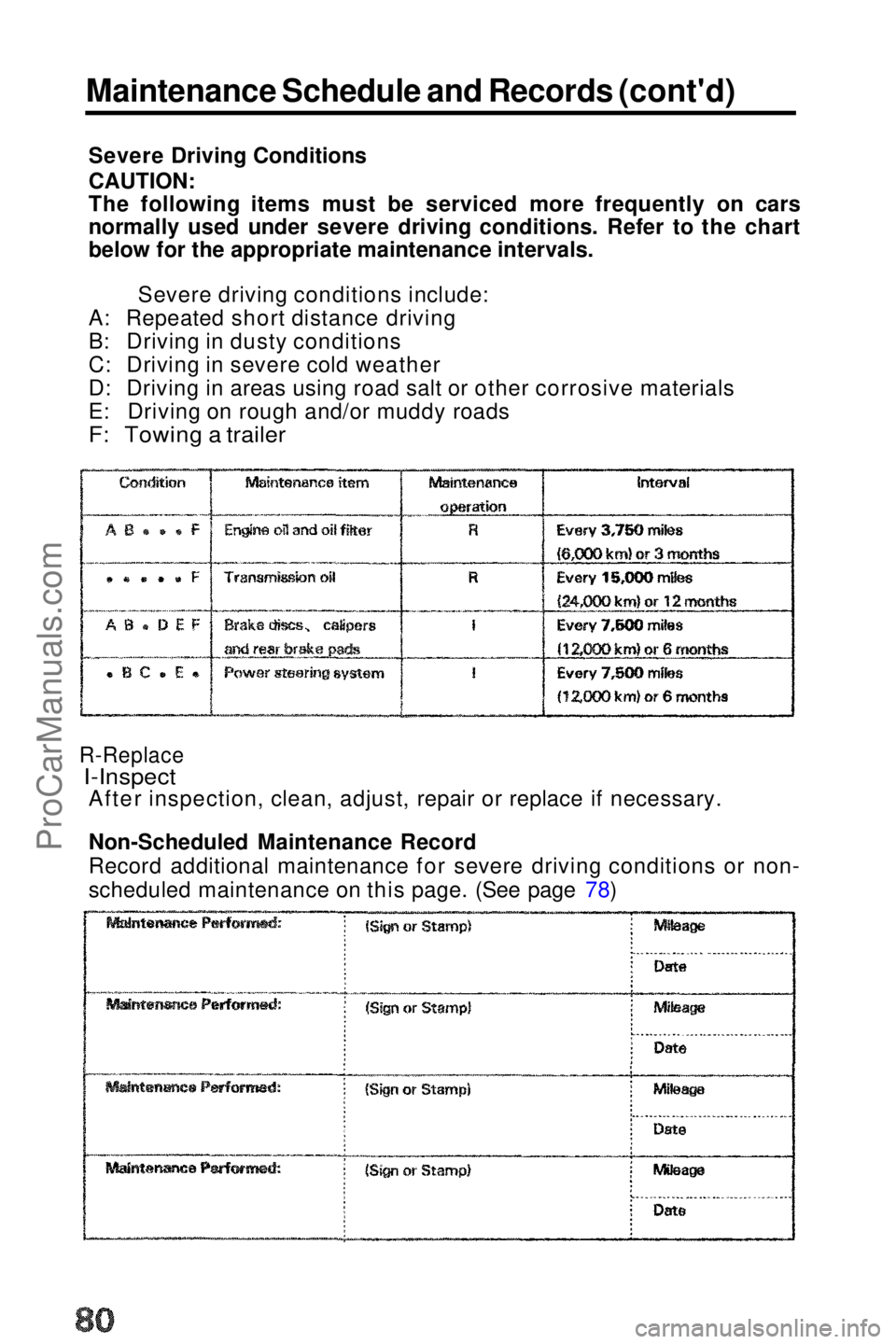
The following items must be serviced more frequently on cars
normally used under severe driving conditions. Refer to the chart
below for the appropriate maintenance intervals. Severe driving conditions include:
A: Repeated short distance driving
B: Driving in dusty conditions
C: Driving in severe cold weather
D: Driving in areas using road salt or other corrosive materials
E: Driving on rough and/or muddy roads
F: Towing a trailer
R-Replace
I-Inspect
After inspection, clean, adjust, repair or replace if necessary.
Non-Scheduled Maintenance Record
Record additional maintenance for severe driving conditions or non-
scheduled maintenance on this page. (See page 78)ProCarManuals.comMain Menu t s
Page 120 of 143

Jump Starting (cont'd)
3. Use the other cable to connect the negative terminal of the booster battery to the engine at the ground cable as shown.
4.To remove the cables, reverse the above procedures exactly.
DO NOT push or tow a car to start it. The forward surge when the
engine starts could cause a collision. Also, under some conditions,
the catalytic converter could be damaged. A car equipped with an
automatic transmission cannot be started by pushing or towing.
NOTE:
After jump-starting the car, there is a possibility that the ALB
warning light may come on due to insufficient battery voltage. After
the battery is sufficiently recharged and the engine is turned off and restarted, the ALB warning light should indicate that the ALB
system is OK, by coming on for a few seconds each time the engine is started. If the light remains on after recharging, have it checked
by a Honda dealer.ProCarManuals.comMain Menu t s
Page 121 of 143

If towing is necessary, contact a professional towing service. Your
authorized Honda dealer can assist you with detailed towing
instructions.
Never use tow chains or rope to tow a car; your ability to safety
control the car may be adversely affected.
We recommend the following:
Flat Bed Equipment — Entire car is winched on a flat bed vehicle.
This is the best way of transporting your Honda.
Wheel Lift Type — Tow with the front wheels off the ground.
If the
car can only be towed with the front wheels on the ground:
make sure the transmission is full of fluid (see page 86 — 87)
and tow with the transmission in neutral (N) and the ignition key in
the I position.
CAUTION:
To avoid serious damage on automatic transmission cars, first start the engine and shift to D, then to N and shut the engine off. If
the engine does not run or the transmission cannot be shifted
while the engine is running, the car must be transported on flatbed equipment.
Check local regulations for towing.
CAUTION:
Do not exceed 35 mph (55 km/h) or tow for distances of more
than 50 miles (80 km). If a Sling Type tow is used, the tow truck driver should position
wood spacer blocks between your car's frame and the chains
and lift straps to avoid damaging the bumper and the body. Do not use the bumpers to lift the car or to support the car's
weight while towing.
When towing a car with 4WS even with the front wheels off the ground, turn the wheels straight ahead and tie the steering wheel in place. TowingProCarManuals.comMain Menu s t
Page 122 of 143

If Your Car Gets Stuck
If your car gets stuck in sand, mud, or snow, call a professional
towing service for assistance in getting your car out,
CAUTION:
Do not rev up the engine and allow the wheels to spin freely at
high speed. Severe transmission damage may result if the wheels are allowed to spin for more than a few seconds. DO NOT try to free a car with automatic transmission from
snow etc. by rocking the car alternately between forward and
reverse gears. Severe transmission damage may result from
shifting into gear with the wheels moving.ProCarManuals.comMain Menu s t