air condition HONDA PRELUDE 1992 Owner's Manual
[x] Cancel search | Manufacturer: HONDA, Model Year: 1992, Model line: PRELUDE, Model: HONDA PRELUDE 1992Pages: 225, PDF Size: 2.1 MB
Page 156 of 225
Engine Belts, Tires
Engine Belts
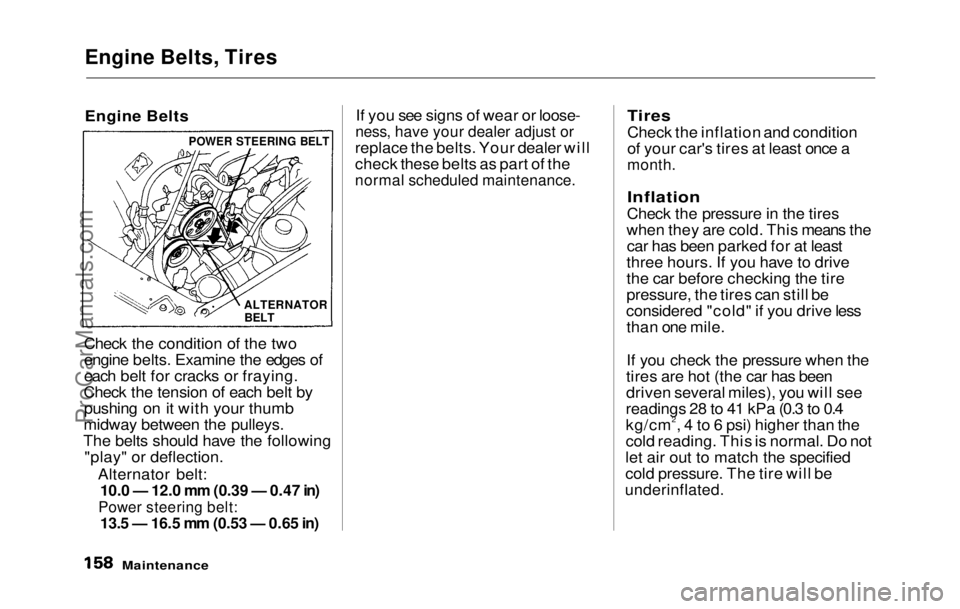
Check the condition of the two
engine belts. Examine the edges of
each belt for cracks or fraying.
Check the tension of each belt by pushing on it with your thumb
midway between the pulleys.
The belts should have the following "play" or deflection.
Alternator belt:
10.0 — 12.0 mm (0.39 — 0.47 in)
Power steering belt:
13.5 — 16.5
mm
(0.53
—
0.65 in)
If you see signs of wear or loose-
ness, have your dealer adjust or
replace the belts. Your dealer will
check these belts as part of the
normal scheduled maintenance.
Tires
Check the inflation and condition
of your car's tires at least once a
month.
Inflation
Check the pressure in the tires
when they are cold. This means the car has been parked for at least
three hours. If you have to drive
the car before checking the tire
pressure, the tires can still be
considered "cold" if you drive less than one mile.
If you check the pressure when the
tires are hot (the car has been
driven several miles), you will see
readings 28 to 41 kPa (0.3 to 0.4
kg/cm2, 4 to 6 psi) higher than the
cold reading. This is normal. Do not
let air out to match the specified
cold pressure. The tire will be
underinflated.
Maintenance
POWER STEERING BELT
ALTERNATOR
BELTProCarManuals.comMain Menu Table of Contents s t
Page 159 of 225

Tires
Replacing Tires
The tires that came with your Honda were selected to match the
performance capabilities of the car
and provide the best combination of
handling, ride comfort, and long life.
You should replace them with
radial tires of the same size, load
range, and speed rating. Mixing
radial and bias-ply or bias-belted tires on your car can reduce its
braking ability, traction, and
steering accuracy.
It is best to replace all four tires at
the same time. If that is not possi-
ble or necessary, then replace the two front tires or the two rear tires
as a pair. Replacing just one tire
can seriously affect your car's han-
dling.
If you ever need to replace a wheel,
make sure you use the same wheel
that originally came on your Honda.
Replacement wheels are available
at your Honda dealer. Wheels and Tires
Wheel:
(US: S, Canada: S)
14 x 5.5 JJ
(US: Si, Si 4WS, Canada: SR, SR 4WS)
15
x
6.5 JJ
Tire:
(US: S, Canada: S)
185/70R14 87H
(US: Si, Si 4WS, Canada: SR, SR 4WS)
205/55R15 87V
DOT Tire Quality Grading
(US Cars)
The tires on your car meet all U.S.
Federal Safety Requirements. All
tires are also graded for treadwear,
traction, and temperature perform-
ance according to Department of
Transportation (DOT) standards.
The following explains these
gradings.
Treadwear
The treadwear grade is a compara-
tive rating based on the wear rate
of the tire when tested under con-
trolled conditions on a specified
government test course. For exam-
ple, a tire graded 150 would wear
one and one half (1-1/2) times as
well on the government course as a
tire graded 100. The relative per-
formance of tires depends upon the
actual conditions of their use, how-
ever, and may depart significantly
from the norm due to variations in
driving habits, service practices
and differences in road character-
istics and climate.
CONTINUED
MaintenanceProCarManuals.comMain Menu Table of Contents s t
Page 207 of 225
Emission Controls
The burning of gasoline in your
car's engine produces several by-
products. Some of these are carbon
monoxide (CO), oxides of nitrogen
(NOx) and hydrocarbons (HC).
Gasoline evaporating from the tank
also produces hydrocarbons. Con-
trolling the production of NOx, CO,
and HC is important to the environ-
ment. Under certain conditions of
sunlight and climate, NOx and HC
react to form photochemical "smog."
Carbon monoxide does not contri-
bute to smog creation, but it is a
poisonous gas.
The Clean Air Act
The United States Clean Air Act*
sets standards for automobile
emissions. It also requires that
automobile manufacturers explain
to owners how their emission
controls work and what to do to
maintain them. This section
summarizes how the emission con-
trols work. Scheduled maintenance
is on page 129 .
* In Canada, Honda vehicles
comply with the Canadian Motor
Vehicle Safety Standards (CMVSS)
for Emissions valid at the time they
are manufactured.
Crankcase Emission Control
System
Your car has a Positive Crankcase
Ventilation (PCV) System. This
keeps gasses that build up in the engine's Crankcase from going into
the atmosphere. The PCV valve
routes them from the crankcase
back to the intake manifold. They
are then drawn into the engine and
burned.
Evaporative Emission
Control SystemAs gasoline evaporates in the fuel
tank, a canister filled with charcoal
adsorbs the vapor. It is stored in
this canister while the engine is off.
After the engine is started and
warmed up, the vapor is drawn into the engine and burned during
driving.
Technical Informatio n
ProCarManuals.comMain Menu Table of Contents s t
Page 208 of 225
Emission Controls
Exhaust Emission Controls
The exhaust emission controls
include four systems: PGM-FI,
Ignition Timing Control, Exhaust
Gas Recirculation and Catalytic
Converter. These four systems
work together to control the engine's combustion and minimize
the amount of HC, CO, and NOx
that comes out the tailpipe. The
exhaust emission control systems
are separate from the crankcase
and evaporative emission control
systems.
PGM-FI System
The PGM-FI System on your car
has three sub systems: Air Intake,
Electronic Control, and Fuel
Control. The Electronic Control
Unit (ECU) uses various sensors to
determine how much air is going
into the engine. It then controls
how much fuel to inject under all
operating conditions. Ignition Timing Control System
This system constantly adjusts the
ignition timing, reducing the
amount of HC, CO and NOx
produced.
Exhaust Gas Recirculation (EGR)
The EGR system takes some of the
exhaust gas and routes it back into
the intake manifold. Adding ex-
haust gas to the air/fuel mixture re-
duces the amount of NOx produced
when the fuel is burned.
Catalytic Converter
The catalytic converter is in the exhaust system. Through chemical
reactions, it converts HC, CO, and
NOx in the engine's exhaust to
carbon dioxide (CO 2), dinitrogen
(N 2), and water vapor.
Replacement Parts
The emission control systems are
designed and certified to work to-
gether in reducing emissions to
levels that comply with the Clean
Air Act. To make sure the emis-
sions remain low, you should use
only new genuine Honda replace-
ment parts or their equivalent for
repairs. Using lower quality parts
may increase the emissions from
your car .
The emissions control systems are
covered b y
warranties separate
from the rest of your car. Read
your warranty manual for more
information.
Technical InformationProCarManuals.comMain Menu Table of Contents s t
Page 217 of 225
Index
Accessories
Installation................................. 105
ACCESSORY
(Ignition Key Position).............. 48
Adding
Automatic Transmission
Fluid........................................ 144
Brake Fluid............................... 146 Clutch Fluid.............................. 147
Engine Oil...:.............................. 135
Manual Transmission Fluid... 145
Power Steering Fluid.............. 148
Radiator Coolant...................... 139
Windshield Washer fluid ........ 143
Additional Safety Information .... 16
Door Locks.................................. 16
Driving with Pets....................... 17
Seat-back Position..................... 16
Storing Cargo Safely................. 17
Additives, Engine Oil................... 136
Adjustments
Mirrors....................................... .
59
Seats............................................. 51
Steering Wheel..........................
43
Airbag (SRS).................................. 1
0
Air Conditioning............................. 68
Maintenance..............................
157
Usage............................................ 6 8
Ai
r Filter........................................
149
Air Outlet
s
(Vents)......................... 68
Air Pressure, Tires ......................
159
Alcohol an d
Drugs.......................... 24
Alcohol in Gasoline........................ 98
Antifreeze......................................
139
Anti-lock Brake s
(ABS)
Description................................
208
Indicator Light.................. .
34,
118
Operation................................... 117
Anti-theft Steerin
g
Column
Lock.............................................. 48
Appearance Care..........................
175
Ashtray............................................. 65
Audio System................................. .
75
Automatic Speed Control............. 44
Automatic Transmission............ 112
Capacity, Fluid........................
.
206
Checking Fluid Level.............. 144
Shifting
...................................... 113
Shift Leve r
Positions...............
112
Shift Lock Release................... 115
Battery
Charging System Light............. 33
Jump Starting............................ 191
Maintenance.............................. 152
Specifications............................ 207
Before Driving
................................ 97
Belts, Seat ......................................... 4
Body Repair
...................................
181
Brakes
Anti-lock Syste
m (ABS)..........
117
Break-in, Ne
w
Linings.............. 98
Fluid............................................
146
Light, Burned-out................... .
169
Parking......................................... 61
System Light.............................. .
33
Wear Indicators.....................
116
Brakes, AB S
Description...............................
.
208
Operation................................... 117
System Indicator...............
.
34,
118
Braking System...........................
.
116
Break-in, Ne
w
Car ......................... 98
CONTINUEDProCarManuals.comMain Menu s t
Page 218 of 225
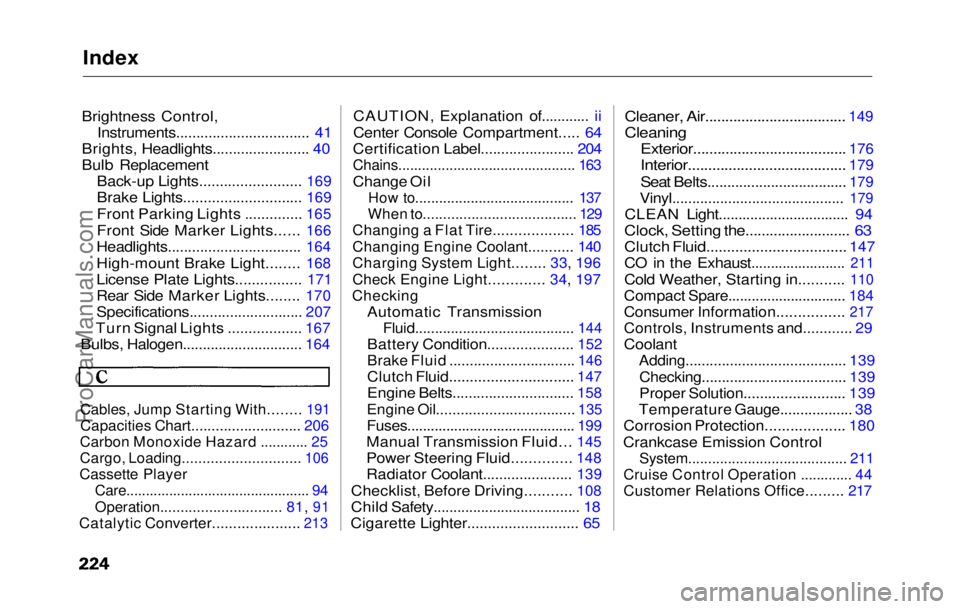
Index
Brightness Control, Instruments................................. 41
Brights, Headlights........................ 40
Bulb Replacement Back-up Lights......................... 169
Brake Lights.............................
169
Front Parking
Lights ..............
165
Front Side
Marker Lights......
166
Headlights................................. 164
High-mount Brake
Light........
168
License Plate
Lights................
171
Rear Sid
e
Marker Lights........
170
Specifications............................ 207
Turn Signa
l
Lights ..................
167
Bulbs, Halogen.............................
.
164
Cables, Jum
p
Starting With........
191
Capacities Chart...........................
206
Carbo
n Monoxide Hazard ............ 25
Cargo, Loading.............................
106
Cassette Playe r
Care..............................................
. 94
Operation.............................. 81,
91
Catalytic Converter.................... .
213
CAUTION, Explanatio
n
of............ ii
Center Console Compartment..... 64
Certification Label....................... 204
Chains............................................. 163
Change Oil
How to........................................ 137
When to...................................... 129
Changing a Flat Tire................... 185
Changing Engine Coolant........... 140
Charging System Light........ 33, 196
Check Engine Light............. 34, 197
Checking
Automatic Transmission
Fluid........................................
144
Battery Condition.................... .
152
Brake Flui
d
...............................
146
Clutch Fluid.............................
.
147
Engine Belts.............................
.
158
Engine Oil.................................
.
135
Fuses........................................... 199
Manual Transmissio
n
Fluid...
145
Power Steerin
g
Fluid..............
148
Radiator Coolant.....................
.
139
Checklist, Befor
e
Driving...........
108
Child Safety....................................
.
18
Cigarette Lighter........................... 65
Cleaner, Air...................................
149
Cleaning
Exterior......................................
176
Interior....................................... 179
Seat Belts...................................
179
Vinyl........................................... 179
CLEAN Light................................
.
94
Clock, Setting the.......................... 63
Clutch Fluid..................................
147
CO i n
the Exhaust........................
211
Cold Weather
,
Starting in...........
110
Compact Spare.............................
.
184
Consumer Information................
217
Controls, Instruments
and............ 29
Coolant
Adding........................................ 139
Checking.................................... 139
Proper Solution......................... 139
Temperature Gauge.................. 38
Corrosion Protection................... 180
Crankcase Emission Control
System........................................ 211
Cruise Control Operation ............. 44
Customer Relations Office......... 217ProCarManuals.comMain Menu s t