service HONDA PRELUDE 1992 Owner's Manual
[x] Cancel search | Manufacturer: HONDA, Model Year: 1992, Model line: PRELUDE, Model: HONDA PRELUDE 1992Pages: 225, PDF Size: 2.1 MB
Page 159 of 225

Tires
Replacing Tires
The tires that came with your Honda were selected to match the
performance capabilities of the car
and provide the best combination of
handling, ride comfort, and long life.
You should replace them with
radial tires of the same size, load
range, and speed rating. Mixing
radial and bias-ply or bias-belted tires on your car can reduce its
braking ability, traction, and
steering accuracy.
It is best to replace all four tires at
the same time. If that is not possi-
ble or necessary, then replace the two front tires or the two rear tires
as a pair. Replacing just one tire
can seriously affect your car's han-
dling.
If you ever need to replace a wheel,
make sure you use the same wheel
that originally came on your Honda.
Replacement wheels are available
at your Honda dealer. Wheels and Tires
Wheel:
(US: S, Canada: S)
14 x 5.5 JJ
(US: Si, Si 4WS, Canada: SR, SR 4WS)
15
x
6.5 JJ
Tire:
(US: S, Canada: S)
185/70R14 87H
(US: Si, Si 4WS, Canada: SR, SR 4WS)
205/55R15 87V
DOT Tire Quality Grading
(US Cars)
The tires on your car meet all U.S.
Federal Safety Requirements. All
tires are also graded for treadwear,
traction, and temperature perform-
ance according to Department of
Transportation (DOT) standards.
The following explains these
gradings.
Treadwear
The treadwear grade is a compara-
tive rating based on the wear rate
of the tire when tested under con-
trolled conditions on a specified
government test course. For exam-
ple, a tire graded 150 would wear
one and one half (1-1/2) times as
well on the government course as a
tire graded 100. The relative per-
formance of tires depends upon the
actual conditions of their use, how-
ever, and may depart significantly
from the norm due to variations in
driving habits, service practices
and differences in road character-
istics and climate.
CONTINUED
MaintenanceProCarManuals.comMain Menu Table of Contents s t
Page 185 of 225
Changing a Flat Tire
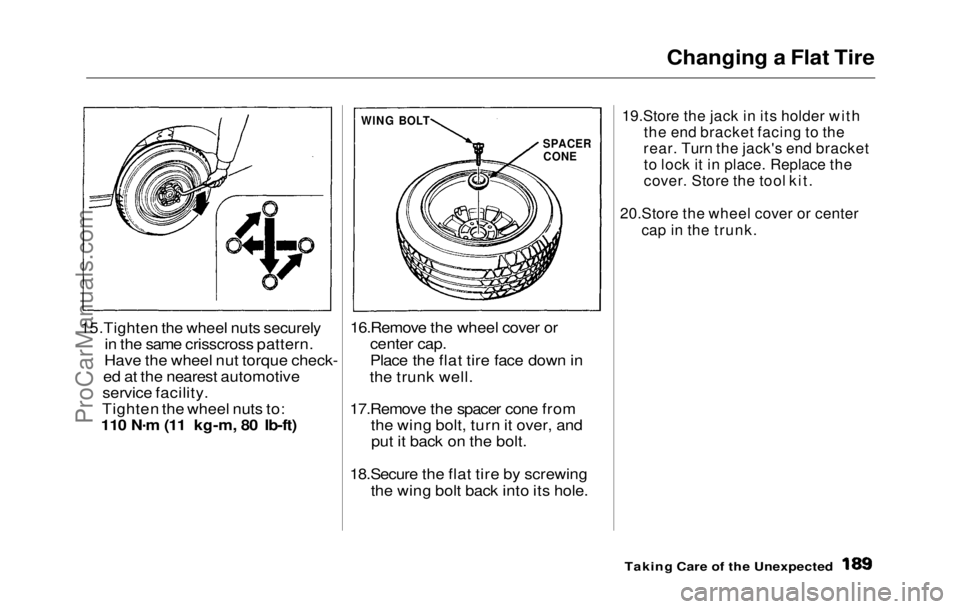
15.Tighten the
wheel nuts securely
in the same crisscross pattern.
Have the wheel nut torque check-
ed at the nearest automotive
service facility.
Tighten the wheel nuts to:
110 N .
m (1
1 kg-m, 80 Ib-ft)
16.Remove the wheel cover or
center cap.
Place the flat tire face down in
the trunk well.
17.Remove the
spacer cone from
the wing bolt, turn it over, and
put it back on the bolt.
18.Secure th e
flat tire by screwing
the wing bolt back into its hole.
19.Store th
e
jack in its holder with
the end bracket facing to the
rear. Turn the jack'
s end bracket
to lock it in place. Replace the
cover. Store the tool kit.
20.Store th e
wheel cover or center
cap in the trunk.
Taking Car
e
of the Unexpected
WING BOLT
SPACERCONEProCarManuals.comMain Menu Table of Contents s t
Page 192 of 225
Charging System Indication
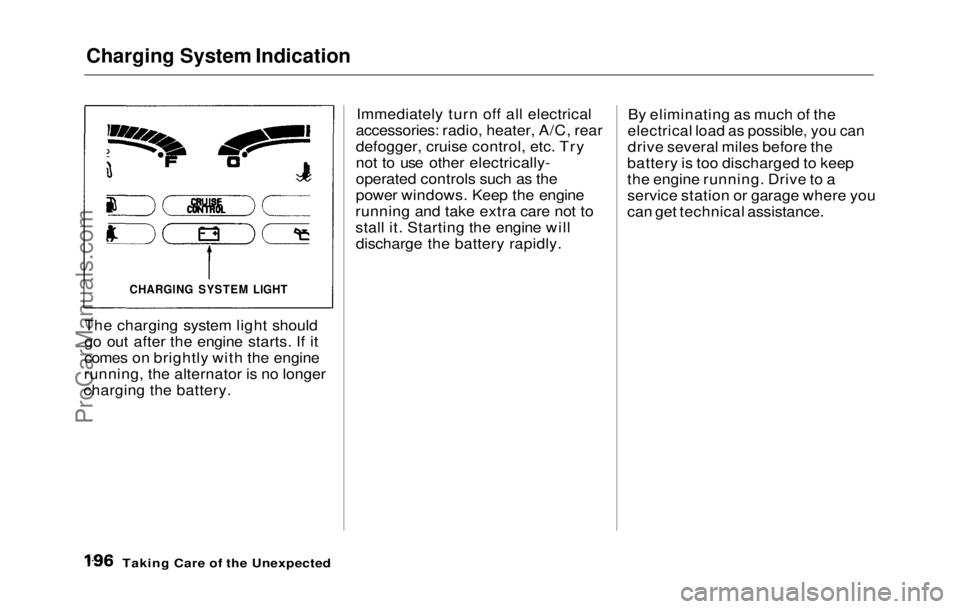
The charging system light should
go out after the engine starts. If it
comes on brightly with the engine
running, the alternator is no longer
charging the battery. Immediately turn off all electrical
accessories: radio, heater, A/C, rear
defogger, cruise control, etc. Try
not to use other electrically-
operated controls such as the
power windows. Keep the engine
running and take extra care not to
stall it. Starting the engine will discharge the battery rapidly. By eliminating as much of the
electrical load as possible, you can
drive several miles before the
battery is too discharged to keep
the engine running. Drive to a
service station or garage where you
can get technical assistance.
Taking Care of the Unexpected
CHARGING SYSTEM LIGHTProCarManuals.comMain Menu Table of Contents s t
Page 198 of 225
Towing
If your car needs to be towed, call a
professional towing service or, if
you belong to one, an organization
that provides roadside assistance.
Never tow your car behind another car with just a rope or chain. It is
very dangerous.
Emergency Towing
There are three popular methods of
towing a car:
Flat-bed Equipment — The
operator loads your car on the back
of a truck. This is the best way
of transporting your Honda.
Wheel Lift Equipment — The tow
truck uses two pivoting arms that
go under the tires (front or rear)
and lift them off the ground. The
other two wheels remain on the
ground.
Sling-type Equipment — The tow
truck uses metal cables with hooks
on th
e
ends. These hooks go around
parts of the frame or suspension
and the cables lift that end of the
car off the ground. Your car's sus-
pension and body can be seriously
damaged if this method
of towing
is attempted.
If your Honda cannot be trans-
ported by flat-bed, it should be
towed with the front wheels off the
ground. If due to damage, your car
must be towed with the front
wheels on the ground, do the
following:
5-Speed Transmission
Release the parking brake.
Shift the transmission to Neutral.
Automatic Transmission
Release the parking brake.
Start the engine.
Shift to D4, then to N.
Turn off the engine. Improper towing preparation will
damage the transmission. Follow
the above procedure exactly. If you
cannot shift the transmission or
start the engine (automatic trans-
mission), your car must be trans-
ported on a flat-bed. It is best to tow the car no far-
ther than 80 km (50 miles), and
keep the speed below 35 mph (55
km/h).
Trying to lift or tow your car by
the bumpers will cause serious
damage. The bumpers are not
designed to support the car's
weight.
Taking Care
of the Unexpected NOTICE
NOTICEProCarManuals.comMain Menu Table of Contents s t
Page 212 of 225

Customer Relations Information
Honda dealership
personnel are
trained professionals. They should
be able to answer all your questions. If you encounter a problem that
your dealership does not solve to
your satisfaction, please discuss it
with the dealership's management.
The Service Manager or General Manager can help. Almost all
problems are solved in this way. If you are dissatisfied with the
decision made by the dealership's
management, contact your Honda
Customer Relations Zone Office.
Refer to the U.S. and Canadian
Zone Office maps on the following
pages.
When you call or write, please give
us this information:
Vehicle Identification Number
(see page 204)
Name and address of the dealer who services your car
Date of purchase
Mileage on your car
Your name, address, and tele- phone number
A detailed description of the problem
Name of the dealer who sold the
car to you
Warranty and Customer RelationsProCarManuals.comMain Menu Table of Contents s t
Page 216 of 225
Authorized Manuals
These Publications cannot be returned for credit without receiving advance authorization within 14 days of
delivery On returns, a restocking fee may be applied against the original order
P.O. BOX 07280 DETROIT MICHIGAN 48207 (313) 883-1430
Service Manual:
This manual covers maintenance and recommended procedures for repair to engine and chassis components.
It is written for the Journeyman mechanic, but is
simple enough for most mechanically-inclined owners
to understand.
Electrical Troubleshooting Manual:
This manual complements the Service Manual by providing in-depth troubleshooting information for
each electrical circuit in your car.
Body Repair Manual:
This manual describes the procedures involved in the
replacement of damaged body parts.ProCarManuals.comMain Menu Table of Contents s t
Page 223 of 225
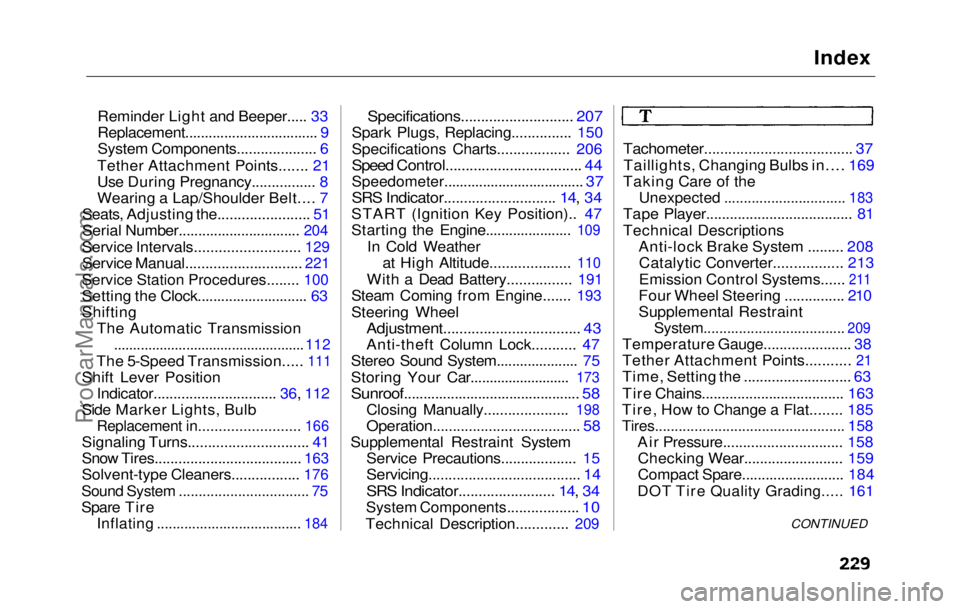
Index
Reminder Light and Beeper..... 33
Replacement.................................. 9
System Components.................... 6
Tether Attachment Points....... 21
Use During Pregnancy................ 8
Wearing a Lap/Shoulder Belt.... 7
Seats, Adjusting the....................... 51
Serial Number............................... 204
Service Intervals..........................
129
Service Manual............................
.
221
Service Station Procedures........ 100
Setting th
e
Clock............................ 63
Shifting The Automatic Transmission
..................................................
112
The 5- Speed
Transmission.....
111
Shift Leve
r
Position
Indicator...............................
36, 112
Side Marke r
Lights, Bulb
Replacement in.........................
166
Signaling Turns............................. .
41
Snow Tires.....................................
163
Solvent-type Cleaners................ .
176
Sound Syste
m
................................. 75
Spare Tire
Inflating .....................................
184
Specifications............................ 207
Spar
k Plugs, Replacing............... 150
Specifications Charts.................. 206
Speed Control.................................. 44
Speedometer.................................... 37
SRS Indicator........................... .
14, 34
START (Ignition Key Position)..
47
Starting th e
Engine......................
109
In Col
d
Weather
at High Altitude....................
110
With a Dea
d Battery................
191
Steam Comin
g
from Engine.......
193
Steering Whee
l
Adjustment.................................
. 43
Anti-theft Column Lock........... 47
Stereo Sound System..................... 75
Storing Your Car..........................
173
Sunroof............................................. 58
Closin
g Manually.....................
198
Operation.....................................
58
Supplementa
l Restraint System
Service Precautions................... 15
Servicing...................................... 14
SRS Indicator........................ 14, 34
System Components.................. 10
Technical Description............ .
209
Tachometer.....................................
37
Taillights
, Changing Bulbs in.... 169
Taking Care of the
Unexpected ...............................
183
Tape Player.................................... .
81
Technical Descriptions Anti-lock Brake System ......... 208Catalytic Converter................. 213
Emission Control Systems......
211
Four Whee l
Steering ............... 210
Supplemental Restraint
System....................................
209
Temperature Gauge..................... .
38
Tether Attachment Points...........
21
Time, Settin g
the ........................... 63
Tire Chains.................................... 163
Tire, How to Change a Flat........ 185
Tires................................................ 158
Air Pressure.............................. 158Checking Wear......................... 159
Compact Spare.......................... 184
DOT Tire Quality Grading..... 161
CONTINUEDProCarManuals.comMain Menu s t