brakes HONDA PRELUDE 1992 Owners Manual
[x] Cancel search | Manufacturer: HONDA, Model Year: 1992, Model line: PRELUDE, Model: HONDA PRELUDE 1992Pages: 225, PDF Size: 2.1 MB
Page 33 of 225
Indicator Lights
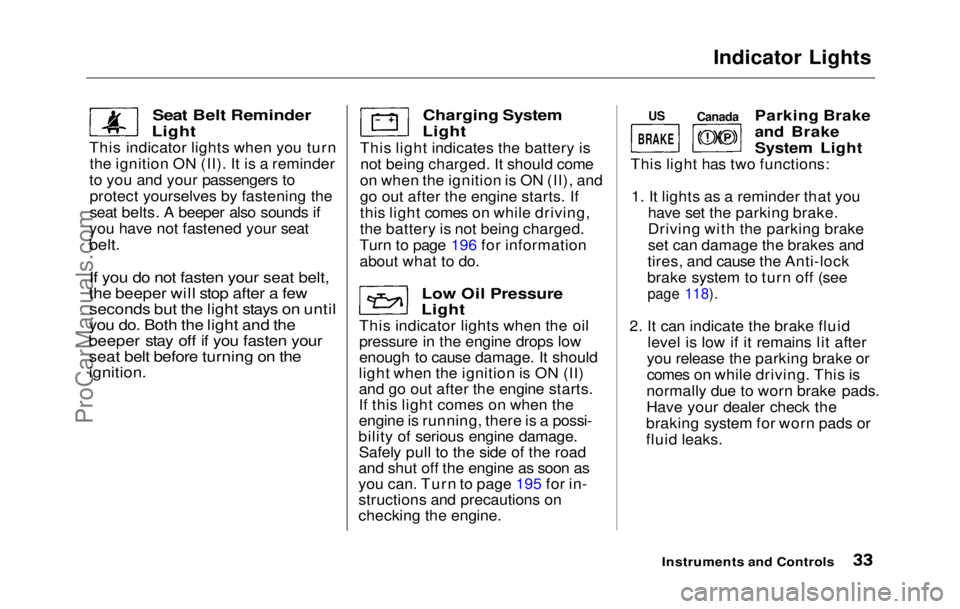
Seat Belt Reminder
Light
This indicator lights when you turn the ignition ON (II). It is a reminder
to you and your passengers to protect yourselves by fastening the
seat belts. A beeper also sounds if
you have not fastened your seat
belt.
If you do not fasten your seat belt,
the beeper will stop after a few seconds but the light stays on until
you do. Both the light and the
beeper stay off if you fasten your seat belt before turning on the
ignition.
Charging System
Light
This light indicates the battery is not being charged. It should come
on when the ignition is ON (II), and
go out after the engine starts. If
this light comes on while driving,
the battery is not being charged.
Turn to page 196 for information
about what to do.
Low Oil Pressure
Light
This indicator lights when the oil
pressure in the engine drops low
enough to cause damage. It should
light when the ignition is ON (II)
and go out after the engine starts.
If this light comes on when the
engine is running, there is a possi-
bility of serious engine damage. Safely pull to the side of the road
and shut off the engine as soon as
you can. Turn to page 195 for in-
structions and precautions on
checking the engine.
Canada
Parking Brake
and Brake
System Light
This light has two functions:
1. It lights as a reminder that you
have set the parking brake.
Driving with the parking brake
set can damage the brakes and
tires, and cause the Anti-lock
brake system to turn off (see
page 118).
2. I t
can indicate the brake fluid
level is low if it remains lit after
you release the parking brake or
comes on while driving. This is
normally due to worn brake pads.
Have your dealer check the
braking system for worn pads o r
flui d
leaks.
Instruments an d
Controls
US
BRAKEProCarManuals.comMain Menu Table of Contents s t
Page 61 of 225
Mirrors, Parking Brake
Available on all Canadian models
The outside mirrors are heated to
remove fog and frost. Press the
mirror defroster button to turn on
the heaters. The light in the button
comes on as a reminder. Press the
button again to turn the heaters off.
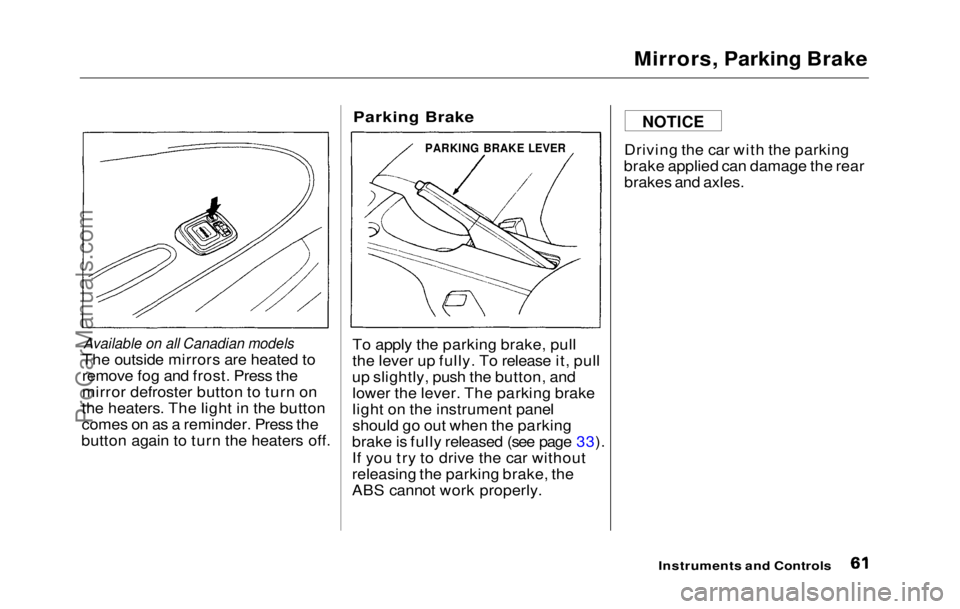
Parking Brake
To apply the parking brake, pull
the lever up fully. To release it, pull
up slightly, push the button, and lower the lever. The parking brake
light on the instrument panel
should go out when the parking
brake is fully released (see page 33).
If you try to drive the car without
releasing the parking brake, the
ABS cannot work properly. Driving the car with the parking
brake applied can damage the rear brakes and axles.
Instruments and Controls
NOTICE
PARKING BRAKE LEVERProCarManuals.comMain Menu Table of Contents s t
Page 97 of 225
Break-in Period, Gasoline
Break-in Period
Help assure your car's future
reliability and performance by
paying extra attention to how you
drive during the first 1,000 km (600
miles).
During thi
s period:
Avoid full-throttle starts and
rapid acceleration.
If you need to add oil, use the
engine oil recommended in this
owner's manual.
Avoid hard braking. New brakes need to be broken-in by moderate
use for the first 300 km (200
miles).
You should follow these same re-
commendations with an overhauled
or exchanged engine, or when the
brakes are relined. Gasoline
Your Honda is designed to operate
most effectively on unleaded
gasoline.
Using gasoline containing lead will
damage your car's emission
controls. Thi s
contributes to air
pollution and can void certain parts
of your warranty.
(S model)
Use an unleaded gasoline with a
pump octane number of 86 or
higher.
Use of a lower octane gasoline can
cause a persistent, heavy metallic
rapping noise that can lead to
engine damage.
(All other models)
Use a
premium unleaded gasoline
with a pump octane number of
91
or higher .
I
f you are unable to find premium
unleaded, you may substitute an
unleaded regular gasoline. The engine will compensate for the
lower octane, but you may notice a
slight decrease in power as a result.
Oxygenated Fuels
Some conventional gasolines are
being blended with alcohol or an
ether compound to increase the
gasoline's octane. These gasolines
are collectively referred to as
oxygenated fuels. Some areas of
the United States and Canada use
oxygenated fuels to help meet clean
air standards.
If you use an oxygenated fuel, be
sure it meets the minimum octane
rating requirement as recom-
mended.
Before DrivingProCarManuals.comMain Menu Table of Contents s t
Page 106 of 225

Driving
This section gives you tips on
starting the engine under various conditions, and how to operate the
5-speed and automatic transmis-
sions. It also includes important information on your car's braking
system and facts you need if you
are planning to tow a trailer. Preparing to Drive ....................... 108
Starting the Engine...................... 109
5-speed Transmission............. 109
Automatic Transmission........ 109 Starting in Cold Weather at High Altitude.................... 110
5-speed Manua l
Transmission...
111
Recommended Shif
t
Points....
111
Maximum Speeds....................
.
112
Automatic Transmission...........
.
112
Shift Leve
r
Positions...............
112
Maximum Speeds....................
.
115
Shift Loc
k
Release...................
115
The Brakin
g
System....................
116
Brake Wea
r
Indicators............
116
Brake Syste
m
Design..............
116
Anti-lock Brakes.....................
.
117
Four Whee
l
Steering....................
118
Driving i
n
Bad Weather..............
119
Towing a
Traile
r ..........................
121
Driving
ProCarManuals.comMain Menu s t
Page 110 of 225
5-speed Manual Transmission
The manual
transmission is syn-
chronized in all forward gears for smooth operation. It has a lockout
so you cannot shift directly from
Fifth to Reverse. When shifting up
or down, make sure you push the
clutch pedal down all the way, shift
to the next gear, and let the pedal
up gradually. When you are not shifting, do not rest your foot on
the clutch pedal. This can cause
your clutch to wear out faster. Come to a full stop before you shift
into reverse. You can damage the
transmission by trying to shift into
reverse with the car moving.
Depress the clutch pedal and pause
for a few seconds before putting it in reverse, or shift into one of the
forward gears for a moment. This
stops the gears so they won't
"grind".
You can get extra braking from the
engine when slowing down by
shifting to a lower gear. This extra
braking can help you maintain a safe speed and prevent your brakes
from overheating while going down a steep hill. Before downshifting,
make sure engine speed will not go
into the red zone in the lower gear.
Refer to the Maximum Speeds
chart.
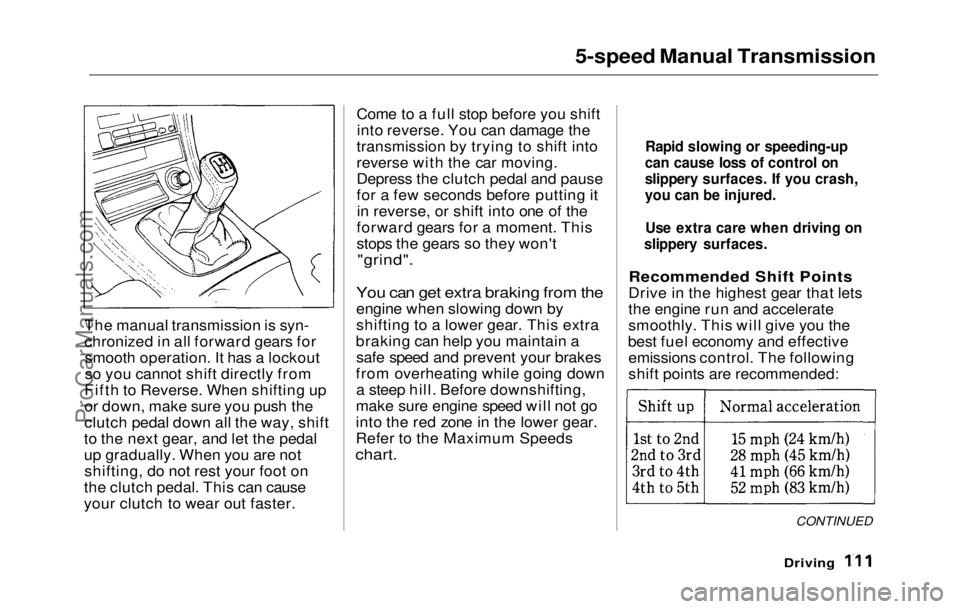
Recommended Shift Points
Drive in the highest gear that lets
the engine run and accelerate
smoothly. This will give you the
best fuel economy and effective emissions control. The following
shift points are recommended:
CONTINUED
Driving
Rapid slowing or speeding-up
can cause loss of control on
slippery surfaces. If you crash,
you can be injured.
Use extra care when driving on
slippery surfaces.ProCarManuals.comMain Menu Table of Contents s t
Page 115 of 225
The Braking System
Your Honda is equipped with disc brakes at all four wheels. The
braking system is power-assisted to
reduce the effort needed on the
brake pedal.
Put your foot on the brake pedal
only when you intend to brake.
Resting your foot on the pedal
keeps the brakes applied lightly,
causing them to build up heat. Heat
build-up can reduce how well your
brakes work. It also keeps your
brake lights on all the time, confusing drivers behind you.
Constant application of the brakes
when going down a long hill builds
up heat and reduces their effective-
ness. Use the engine to assist the
brakes by downshifting to a lower
gear and taking your foot off the
accelerator pedal. Check your brakes after driving
through deep water. Apply the
brakes moderately to see if they feel normal. If not, apply them
gently and frequently until they do. Since a longer distance is needed to
stop with wet brakes, be extra
cautious and alert in your driving.
Brake Wear Indicators
All four brakes have audible brake
wear indicators. When the brake pads need re-placing, you will hear a distinctive
metallic "screeching" sound when
you apply the brakes. If you do not
have the brake pads replaced, they
will begin screeching all the time.
Your brakes may sometimes squeal
or squeak when you apply them
lightly. Do not confuse this with the
brake wear indicators. They make a very audible "screeching".
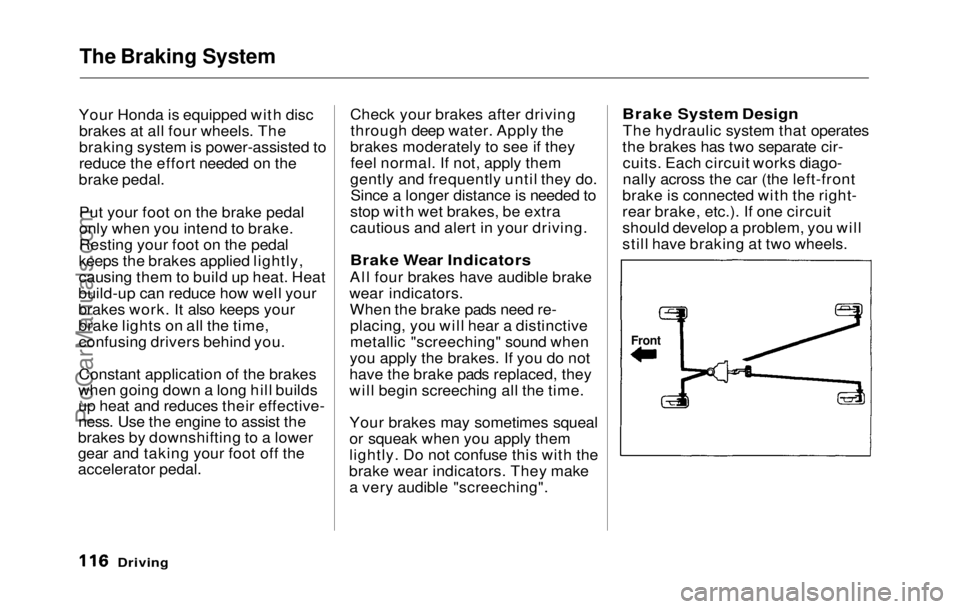
Brake System Design
The hydraulic system that operates
the brakes has two separate cir- cuits. Each circuit works diago-
nally across the car (the left-front
brake is connected with the right-
rear brake, etc.). If one circuit
should develop a problem, you will
still have braking at two wheels.
Driving
FrontProCarManuals.comMain Menu Table of Contents s t
Page 116 of 225

The Braking System
If this happens, you will immediate-
ly notice that the brake pedal goes
down much farther and you need to press on it much harder. A much
longer distance will be needed to stop the car.
Slow the car by downshifting to a
lower gear and removing your foot
from the accelerator pedal. Pull to
the side of the road as soon as it is
safe. Because of the longer stop-
ping distance needed, brake system
failure is very hazardous. It is best
to have your car towed, but if you
must drive the car in this condition,
be extremely cautious. Have your car repaired as soon as possible.
Anti-lock Brakes
The Prelude Si and Si 4WS models
in
the U.S. and SR and SR 4WS
models in Canada have an Anti-
lock Brake System (ABS) as standard equipment.
ABS helps you maintain steering
control. It does this by helping you
to prevent the wheels from locking
up and skidding.
The ABS is always "On". It
requires no special effort or driving
technique. You will feel a pulsation
in the brake pedal when the ABS
activates.
Activation varies with the amount of traction your tires have. On drypavement, you will need to press on
the brake pedal very hard before
you feel the pedal
pulsation that
means the ABS has activated.
However, you may feel the ABS
activate immediately if you are
trying to stop on snow or ice. Under all conditions, the ABS is helping to
prevent the wheels from locking so
you can retain steering
control.
You should continue to press on the
brake pedal with the same force.
You may feel a slight movement of
the brake pedal just after you start
the engine. This
is
the ABS
working.
Driving
CONTINUEDProCarManuals.comMain Menu Table of Contents s t
Page 117 of 225
The Braking System, Four Wheel Steering
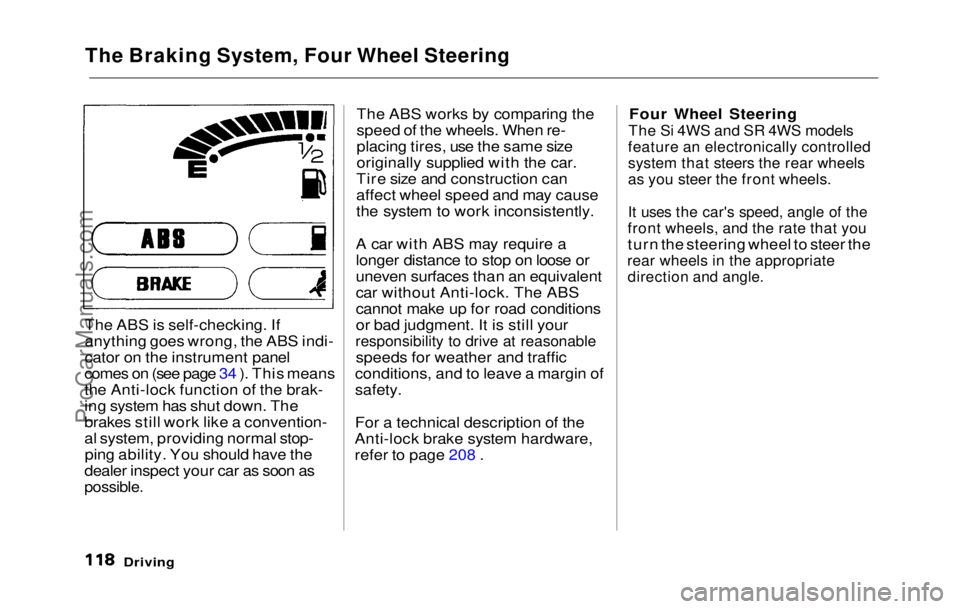
The ABS is self-checking. If
anything goes wrong, the ABS indi-
cator on the instrument panel
comes on (see page 34 ). This means
the Anti-lock function of the brak-
ing system has shut down. The
brakes still work like a convention-
al system, providing normal stop- ping ability. You should have the
dealer inspect your car as soon as
possible.
The ABS works by comparing the
speed of the wheels. When re-
placing tires, use the same size
originally supplied with the car.
Tire size and construction can
affect wheel speed and may cause
the system to work inconsistently.
A car with ABS may require a
longer distance to stop on loose or
uneven surfaces than an equivalent
car without Anti-lock. The ABS
cannot make up for road conditions
or bad judgment. It is still yourresponsibility to drive at reasonable
speeds for weather and
traffic
conditions, and to leave a margin of
safety.
For a technical description of the
Anti-lock brake system hardware,
refer to page 208 . Four Wheel Steering
The Si 4WS and SR 4WS models
feature an electronically controlled
system that steers the rear wheels
as you steer the front wheels.
It uses the car's speed, angle of the
front wheels, and the rate that you
turn the steering wheel to steer the
rear wheels in the appropriate
direction and angle.
DrivingProCarManuals.comMain Menu Table of Contents s t
Page 119 of 225
Driving in Bad Weather
Driving Technique — Always
drive slower than you would in dry
weather. It takes your car longer to react, even in conditions that may
seem just barely damp. Apply
smooth, even pressure to all the
controls. Abrupt steering wheel
movements or sudden, hard appli-
cation of the brakes can cause loss
of control in wet weather. Be extra
cautious for the first few miles of
driving while you adjust to the change in driving conditions. This
is especially true in snow. A person
can forget some snow-driving tech- niques during the summer months.
Practice is needed to relearn those
skills.
Exercise extra caution when
driving in rain after a long dry spell.
After months of dry weather, the
first rains bring oil to the surface of
the roadway, making it slippery. Visibility — Being able to see
clearly in all directions and being
visible to other drivers are impor-
tant in all weather conditions. This is more difficult in bad weather. To
be seen more clearly during day-
light hours, turn on your headlights.
Inspect your windshield wipers and
washers frequently. Keep the wind- shield washer reservoir full of the
proper fluid. Replace the wind-
shield wiper blades if they start to
streak the windshield or leave parts
unwiped. Use the defrosters and air conditioner to keep the windows
from fogging up on the inside (see
page 73).
Traction — Check your tires
frequently for wear and proper pressure. Both are important in
preventing "hydroplaning" (loss of
traction on a wet surface). In the
winter, mount snow tires on all four
wheels for the best handling.
Watch road conditions carefully, they can change from moment to
moment. Wet leaves can be as slip-
pery as ice. "Clear" roads can have
patches of ice. Driving conditions
can be very hazardous when the
outside temperature is near freez-
ing. The road surface can become
covered with areas of water pud-
dles mixed with areas of ice, so
your traction can change without
warning.
Be careful when downshifting. If
traction is low, you can lock up the
drive wheels for a moment and
cause a skid.
DrivingProCarManuals.comMain Menu Table of Contents s t
Page 122 of 225
Towing a Trailer
Mirrors
Many states and provinces have
laws requiring special outsidemirrors when you are towing a
trailer. Check the laws in your area.
You may want to install mirrors, even if they are not required. Hook
up the trailer and see how much it obscures your ability to see behind
you with the standard mirrors. Ifyou cannot see directly behind you,
or have a large blind spot next to
the trailer or the car, you should
install mirrors intended for towing.
Connecting the Trailer
Most trailers that have a gross
weight of 450 kg (1,000 Ibs) do not
have their own braking system. If you are thinking of getting a trailer
that does have brakes, make sure
they are electrically-operated.
There are no provisions in your car
to tap into its hydraulic braking
system. Any attempt to attach the
trailer's brakes to your car's
hydraulic system, no matter how successful it may seem, will lower
braking effectiveness and create a potential hazard.
Always use a safety chain when towing a trailer. Connect the safety
chain securely at both ends. Make
sure the chain crosses under the
tongue so it will catch the trailer if
it becomes unhitched. Leave
enough slack in the chain so it can't
bind in a sharp turn. Do not let it drag on the ground.
Before Starting Out
As you are preparing to tow your
trailer, do the following:
Measure the trailer's tongue load.
You can do this with a bathroom
scale.
Verify that the hitch and safety chain are securely fastened.
Check the condition and air
pressure of all tires on the trailer
and your car. Low tire pressure
can seriously affect the handling.
Also check the spare tires.
With everything loaded and the
trailer connected, check that the
rear of the car is not sagging. If
so, redistribute the load in the
car.
Check that all lights on the car
are working properly.
DrivingProCarManuals.comMain Menu Table of Contents s t