belt HONDA PRELUDE 1998 Owner's Guide
[x] Cancel search | Manufacturer: HONDA, Model Year: 1998, Model line: PRELUDE, Model: HONDA PRELUDE 1998Pages: 278, PDF Size: 2.61 MB
Page 39 of 278
Protecting Children
Physical Size
Physically, a child must be large
enough for the lap/shoulder belt to
properly fit over their hips, chest, and shoulder (see page 14). If the
seat belt does not fit properly, the
child should not sit in the front.
Maturity
To safely ride in front, a child must be able to follow the rules, including
sitting properly and wearing their
seat belt properly throughout a ride. If you decide that a child can safely
ride up front, be sure to:
Carefully read the owner's manual,
and make sure you understand all seat belt instructions and all safety
information. Move the vehicle seat to the rear-
most position.
Have the child sit up straight with
their back against the seat and
their feet on or near the floor. Check that the child's seat belt is
properly positioned and secured.
Closely supervise the child. Even
mature children sometimes need
to be reminded to fasten their seat
belt or sit properly.
Using Child Seats with Tethers
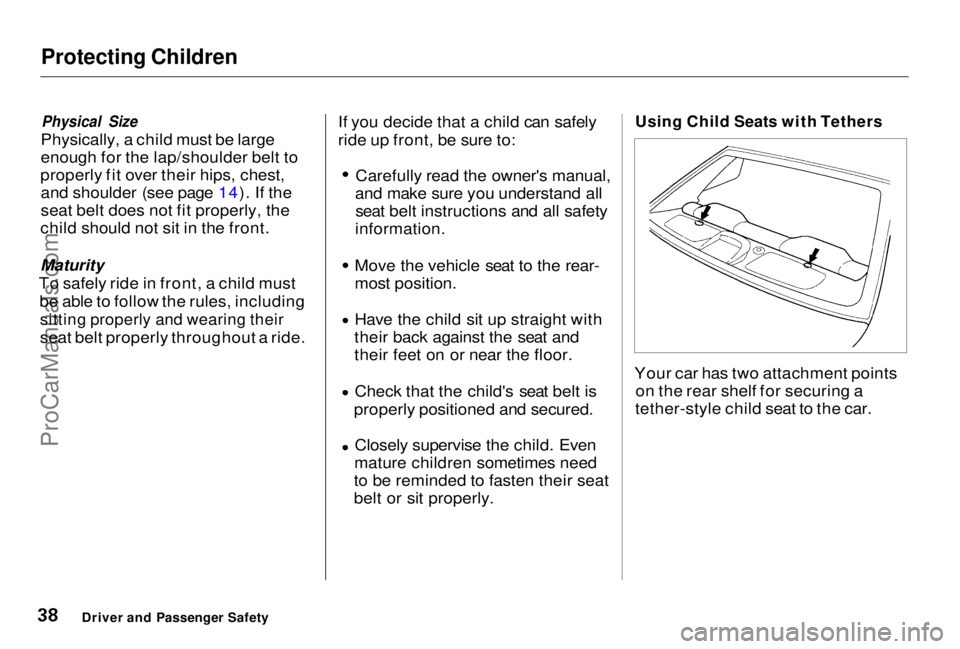
Your car has two attachment points on the rear shelf for securing a
tether-style child seat to the car.
Driver and Passenger SafetyProCarManuals.comMain Menu Table of Contents s t
Page 41 of 278
Additional Information About Your Seat Belts
Seat Belt System Components
Your seat belt system includes lap/ shoulder belts in all four seating
positions.
The system also includes alight on the instrument
panel to remind you and your
passengers to fasten your belts. If
the driver's seat belt is not fastened
before the ignition is turned ON (II),
the light will come on and a beeper
will also sound. The beeper will stop after a few seconds, but the light will
stay on until the driver's seat belt is
fastened.
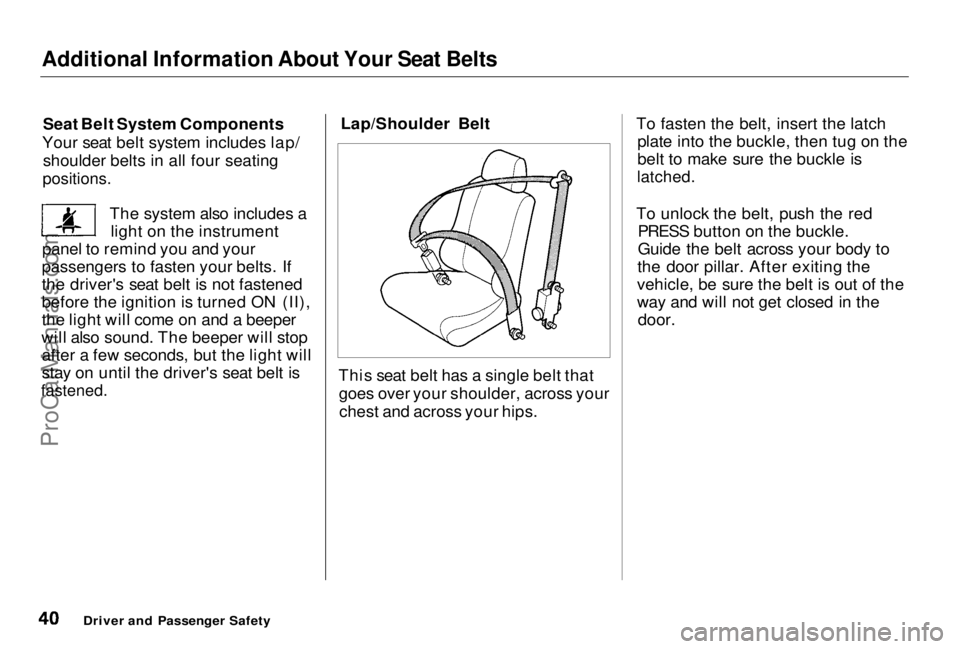
Lap/Shoulder Belt
This seat belt has a single belt that goes over your shoulder, across yourchest and across your hips. To fasten the belt, insert the latch
plate into the buckle, then tug on the
belt to make sure the buckle is
latched.
To unlock the belt, push the red PRESS button on the buckle.
Guide the belt across your body to
the door pillar. After exiting the
vehicle, be sure the belt is out of the
way and will not get closed in the
door.
Driver and Passenger SafetyProCarManuals.comMain Menu Table of Contents s t
Page 42 of 278
Additional Information About Your Seat Belts
All seat belts have an emergency locking retractor. In normal driving,
the retractor lets you move freely in
your seat while it keeps some
tension on the belt. During a collision or sudden stop, the retractor
automatically locks the belt to help
restrain your body.
The seat belts in all seating positions except the driver's have an additional
locking mechanism that must be activated to secure a child seat. (See
pages 28 and 32 for instructions on
how to secure child seats with this
type of seat belt.)
If the shoulder part of the belt is
pulled all the way out, the locking
mechanism will activate. The belt
will retract, but it will not allow a passenger to move freely. To deactivate the locking
mechanism, unlatch the buckle and
let the seat belt fully retract. To
refasten the belt, pull it out only as
far as needed.
See page 14 for instructions on how
to wear the lap/shoulder belt
properly.
Driver and Passenger SafetyProCarManuals.comMain Menu Table of Contents s t
Page 43 of 278
Additional Information About Your Seat Belts
Seat Belt Maintenance
For safety, you should check the
condition of your seat belts regularly.
Pull each belt out fully and look for
frays, cuts
, burns, and wear. Check
that the latches work smoothly and
that th
e lap/shoulder belts retract
easily. Any belt not in good condition
or not working properly will not
provide good protection and should
be replaced
as soon as possible.
Honda provides a lifetime warranty
on seat belts. Honda will repair or
replace
any seat belt component that
fails t
o function properly during
normal use.
Please see your Honda Warranty Information booklet for details.
If a seat belt is worn during a crash,
yo
u should have your dealer inspect
the belt, and
replace it if necessary.
A belt that has been worn during a crash may not
provide the same level
of protection in a subsequent crash.
The
dealer should also inspect the
anchors for damage and replace
the
m if needed.
For information on how to clean your sea
t belts, see page 223.
Driver an
d Passenger Safety
Not checking or maintaining
seat belt
s can result in serious
injury or death if the seat belts
do not work properly when
needed
.
Check your seat belts regularly
and
have any problem
corrected a
s soon as possible.
ProCarManuals.comMain Menu Table of Contents s t
Page 44 of 278
Additional Information About Your SRS
SRS Components
Your Supplemental Restraint System (SRS) includes:
Two frontal airbags. The driver'sairbag is stored in the center of
the steering wheel; the front
passenger's airbag is stored in the dashboard. Both are marked
"SRS".
Sensors that can detect a severe
frontal collision. A sophisticated electronic system
that continually monitors thesensors, control unit, the airbag
activators, and all related wiring
when the ignition is ON (II). An indicator light on the
instrument panel to alert you to a
possible problem with the system (see page 45). Emergency backup power in case
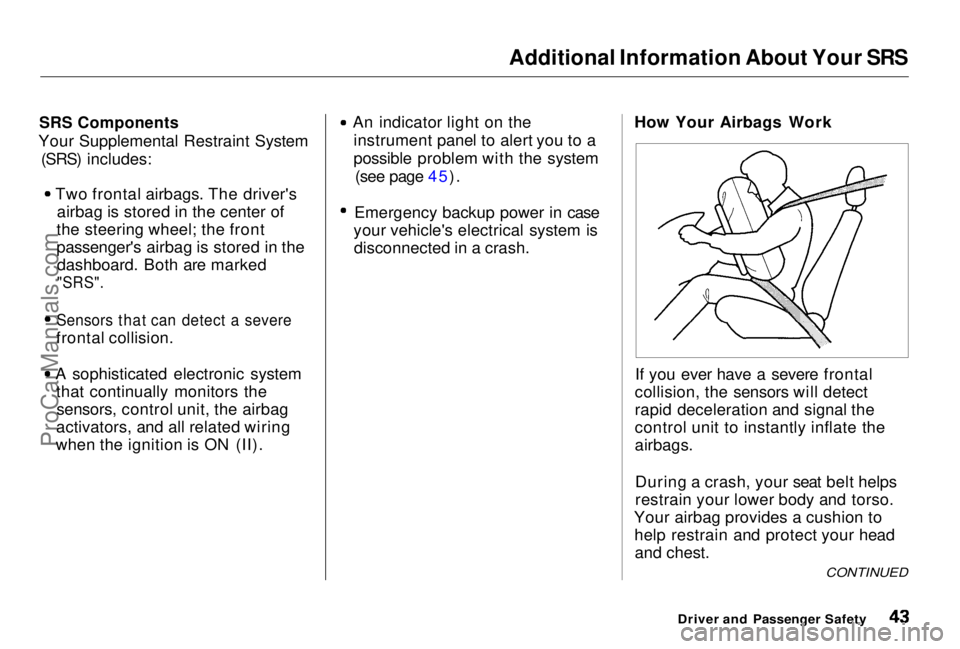
your vehicle's electrical system is disconnected in a crash. How Your Airbags Work
If you ever have a severe frontal
collision, the sensors will detect
rapid deceleration and signal the
control unit to instantly inflate the
airbags.
During a crash, your seat belt helps
restrain your lower body and torso.
Your airbag provides a cushion to help restrain and protect your headand chest.
Driver and Passenger Safety
CONTINUEDProCarManuals.comMain Menu Table of Contents s t
Page 45 of 278
Additional Information About Your SRS
Since both airbags use the same
sensors, both airbags normally
inflate at the same time. However, it
is possible for only one airbag to inflate.
This can occur when the severity of a collision is at the margin, or
threshold, that determines whether or not the airbags will deploy. In
such cases, the seat belt will provide
sufficient protection, and the
supplemental protection offered by
the airbag would be minimal.
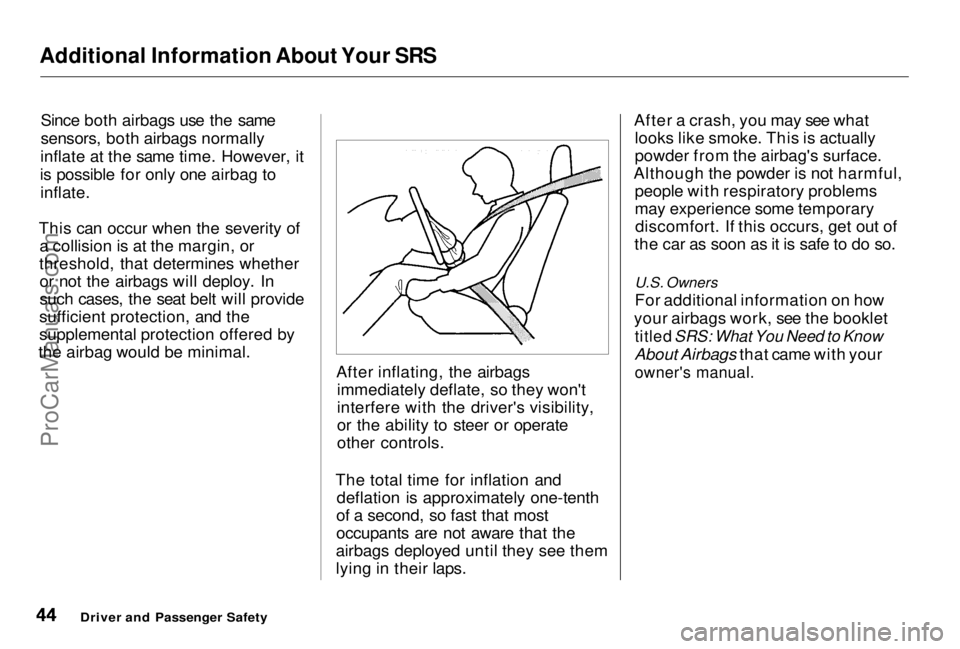
After inflating, the airbagsimmediately deflate, so they won't
interfere with the driver's visibility,
or the ability to steer or operate
other controls.
The total time for inflation and deflation is approximately one-tenth
of a second, so fast that most
occupants are not aware that the
airbags deployed until they see them
lying in their laps. After a crash, you may see what
looks like smoke. This is actually
powder from the airbag's surface.
Although the powder is not harmful, people with respiratory problems
may experience some temporarydiscomfort. If this occurs, get out of
the car as soon as it is safe to do so.
U.S. Owners
For additional information on how
your airbags work, see the booklet
titled SRS: What You Need to Know
About Airbags that came with your
owner's manual.
Driver and Passenger SafetyProCarManuals.comMain Menu Table of Contents s t
Page 47 of 278
Additional Information About Your SRS
Additional Safety Precautions Do not attempt to deactivate yourairbags. Together, airbags and
seat belts provide the best
protection in a severe frontal
collision.
Do not tamper with SRS
components or wiring for any
reason. Tampering could cause
the airbags to deploy, possibly causing very serious injury.
See page 127 for further information
and precautions relating to your SRS.
Driver and Passenger SafetyProCarManuals.comMain Menu Table of Contents s t
Page 52 of 278
Indicator Lights
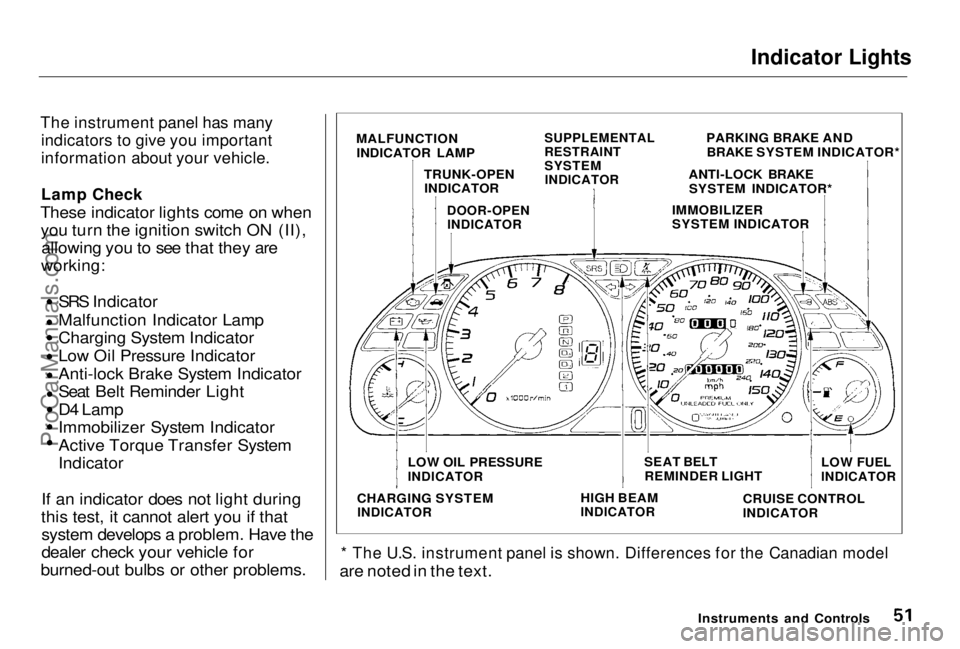
The instrument panel has many indicators to give you important
information about your vehicle.
Lamp Chec
k
These indicator lights come on when you turn the ignition switch ON (II), allowin
g you to see that they are
working:
SRS
Indicator
Malfunction Indicator Lamp
Charging System Indicator Low Oil Pressure Indicator
Anti-lock Brake System Indicator
Seat Belt Reminder Light
D4 Lamp
Immobilizer System Indicator
Active Torque Transfer
System
Indicator
If an
indicator does not light during
this test, it cannot alert you if that system
develops a problem. Have the
dealer check your vehicle for
burned-ou
t bulbs or other problems.
* The
U.S. instrument panel is shown. Differences for the Canadian model
are
noted in the text.
Instruments
and Controls
MALFUNCTION
INDICATOR LAM
P
TRUNK-OPEN INDICATOR
SUPPLEMENTAL
RESTRAINT
SYSTEM
INDICATOR
DOOR-OPEN
INDICATOR
PARKING BRAKE AND
BRAKE SYSTEM INDICATOR*
ANTI-LOCK BRAKE SYSTEM INDICATOR*
IMMOBILIZER
SYSTEM INDICATOR
LOW OIL PRESSURE
INDICATOR
SEAT BELT
REMINDER LIGHT LOW
FUEL
INDICATOR
CHARGING SYSTEM
INDICATOR
HIGH
BEAM
INDICATOR
CRUISE CONTRO L
INDICATOR
ProCarManuals.comMain Menu Table of Contents s t
Page 53 of 278
Indicator Lights
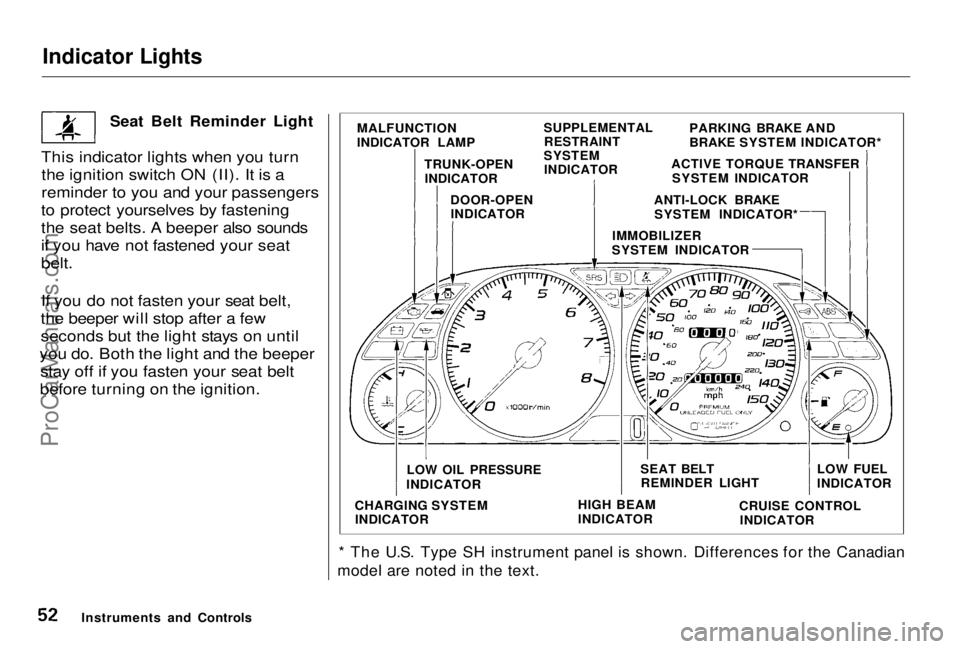
Seat Belt Reminder Light
This indicator lights when you turn the ignition switch ON (II). It is a
reminder to you and your passengers
to protect yourselves by fastening
the seat belts. A beeper also sounds
if you have not fastened your seat
belt.
If you do not fasten your seat belt,
the beeper will stop after a few
seconds but the light stays on until
you do. Both the light and the beeper stay off if you fasten your seat belt
before turning on the ignition.
* The U.S. Type SH instrument panel is shown. Differences for the Canadian
model are noted in the text.
Instruments and Controls MALFUNCTION
INDICATOR LAMP
SUPPLEMENTAL
RESTRAINT
SYSTEM INDICATOR
TRUNK-OPEN
INDICATOR
DOOR-OPENINDICATOR PARKING BRAKE AND
BRAKE SYSTEM INDICATOR*
ACTIVE TORQUE TRANSFER SYSTEM INDICATOR
ANTI-LOCK BRAKE SYSTEM INDICATOR*
IMMOBILIZER
SYSTEM INDICATOR
LOW OIL PRESSURE
INDICATOR
CHARGING SYSTEM INDICATOR SEAT BELT
REMINDER LIGHT
HIGH BEAM
INDICATOR LOW FUEL
INDICATOR
CRUISE CONTROL INDICATORProCarManuals.comMain Menu Table of Contents s t
Page 75 of 278
Keys and Locks
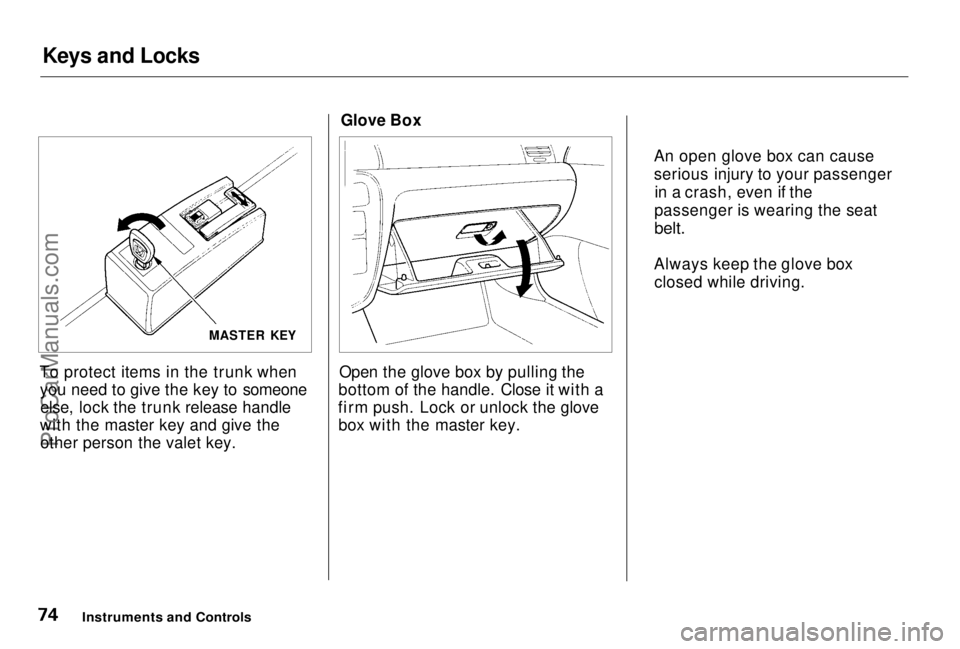
To protect items in the trunk when you need to give the key to someoneelse, lock the trunk release handle
with the master key and give the other person the valet key. Glove Box
Open the glove box by pulling the
bottom of the handle. Close it with a
firm push. Lock or unlock the glove box with the master key.
Instruments and Controls
An open glove box can cause
serious injury to your passenger
in a crash, even if the
passenger is wearing the seat
belt.
Always keep the glove box closed while driving.
MASTER KEYProCarManuals.comMain Menu Table of Contents s t