fuel cap HONDA PRELUDE 2000 Owner's Manual (in English)
[x] Cancel search | Manufacturer: HONDA, Model Year: 2000, Model line: PRELUDE, Model: HONDA PRELUDE 2000Pages: 293, PDF Size: 3.43 MB
Page 1 of 293
 2000 Prelude Online Reference Owners Manual
Use these links (and links throughout this manual) to navigate through\
this reference.
For a printed owners manual, click on authorized manuals or go")
2000 Prelude Online Reference Owner's Manual
Use these links (and links throughout this manual) to navigate through\
this reference.
For a printed owner's manual, click on authorized manuals or go to www.h\
elminc.com.
Contents
Owner's Identification Form
Introduction ........................................................................\
................................................................. i
A Few Words About Safet y........................................................................\
.........................................ii
Your Vehicle at a Glance........................................................................\
............................................ .2
Driver and Passenger Safety ........................................................................\
......................................5
Proper use and care of your vehicle's seat belts, and Supplemental Restr\
aint System.
Instruments and Controls........................................................................\
........................................ .51
Instrument panel indicator and gauge, and how to use dashboard and steering colu\
mn controls.
Comfort and Convenience Features ........................................................................\
........................ 97
How to operate the climate control system, the audio system, and other c\
onvenience features.
Before Driving........................................................................\
..........................................................125
What gasoline to use, how to break-in your new vehicle, and how to load luggage and other cargo.
Driving ........................................................................\
..................................................................... .139
The proper way to start the engine, shift the transmission, and park, pl\
us towing a trailer.
Maintenance........................................................................\
.............................................................167
The Maintenance Schedule shows you when you need to take yo ur vehicle to the dealer.
Appearance Care........................................................................\
..................................................... .227
Tips on cleaning and protecting your vehicle. Things to look for if your\
vehicle ever needs body repairs.
Taking Care of the Unexpected........................................................................\
..............................235
This section covers several problems motorists sometimes experience, a nd how to handle them.
Technical Information........................................................................\
............................................ .261
ID numbers, dimensions, capacities, and technical information.
Warranty and Customer Relations (U.S. and Canada)................................................................273
A summary of the warranties covering your new Acura, and how to contact \
us.
Authorized Manuals (U.S. only)........................................................................\
..............................279
How to order manuals and other technical literature.
Index........................................................................\
........................................................................\
...... I
Service Information Summary
A summary of information you need when you pull up to the fuel pump.
Page 130 of 293
Servic
e Statio n Procedure s
Fillin g th e Fue l Tan k
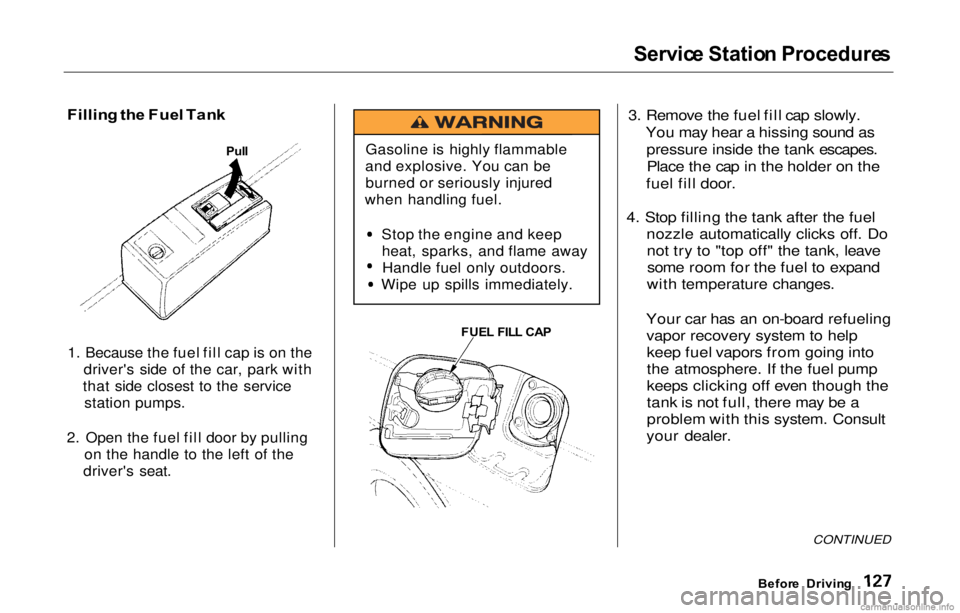
1. Because the fuel fill cap is on the driver's side of the car, park with
that side closest to the service station pumps.
2. Open the fuel fill door by pulling on the handle to the left of the
driver's seat.
3. Remove the fuel fill cap slowly.
You may hear a hissing sound aspressure inside the tank escapes.Place the cap in the holder on the
fuel fill door.
4. Stop filling the tank after the fuel nozzle automatically clicks off. Donot try to "top off" the tank, leavesome room for the fuel to expand
with temperature changes.
Your car has an on-board refueling vapor recovery system to helpkeep fuel vapors from going into
the atmosphere. If the fuel pump
keeps clicking off even though the
tank is not full, there may be a
problem with this system. Consult
your dealer.
CONTINUED
Befor e Drivin g
Gasoline is highly flammable
and explosive. You can be burned or seriously injured
when handling fuel.
Stop the engine and keepheat, sparks, and flame awayHandle fuel only outdoors.
Wipe up spills immediately.
FUEL FIL L CA P
Pul
l
Page 131 of 293
Service Statio n Procedure s
5. Screw the fuel fill cap back on,
tighten it until it clicks severaltimes. If you do not properly
tighten the cap, the Malfunction
Indicator Lamp may come on (see
page 250).
6. Push the fuel fill door closed until it latches. Openin
g th e Hoo d
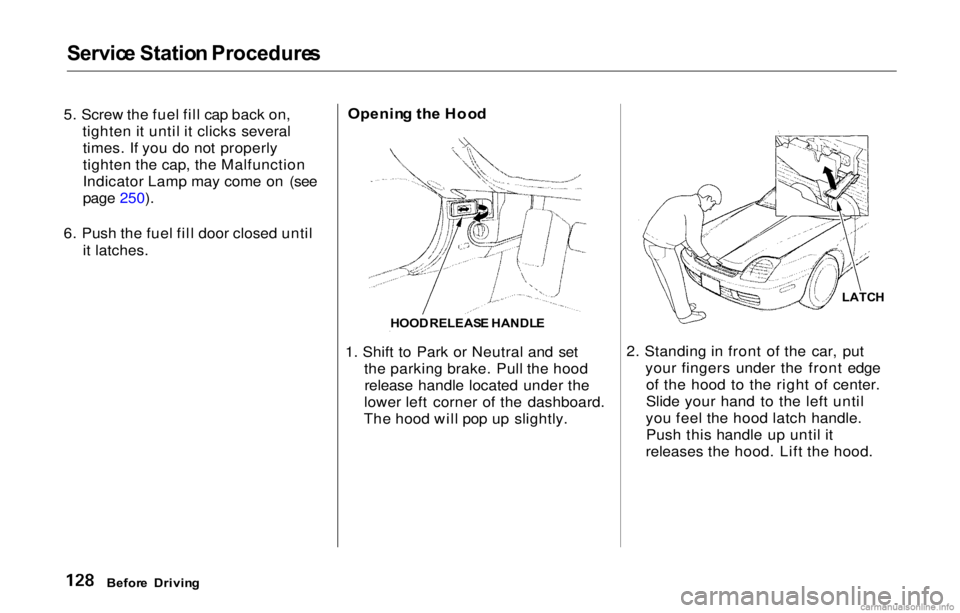
1. Shift to Park or Neutral and set the parking brake. Pull the hoodrelease handle located under the
lower left corner of the dashboard.
The hood will pop up slightly. 2. Standing in front of the car, put
your fingers under the front edgeof the hood to the right of center.
Slide your hand to the left until
you feel the hood latch handle. Push this handle up until it
releases the hood. Lift the hood.
Befor e Drivin g HOOD
RELEAS E HANDL E
LATCH
Page 184 of 293
Engin
e Oi l
Addin g Oi l
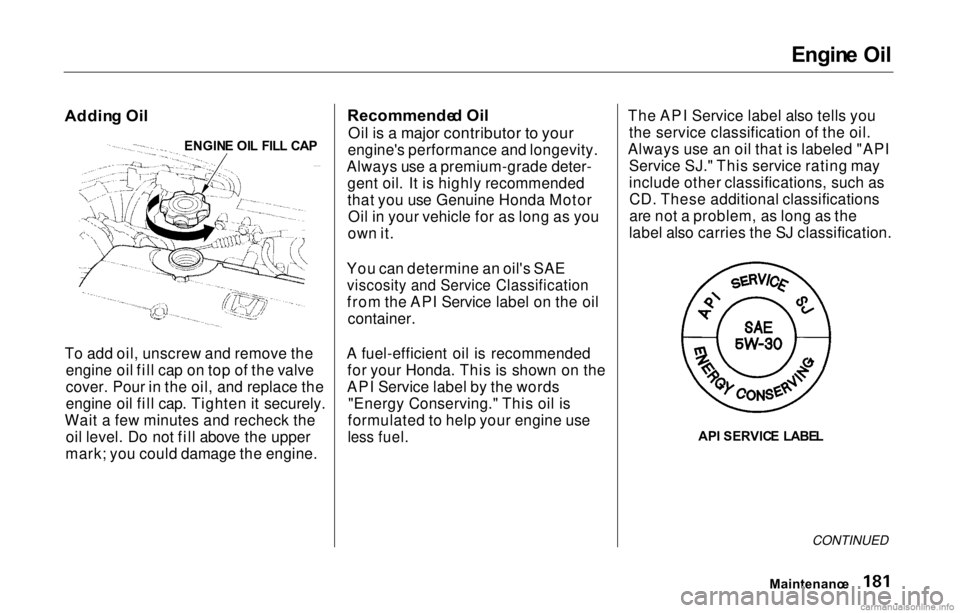
To add oil, unscrew and remove the engine oil fill cap on top of the valve
cover. Pour in the oil, and replace the
engine oil fill cap. Tighten it securely.
Wait a few minutes and recheck the oil level. Do not fill above the upper
mark; you could damage the engine.
Recommende
d Oi l
Oil is a major contributor to your
engine's performance and longevity.
Always use a premium-grade deter- gent oil. It is highly recommended
that you use Genuine Honda MotorOil in your vehicle for as long as you
own it.
You can determine an oil's SAE
viscosity and Service Classification
from the API Service label on the oil container.
A fuel-efficient oil is recommended for your Honda. This is shown on the
API Service label by the words "Energy Conserving." This oil is
formulated to help your engine use
less fuel.
The API Service label also tells you
the service classification of the oil.
Always use an oil that is labeled "API Service SJ." This service rating may
include other classifications, such asCD. These additional classifications
are not a problem, as long as the
label also carries the SJ classification.
API SERVIC E LABE L
Maintenanc e
ENGIN
E OI L FIL L CA P
CONTINUED
Page 193 of 293
Windshiel
d Washer s
Check the level in the windshield
washer reservoir at least monthly during normal usage. In bad weather,
when you use the washers often, check the level every time you stop
for fuel.
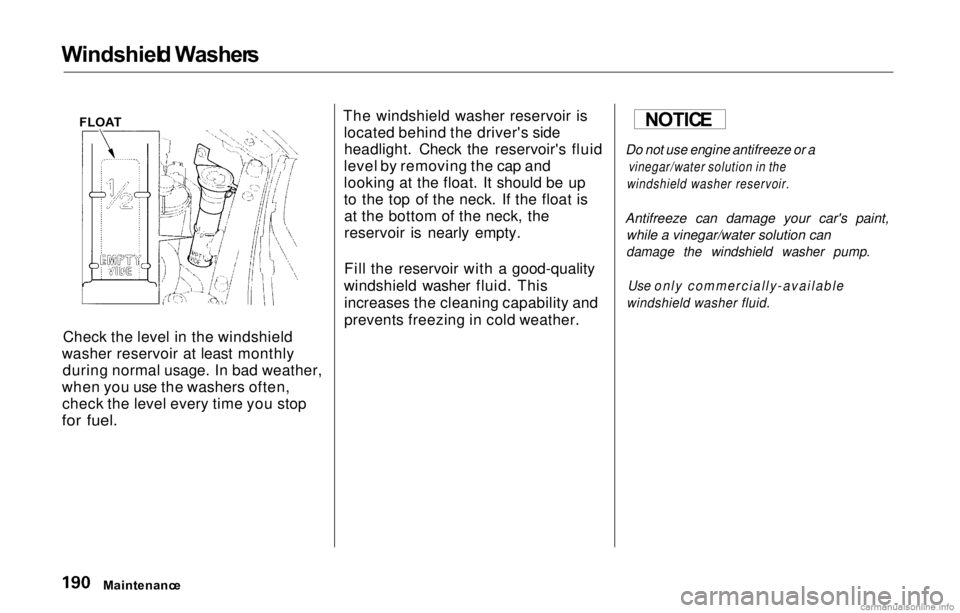
The windshield washer reservoir is
located behind the driver's sideheadlight. Check the reservoir's fluid
level by removing the cap and
looking at the float. It should be up
to the top of the neck. If the float is at the bottom of the neck, the
reservoir is nearly empty.
Fill the reservoir with a good-quality
windshield washer fluid. This increases the cleaning capability and
prevents freezing in cold weather.
Maintenanc e
Do not use engine antifreeze or a
vinegar/water solution in the
windshield washer reservoir.
Antifreeze can damage your car's paint, while a vinegar/water solution can
damage the windshield washer pump.
Use
only commercially-available
windshield washer fluid.
FLOA
T NOTIC
E
Page 253 of 293
Malfunctio
n Indicato r Lam p
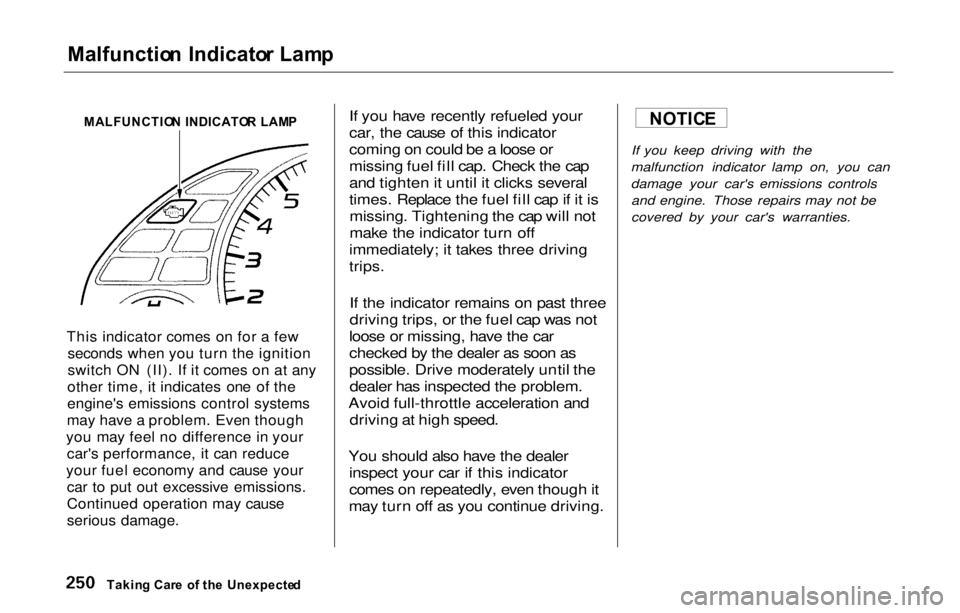
This indicator comes on for a few seconds when you turn the ignition
switch ON (II). If it comes on at any
other time, it indicates one of the
engine's emissions control systems
may have a problem. Even though
you may feel no difference in your car's performance, it can reduce
your fuel economy and cause your car to put out excessive emissions.
Continued operation may cause
serious damage.
If you have recently refueled your
car, the cause of this indicator
coming on could be a loose or
missing fuel fill cap. Check the cap
and tighten it until it clicks several
times. Replace the fuel fill cap if it is
missing. Tightening the cap will not
make the indicator turn off
immediately; it takes three driving
trips.
If the indicator remains on past three
driving trips, or the fuel cap was not
loose or missing, have the car
checked by the dealer as soon as
possible. Drive moderately until the dealer has inspected the problem.
Avoid full-throttle acceleration and driving at high speed.
You should also have the dealer inspect your car if this indicator
comes on repeatedly, even though it
may turn off as you continue driving. If you keep driving with the
malfunction indicator lamp on, you can
damage your car's emissions controls and engine. Those repairs may not be
covered by your car's warranties.
Takin g Car e o f th e Unexpecte d
MALFUNCTIO
N INDICATO R LAM P NOTIC
E
Page 264 of 293
Technica
l Informatio n
The diagrams in this section give you the dimensions and capacities ofyour Honda, and the locations of theidentification numbers. The expla-
nations of several electronic and
mechanical systems on your Honda are for the more technically-oriented
owner. Identification Numbers................. 262
Specifications................................. 264
DOT Tire Quality Grading........... 266 Treadwear.................................. 266
Traction....................................... 266
Temperature.............................. 26
7
Oxygenated Fuels.......................... 268
Driving i
n Foreign Countries....... 269
Emissions Controls........................ 270 The Clean Air Act...................... 270Crankcase Emissions Control System..................................... 270
Evaporative Emissions Control
System.....................................270
Exhaust Emissions Controls.... 271 PGM-FI System..................... 271
Ignition Timing Control
System.................................271
Exhaust Gas Recirculation (EGR) System.................... 271
Three Way Catalytic Converter............................ 271
Replacement Parts..................... 271
Three Way Catalytic Converter... 272
Technical Informatio n
Page 273 of 293
Emission
s Control s
The burning of gasoline in your car's engine produces several byproducts.
Some of these are carbon monoxide (CO), oxides of nitrogen (NOx) and
hydrocarbons (HC). Gasoline evaporating from the tank also
produces hydrocarbons. Controlling
the production of NOx, CO, and HC is important to the environment.
Under certain conditions of sunlight and climate, NOx and HC react to
form photochemical "smog." Carbon monoxide does not contribute tosmog creation, but it is a poisonous
gas.
Th
e Clea n Ai r Ac t
The United States Clean Air Act* sets standards for automobile
emissions. It also requires that
automobile manufacturers explain to owners how their emissions controls
work and what to do to maintain
them. This section summarizes how
the emissions controls work.
Scheduled maintenance is on page 172.
* In Canada, Honda vehicles comply
with the Canadian Motor Vehicle Safety Standards (CMVSS) for
Emissions valid at the time they are
manufactured.
Crankcas e Emission s Contro l
Syste m
Your car has a Positive Crankcase
Ventilation System. This keeps gasses that build up in the engine'scrankcase from going into the
atmosphere. The Positive Crankcase
Ventilation valve routes them from the crankcase back to the intake
manifold. They are then drawn into
the engine and burned.
Evaporativ e Emission s Contro l
Syste m
As gasoline evaporates in the fuel tank, an evaporative emissionscontrol canister filled with charcoal
adsorbs the vapor. It is stored in this
canister while the engine is off. After
the engine is started and warmed up,
the vapor is drawn into the engineand burned during driving.
Onboar d Refuelin g Vapo r
Recover y
The Onboard Refueling Vapor Recovery (ORVR) system captures
the fuel vapors during refueling. The
vapors are adsorbed in a canister filled with activated carbon. While driving, the fuel vapors are drawn
into the engine and burned off.
Technica l Informatio n
Page 287 of 293
Inde
x
Emergency Brake............................ 89
Emergency Flashers....................... 65
Emergency Towing....................... 258
Emission Controls......................... 270
Engine Coolant Temperature Gauge ..... 59
Malfunction Indicator
Lamp................................. 55, 250
Oil Pressure Indicator......... 55, 248
Oil, What Kind to Use............... 181
Overheating................................ 246
Specifications............................. 264
Ethanol in Gasoline ....................... 268
Evaporative Emission Controls.... 270
Exhaust Fumes................................ 49
Expectant Mothers, Use of Seat Belts by......................................... 19
Exterior. Cleaning the................... 228
Fabric, Cleaning............................. 230
Fan, Interior...................................... 98
Features, Comfort and
Convenience.................................
97
Filling the Fuel Tank.....................
127
Filters
Air................................................ 195
Oil................................................ 183
First
Gear, Shifting........................ 150
5-speed Manual Transmission Checking Fluid Level................ 192
Shifting the................................. 142
Flashers, Hazard Warning.............. 65
Flat Tire, Changing a.................... 237
Fluids Automatic Transmission........... 191
Brake........................................... 193
Clutch.......................................... 194
Manual Transmission............... 192
Power Steering........................... 194
Windshield Washer................... 190
FM Stereo Radio
Reception.................................... 110
Folding Rear Seat............................ 84
Foreign Countries, Driving in...... 269
Four-way Flashers........................... 65
Front End, Towing by
Emergency Wrecker................. 258
Fuel.................................................. 126
Fill Door and Cap....................... 127
Gauge............................................ 59
Octane Requirement................. 126
Oxygenated................................ 268
Reserve Indicator......................... 57
Tank, Filling the......................... 127
Fuses, Checking the...................... 254
Gas Mileage. Improving................ 132
Gasohol........................................... 268
Gasoline.......................................... 126
Fuel Reserve Indicator................ 57
Gauge............................................ 59
Octane Requirement................. 126
Tank, Filling the......................... 127
Gas Station Procedures................. 127
Gauges
Engine Coolant Temperature .... 59
Fuel................................................ 59
Gearshift Lever Positions Automatic Transmission........... 144
5-speed Manual Transmission.......................... 142
Glass Cleaning............................... 231
Glove Box......................................... 79