open hood HONDA PRELUDE 2000 Owner's Manual (in English)
[x] Cancel search | Manufacturer: HONDA, Model Year: 2000, Model line: PRELUDE, Model: HONDA PRELUDE 2000Pages: 293, PDF Size: 3.43 MB
Page 128 of 293
Befor
e Drivin g
Before you begin driving your Honda,
you should know what gasoline to use, and how to check the levels of
important fluids. You also need to
know how to properly store luggageor packages. The information in this
section will help you. If you plan to
add any accessories to your car,
please read the information in this
section first.
Break-in Period.............................. 126
Gasoline.......................................... 126
Service Station Procedures .......... 127 Filling the Fuel Tank................. 127
Opening the Hood..................... 128
Oil Check................................ 130
Engine Coolant Check.......... 131
Fuel Economy................................ 132
Vehicle Condition...................... 132
Driving Habits............................ 132
Accessories and Modifications.... 133
Accessories................................. 133Modifications............................. 134
Additional Safety Precaution.... 134
Carrying Cargo.............................. 135
Load Limit.................................. 136
Carrying Items in the Passenger Compartment......................... 136
Carrying Cargo in the Trunk or
on a Roof Rack....................... 137
Before Drivin g
Page 131 of 293
Service Statio n Procedure s
5. Screw the fuel fill cap back on,
tighten it until it clicks severaltimes. If you do not properly
tighten the cap, the Malfunction
Indicator Lamp may come on (see
page 250).
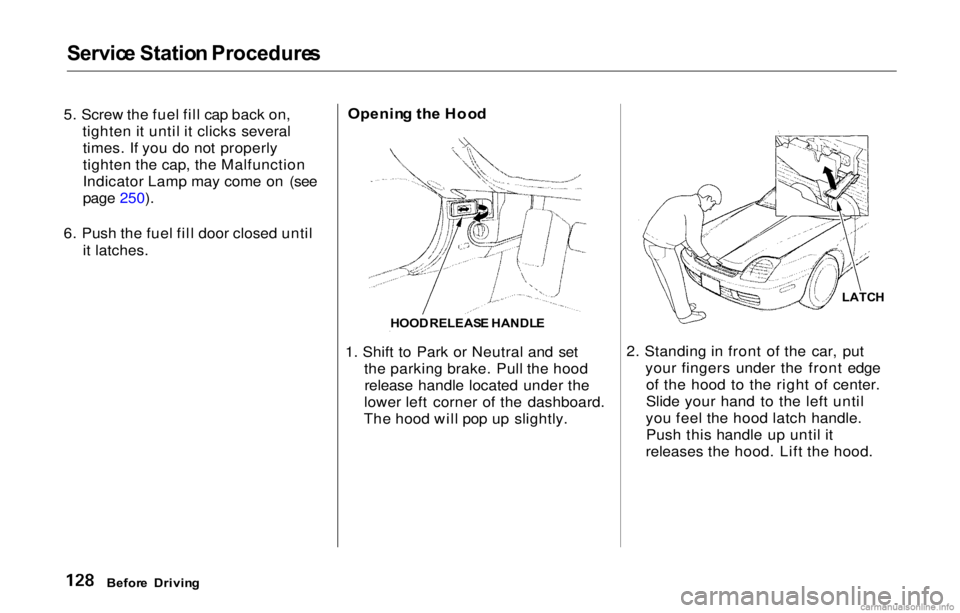
6. Push the fuel fill door closed until it latches. Openin
g th e Hoo d
1. Shift to Park or Neutral and set the parking brake. Pull the hoodrelease handle located under the
lower left corner of the dashboard.
The hood will pop up slightly. 2. Standing in front of the car, put
your fingers under the front edgeof the hood to the right of center.
Slide your hand to the left until
you feel the hood latch handle. Push this handle up until it
releases the hood. Lift the hood.
Befor e Drivin g HOOD
RELEAS E HANDL E
LATCH
Page 132 of 293
Service
Statio n Procedures
If you can open the hood without
lifting the hood latch handle, or the
hood latch handle moves stiffly or does not spring back as before, the
mechanism should be cleaned and
lubricated (see page 196).
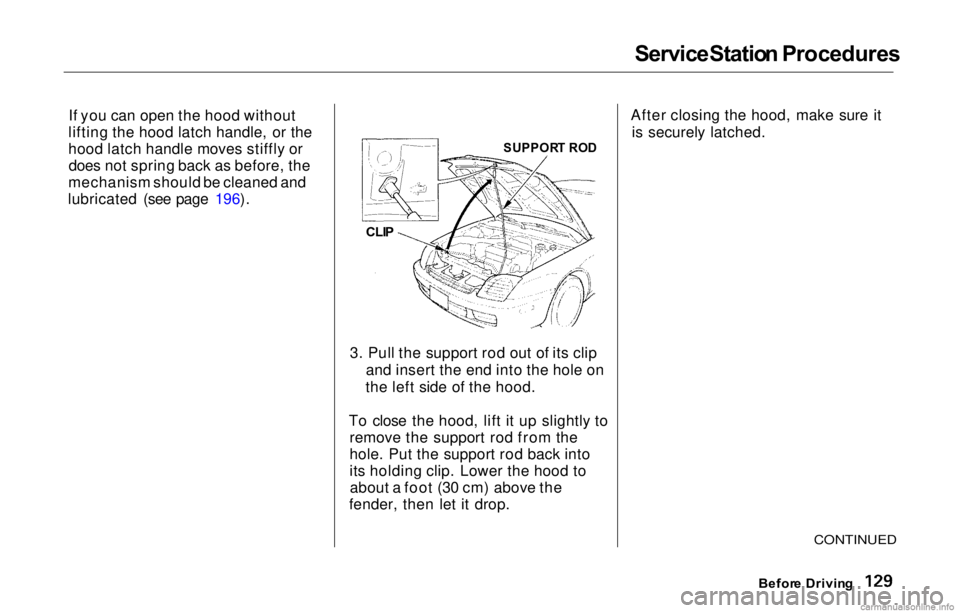
3. Pull the support rod out of its clipand insert the end into the hole on
the left side of the hood.
To close the hood, lift it up slightly to remove the support rod from the
hole. Put the support rod back into
its holding clip. Lower the hood toabout a foot (30 cm) above the
fender, then let it drop. After closing the hood, make sure it
is securely latched.
Before Drivin g
CONTINUED
SUPPOR
T RO D
CLI P
Page 186 of 293
Engin
e Oi l
Changin g th e Oi l an d Filte r
Always change the oil and filter according to the time and distance (miles/kilometers) recommenda-
tions in the maintenance schedule.
The oil and filter collect contami- nants that can damage your engine if
they are not removed regularly.
Changing the oil and filter requires
special tools and access from
underneath the car. The car should
be raised on a service station-type
hydraulic lift for this service. Unless
you have the knowledge and proper equipment, you should have this
maintenance done by a skilled
mechanic.
1. Run the engine until it reaches normal operating temperature,
then shut it off.
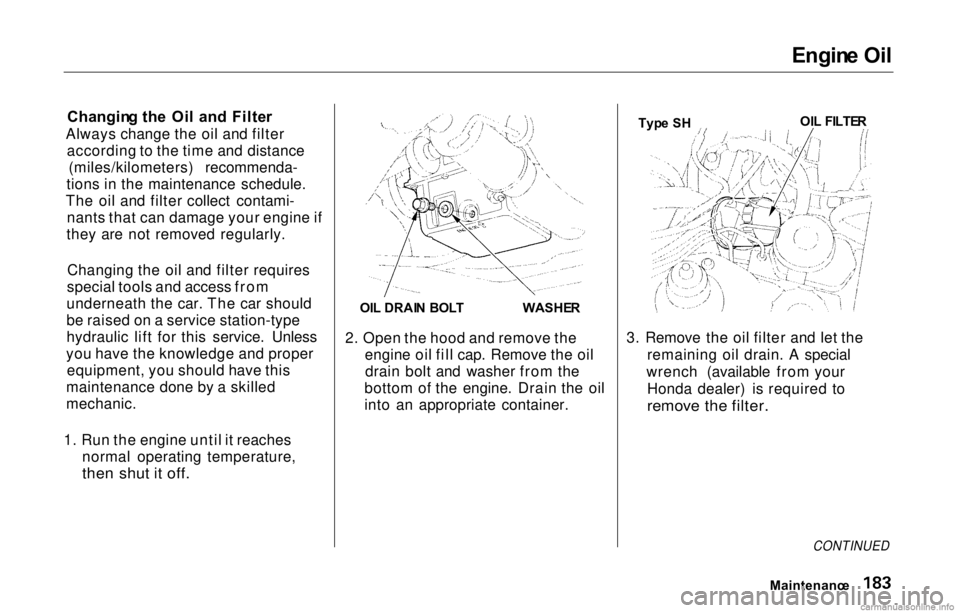
2. Open the hood and remove the
engine oil fill cap. Remove the oildrain bolt and washer from the
bottom of the engine. Drain the oil
into an appropriate container. 3. Remove the oil filter and let the
remaining oil drain. A special
wrench (available from your Honda dealer) is required to
remove the filter.
Maintenance
Typ
e S H OI
L FILTE R
OI L DRAI N BOL T
WASHER
CONTINUED
Page 190 of 293
Coolin
g Syste m
Do not add any rust inhibitors or other additives to your car's coolingsystem. They may not be compatible
with the coolant or engine compo-
nents.
Replacin g Engin e Coolan t
The cooling system should be completely drained and refilled with
new coolant according to the time
and distance recommendations in
the maintenance schedule. Only use Genuine Honda Antifreeze/Coolant.
Draining the coolant requires access
to the underside of the car. Unless
you have the tools and knowledge,
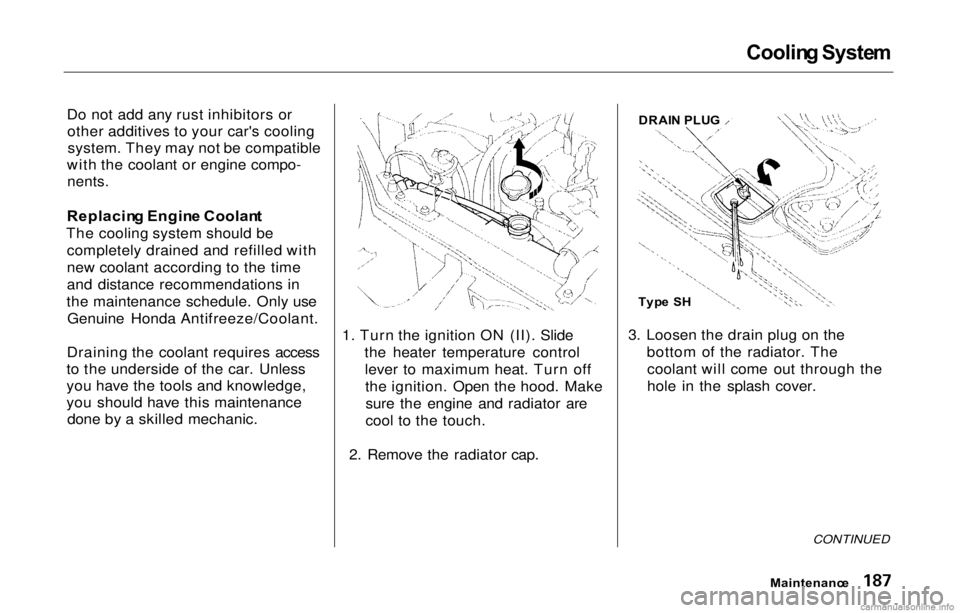
you should have this maintenance done by a skilled mechanic. 1. Turn the ignition ON (II). Slide
the heater temperature controllever to maximum heat. Turn offthe ignition. Open the hood. Makesure the engine and radiator are
cool to the touch.
2. Remove the radiator cap. 3. Loosen the drain plug on the
bottom of the radiator. Thecoolant will come out through the
hole in the splash cover.
CONTINUED
Maintenanc e
DRAI
N PLU G
Typ e S H
Page 216 of 293
Light
s
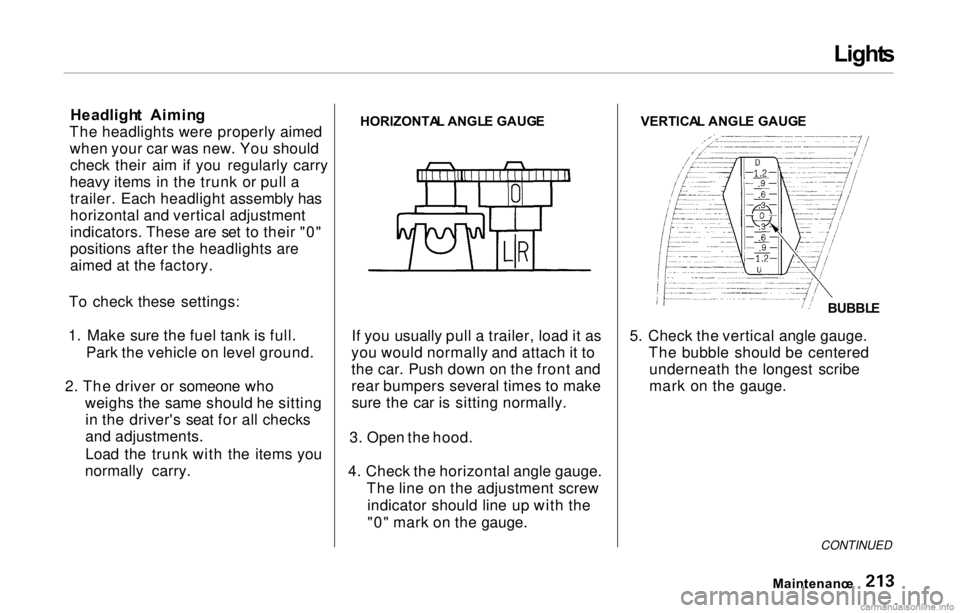
Headligh t Aimin g
The headlights were properly aimed when your car was new. You shouldcheck their aim if you regularly carry
heavy items in the trunk or pull a trailer. Each headlight assembly has
horizontal and vertical adjustment
indicators. These are set to their "0"
positions after the headlights are
aimed at the factory.
To check these settings:
1. Make sure the fuel tank is full. Park the vehicle on level ground.
2. The driver or someone who weighs the same should he sittingin the driver's seat for all checks
and adjustments.
Load the trunk with the items you
normally carry. HORIZONTA
L ANGL E GAUG E
If you usually pull a trailer, load it as
you would normally and attach it to
the car. Push down on the front and
rear bumpers several times to make sure the car is sitting normally.
3. Open the hood.
4. Check the horizontal angle gauge. The line on the adjustment screwindicator should line up with the
"0" mark on the gauge. VERTICA
L ANGL E GAUG E
5. Check the vertical angle gauge. The bubble should be centeredunderneath the longest scribe
mark on the gauge.
MaintenanceCONTINUED
BUBBLE
Page 218 of 293
Light
s
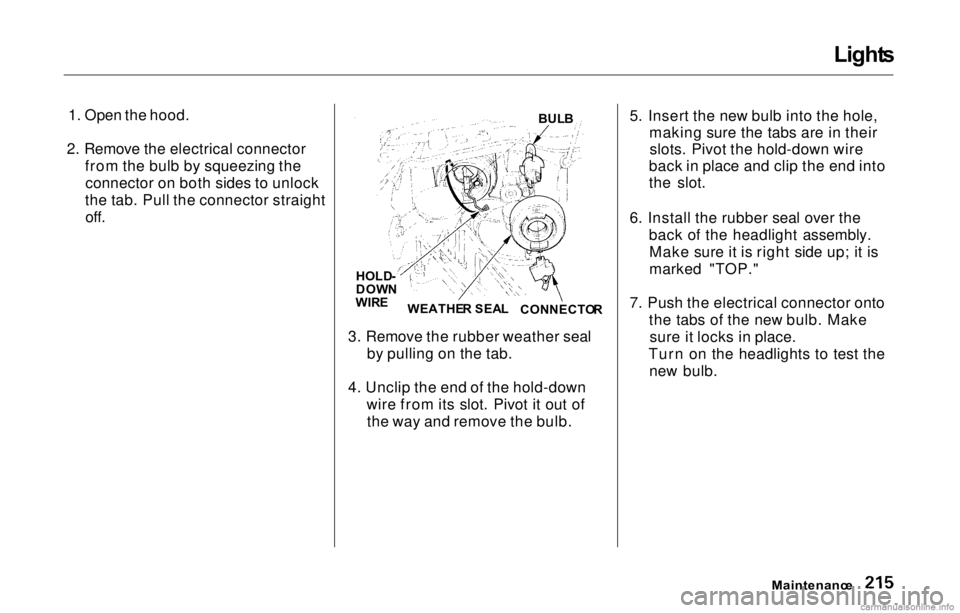
1. Open the hood.
2. Remove the electrical connector from the bulb by squeezing theconnector on both sides to unlock
the tab. Pull the connector straight off.
3. Remove the rubber weather sealby pulling on the tab.
4. Unclip the end of the hold-down wire from its slot. Pivot it out ofthe way and remove the bulb. 5. Insert the new bulb into the hole,
making sure the tabs are in theirslots. Pivot the hold-down wire
back in place and clip the end into
the slot.
6. Install the rubber seal over the back of the headlight assembly.Make sure it is right side up; it is
marked "TOP."
7. Push the electrical connector onto the tabs of the new bulb. Makesure it locks in place.
Turn on the headlights to test the new bulb.
Maintenance
BUL
B
HOLD -
DOW N
WIR E
WEATHE R SEA L
CONNECTO R
Page 219 of 293
Light
s
Replacin g a Parkin g Ligh t Bul b
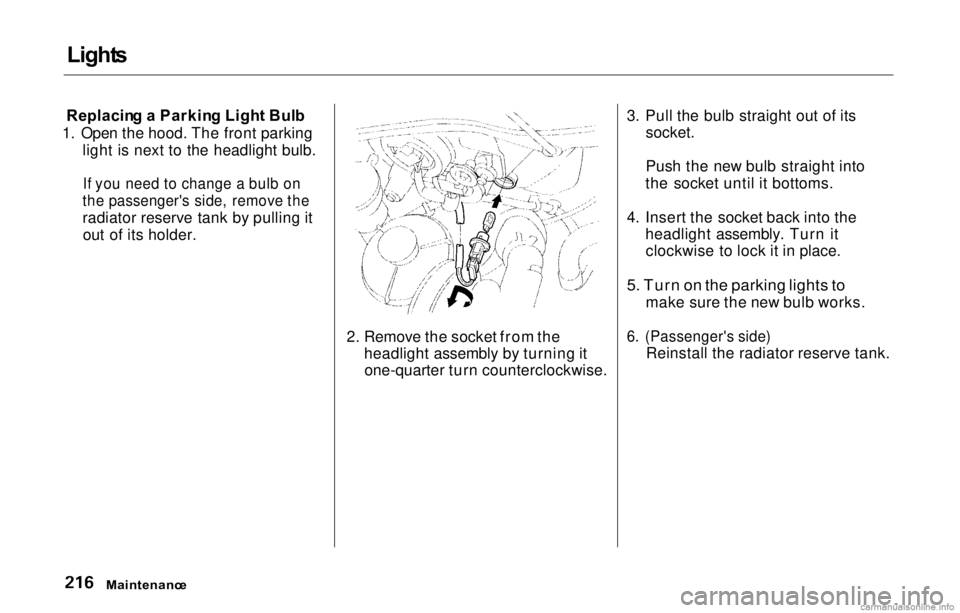
1. Open the hood. The front parking light is next to the headlight bulb.
If you need to change a bulb on
the passenger's side, remove the
radiator reserve tank by pulling it out of its holder.
2. Remove the socket from theheadlight assembly by turning itone-quarter turn counterclockwise. 3. Pull the bulb straight out of its
socket.
Push the new bulb straight into
the socket until it bottoms.
4. Insert the socket back into the headlight assembly. Turn itclockwise to lock it in place.
5. Turn on the parking lights to
make sure the new bulb works.
6. (Passenger's side)
Reinstall the radiator reserve tank.
Maintenanc e
Page 247 of 293
If You r Engin e Won' t Start , Jum p Startin g
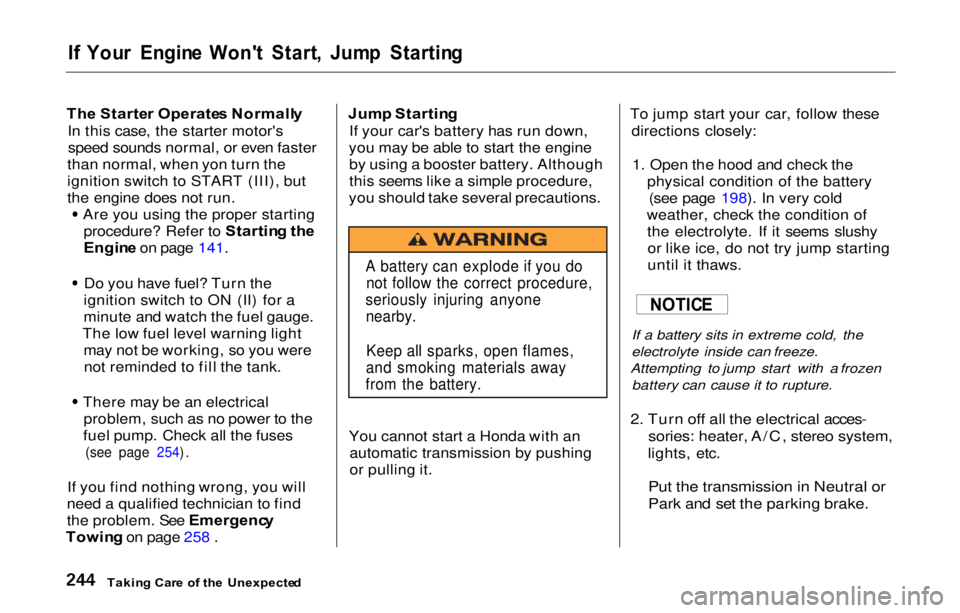
The Starte r Operate s Normall y
In this case, the starter motor's speed sounds normal, or even faster
than normal, when yon turn the
ignition switch to START (III), but
the engine does not run.
Are you using the proper starting procedure? Refer to Startin g th e
Engin e on page 141.
Do you have fuel? Turn the
ignition switch to ON (II) for a
minute and watch the fuel gauge.
The low fuel level warning light may not be working, so you werenot reminded to fill the tank.
There may be an electrical problem, such as no power to the
fuel pump. Check all the fuses
(see page 254).
If you find nothing wrong, you will
need a qualified technician to find
the problem. See Emergenc y
Towin g on page 258 . Jum
p Startin g
If your car's battery has run down,
you may be able to start the engine by using a booster battery. Although
this seems like a simple procedure,
you should take several precautions.
You cannot start a Honda with an automatic transmission by pushing
or pulling it. To jump start your car, follow these
directions closely:
1. Open the hood and check the physical condition of the battery(see page 198). In very cold
weather, check the condition of the electrolyte. If it seems slushyor like ice, do not try jump starting
until it thaws.
If a battery sits in extreme cold, the
electrolyte inside can freeze.
Attempting to jump start with a frozen
battery can cause it to rupture.
2. Turn off all the electrical acces-
sories: heater, A/C, stereo system,
lights, etc.
Put the transmission in Neutral or
Park and set the parking brake.
Takin g Car e o f th e Unexpecte d
A battery can explode if you do
not follow the correct procedure,
seriously injuring anyone nearby.
Keep all sparks, open flames,
and smoking materials away
from the battery.
NOTIC E
Page 249 of 293
If You r Engin e Overheat s
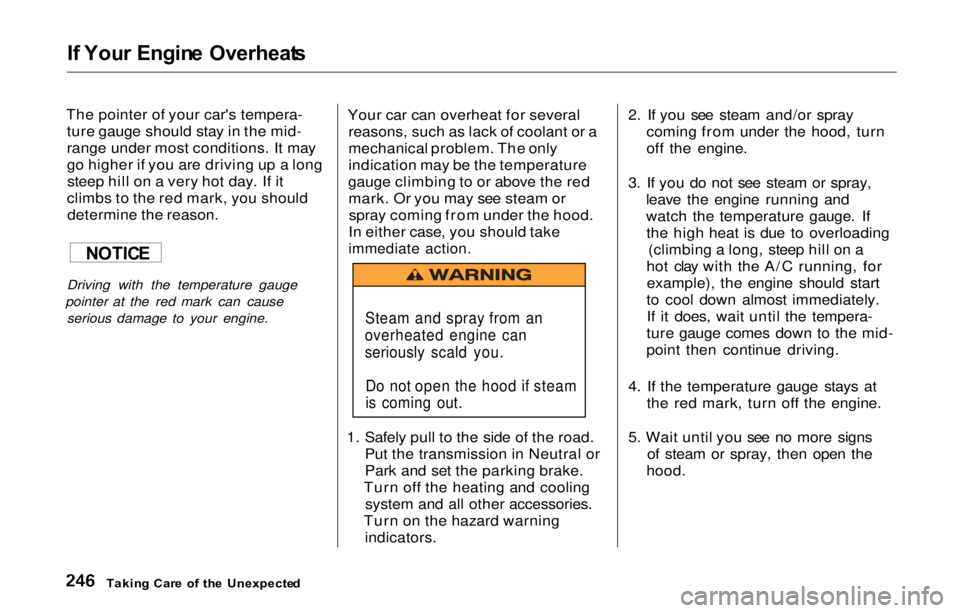
The pointer of your car's tempera-
ture gauge should stay in the mid-
range under most conditions. It may
go higher if you are driving up a longsteep hill on a very hot day. If it
climbs to the red mark, you should determine the reason.
Driving with the temperature gauge
pointer at the red mark can cause serious damage to your engine.
Your car can overheat for severalreasons, such as lack of coolant or a
mechanical problem. The only
indication may be the temperature
gauge climbing to or above the red mark. Or you may see steam orspray coming from under the hood.
In either case, you should take
immediate action.
1. Safely pull to the side of the road. Put the transmission in Neutral or
Park and set the parking brake.
Turn off the heating and cooling system and all other accessories.
Turn on the hazard warning indicators. 2. If you see steam and/or spray
coming from under the hood, turn
off the engine.
3. If you do not see steam or spray, leave the engine running and
watch the temperature gauge. Ifthe high heat is due to overloading (climbing a long, steep hill on a
hot clay with the A/C running, for example), the engine should start
to cool down almost immediately. If it does, wait until the tempera-
ture gauge comes down to the mid-
point then continue driving.
4. If the temperature gauge stays at the red mark, turn off the engine.
5. Wait until you see no more signs of steam or spray, then open the
hood.
Takin g Car e o f th e Unexpecte d
NOTICE
Steam and spray from an
overheated engine can
seriously scald you.
Do not open the hood if steam
is coming out.